
The best guppy food is a high-quality micro pellet formulated specifically for small tropical fish — look for one with high protein content, added vitamin D3, some plant-based matter for balanced nutrition, and astaxanthin for color enhancement. A quality pellet should be samll enough to fit the Mouth of the guppy, slow sinking to give the Guppy ample chance to gulp it and it should not dissolve and pollute the water.
Guppy food plays a major role in growth, coloration, breeding, and overall health. But most feeding advice misses the one thing that actually explains why guppies need to be fed the way they do — their digestive system is fundamentally different from most fish, and understanding it changes how you should think about every feeding decision you make.
In this guide:
➜ What do guppies eat?
➜ What do guppies eat in the wild?
➜ Why guppies need frequent small meals
➜ Best guppy food
➜ Live guppy food
➜ High protein guppy food
➜ Best guppy food for color enhancement
➜ Fancy guppy food
➜ Guppy fry food
➜ Homemade and DIY guppy food
➜ What vegetables can guppies eat
➜ How often should you feed guppies
➜ Common feeding mistakes
➜ Can poor food cause guppy diseases
➜ Frequently asked questions
What Do Guppies Eat?
Guppies are omnivores, meaning they eat both animal-based and plant-based foods.
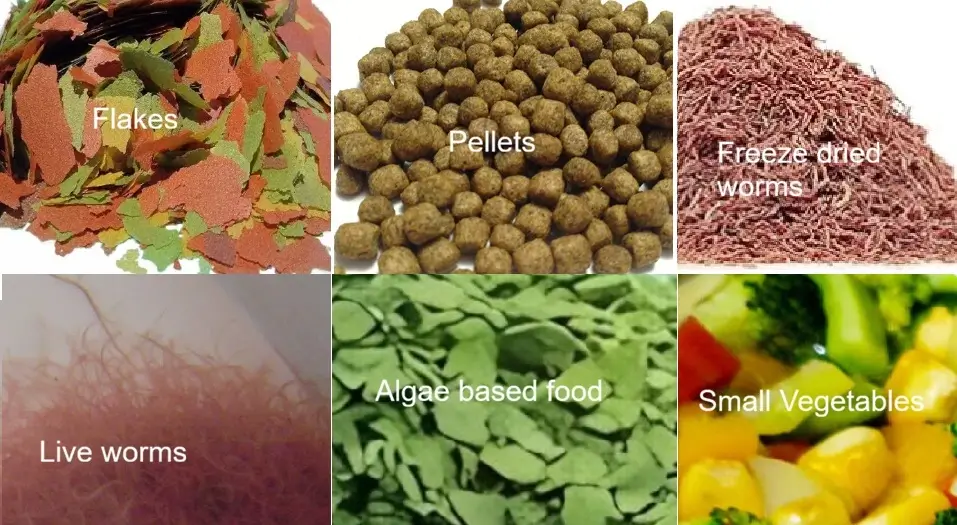
In aquariums, guppies commonly eat:
➜ Flakes
➜ Micro pellets
➜ Live foods
➜ Frozen foods
➜ Algae-based foods
➜ Small vegetables
A varied diet helps improve color, activity, growth, and immune system strength — and given what we now know about their digestive system, variety also supports a healthier gut microbiome.
What Do Guppies Eat in the Wild?
Wild guppies are opportunistic feeders and eat a wide variety of foods found in rivers and streams.
In nature, guppies commonly feed on:
➜ Algae
➜ Small insects
➜ Mosquito larvae
➜ Tiny crustaceans
➜ Plant matter
➜ Zooplankton
Guppies are not picky eaters. If food is small enough to fit into their upward-facing mouth, they will generally try eating it. Their mouth is positioned to graze algae and detritus from surfaces and pick floating insects off the water, and the small teeth in their pharynx are designed for tearing rather than chewing — another reason crushed or small-particle food suits them far better than large chunks.
Why Guppies Need Frequent Small Meals
Most people tell you to feed guppies small amounts often, but they rarely explain why. The answer lies in their digestive system, and once you understand it, every other feeding decision in this guide makes a lot more sense.
➜ Guppies do not have a true stomach. Instead of a stomach that stores and slowly processes a large meal the way ours does, guppies have what’s called an intestinal bulb, a small expansion at the start of the intestine where initial digestion begins immediately. There’s no holding tank for food, whatever they eat moves directly into the digestive process.
➜ This is the core reason guppies need frequent, small feedings rather than one or two large ones. A guppy simply doesn’t have the internal capacity to process a big meal efficiently. Large feedings sit partially undigested, increase the risk of constipation and bloating, and pass excess waste into the water faster than a small frequent meal would. If overfeeding goes on long enough, it’s one of the most common roads to a swollen, bloated guppy.
➜ Their intestine is also relatively long and coiled compared to their body size, typical of fish that eat a lot of plant matter and detritus in the wild. Interestingly, gut length can actually adapt to diet: guppies eating more carnivorously tend to have shorter intestines, while those eating more detritus and plant matter develop longer ones to maximize nutrient absorption. This is part of why a balanced diet of both animal protein and plant matter suits their natural digestive design so well.
➜ The liver, gallbladder, and pancreas secrete bile and enzymes directly into the intestine to break down proteins, fats, and carbohydrates. A healthy gut microbiome, a community of beneficial bacteria living in the intestine, also plays a significant role in breaking down plant matter and supporting immune function, one reason a varied diet matters, different foods support different aspects of that internal bacterial balance.
What this means practically:
➜ Feed small amounts 2–3 times daily for adults, more often for fry, never one large meal
➜ Each portion should be small enough to disappear within 2–3 minutes
➜ A varied diet supports the gut microbiome better than a single food source
➜ Overfeeding is not just a water quality issue, it directly stresses a digestive system that was never built to process large quantities at once
Best Guppy Food
High Quality Commericial Micro pellets are widely considered the Best GuppyFood— and the reason comes down to fit. They are specifically sized for small community fish like guppies, tetras, and mollies, so they fit easily into a guppy’s mouth, including fry, without needing to be crushed the way standard flakes sometimes do. The full reasoning behind why fit matters this much is covered in the flakes vs pellets comparison just below.
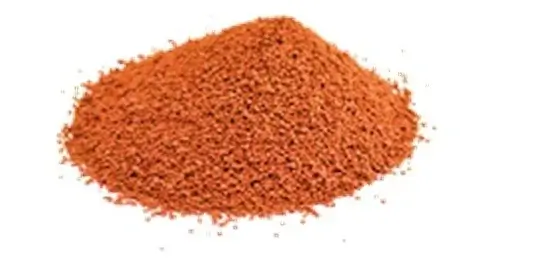
That said, combining food types gives the best long-term results given the digestive considerations explained above. High-quality flakes remain a perfectly good staple too — particularly crushed for fry — and occasional live food adds the protein boost that processed food alone cannot fully replicate.
Popular Guppy Foods:
Micro pellets — the best all-around staple, ideal fit for adult and fry mouths
High-quality flakes — good staple, crush for smaller guppies and fry
Brine shrimp — live or frozen, excellent protein source
Daphnia — high fiber, supports digestion
Bloodworms — rich treat, feed in moderation
Spirulina-based foods — supports color and digestion as it is a plant-based food
Popular guppy food brands among hobbyists include Hikari, Omega One, Fluval Bug Bites, Cobalt, New Life Spectrum, Xtreme, and NorthFin.
Flakes vs Micro Pellets — Which Is Better?
Both have real advantages, and understanding the mechanics of each helps you choose correctly for your specific tank.
Flakes float on the surface, giving guppies ample opportunity to grasp them at their own pace rather than chasing food that is already sinking away. Because flakes float and break down slowly, they rarely reach the substrate uneaten — guppies get to the food before it settles, which means less risk of fish picking through waste at the bottom. The tradeoff is that lower-quality flakes can disperse and break apart across the tank, clouding the water if too much is fed at once or if the flakes are poor quality to begin with. Flakes also tend to be lower risk for indigestion, since the flat, thin shape is easy for a guppy to break into smaller pieces with its small pharyngeal teeth before swallowing. But on the other side there is that risk of galloping air while gulping which can cause blaoting.
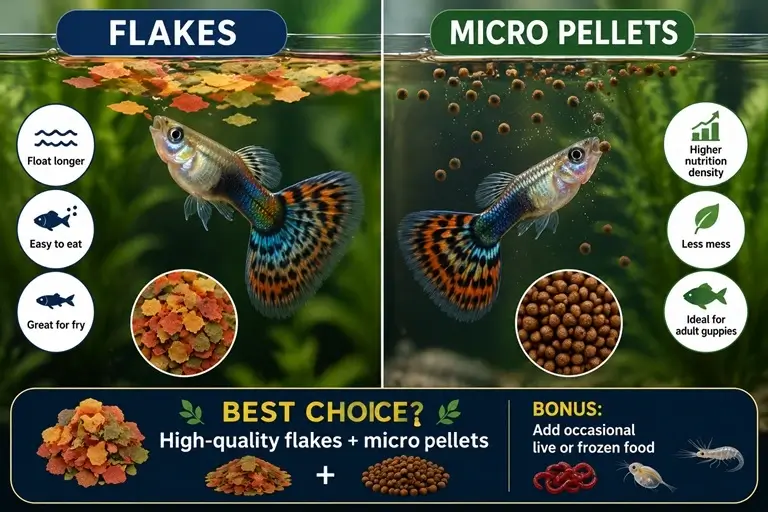
Micro Pellets that sink in too soon is where their main risk comes in. Guppies need to do bottom feeding if the micro pellet sinks too fast. A lot of watse and substrate also goes when guppy does bottom feeding. So a High Quality slow sinking Micro Peelte is regarded as the best guppy food. When i say High Quality Micro pellet the ingerdients matter. The micro pellets should contain Vitamin D3 which is never present in Aquariums due to lack of sunlight, though you may have articfical light. It should also contain high protein, vegetable matter, Vitamins and added Minerals to nourish the guppy. So while choosing micro pellets, its better you look at all these aspects even if the price is onthe higher side.
The practical takeaway:
➜ In a single-species guppy tank, micro pellets are ideal
➜ In a community tank with larger fish, regular-sized pellets may be necessary instead, since micro pellets sized for guppies can be too small or get out-competed by larger tankmates before guppies get their share
Live Guppy Food
Live foods are excellent for improving activity, breeding condition, and growth. They are best reserved mainly for adult guppies — live food is generally too large or too active for very young fry to handle effectively, though baby brine shrimp is the exception and works well even for fry once they develop basic hunting coordination.
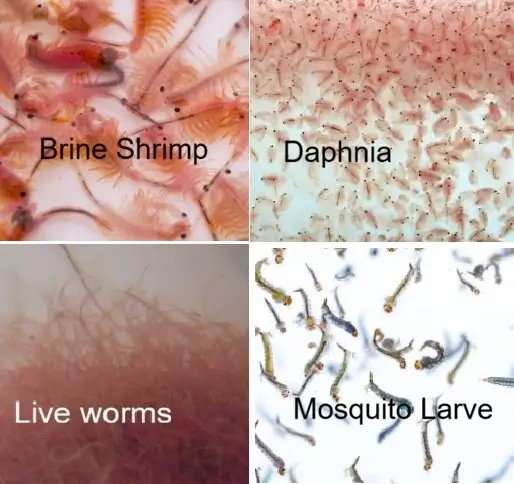
Popular live guppy foods include:
➜ Brine shrimp
➜ Daphnia
➜ Mosquito larvae
➜ Microworms
➜ White worms and grindle worms — both high-protein annelid worms favored by serious breeders for conditioning adult females and accelerating growth in smaller, slower-growing fish
Many guppies become noticeably more active and colorful when live foods are added 2–3 times a week. Beyond nutrition, live food also taps into a guppy’s natural hunting instinct — they actively chase and forage rather than passively eating off the surface, which provides genuine behavioral enrichment.
Caution matters here. Live food sourced from unreliable places can introduce parasites or disease, particularly from wild-collected sources. Culturing your own brine shrimp, daphnia, or worms at home is the safest approach if you plan to feed live food regularly. Frozen versions of these same foods are a safer, more convenient alternative that retains most of the nutritional value without the contamination risk — always thaw frozen food in a small amount of tank water first rather than dropping it in frozen, which can shock the tank temperature (see our temperature for guppies guide for why even small swings matter) and introduces cloudy packing liquid you do not want in your water.
High Protein Guppy Food
A food is generally considered “high protein” for guppies when protein makes up roughly 35–45% or more of its content, compared to standard staple flakes or pellets which usually sit closer to 30–35%. In practice, this means live and frozen foods like brine shrimp, bloodworms, and daphnia — along with specialized fry foods — rather than typical everyday flakes. Checking the ingredient label helps too: a high protein food lists whole fish, shrimp meal, or similar animal-based ingredients first, rather than fillers like wheat flour or generic “fish meal.”
Protein-rich foods are especially useful for:
➜ Growing fry
➜ Breeding guppies and conditioning females before breeding
➜ Fancy guppies developing finnage and color
➜ Weak or recovering fish
Popular high protein foods include:
➜ Brine shrimp
➜ Bloodworms
➜ White worms and grindle worms
➜ High-quality fry foods
➜ Protein-rich micro pellets
Plant matter matters just as much as protein
It is easy to focus entirely on protein and forget the other half of a guppy’s natural diet. In the wild, guppies do not just hunt insects and larvae — they spend much of their day grazing on algae and biofilm too. This is not incidental. Plant matter provides fiber that supports healthy digestion, and given that guppies lack a true stomach and rely on a long, coiled intestine to process food, that fiber plays a real functional role rather than just adding bulk.
A diet that is too heavily weighted toward protein — feeding bloodworms or brine shrimp as a regular staple rather than an occasional boost — can actually work against good digestion rather than support it. The wild diet works because it is balanced: protein from insects and crustaceans, fiber and nutrients from algae and plant matter, together. Spirulina-based foods and occasional vegetables are how you replicate that plant-matter half of the diet in an aquarium.
Too much protein without balance can contribute to digestive issues — remember, guppies lack a true stomach and their digestive system handles a mixed, moderate diet better than a protein-heavy one fed in large amounts. Balance protein-rich feedings with regular staple food and some plant matter rather than making it the entire diet.
Best Guppy Food for Color Enhancement
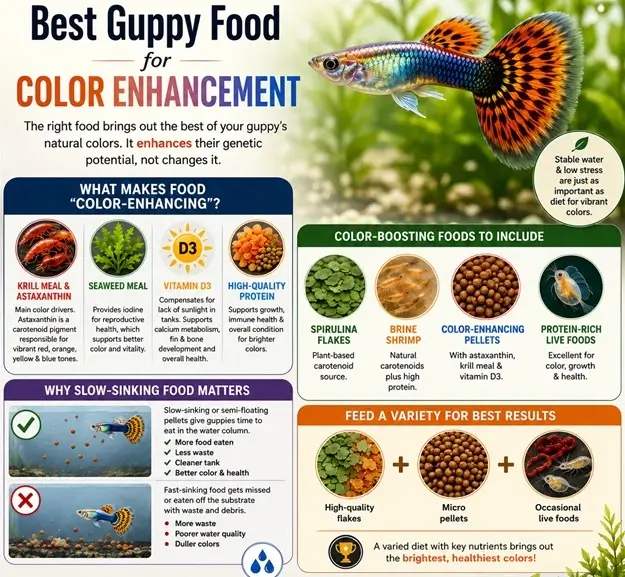
Many fish keepers feed specialized foods to improve guppy coloration. It is worth knowing upfront that no food can change a guppy’s underlying genetics — diet brings out the best of the color a guppy already has, it does not create color that is not genetically present. That said, the right ingredients make a real, visible difference within the genetic ceiling a guppy has. If your guppy’s color has faded rather than just looking dull from birth, that’s a different issue worth ruling out separately — see our guppy losing color guide.
What actually makes a food “color-enhancing”
Quality color formulas rely on a few specific ingredients to do the work. Krill meal and astaxanthin are the main color drivers — astaxanthin is a carotenoid pigment that guppies cannot produce themselves and must get from food, and it is directly responsible for vibrant colors like red, orange, yellow, and blue tones. Seaweed meal contributes iodine, which supports reproductive capacity rather than color directly, but a guppy in good breeding condition typically displays better color too.
One ingredient worth calling out specifically is vitamin D3. In the wild, fish get vitamin D from sunlight exposure. Aquarium guppies kept under standard tank lighting do not receive anything close to the UV exposure of natural sunlight, so vitamin D3 has to come from food instead. A quality color-enhancing food with added D3 compensates for this gap — it supports calcium metabolism, bone and fin development, and overall health in a way that indirectly shows up as a more vibrant, well-conditioned fish. This is one of the most overlooked reasons commercial color foods outperform homemade alternatives that skip fortification entirely.
Color-enhancing foods commonly include:
➜ Spirulina flakes — plant-based carotenoid source
➜ Brine shrimp — natural carotenoids plus high protein
➜ Color-enhancing pellets with astaxanthin, krill meal, and added vitamin D3
➜ Protein-rich live foods
Why slow-sinking food matters for color and health
Texture and sink rate matter more than most hobbyists realize. Slow-sinking pellets — sometimes called semi-floating — give guppies a window of several seconds where the food hangs in the water column before settling. This lets guppies catch and eat it properly rather than chasing food that has already dropped to the substrate. Food that sinks too fast either gets missed entirely or eaten off the tank floor, where guppies end up picking through waste and debris along with the food itself — not ideal for color, growth, or general health. A slow-sinking or semi-floating formula keeps feeding cleaner and ensures more of what you feed actually gets eaten as intended rather than wasted on the substrate.
Stable water quality and low stress matter just as much as diet for maintaining vibrant colors — a stressed or sick guppy will look dull regardless of how well it is fed.
Good color-enhancing commercial foods include Hikari Fancy Guppy, Omega One Color Mini Sinking Pellets, New Life Spectrum, NorthFin Color & Growth Formula, and Aquatic Foods Inc. Guppy Micro Sinking Granules.
Fancy Guppy Food
Fancy guppies often benefit from slightly higher-quality diets because selective breeding has made some strains more delicate than their hardier wild-type relatives — the same heightened sensitivity that shows up in how fancy guppies handle temperature swings too. High-quality food supports brighter colors and healthier growth, and as a practical bonus, better quality food also tends to pollute the water less than cheap fillers that pass through largely undigested.
Fancy guppy food should focus on:
➜ High-quality protein as the first ingredient, not fillers
➜ Color support from natural pigments like astaxanthin and spirulina
➜ Vitamin D3 to compensate for the lack of natural sunlight in an aquarium, supporting bone, fin, and overall development
➜ Easy digestibility
➜ Balanced nutrition rather than a single extreme
Since color is usually the entire reason someone is keeping fancy guppies in the first place, a dedicated color-enhancing food is worth prioritizing over a generic staple — the same brands listed in the color enhancement section above are the ones fancy guppy keepers reach for most.
Many fish keepers feed fancy guppies a rotation of micro pellets, flakes, frozen foods, and occasional live foods. Micro pellets are especially popular among fancy guppy keepers because many fancy strains handle them more easily than larger pellets, and fancy guppies tend to be more sensitive to the water quality problems caused by overfeeding — another reason their more delicate digestive tolerance favors smaller, more frequent meals.
Guppy Fry Food
Baby guppies need tiny food that fits their small mouths. Crushed quality flakes work well, and so do dedicated fry foods designed for this exact purpose. For the full picture of fry care beyond feeding, growth stages, tank setup, and survival, see our guppy fry guide and our guppy fry growth guide for the week-by-week timeline.
It is worth feeding fry the highest quality food you can manage, including formulas with vitamin D3, astaxanthin, and other color-supporting ingredients, even though their adult colors have not developed yet. Good nutrition during this growth stage builds the foundation for how vivid their coloration turns out as adults — by the time you can actually see the colors coming in, the groundwork has already been laid by what they were fed as fry.
Popular guppy fry food options include:
Crushed flakes — finely crushed between your fingers
Baby brine shrimp — once fry develop hunting coordination, usually after the first week
Fry powder food — commercial fine-particle food designed specifically for newborns, ideally one fortified with D3 and color-supporting ingredients
Frequent small feedings improve fry growth and survival significantly more than for adults, simply because fry are growing faster relative to their body size and their digestive systems are even less equipped to handle large meals.
Most fry are fed:
➜ 3–5 small meals daily
Homemade and DIY Guppy Food
Some fish keepers prepare homemade guppy food using simple ingredients, either to add variety or to reduce reliance on commercial products. Done correctly, it can be a useful supplement — but it requires more preparation and care than just opening a container of flakes.
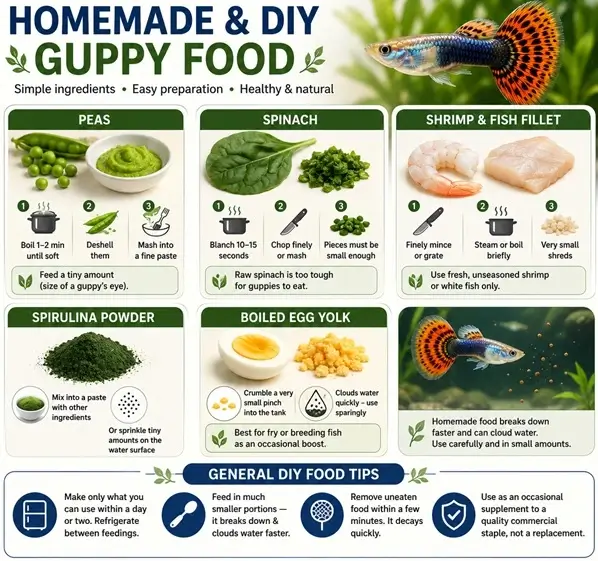
How to prepare common DIY ingredients:
Peas — boil a few peas for 1–2 minutes until soft, deshell them, and mash into a fine paste. Feed only a tiny amount, about the size of a guppy’s eye, since peas are mainly useful as an occasional digestive aid rather than a staple.
Spinach — blanch a leaf briefly in boiling water for 10–15 seconds to soften it, then chop it finely or mash it into small pieces guppies can actually fit in their mouths. Raw spinach is too tough for guppies to eat effectively.
Shrimp and fish fillet — use only fresh, unseasoned shrimp or white fish, finely minced or grated into very small shreds. Steam or boil briefly first rather than feeding raw, which reduces the risk of introducing parasites or bacteria.
Spirulina powder — can be mixed directly into a paste with other ingredients, or sprinkled in tiny amounts onto the water surface, where guppies will pick at it directly.
Boiled egg yolk — boil an egg fully, take a small piece of the yolk, and crumble it into the tank in a very small pinch. This clouds water quickly, so use it sparingly and only occasionally, mainly for fry or breeding fish needing an extra nutritional boost.
Combining ingredients into a mixed paste
Rather than feeding each ingredient on its own, many hobbyists combine a few together into a single paste for more balanced nutrition in one feeding. A simple combination might include mashed peas, a small piece of boiled egg yolk, and a pinch of spirulina powder, mixed thoroughly into a smooth paste using a small amount of tank water to bind it together. Spirulina adds plant-based nutrients and color support, peas help with digestion, and egg yolk contributes protein and fat — together giving a more rounded feeding than any single ingredient alone. Roll the mixture into a tiny pinch-sized portion and drop it in, or freeze small portions in an ice cube tray to use over several feedings rather than preparing fresh every time. As with any homemade food, feed only a small amount and remove anything uneaten promptly, since a mixed paste breaks down and clouds water just as quickly as its individual ingredients would.
General DIY food tips:
➜ Prepare only what you can use within a day or two — homemade food spoils faster than commercial food and should be refrigerated between feedings
➜ Feed less. Homemade food breaks apart in water faster than commercial flakes or pellets, so the same size portion creates more waste and cloudier water.
➜ Remove any uneaten food within a few minutes rather than letting it sit, since homemade food decays quickly compared to flakes or pellets
➜ Treat homemade food as an occasional supplement to a quality commercial staple, not a full replacement
Homemade food should be used carefully and in small amounts — it breaks down and clouds water faster than commercial food, and improper storage increases the risk of introducing bacterial contamination.
What Vegetables Can Guppies Eat?
Guppies are opportunistic eaters and will try many foods beyond commercial flakes or pellets.
Safe vegetables to occasionally feed guppies:
➜ Peas — particularly useful for helping mild constipation
➜ Spinach — rich in vitamins A, C, and K
➜ Cucumber — hydrating, low calorie
➜ Zucchini — rich in vitamins A and C
➜ Carrots — grated or finely chopped, supports immune health
➜ Lettuce
➜ Broccoli
➜ Green beans
Vegetables should always be softened or blanched before feeding — boil briefly, then plunge into ice water to stop the cooking, then chop into tiny guppy-sized pieces. Many hobbyists thread vegetables onto a skewer or toothpick to keep them in place and make cleanup easier rather than letting pieces float around the tank.
Vegetables to avoid entirely:
➜ Onions and garlic — contain compounds that can damage red blood cells and irritate the digestive tract
➜ Potatoes — high in starch that guppies cannot digest well, leading to bloating and constipation, and they pollute water as they break down
➜ Citrus fruit — too acidic, disrupts digestive pH balance and can cause irritation
However, excess homemade or vegetable feeding can quickly pollute water if overused — treat vegetables as a supplement, not a staple replacement.
How Often Should You Feed Guppies?
Given everything we now understand about their digestive system, the answer makes more sense than a generic rule would suggest.
Most adult guppies do best fed:
➜ 2–3 times daily in small portions
Feed only what guppies can finish within 2 minutes. If food is still floating after that, you fed too much — scale back next time. This two-minute rule exists specifically because of their lack of a true stomach — there is no internal storage for excess food, so anything beyond what they can quickly process becomes waste in the water rather than nutrition in the fish.
Overfeeding is one of the most common beginner mistakes, and leftover food pollutes water fast. A weekly fasting day — skipping one feeding day every 7 days — is a practice some experienced breeders use to support digestion and reduce waste buildup, mimicking the natural variability of food availability in the wild.
If your guppy suddenly stops eating, check our guide on why guppies stop eating.
Common Feeding Mistakes
Common beginner feeding mistakes include:
➜ Overfeeding — the single most common and damaging mistake
➜ Feeding poor-quality food with fillers as the main ingredient
➜ Feeding pellets too large for guppies to swallow
➜ Leaving uneaten food in the tank to decay
➜ Feeding too many bloodworms as a regular staple rather than an occasional treat
➜ Relying on a single food type rather than rotating varieties
Poor feeding habits worsen water quality and increase stress. Uneaten food breaks down quickly, raises ammonia levels, and contributes directly to disease outbreaks — particularly given how little internal capacity guppies have to process excess food before it becomes waste. See our guppy ammonia guide for the symptoms and emergency steps if this has already gotten out of hand.
Can Poor Food Cause Guppy Diseases?
Yes. Poor nutrition weakens the immune system and increases disease risk. It also fades color and makes fish less active or less interested in food generally — a guppy on a poor diet often looks listless even before other symptoms appear.
Long-term poor feeding may contribute to:
➜ Weak growth
➜ Digestive problems — bloating and constipation are especially common given their lack of a true stomach, see our bloated guppy guide for the signs and fixes
➜ Reduced color
➜ Increased disease risk
➜ Shorter lifespan
Water quality plays a major role in overall health alongside diet. Read our guide on guppy water parameters for proper tank conditions, and our complete guide on guppy lifespan for how nutrition and stress connect to longevity. If your guppy stops eating completely, that’s covered in the feeding frequency section above.
Frequently Asked Questions
What is the best guppy food?
Micro pellets are widely considered the best staple food because they are precisely sized for a guppy’s mouth, including fry, and create less mess than flakes. Combining micro pellets with occasional flakes, live food, and vegetables gives the most complete diet.
Can guppies eat only flakes?
They can survive on flakes alone, but a varied diet is healthier long-term and keeps them more active and better colored.
What food improves guppy color?
Foods containing spirulina, carotenoids, and protein-rich ingredients help bring out existing color, though diet cannot change genetics — a dull-colored guppy will not become vividly colored from food alone.
Can guppies eat bloodworms daily?
Bloodworms are best fed in moderation as a treat rather than daily — they are rich and guppies love them, but overfeeding rich foods regularly can cause digestive issues.
What is the best baby guppy food?
Baby brine shrimp, finely crushed flakes, and commercial fry powder food are the most commonly used options for newborn fry.
Can overfeeding kill guppies?
Indirectly yes — overfeeding pollutes water through leftover decaying food, and guppies lacking a true stomach cannot store or process excess food the way some fish can, making them particularly vulnerable to overfeeding-related stress.
Do fancy guppies need special food?
Fancy guppies benefit from higher-quality and more varied diets to maintain their bright colors and because selective breeding has made many strains more sensitive to poor nutrition than hardier wild-type guppies.
Can guppies eat vegetables?
Yes. Softened vegetables like peas, spinach, and cucumber support digestion and provide nutrients flakes alone do not offer.
What home food can guppies eat?
In an emergency, softened vegetables like peas or spinach can work temporarily, along with boiled egg yolk in very small amounts. These should not replace proper fish food long-term.
What can I feed guppies if I don’t have fish food?
Softened peas, spinach, or cucumber can work as a short-term substitute. Crushed boiled egg yolk in tiny amounts also works for emergencies, though it clouds water quickly if overused.
Can I feed rice to my guppy?
No, rice is not recommended. It offers little nutritional value for guppies and can pollute the aquarium as it breaks down.
Can guppies go 2 days without food?
Yes. Healthy adult guppies can comfortably go 2–3 days without food, and some breeders intentionally use a weekly fasting day to support digestion. It is much safer to underfeed slightly than to overfeed.
Why is my guppy spitting out food?
This can happen if the food is too large, stale, or if the fish is stressed or unwell. Occasionally spitting out a piece while gulping is normal; consistently rejecting all food is not.
Can guppies eat mosquito larvae?
Yes. Mosquito larvae are a natural part of a wild guppy’s diet and make an excellent protein-rich treat in captivity.
How long can guppies survive without food?
Healthy adult guppies can typically survive several days without food, sometimes longer, though stable water quality remains important throughout.
Can guppies eat betta food?
Occasionally yes, since both are tropical fish, but guppies generally do better long-term on food formulated for community fish rather than betta-specific food.
Is banana good for guppies?
Banana is not a typical or recommended guppy food. Guppies do better with their natural omnivorous diet of protein and standard vegetables — fruit, including banana, should not be a regular part of their diet due to sugar content.
Do guppies prefer flakes or pellets?
Many guppies eat both happily, but fancy guppies and fry often handle micro pellets more easily due to their precise size and shape.
Which guppy food brands are popular?
Hikari, Omega One, Fluval Bug Bites, Cobalt, New Life Spectrum, Xtreme, and NorthFin are commonly used by hobbyists.
Can guppies eat freeze-dried food?
Yes, though freeze-dried foods can expand after soaking, so feed carefully and in small amounts to avoid bloating.
Can poor feeding affect guppy breeding?
Yes. Weak nutrition reduces breeding success and fry survival rates significantly.
Why are my guppies always hungry?
Guppies are naturally active opportunistic feeders, so they often appear eager to eat even shortly after a feeding — this does not mean they are underfed.
Can guppies choke on pellets?
Large pellets can be difficult for smaller guppies to swallow whole, which is why micro pellets are preferred, though guppies can sometimes break larger pellets apart to eat in pieces.
Should guppies have fasting days?
Some experienced keepers skip feeding for one day a week to support digestion and reduce waste buildup — this is a reasonable practice given how guppies process food.
Can guppies eat egg yolk?
Yes, in tiny amounts, particularly for fry or breeding fish — but it clouds water quickly if overused, so use sparingly.
Do guppies eat at night?
Guppies are primarily daytime feeders and are far less active once lights are off.
Can feeding affect guppy aggression?
Yes. Hungry or overcrowded guppies can become more competitive and aggressive during feeding time.
Final Thoughts
The reason “feed small amounts often” works so well for guppies is not an arbitrary rule — it directly matches how their digestive system is built. No true stomach, an intestinal bulb that begins digesting immediately, and a relatively long intestine designed for a varied omnivorous diet all point to the same conclusion: small, frequent, varied meals suit guppies far better than large infrequent ones.
Build a feeding routine around micro pellets or quality flakes as your staple, rotate in live or frozen food a few times a week, and add the occasional vegetable for digestive support. Get that rhythm right and most of the common guppy health problems — bloating, dull color, poor growth, water quality crashes — become far less likely.