
Betta fish care is one of the most popular topics in the freshwater hobby — and one of the most misunderstood. This guide covers everything from tank setup and water parameters to diet, lifespan, disease, tank mates, and breeding, then walks through the Betta varieties every hobbyist should know, from Halfmoon to Dragon Scale.
Quick Navigation
➜ What Is a Betta Fish?
➜ Betta Quick Facts
➜ Betta Care
➜ Betta Tank Setup
➜ Betta Water Parameters
➜ Betta Diet
➜ Betta Lifespan
➜ Betta Diseases
➜ Betta Tank Mates
➜ Betta Breeding
➜ Betta Varieties
➜ Betta Types
➜ Halfmoon
➜ Crowntail
➜ Plakat
➜ Dumbo
➜ Double Tail
➜ Koi Betta
➜ Alien Betta
➜ Mustard Gas
➜ Dragon Scale
➜ Samurai
➜ FAQ
➜ Final Thoughts
What Is a Betta Fish?
The Betta (Betta splendens) is a small freshwater fish native to Southeast Asia — Thailand, Cambodia, Laos, and Vietnam — where it lives in slow-moving rice paddies, ditches, and floodplains rather than open water. This is why Bettas developed a labyrinth organ, which lets them gulp air from the surface and survive in water that’s too low in oxygen for most other fish.
Bettas were domesticated roughly 1,000 years ago and originally bred in Thailand for fighting sport, which is where the common name “Siamese fighting fish” comes from. Over the last century, breeders shifted focus toward color and fin development instead, which is how we ended up with the huge range of tail shapes and color patterns covered later in this guide. Bettas belong to the gourami family (Osphronemidae) and typically reach 2.25 to 3 inches in body length, not counting fins.
Betta males are the ones with bright colors, long flowing fins, and a strong territorial behavior which means that they can’t be housed with other male Bettas. Females tend to have shorter fins and more muted coloring, though well-bred fancy females are still strikingly colorful, and several females can sometimes be kept together in a group called a sorority.
Betta Fish Quick Facts
| Attribute | Details |
|---|---|
| Scientific Name | Betta splendens |
| Family | Osphronemidae |
| Adult Size | 2.25–3 inches |
| Lifespan | 3–5 years |
| Temperature | 76–82°F (24–28°C) |
| pH | 6.5–7.5 |
| Tank Size | 5+ gallons |
| Diet | Carnivore |
| Temperament | Territorial |
Betta Care
Betta care comes down to a handful of fundamentals. Get these right and a Betta is one of the easier tropical fish to keep:
• A heated, filtered tank of at least 5 gallons — never an unheated bowl or vase
• Stable water temperature between 76–82°F (24–28°C)
• Gentle water flow — strong filters damage fins and stress the fish
• A high-protein Betta-specific pellet fed in small amounts once or twice daily
• Weekly partial water changes to keep ammonia and nitrite at zero
• A secure lid — Bettas are strong jumpers
• Careful tank mate selection, since males are territorial
Each of these gets its own detailed section below, starting with tank setup.
Betta Tank Setup
A 2.5 gallon tank is the bare minimum for one betta. Fish waste builds up quickly in 2.5 gallons, which can turn toxic. A 5-gallon or 10-gallon tank is good because larger tanks keep water cleaner and safer for a longer time and you can house peacuful fishes along with Betta. Larger volumes dilute waste faster, hold temperature more evenly, and are more forgiving of small maintenance mistakes. Bettas like to swim and explore. A 2.5-gallon tank limits their movement and full growth potential.
• Heater: essential — Bettas are tropical fish and can’t regulate their own body temperature
• Filter: a sponge filter or a hang-on-back filter with the flow baffled down works best; strong currents can exhaust long-finned varieties causing stress
• Lid: Bettas are surface-oriented jumpers, so an open-top tank is a real risk. If you are using an open tank then lower the water level 3 to 4 inches minimum below the top edge
• Substrate and plants: live are the best. If you are choosing some artificial plants then silk plants are safer than hard plastic, which can tear delicate fins. You can use AquaSoils, fine sand and smooth fine gravel as a substrate.
• Hiding spots: Betta fish love having secure hiding spots like caves,Dooms, plant clusters, or driftwood which helps reduce stress
• Surface access: Betta fish require unobstructed access to the water surface because they possess a labyrinth organ that allows them to breathe atmospheric air. Leave some open water surface at the top so that the Betta can reach the surface to breathe
Always cycle a new tank (run the filter and build up beneficial bacteria) for several weeks before adding a Betta, or use bottled bacteria to speed up the process.
Betta Water Parameters
Stability matters more than hitting an exact number, but these are the ranges that you aim for:
• Temperature: 76–82°F (24–28°C)
• pH: 6.5–7.5, with many keepers targeting close to neutral
• Ammonia: 0 ppm
• Nitrite: 0 ppm
• Nitrate: under 20 ppm
• General hardness (GH): roughly 3–4 dGH, soft to moderately hard
Test weekly with a liquid test kit, dechlorinate any tap water before it goes in the tank, and change 25–30% of the water on a weekly schedule. Match the temperature of new water to the tank within a degree or two to avoid shocking the fish.
Betta Diet
Bettas are carnivores with a small stomach, roughly the size of their own eye, which makes overfeeding the most common feeding mistake.
• Base diet: A high-quality pellet formulated specifically for Bettas, not a generic tropical flake. A high-protein diet consisting of Bloodworms, Brine Shrimp and Daphnia forzen or live can be used as occasional treats.
• Amount: roughly 2–4 pellets per feeding, adjusted for the size of the fish. Since Betta Tanks tend to be smaller this negate the risk of polluting the water.
• Frequency: once or twice a day, at consistent times. Bettas are not active swimmers. So over feeding can cause bloating, digestive blockages, and poor water quality
• Fasting: skipping a day roughly once a week helps prevent bloating and constipation or swim bladder issues
If a Betta looks bloated or constipated, fffer them with tiny pieces of frozen or live Daphnia as betta are more of a meat eater. An alternatively can be a single piece of boiled, thawed and shelled green pea. Watch the fish’s body shape from above rather than feeding on a fixed schedule regardless of appetite — a slightly underweight fish needs more food, a rounded one needs less.
Betta Lifespan
Most Bettas live 3 to 5 years in captivity, and some reach 6 to 7 years under excellent care. Wild Bettas typically live 2 to 3 years, since they face predation and competition that captive fish don’t.
The single biggest factor is age at purchase: pet store Bettas are often already 6 months to a year old by the time they’re sold, which eats into the lifespan you’ll actually get to enjoy. Beyond that, tank size, stable warm water, and a varied diet are the main levers a keeper actually controls.
Betta Diseases
Most Betta illnesses trace back to poor water quality or stress, which makes prevention mostly a matter of maintaining the parameters above. The most common conditions to know:
• Fin/tail rot: bacterial or fungal infection causing ragged, discolored, or disintegrating fin edges, usually linked to dirty water
• Ich (white spot disease): a protozoan parasite that causes tiny white spots across the body and fins, along with rubbing against decor
• Velvet: another parasite, recognizable by a dusty gold or rust-colored coating, best seen by shining a flashlight on the fish
• Dropsy: a swollen body with scales that stick outward in a pinecone pattern, usually a sign of organ failure and often fatal by the time it’s visible
• Columnaris: a fast-moving, contagious bacterial infection causing white or grey patches, often on the head, gills, or mouth
• Swim bladder disorder: difficulty maintaining normal swimming position, often from overfeeding or constipation rather than infection
• Popeye: one or both eyes bulging outward, usually linked to poor water quality, injury, or bacterial infection
Quarantine any new fish or plants before adding them to an established tank, and keep a bottle of aquarium-safe antibacterial or antifungal medication on hand for early intervention. This guide is for general information — a fish showing serious symptoms is best assessed by an aquatic vet or an experienced local fish store where possible.
Betta Tank Mates
Male Bettas can live entirely alone and many do best that way, but a number of tank mates work well in a large enough setup. As a general rule, once tank mates are added, size up to at least 10 gallons.
• Nerite and mystery snails: usually too large for a Betta to swallow and protected by a hard shell, though a curious or aggressive Betta may still nip at their antennae and send them into hiding for a while
• Amano or ghost shrimp: adult size makes them harder to swallow than cherry shrimp, which run smaller and are more often lost to a hungry Betta — shrimplets of any species are almost always at risk, and outcomes still depend heavily on the individual Betta’s temperament, so dense plants like Java moss for hiding help either way
• Corydoras catfish: peaceful bottom-dwellers that rarely trigger territorial behavior
• Harlequin rasboras and neon or ember tetras: fast-moving schooling fish kept in groups of six or more
• African dwarf frogs: peaceful and low-maintenance, provided the frog has a way to reach the surface
• Guppies: can work in a large, well-planted community tank, though fancy long-finned males are more likely to draw attention than plainer females
• Mollies: possible in a spacious tank with close monitoring, since mollies share similar water needs
Avoid other Bettas, fin-nipping species such as tiger barbs, and anything with bright colors or flowing fins that could be mistaken for a rival. Introduce new tank mates gradually and watch closely for the first few days.
Betta Breeding
Breeding Bettas is a rewarding project, but it takes a dedicated setup and a few weeks of attention. Sexual maturity is typically reached around 4–6 months of age.
1. Condition the male and female separately for 1–2 weeks with live or frozen foods like bloodworms, brine shrimp, or daphnia
2. Set up a breeding tank around 78–80°F with shallow water (5–6 inches), floating plants, and no strong filter current
3. Introduce the female inside a clear divider or container so the pair can see each other without direct contact for a few days
4. Once the male has built a bubble nest at the surface, release the female into the tank
5. During spawning, the male wraps around the female; she releases eggs that he catches and places into the bubble nest
6. Remove the female immediately afterward — the male often turns aggressive once spawning is complete
7. The male guards and tends the nest alone; eggs typically hatch within 24–48 hours
8. Once fry are free-swimming (usually 2–3 days after hatching), remove the male so he doesn’t eat them
9. Feed fry infusoria or freshly hatched baby brine shrimp several times a day in very small amounts
Perform small daily water changes in the fry tank and keep the water pristine — fry are far less tolerant of poor water quality than adult Bettas.
Betta Varieties
Betta splendens has been selectively bred into dozens of recognized forms, generally classified along two independent axes: tail/fin shape (Halfmoon, Crowntail, Plakat, and so on) and color or scale pattern (Koi, Mustard Gas, Dragon Scale, and so on). A single fish can combine both, for example a Halfmoon Dragon Scale or a Dumbo Plakat.
One color line worth a special mention is the GloFish Betta, a fluorescent variety produced through genetic modification rather than traditional selective breeding, with the same day-to-day care needs as any other Betta.
The ten varieties below cover the most popular and most frequently asked-about types in the hobby. Full individual care guides for each are coming soon — jump to the Betta Types section now, or keep reading for the complete care picture first.
Betta Types
Here’s how the ten types stack up at a glance before the full write-up on each below.
| Type | Tail / Feature | Care Level | Beginner Friendly |
|---|---|---|---|
| Halfmoon | Long 180° tail | Moderate | ✓ |
| Crowntail | Spiky fin rays | Easy | ✓ |
| Plakat | Short fins | Easy | ✓ |
| Dumbo (Elephant Ear) | Enlarged pectoral fins | Moderate | ✓ |
| Double Tail | Split double tail | Moderate | ✓ |
| Koi Betta | Marble color pattern | Easy | ✓ |
| Alien Betta | Metallic wild-type body | Moderate | ✓ |
| Mustard Gas | Blue body with yellow fins | Easy | ✓ |
| Dragon Scale | Thick metallic scales | Moderate | ✓ |
| Samurai | Dragon-scale armor pattern | Moderate | ✓ |
Halfmoon
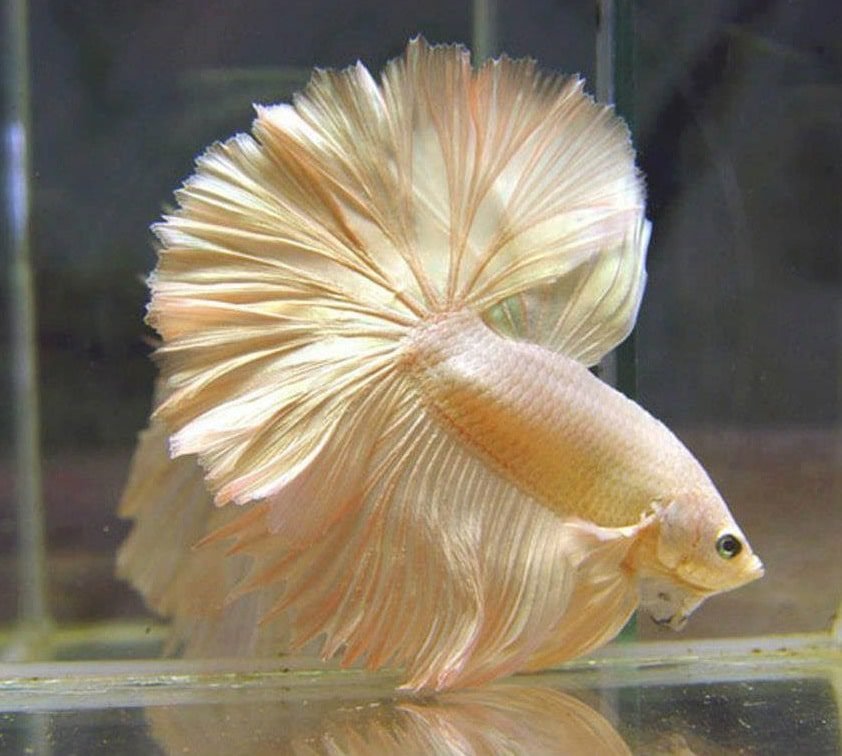
The Halfmoon is the showpiece of the hobby: its caudal fin spreads into a full 180-degree “D” shape when flared, with the dorsal and anal fins extended to overlap the tail’s edges. That much fin surface area is stunning to look at but delicate in practice — Halfmoons need pristine, stable water and gentle flow, since their heavy fins are prone to tearing and fin rot in a rougher setup.
Crowntail
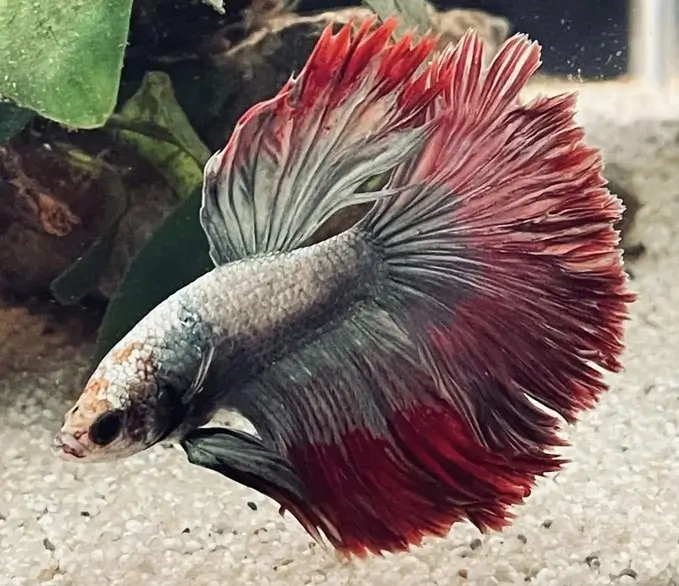
The Crowntail was first developed by Indonesian breeder Ahmad Yusuf and is instantly recognizable by its reduced fin webbing, which leaves the individual fin rays exposed in a spiky, crown-like fringe across the dorsal, anal, and caudal fins. Because the exposed rays have less protective webbing than other varieties, water quality needs to stay especially clean to prevent the rays from curling or fraying.
Plakat
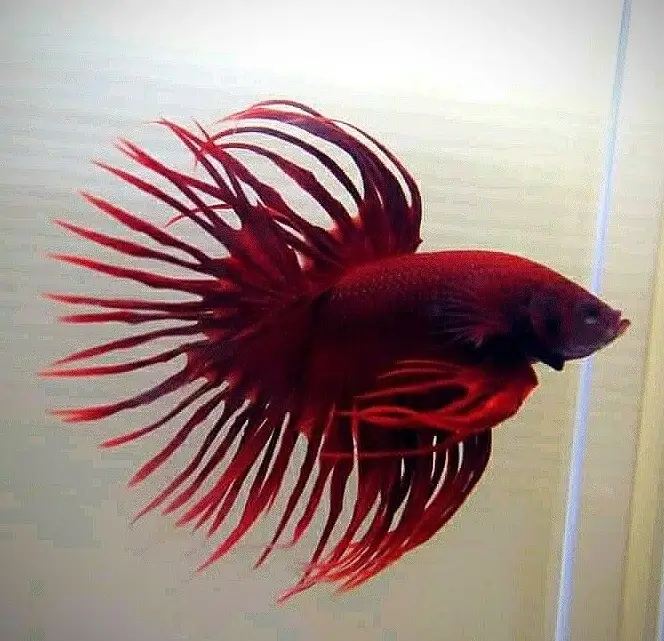
Plakat means “fighting fish” in Thai, and this short-finned form is the closest living link to the original fighting strain and to wild Betta splendens. The compact fins make Plakats sturdier, less prone to tearing, and stronger swimmers than their long-finned cousins, which is why they’re often recommended to beginners — though their fighting-strain background also means they can be a little more feisty in temperament.
Dumbo
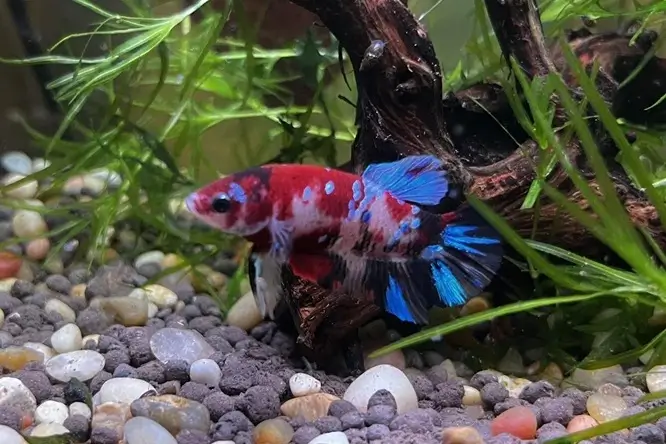
Dumbo, sometimes called Elephant Ear, isn’t a tail type at all — it’s defined entirely by oversized pectoral fins that flare out from behind the gills like a pair of ears. The trait can be paired with virtually any tail shape, so it’s common to see a Dumbo Halfmoon or a Dumbo Plakat, with the large pectorals adding a distinctive, graceful motion as the fish swims.
Double Tail
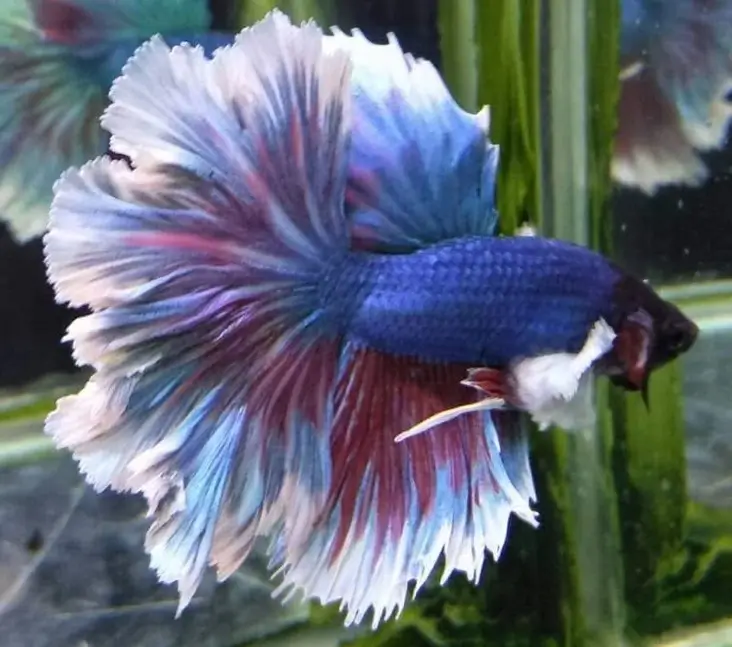
A true Double Tail has two complete, separate caudal fin lobes rather than one tail that’s merely split, usually paired with a noticeably broader dorsal fin and a shorter body. It’s a striking look, but the underlying genetic mutation can also affect the swim bladder and is associated with a shorter lifespan and greater susceptibility to fin disease than single-tailed varieties, so it’s worth knowing that trade-off before choosing one.
Koi Betta
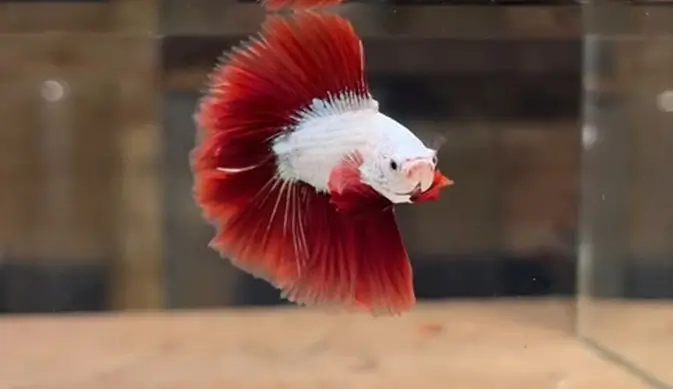
Koi Bettas are a marble-patterned variety bred to echo the look of Japanese koi carp, typically showing patches of orange, white, red, and black across the body and fins, often with a metallic sheen layered on top. What makes them especially fun to own is the “jumping gene” behind the marble pattern, which causes the coloring to shift unpredictably over months or years — a fish bought mostly white may end up mostly orange a year later.
Alien Betta
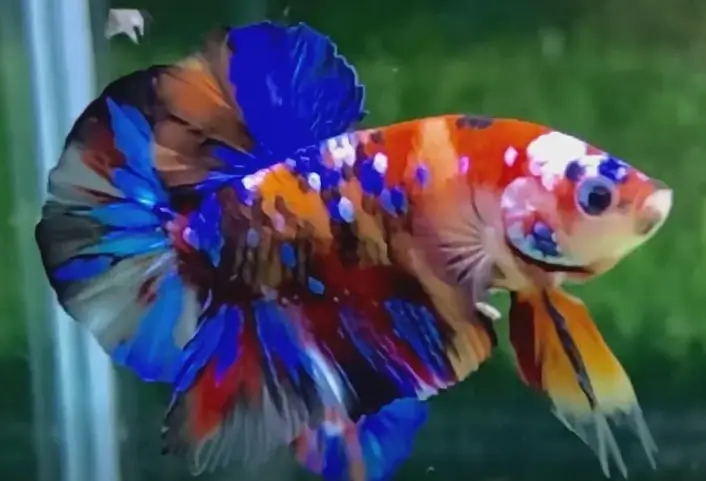
The Alien Betta is a hybrid line, developed from crosses with wild species such as Betta smaragdina and Betta imbellis, known for an elongated, streamlined body that’s noticeably different from the standard Betta splendens shape. Its defining feature is a dense, metallic iridescent sheen — in blue, green, copper, or black — that spreads across the body and short, compact fins, often extending into a distinctive “masked” face pattern.
Mustard Gas
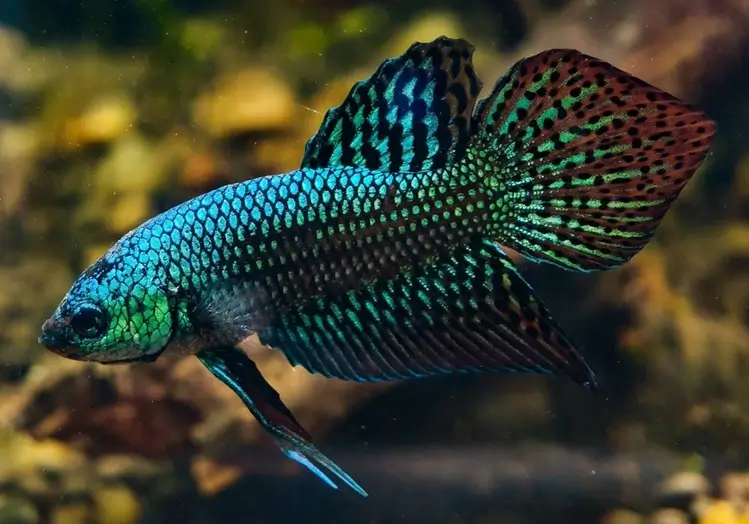
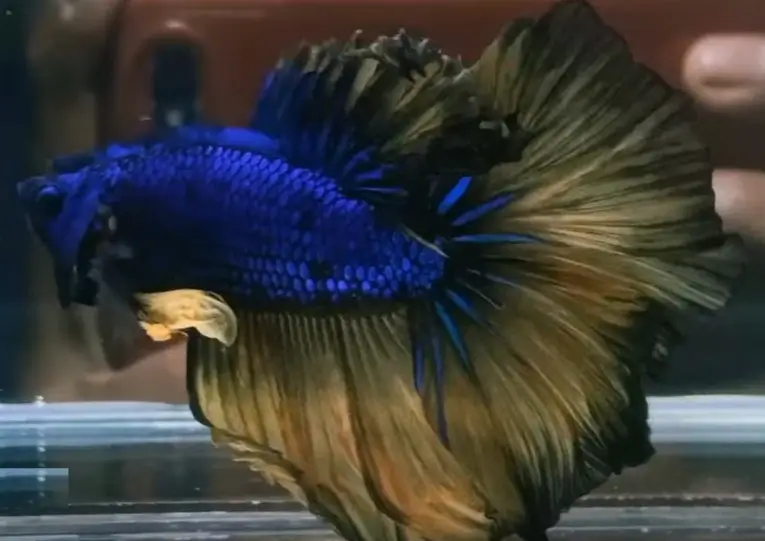
Mustard Gas Bettas are a bi-color variety with a dark blue or green body set against bright mustard-yellow or orange fins. The pattern was first developed in 1999 by American breeder Jude Al after roughly 13 years of selective work, though most examples sold today are the result of later cross-breeding rather than “true” original lines, and the pattern occasionally shows up combined with a green body or dragonscale texture.
Dragon Scale
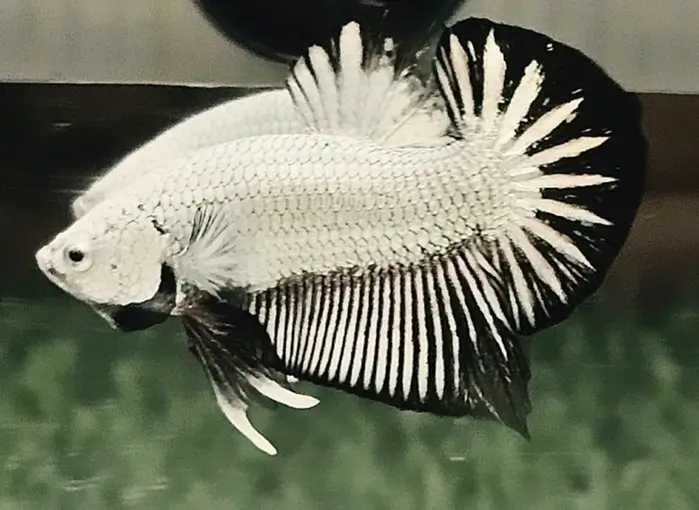
Dragon Scale Bettas carry thick, opaque, metallic scales that resemble a suit of armor, a look first developed around 2004 by crossing domesticated Betta splendens with the wild species Betta mahachai. The base color usually still shows through at the tail, gills, and fin edges. One important thing to know before buying one: the same thick-scaling trait commonly grows over the eyes as the fish matures, which can lead to blindness — this isn’t a rare fluke, it’s a well-documented trade-off of the variety.
Samurai
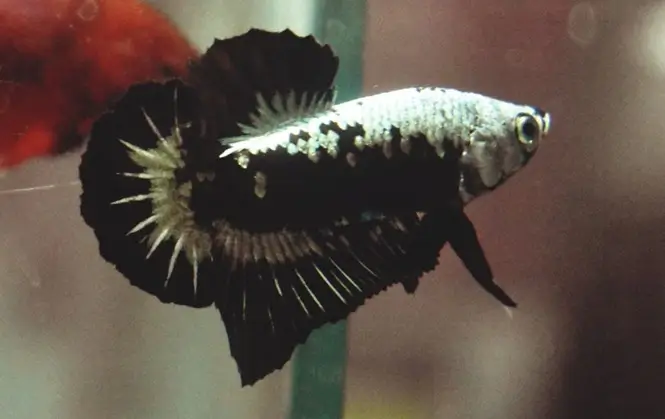
The Samurai combines a solid, often dark body color with thick, metallic dragon-scale plating concentrated across the top half of the body, creating an armor-like, high-contrast look reminiscent of samurai armor. It’s essentially a dragonscale pattern layered onto a dark base color rather than a separate genetic line, and it carries the same general care needs as other dragonscale Bettas.
FAQ
Can two betta fish live together in the same tank?
Two male Bettas should never share a tank — they’ll fight, often fatally, no matter how large the tank is. Female Bettas are more flexible: a group of three to five, kept in odd numbers so one fish isn’t singled out, can sometimes cohabit in a heavily planted 10-gallon-plus tank, a setup known as a sorority. Even then, keep a backup tank ready in case the group doesn’t settle peacefully.
Do betta fish need a heater and filter?
Yes to both. Bettas are tropical fish and can’t regulate their own body temperature, so an unheated tank will run too cold for them to stay healthy. A filter is just as important for keeping ammonia and nitrite at zero — just choose a gentle one, since strong currents exhaust long-finned varieties and can damage fins.
Can betta fish live with goldfish?
No. Goldfish need cooler water (roughly 65–74°F) than a Betta’s tropical range (76–82°F), so there’s no single temperature that keeps both healthy. Goldfish also produce far more waste and need stronger filtration than a Betta setup provides, and a male Betta may mistake a colorful goldfish for a rival.
Is a betta a good fish for beginners?
Generally, yes. A Plakat or Veiltail in a properly heated, filtered 5 to 10-gallon tank is one of the more forgiving tropical fish for a first-time keeper. The most common beginner mistakes are housing a Betta in an unheated bowl, overfeeding, and adding tank mates before the tank has finished cycling.
Why does my betta keep building bubble nests?
Bubble nests are a natural, hardwired breeding behavior in males and show up even with no female present. It’s often a sign the fish is mature and reasonably settled in its environment, though a bubble nest on its own isn’t a guaranteed sign of happiness — it’s still worth checking water parameters if anything else about the fish seems off.
How big do betta fish get?
Most Betta splendens reach about 2.25 to 3 inches in body length as adults, not counting their fins. Long-finned varieties like the Halfmoon can look considerably larger once fully flared, even though the body itself stays the same size.
Can a betta live in a bowl with no filter or heater?
They can survive short-term, but it isn’t a setup that supports long-term health. Small, unheated volumes swing in temperature and ammonia far faster than a proper tank, which is why every major care guide points to a heated, filtered 5-gallon tank as the real minimum instead.
Final Thoughts
A Betta is a small fish with a short list of real requirements: warm, stable, clean water; a gentle filter; the right amount of food; and a tank sized for its fins rather than just its body. Get those basics right and most of the disease and lifespan problems that give Bettas a reputation for being fragile simply don’t come up.
Where Bettas really stand apart is the sheer range of fin shapes and color patterns bred into Betta splendens over the last century — from a battle-hardened Plakat to a color-shifting Koi to an armor-plated Dragon Scale. Bookmark this page as your reference point, and check back soon as we publish full individual care guides for each Betta type linked in the Betta Types section above.