
The Tuxedo Guppy is one of the most striking guppy strains, named for its elegant two-tone body that looks like a formal tuxedo suit. With bright colors on the upper body and dark shading on the lower half, these guppies are both beautiful and beginner-friendly.
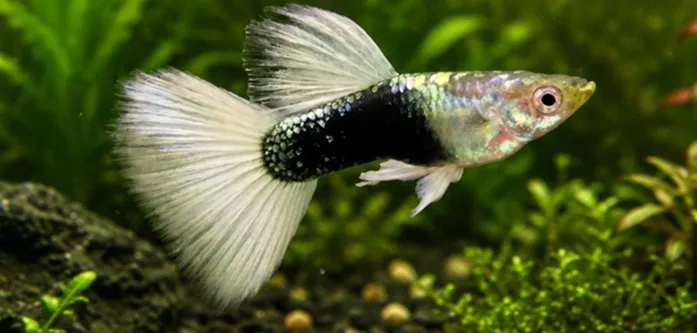
Hardy, peaceful, and endlessly colorful, Tuxedo Guppies are a favorite among aquarists worldwide. In this guide, you’ll discover everything about Tuxedo Guppy care, varieties, breeding, and prices.
Quick Navigation
➜ What Makes Tuxedo Guppy Special?
➜ General Care Guide for Tuxedo Guppies
➜ Popular Tuxedo Guppy Colors and Varieties
➜ Red Tuxedo Guppy
➜ Pink Tuxedo Guppy
➜ Blue Tuxedo Guppy
➜ Yellow Tuxedo Guppy
➜ Dragon Tuxedo Guppy
➜ Leopard Tuxedo Guppy
➜ White Tuxedo Guppy
➜ Male vs Female Tuxedo Guppies
➜ Breeding & Gestation of Tuxedo Guppy
➜ Frequently Asked Questions
What Makes Tuxedo Guppy Special?
• Color Pattern: Dark lower body (black/navy/gray) with bright shades like red, blue, pink, yellow, or gold.
• Beginner-Friendly: Hardy and adaptable to most aquarium setups.
• Male vs Female: Males are smaller, more colorful, with longer fins. Females are larger with a visible gravid spot.
• Lifespan: 2–3 years with proper care.
• Size: Males ~1.5 inches, females ~2.5–3 inches.
General Care Guide for Tuxedo Guppies
Tank Setup
• Tank Size: 10 gallons minimum for a small group (larger tanks preferred).
• Temperature: 72–82°F (22–28°C).
• pH Range: 6.8–7.8.
• Filtration: Sponge or gentle HOB filter (avoid strong currents).
• Décor: Live plants such as Java moss, Anubias, or floating plants. These provide cover, oxygen, and breeding spots.
See our guppy tank setup guide and guppy water parameters guide for the full walkthrough.
Diet & Feeding
• Staple Foods: High-quality flakes or guppy micro-pellets.
• Protein Boost: Brine shrimp, bloodworms, and daphnia.
• Vegetables: Blanched spinach, zucchini, and spirulina flakes.
• Feeding Frequency: 2–3 small meals per day.
See our best guppy food guide for the full feeding schedule.
Tank Mates
Tuxedo Guppies are peaceful and thrive with other community fish:
• Good Companions: Mollies, Platies, Corydoras, Neon Tetras, Rasboras, Shrimp.
• Avoid: Aggressive or fin-nipping fish like barbs or cichlids.
See our guppy tank mates guide for the full compatibility list.
Popular Tuxedo Guppy Colors and Varieties
Each Tuxedo Guppy variety offers a unique color combination. Below are the most popular strains.
Red Tuxedo Guppy
The Red Tuxedo Guppy is eye-catching, with its fiery red upper body against a deep black midsection and a flowing red tail. This variety adds bold color to aquariums and is one of the most recognized strains among hobbyists.
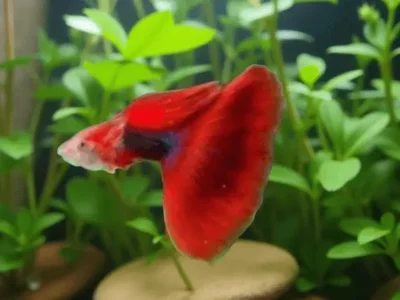
• The red color intensifies with age and diet. Younger males often show a duller, more orange-red tone that deepens into a richer, saturated red as they mature, especially with a diet that includes color-enhancing foods like brine shrimp or spirulina-based flakes.
• The black tuxedo band varies in size between individual fish, even within the same brood — some show just a thin black saddle behind the head, while others carry black most of the way down the body.
• Against dark substrate, the red pops dramatically, making this one of the strongest color choices for a high-contrast display tank.
Read our full guide on the Red Tuxedo Guppy.
Pink Tuxedo Guppy
The Pink Tuxedo Guppy displays delicate pink shades that blend into a mild black tuxedo base, giving it a soft yet striking look. Its gentle tones make it a great choice for aquascapes with subtle color themes.
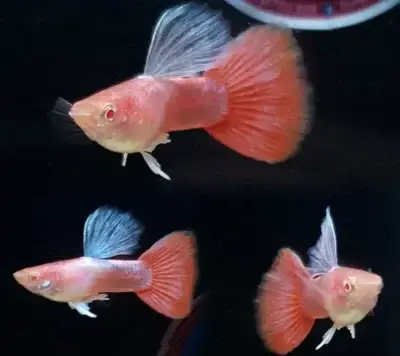
• Pink is technically a diluted red, genetically related to the deeper red tuxedo strain but expressed with less pigment density, which is what gives it that pastel quality instead of a bold, saturated tone.
• Lighting affects how the pink reads. Under warm-toned aquarium lighting, the pink can shift toward a soft peachy hue, while cooler white lighting brings out a cleaner, more true pink.
• Pairs especially well with lighter substrate and plants, since dark backgrounds can make the pastel coloring look washed out by comparison.
Read our full guide on the Pink Tuxedo Guppy.
Blue Tuxedo Guppy
With shimmering metallic blue tones across its body, the Blue Tuxedo Guppy stands out beautifully when paired with darker tank décor. Its cool color palette provides a calming balance in mixed guppy communities.
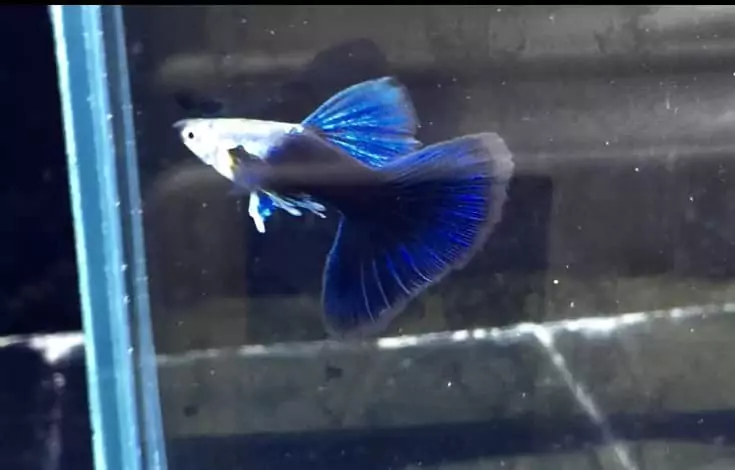
• The blue is iridescent rather than pigment-based, caused by light reflecting off structural cells in the skin, which is why the color can shift and shimmer depending on the viewing angle and how the light hits the fish.
• Color intensity can vary by mood and health. A stressed or unwell guppy often looks noticeably duller, so a Blue Tuxedo holding a strong, vivid shimmer is generally a good visual sign of a healthy fish.
• Blue-toned strains tend to photograph differently under camera flash versus natural light, often appearing more purple or teal in photos than they do in person.
Read our full guide on the Blue Tuxedo Guppy.
Yellow Tuxedo Guppy
They come with bright yellow hues combined with the classic tuxedo tail, making this guppy a cheerful addition to any tank. The contrast of gold-yellow and black makes it especially vibrant under natural or warm lighting.
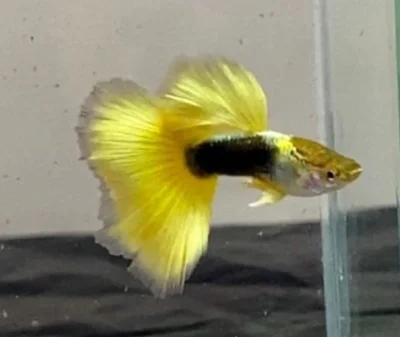
• Yellow is one of the more difficult tuxedo colors to keep vibrant long-term, since it tends to fade faster than red or blue strains without consistent access to color-enhancing food.
• Some individuals lean more gold, others more lemon-yellow, even within the same batch — this is normal variation rather than a sign of a different strain.
• Works particularly well in a planted tank with green foliage, since the yellow stands out clearly against green in a way it doesn’t against darker backgrounds.
Read our full guide on the Yellow Tuxedo Guppy.
Dragon Tuxedo Guppy
Featuring iridescent, metallic scales that resemble a dragon’s skin, combined with vibrant red, orange, and sometimes blue or green coloring, this strain stands out for its large flowing fins and shimmering finish.
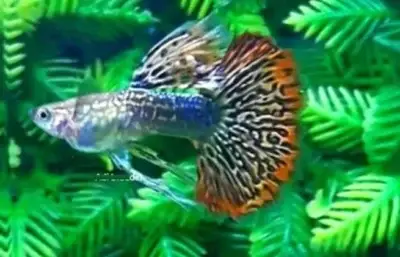
• The “dragon” name comes from the scale pattern itself, not just the color — the scales have a raised, textured look that catches light differently than the smooth-scaled strains above, giving a genuinely scaled, armor-like appearance.
• No two Dragon Tuxedos look quite the same. This strain shows the widest individual variation of any tuxedo color, since it’s often a mix of multiple color genes expressing at once rather than one dominant pigment.
• Considered one of the more premium tuxedo strains among breeders, largely because of that scale texture combined with unpredictable, often striking color combinations.
Read our full guide on the Dragon Tuxedo Guppy.
Leopard Tuxedo Guppy
Spotted with leopard-like patterns over its fins and accented by a tuxedo base, this guppy adds a wild and exotic feel to tanks. Its playful markings make it a favorite in mixed guppy displays.
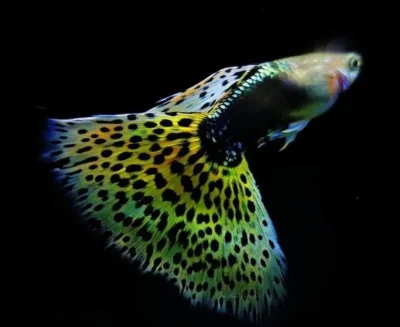
• The spotting is concentrated mainly on the tail and dorsal fin, rather than across the whole body, which is what gives it that leopard-print effect specifically where it’s most visible.
• Spot density and size vary a lot between individuals, from a light scattering of small dots to a dense, almost fully patterned tail.
• Background body color can vary too, most commonly appearing over a yellow, orange, or silver base, which changes how the spots read visually from fish to fish.
Read our full guide on the Leopard Tuxedo Guppy.
White Tuxedo Guppy
Elegant and simple, the White Tuxedo Guppy shows a snowy white body with dark tuxedo shading on its tail. Its clean appearance makes it a stylish addition to aquariums with contrasting colorful strains.
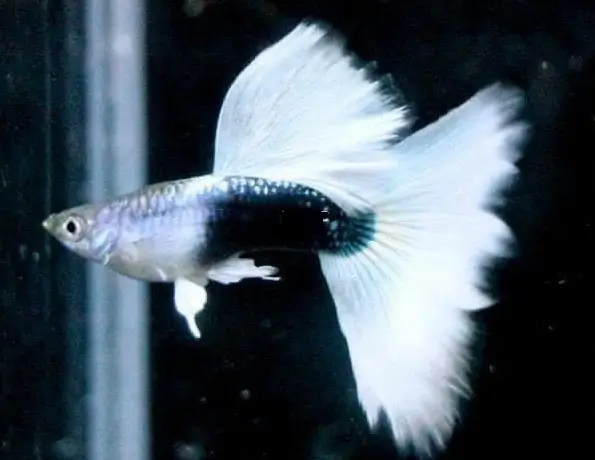
• The white is opaque rather than translucent, which is what separates it visually from an albino or pale strain — it’s a solid, milky white rather than a see-through pale body.
• The contrast between white and black is the whole appeal here, so a well-defined, sharp tuxedo line tends to be more prized than a blurred or fading transition between the two colors.
• Shows algae or water discoloration more easily than darker strains, which makes it a fish that visibly rewards consistent tank maintenance — a slightly dirty tank shows up faster on a white fish than a red or blue one.
Male vs Female Tuxedo Guppies
• Males: Slim, smaller (~1.5″), brighter colors, elongated fins.
• Females: Larger (~2.5–3″), gravid spot near anal fin, rounder belly.
See our male vs female guppy guide for the complete comparison.
Breeding & Gestation of Tuxedo Guppy
• Gestation Period: ~28 days.
• Fry Count: 20–40 fry per female, depending on size & health.
• Setup: Use a breeder box or separate tank with fine-leaved plants.
• Fry Food: Crushed flakes, baby brine shrimp, or specialized fry food.
See our guppy breeding guide, pregnant guppy guide, and guppy fry guide for the complete process from pairing to raising fry.
Frequently Asked Questions
How many Tuxedo Guppy varieties are there?
There are 7 main color varieties covered in this guide, Red, Pink, Blue, Yellow, Dragon, Leopard, and White, each with their own dedicated guide. Several of these also have their own sub-strains, like Red Golden, Red Koi, and Blonde under Red Tuxedo, or Golden, Half-Black, and Banana under Yellow Tuxedo.
Which Tuxedo Guppy variety is easiest to care for?
All Tuxedo Guppy varieties share the same core care requirements, they’re equally beginner-friendly. The color pattern doesn’t affect hardiness, so pick based on which color you like best.
How much do Tuxedo Guppies cost?
Prices generally range from $6 to $25 per pair depending on the specific variety, size, and coloration quality. Rarer strains, like Albino or Half-Black (HB) color combinations, tend to cost more.
Can different Tuxedo Guppy varieties be kept together?
Yes, but keep in mind they will crossbreed freely, since they’re all the same species. If you want to maintain pure color strains for breeding purposes, keep each variety in a separate tank.
Do all Tuxedo Guppies have the same lifespan?
Yes, generally 2 to 3 years with good care, regardless of color variety. Water quality, diet, and stress levels matter more for lifespan than the specific strain.C