
With its flowing double tail, graceful swimming style, and distinctive raspberry-like head growth known as the wen, the Oranda Goldfish is one of the most recognizable and beloved fancy goldfish in the world. Whether you’re drawn to the classic Red Cap Oranda, the striking Panda Oranda, the elegant Blue Oranda, or one of the many other beautiful varieties, all Orandas belong to the same remarkable breed that has fascinated hobbyists for centuries.
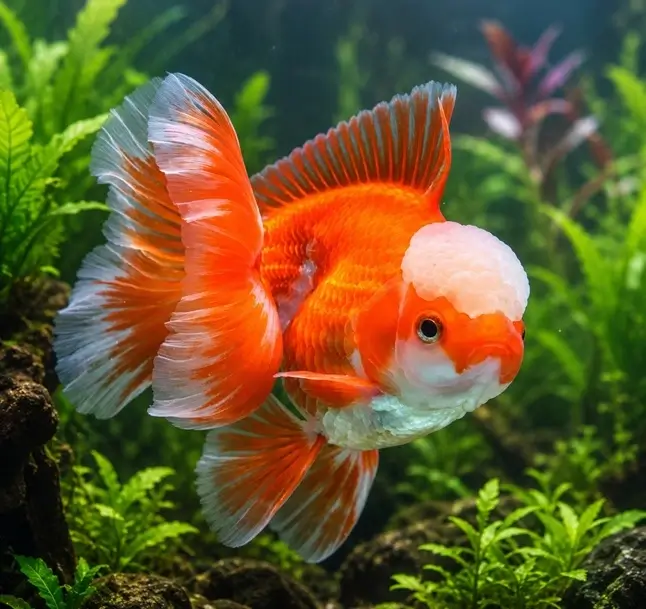
Originally developed in China and later refined by Japanese breeders, the Oranda has become one of the flagship breeds of fancy goldfish. Selective breeding has produced fish with impressive head growth, flowing fins, diverse body shapes, and an extraordinary range of colors and patterns. Today, Orandas are kept by everyone from first-time goldfish owners to serious exhibition breeders around the world.
This guide explores everything you need to know about Oranda Goldfish, including their history, physical characteristics, common color varieties, body types, bloodlines, size, lifespan, care requirements, and much more.
Quick Navigation
➜ Quick Facts
➜ What Is an Oranda Goldfish?
➜ History & Origin
➜ Characteristics
➜ The Science Behind the Wen
➜ Oranda Goldfish Types By Color
➜ Oranda Goldfish By Body Types
➜ Popular Oranda Goldfish Types by bloodlines
➜ Oranda Goldfish Growth & Development
➜ Oranda Goldfish Lifespan
➜ Do Oranda Goldfish Change as They Age?
➜ Oranda Goldfish Care Overview
➜ Buying Guide
➜ Common Mistakes to Avoid
➜ Frequently Asked Questions
Oranda Goldfish Quick Facts
| Characteristic | Details |
|---|---|
| Scientific Name | Carassius auratus |
| Common Name | Oranda Goldfish |
| Family | Cyprinidae |
| Origin | China (later refined in Japan) |
| Adult Size | 6–8 in (15–20 cm), occasionally larger |
| Lifespan | 10–20 years |
| Temperament | Peaceful, social, slow swimmer |
| Difficulty | Moderate |
| Minimum Tank Size | 30 gallons (115 L) |
| Temperature | Normal: 68–79°F (20–26°C) Treatment: Up to 80.6°F (27°C) |
| pH | 7.0–8.0 |
| Diet | Omnivore |
| Best Tank Mates | Other fancy goldfish |
What Is an Oranda Goldfish?
The Oranda Goldfish is a selectively bred variety of Carassius auratus that is best known for the fleshy head growth called the wen. This distinctive feature, combined with a deep egg-shaped body, upright dorsal fin, and elegant double tail, gives the Oranda one of the most recognizable appearances of any fancy goldfish.
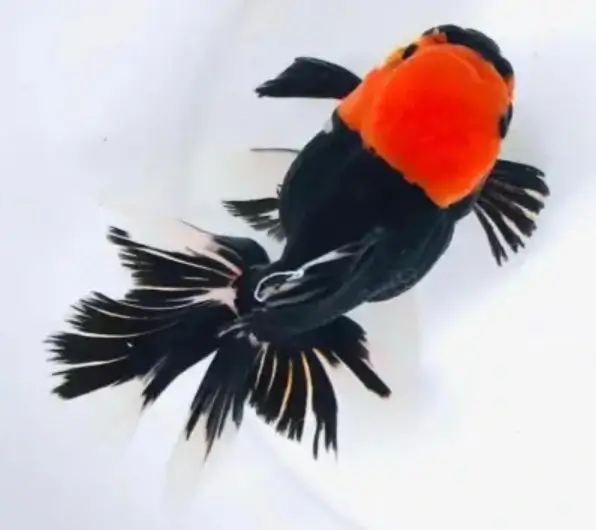
Unlike streamlined varieties such as the Common Goldfish or Comet Goldfish, Orandas have been selectively bred for beauty rather than speed. Their rounded bodies and flowing fins produce slow, graceful movements that make them a favorite among aquarium hobbyists.
Every Oranda shares the same defining characteristics, but the breed displays tremendous diversity in color, body shape, and bloodline. Modern breeders have produced stunning varieties such as the Red Cap Oranda, Panda Oranda, Blue Oranda, Chocolate Oranda, Black Oranda, and Calico (Azumanishiki) Oranda, each with its own unique appearance while retaining the unmistakable Oranda silhouette.
History & Origin
The history of the Oranda Goldfish begins in China, where centuries of selective breeding transformed the wild Prussian carp into increasingly elaborate ornamental goldfish. Among the many fancy varieties that emerged, breeders favored fish with rounded bodies, flowing fins, and eventually the distinctive fleshy head growth that would become the Oranda’s defining feature.
As goldfish keeping spread throughout East Asia, Japanese breeders further refined the Oranda by improving body proportions, fin symmetry, swimming posture, and wen development. Their careful breeding produced the elegant fish that became popular worldwide and laid the foundation for many of today’s modern bloodlines.
Modern Orandas are now bred across Asia, Europe, and North America, with specialized breeding programs producing a remarkable range of colors, body types, and bloodlines. Despite these differences, every Oranda belongs to the same breed and shares the characteristic head growth that has made it one of the world’s most admired fancy goldfish.
Did You Know?
Although the name “Oranda” is believed to come from an old Japanese word referring to the Netherlands (“Holland”), Oranda Goldfish did not originate in Europe. The breed was first developed in China before being refined by Japanese breeders into the spectacular fancy goldfish we know today.
Characteristics of an Oranda Goldfish
Every Oranda Goldfish, regardless of its color or bloodline, shares a set of distinctive physical characteristics that separate it from other fancy goldfish breeds. While the fleshy head growth known as the wen is the feature most people notice first, the Oranda’s deep body, upright dorsal fin, and elegant double tail are equally important in defining the breed.
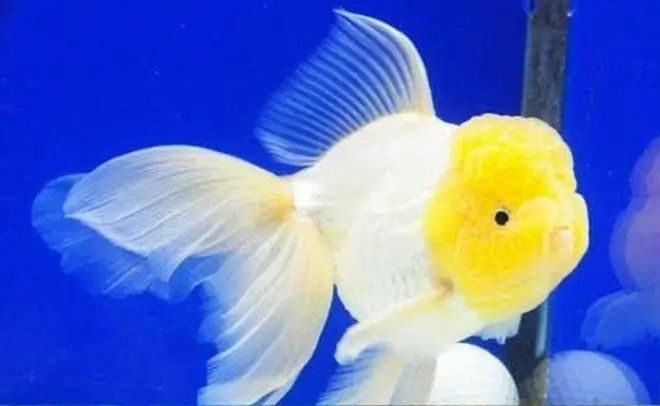
Selective breeding over several centuries has refined these characteristics into the graceful, slow-swimming fish admired by hobbyists today. Although modern Orandas are available in many different colors and body styles, they all retain the same basic body structure that makes them instantly recognizable.
Wen (Head Growth)
The most distinctive feature of an Oranda Goldfish is its fleshy head growth, known as the wen. This soft tissue gradually develops over the top of the head and cheeks as the fish matures, giving Orandas their signature appearance.
Depending on genetics, some fish develop only a modest cap while others produce massive, well-rounded wens that cover much of the face. High-quality specimens are prized for symmetrical, evenly developed head growth that enhances the fish without interfering with vision or feeding.
Body Shape
Orandas have a deep, egg-shaped body that is noticeably taller than it is wide. Their rounded profile gives them a graceful appearance but also makes them slower swimmers than streamlined varieties such as Common or Comet Goldfish.
Modern breeding has produced both compact short-bodied Orandas and more streamlined long-bodied Orandas, both of which are recognized within the hobby and discussed later in this guide.
Dorsal Fin
Unlike Ranchu and Lionhead Goldfish, Orandas possess a fully developed upright dorsal fin. A healthy dorsal fin remains erect while the fish swims and contributes to the breed’s elegant posture.
This single feature immediately distinguishes an Oranda from several closely related fancy goldfish breeds that completely lack a dorsal fin.
Double Tail
The Oranda’s caudal fin consists of two symmetrical lobes that spread gracefully behind the fish. Well-bred specimens have broad, evenly divided tails with smooth edges and balanced proportions.
The flowing tail complements the fish’s slow swimming style and is one of the reasons Orandas are often considered among the most elegant fancy goldfish.
Scales
Most Orandas possess metallic scales that produce a bright reflective sheen. However, certain varieties, particularly Calico Orandas, display nacreous scales that create a softer, pearly appearance.
The interaction between scale type, pigmentation, and reflected light is one of the reasons Orandas display such an extraordinary range of colors.
Swimming Style
Because of their deep body, flowing fins, and additional weight from the wen, Orandas swim slowly and deliberately. They are peaceful fish that are best kept with other fancy goldfish capable of swimming at a similar pace.
Fast-swimming single-tailed goldfish often outcompete Orandas during feeding, making mixed tanks less suitable.
The Science Behind the Wen
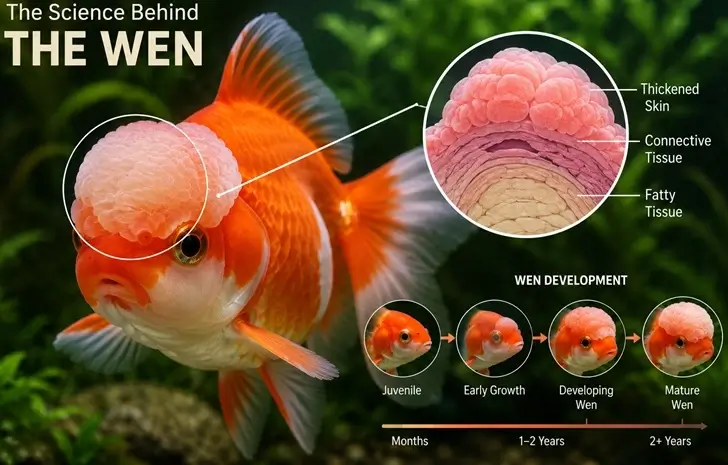
The wen is far more than a decorative feature. It is a genuine overgrowth of skin and connective tissue that has been selectively enhanced through centuries of breeding. Although it gives the Oranda its unmistakable appearance, the biological processes behind wen development are surprisingly complex.
Many care guides simply describe what the wen looks like, but understanding why it develops provides a much better appreciation of this remarkable breed.
Why Does the Wen Grow?
The wen develops because breeders have selectively favored fish that naturally produced thicker skin and connective tissue around the head. Over many generations, these traits became increasingly pronounced, eventually producing the impressive head growth seen in modern Orandas.
Rather than being controlled by a single “wen gene,” current evidence suggests that wen development is a polygenic trait, meaning multiple genes influence its size, shape, and growth pattern.
What Is the Wen Made Of?
The wen consists primarily of thickened skin, connective tissue, and fatty tissue. It is not a tumor or disease but a completely normal anatomical feature of the breed.
As the fish matures, growth hormone signaling encourages these tissues to expand, creating the familiar raspberry-like texture that makes Orandas instantly recognizable.
When Does the Wen Start Developing?
Most juvenile Orandas show little or no visible head growth during their first few months of life. The wen usually begins appearing between 3 and 6 months of age, develops rapidly during the first two years, and may continue thickening slowly for several more years.
This gradual development explains why young Orandas often look dramatically different from mature adults.
Why Do Some Orandas Develop Huge Wens?
Genetics is by far the most important factor. Certain bloodlines—particularly many modern Thai lines—have been selectively bred for exceptionally large and well-rounded wens.
Nutrition and excellent water quality help a fish reach its full genetic potential, but they cannot create a massive wen if the underlying genetics are absent.
Can the Wen Become Too Large?
Yes. In some fish, the wen continues growing until it partially covers the eyes or mouth, making it difficult to locate food or navigate the aquarium. Deep folds can also trap debris, increasing the risk of bacterial or fungal infections if water quality is poor.
Routine observation, excellent filtration, and regular maintenance usually prevent problems. In rare cases, aquatic veterinarians may trim an excessively overgrown wen to restore vision or improve feeding.
Did You Know?
The Oranda isn’t the only fancy goldfish with a wen. Lionhead and Ranchu Goldfish also develop fleshy head growth, but selective breeding has emphasized this feature differently in each breed, resulting in their unique appearance.
Oranda Goldfish Types By Color
One of the reasons Orandas are so popular is their incredible diversity of colors and patterns. While every Oranda shares the same basic body shape and distinctive wen, selective breeding has produced numerous beautiful color varieties, each with its own appearance and popularity among hobbyists.
Some varieties, such as the Red Cap Oranda, have become icons of the aquarium hobby, while others like the Blue Oranda, Panda Oranda, and Chocolate Oranda are prized for their rarity and unique coloration.
Below are some of the most popular Oranda color varieties found today.
Red Cap Oranda
The Red Cap Oranda is perhaps the most famous Oranda variety. It features a brilliant red wen sitting on top of an otherwise pure white body, creating one of the most recognizable appearances in the fancy goldfish world.
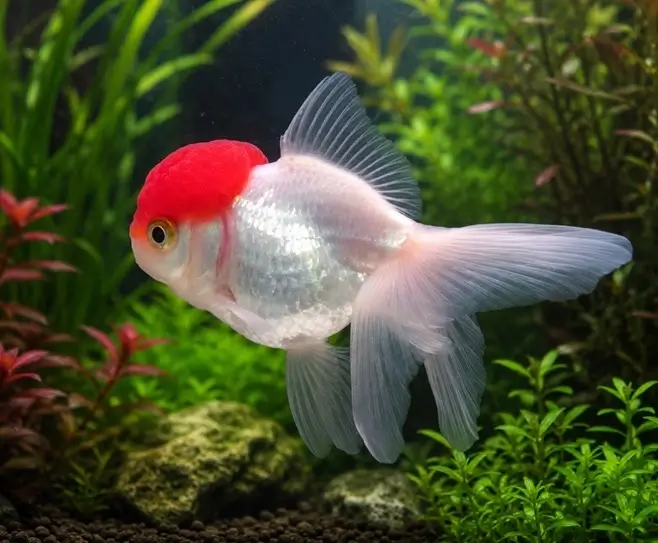
The contrast between the vivid red head growth and snowy white body makes this variety especially popular among beginners and experienced keepers alike.
Read more: Red Cap Oranda Goldfish Guide
Blue Oranda
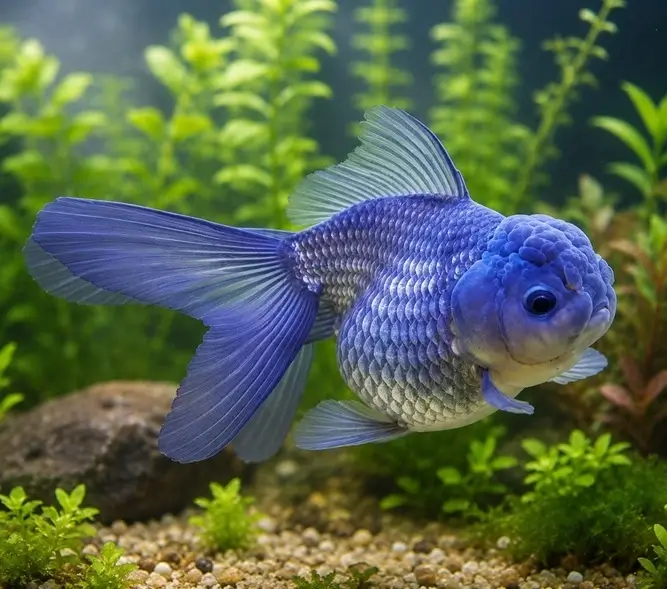
The Blue Oranda is admired for its steel-blue or slate-gray coloration. Its color is created by a complex interaction between pigmentation and light reflected from specialized cells beneath the scales, making it one of the most fascinating Oranda varieties.
Read more: Blue Oranda Goldfish Guide
Black Oranda
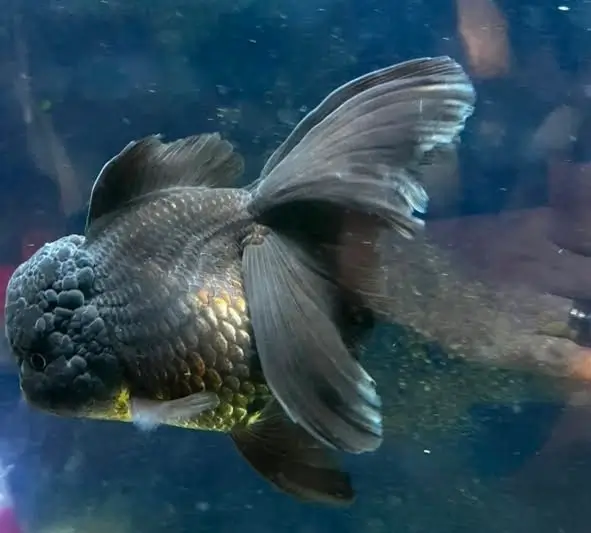
Black Orandas display deep metallic black or charcoal-gray coloration over most or all of the body. High-quality specimens maintain rich, even pigmentation, although some individuals gradually lighten as they mature.
Read more: Black Oranda Goldfish Guide
Chocolate Oranda
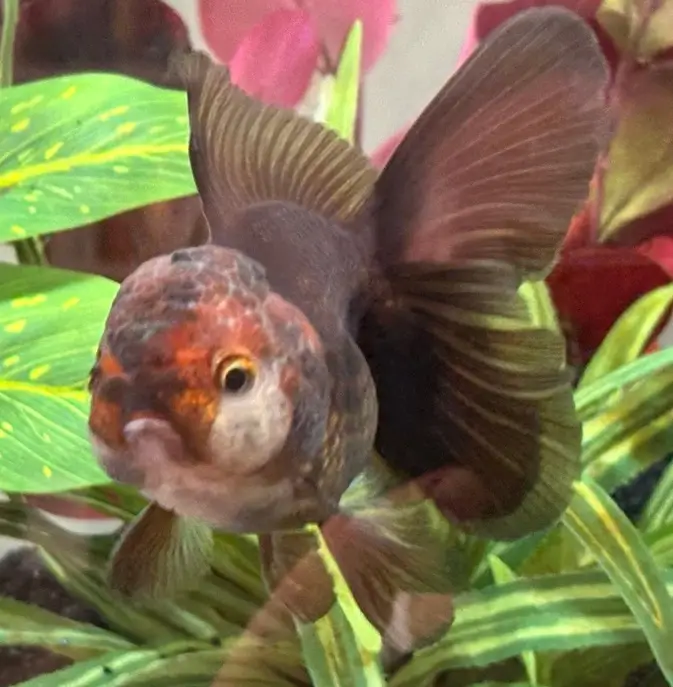
Chocolate Orandas exhibit warm bronze, coffee, or copper-brown coloration. Their unusual metallic sheen gives them a distinctive appearance that stands apart from more traditional goldfish colors.
Calico Oranda
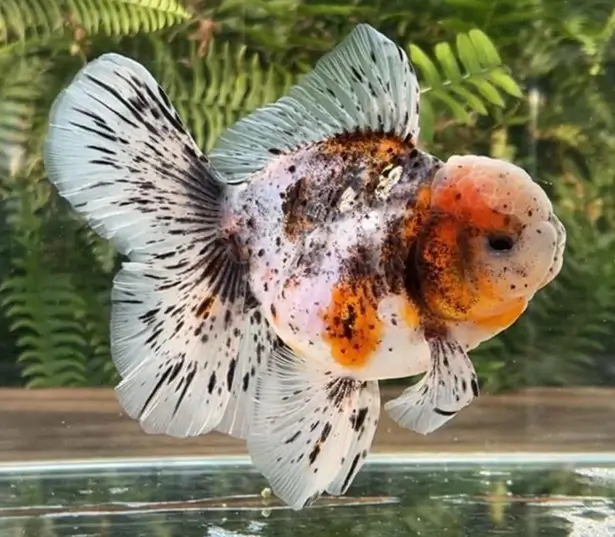
The Calico Oranda, also known as Azumanishiki, combines red, orange, black, white, blue, and sometimes yellow across nacreous scales. Every fish develops a unique mosaic-like pattern, making this one of the most colorful Oranda varieties.
Read more: Red Cap Oranda Goldfish Guide
Panda Oranda
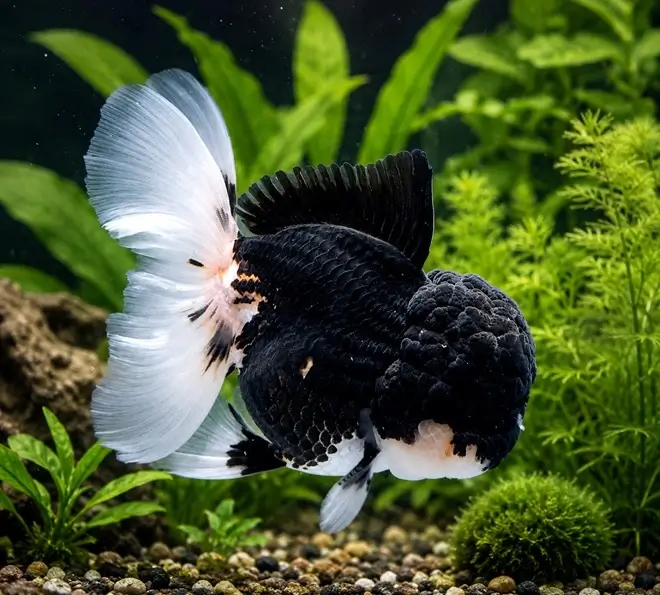
The Panda Oranda features striking black-and-white markings resembling those of a giant panda. Although highly sought after, this color pattern is one of the least genetically stable, with many fish changing color as they mature.
Read more: Panda Oranda Goldfish Guide
Tiger Oranda
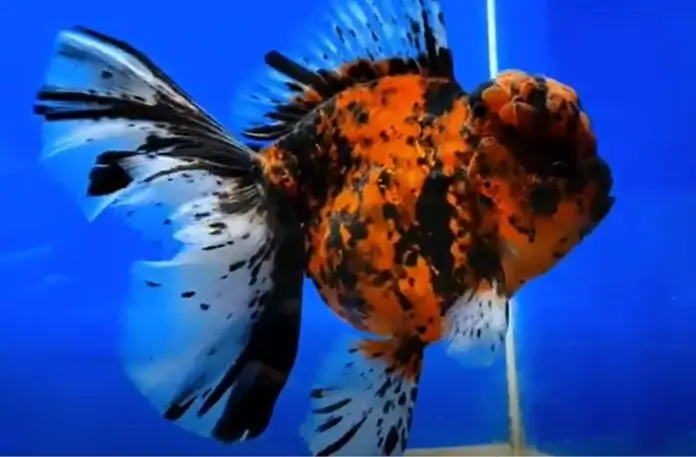
The Tiger Oranda displays mottled or striped markings that combine black, orange, white, and red pigmentation. The exact pattern varies greatly between individuals, making every fish look slightly different.
Sakura Oranda
Named after the Japanese cherry blossom, the Sakura Oranda carries a soft red-and-white pattern set against transparent or matte scales rather than the bold metallic look of a standard Red & White Oranda. That transparent scale type is what earns it the Sakura name, the same color pattern on metallic scales would simply be called Red & White. Sakura coloring is genetically tied to Calico bloodlines, it can emerge when a Calico Oranda’s black pigment fades away, leaving the softer red-and-white pastel look behind.
Did You Know?
Many Oranda color varieties continue changing throughout the first two or three years of life. Blue, Panda, Black, and Chocolate Orandas are especially well known for undergoing gradual color transformations as they mature.
Oranda Goldfish By Body Types
Although all Orandas belong to the same breed, hobbyists generally recognize two main body types. These differences are largely the result of selective breeding rather than separate varieties.
Short-bodied Oranda
Short-bodied Orandas have a compact, rounded body with a deep belly and short back. This body style produces the classic “cute” appearance seen in many modern Thai Orandas and Ingot Orandas.
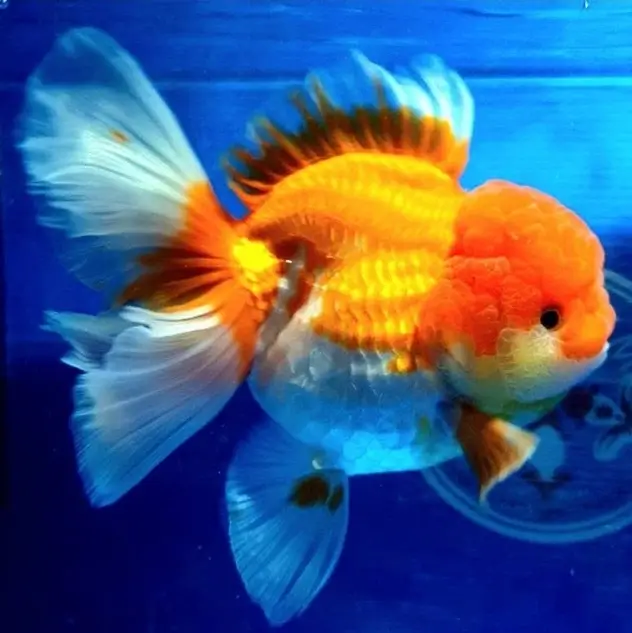
Their compact build often supports exceptionally large wens, although the shortened body can make them slightly more susceptible to buoyancy problems if overfed.
Long-bodied Oranda
Long-bodied Orandas retain the breed’s characteristic rounded shape but have a noticeably longer and more streamlined body. They generally swim more efficiently and often develop a slightly more balanced appearance as adults.
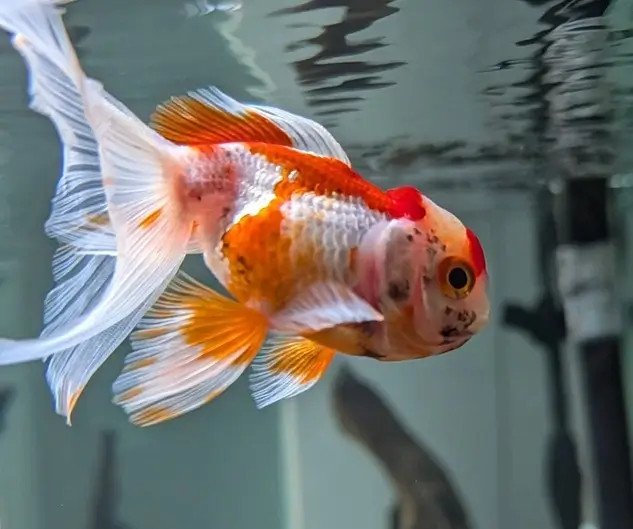
Japanese Nagate Orandas are among the best-known examples of this body type.
Popular Oranda Goldfish Types by Bloodlines
Beyond color and body shape, serious breeders also distinguish Orandas by bloodline. Different breeding programs emphasize specific characteristics such as wen size, body proportions, swimming posture, or overall balance.
Thai Oranda
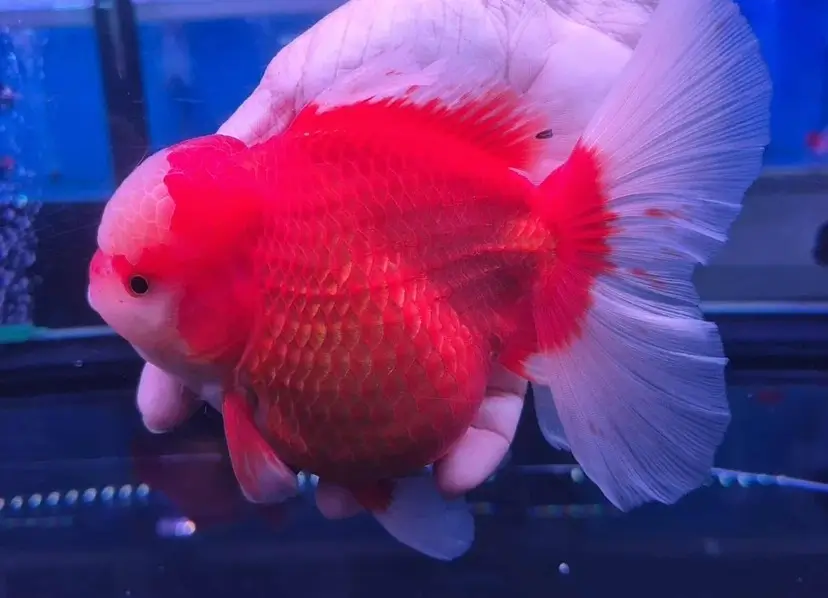
Thai Orandas are famous for their enormous wens, compact body shape, and dramatic appearance. Many of today’s show-quality short-bodied Orandas originate from Thai breeding programs.
Chinese Oranda
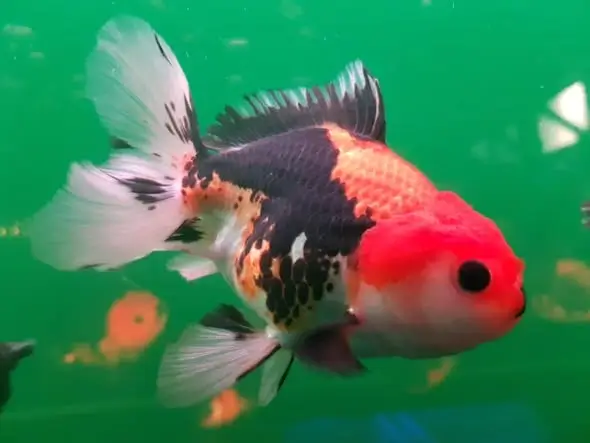
Chinese Orandas represent some of the oldest breeding lines and generally display a more traditional body shape with balanced proportions and steady wen development.
Japanese Oranda
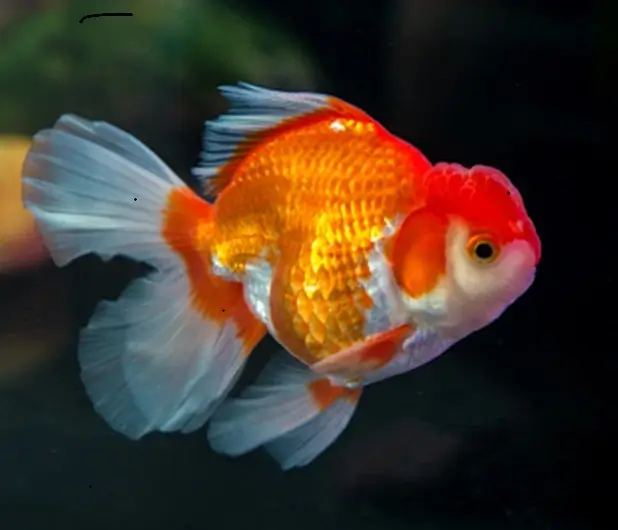
Japanese breeders have long emphasized elegance, symmetry, and graceful swimming ability. Many Japanese bloodlines produce beautifully proportioned fish with refined body shape and excellent fin carriage rather than focusing solely on oversized wens.
Oranda Goldfish Growth & Development
One of the most rewarding aspects of keeping an Oranda Goldfish is watching it transform over time. Juveniles often look surprisingly plain compared to mature adults, with small head growth, lighter coloration, and a slimmer body. Over the next few years, their body deepens, the wen expands, colors continue developing, and the fish gradually acquires the impressive appearance that makes Orandas one of the world’s most admired fancy goldfish.
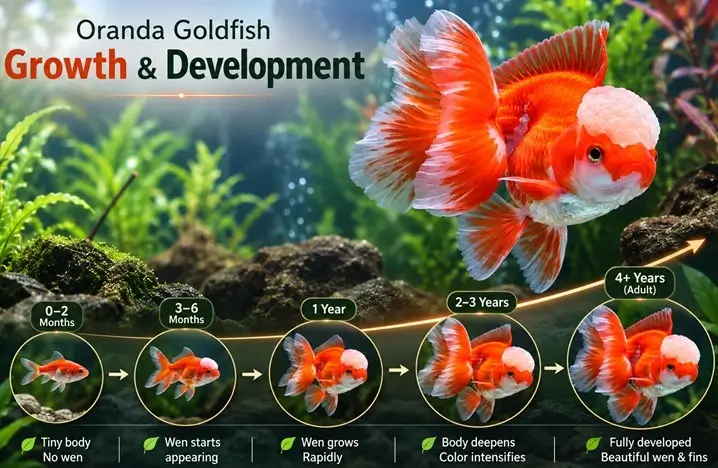
Growth rate depends on genetics, nutrition, water quality, and available swimming space. Fish raised in spacious aquariums or ponds with excellent care generally reach their full potential much faster than those kept in cramped or poorly maintained environments.
How Fast Do Oranda Goldfish Grow?
Young Orandas grow rapidly during their first year of life, especially when provided with high-quality food and excellent water conditions. Growth gradually slows as the fish approaches adulthood, although subtle body changes and wen development often continue for several more years.
While every fish grows at its own pace, most healthy Orandas reach much of their adult body size within two to three years before continuing to mature more slowly.
When Does the Wen Fully Develop?
Most juvenile Orandas show little or no obvious head growth during their first few months. The wen usually begins appearing between 3 and 6 months of age, expands rapidly during the first two years, and may continue thickening until the fish is four or even five years old.
This gradual development explains why experienced hobbyists rarely judge the quality of an Oranda solely by its appearance as a young fish.
How Big Do Oranda Goldfish Get?
Most adult Oranda Goldfish grow between 6 and 8 inches (15–20 cm) in length, although exceptional individuals like Thai Oranda can grow upto 12 inches in size.
Body depth increases significantly as the fish matures, giving adult Orandas their characteristic rounded appearance. Large bloodlines, particularly some pond-raised specimens, often develop thicker bodies and more substantial head growth than aquarium-raised fish.
Did You Know?
An adult Oranda’s final appearance depends on much more than its length. Body depth, tail size, wen development, and overall balance are often more important than simply measuring how many inches the fish has grown.
Oranda Goldfish Lifespan
With proper care, Oranda Goldfish are surprisingly long-lived. Most healthy individuals live between 10 and 20 years, while exceptionally well-maintained fish occasionally exceed two decades.
Genetics certainly influences longevity, but husbandry plays an even larger role. Stable water quality, excellent filtration, a nutritious diet, and adequate swimming space all contribute to a longer, healthier life.
Factors That Influence Lifespan
➜Excellent water quality and biological filtration.
➜A spacious aquarium that allows natural swimming behavior.
➜A balanced omnivorous diet with quality sinking foods.
➜Regular maintenance and consistent water changes.
➜Keeping compatible fancy goldfish companions.
➜Prompt treatment of injuries and disease.
Can Oranda Goldfish Live in Ponds?
Yes, Orandas can live successfully in outdoor ponds in suitable climates, provided water quality remains excellent and temperatures stay within their preferred range. However, because of their flowing fins, slower swimming speed, and prominent wen, they are generally more vulnerable than single-tailed goldfish to predators and competition for food.
Many keepers therefore choose to house their finest Orandas indoors, where environmental conditions are easier to control throughout the year.
Do Oranda Goldfish Change as They Age?
Absolutely. In fact, one of the defining characteristics of the breed is that adults often look dramatically different from juveniles. Color patterns continue evolving, the wen becomes larger and more textured, the body deepens, and the fins appear increasingly elegant as the fish matures.
This continuous development is part of what makes Orandas so fascinating to keep. Rather than remaining static throughout life, each fish gradually develops its own unique appearance that reflects both its genetics and the care it receives.
Oranda Goldfish Care Overview
Although Orandas are considered one of the hardier fancy goldfish, their rounded body, flowing fins, and fleshy head growth mean they have slightly different care requirements than single-tailed goldfish. Good water quality, proper nutrition, and a spacious aquarium allow them to develop their best body shape, vibrant colors, and impressive wen.
Aquarium Size
Orandas require considerably more swimming space than many beginners expect. Although juveniles are often sold at only a few inches long, healthy adults commonly reach 6–8 inches and develop deep, rounded bodies.
➜ One Oranda: Minimum 30 gallons (115 L).
➜ Each additional Oranda: Add approximately 20 gallons (75 L).
➜ A larger aquarium provides greater swimming space, more stable water parameters, and allows the fish to reach its full growth potential.
Water Parameters
Stable water quality is far more important than chasing exact numbers. Orandas tolerate a fairly wide range of conditions, but sudden fluctuations can weaken their immune system and increase the risk of disease.
➜ Temperature: 68–79°F (20–26°C).
➜ Treatment Temperature: Up to 80.6°F (27°C) may be used temporarily during certain disease treatments under appropriate conditions.
➜ pH: 7.0–8.0.
➜ Ammonia: 0 ppm.
➜ Nitrite: 0 ppm.
➜ Nitrate: Ideally below 20–40 ppm through regular maintenance.
Filtration
Orandas produce a surprising amount of waste, making efficient filtration one of the most important aspects of their care. A properly cycled filter keeps ammonia and nitrite at zero while maintaining high oxygen levels throughout the aquarium.
➜ Choose a filter rated for more than the aquarium’s actual volume.
➜ Strong biological filtration is more important than excessive water flow.
➜ Avoid powerful currents that force slow-swimming Orandas to struggle continuously.
Substrate & Decorations
Decorations should enhance the aquarium without creating injury risks for the fish’s delicate fins or wen.
➜ Fine gravel or smooth sand both work well.
➜ Avoid sharp rocks and rough decorations that may damage the wen or fins.
➜ Leave generous open swimming areas while using decorations mainly around the edges of the aquarium.
Live Plants
Many hobbyists assume goldfish destroy every plant they encounter, but several hardy species perform surprisingly well with Orandas.
➜ Anubias.
➜ Java Fern.
➜ Java Moss.
➜ Hornwort.
➜ Vallisneria (may occasionally be nibbled).
These plants tolerate cooler temperatures and generally withstand occasional grazing much better than delicate stem plants.
Diet
A varied diet supports healthy growth, vibrant coloration, and proper wen development. Because Orandas are prone to buoyancy issues, sinking foods are generally preferred over floating foods.
➜ High-quality sinking pellets should form the staple diet.
➜ Supplement with blanched vegetables such as peas, spinach, zucchini, and broccoli.
➜ Offer protein-rich treats such as bloodworms, brine shrimp, or daphnia in moderation.
➜ Feed small portions two to three times daily rather than one large meal.
Tank Mates
Orandas are peaceful, slow-moving fish that do best with companions that swim at a similar pace.
➜ Best companions include other fancy goldfish such as Fantails, Ryukins, Pearlscales, Telescope Goldfish, and Ranchus.
➜ Avoid fast single-tailed goldfish like Commons and Comets, which often outcompete Orandas during feeding.
➜ Avoid aggressive or fin-nipping tropical fish.
Quick Tip
Orandas thrive on consistency. Stable water quality, regular maintenance, and a balanced diet will have a much greater impact on their health than constantly adjusting water chemistry or experimenting with different foods.
Buying an Oranda Goldfish
Whether you’re purchasing your first Oranda or adding another fish to an established collection, choosing a healthy specimen is far more important than selecting the brightest color. Young Orandas often change dramatically as they mature, while a fish with excellent body structure and genetics will usually remain attractive throughout its life.
Many beginners focus entirely on color, only to discover that their beautiful juvenile develops a completely different appearance as it grows. Experienced hobbyists instead evaluate body shape, swimming posture, wen quality, and overall health before considering color.
How to Choose a Healthy Oranda
Before purchasing an Oranda, spend a few minutes observing the fish carefully.
➜ The fish should swim confidently without floating, sinking, or struggling to maintain balance.
➜ The dorsal fin should remain fully erect while swimming.
➜ Both eyes should appear clear and free from cloudiness.
➜ The body should look symmetrical with no bent spine or deformities.
➜ Fins should be fully open without tears, fraying, or white edges.
➜ The wen should appear clean with no cotton-like growths, ulcers, or trapped debris.
➜ The fish should actively search for food and respond to movement outside the aquarium.
Choosing Juveniles vs Adults
Juvenile Orandas are generally less expensive and offer the satisfaction of watching the fish develop over time. However, predicting their final color, body shape, and wen size can be difficult because many traits continue changing during the first few years.
Adult Orandas provide much greater certainty. Their body proportions, coloration, and head growth are already well established, allowing buyers to know exactly what they are purchasing.
Buying Tip
If your goal is to own a spectacular adult Oranda, never choose a fish based solely on its juvenile coloration. Genetics determine how the fish will ultimately develop, and body quality is usually a much better indicator of future potential than color alone.
What Makes a Show-Quality Oranda?
Exhibition-quality Orandas are judged on overall balance rather than a single feature. A fish with an enormous wen but poor body shape will not score as highly as one with excellent proportions throughout.
➜ Deep, well-balanced egg-shaped body.
➜ Smooth back profile without deformities.
➜ Symmetrical, evenly developed wen.
➜ Broad, flowing double tail held correctly while swimming.
➜ Fully erect dorsal fin.
➜ Strong, confident swimming posture.
➜ Bright, healthy coloration appropriate for the variety.
How Much Does an Oranda Goldfish Cost?
The Oranda Goldfish price varies considerably depending on its age, size, bloodline, color variety, and overall quality.
| Quality | Typical Price (USD) |
|---|---|
| Pet Store Juveniles | $15–40 |
| Good Quality Hobby Fish | $40–100 |
| Premium Imported Fish | $100–300+ |
| Show Quality Specimens | $300 to several thousand dollars |
Rare color varieties such as Blue, Panda, or exceptional Thai Orandas often command significantly higher prices than standard Red & White specimens, particularly when they come from well-known breeding lines.
Common Mistakes New Oranda Owners Make
Most problems experienced by new Oranda keepers are caused by husbandry mistakes rather than disease. Fortunately, these are usually easy to avoid.
➜ Keeping Orandas in bowls or undersized aquariums.
➜ Mixing them with fast-swimming Common or Comet Goldfish.
➜ Feeding only floating pellets, increasing the risk of buoyancy problems.
➜ Neglecting regular water changes.
➜ Choosing fish based only on color instead of overall health and body quality.
➜ Assuming the wen will stop growing after the first year.
➜ Expecting juvenile coloration to remain unchanged throughout adulthood.
Remember
The healthiest Orandas aren’t always the most colorful juveniles. Excellent body structure, balanced proportions, active behavior, and strong genetics almost always produce a more impressive adult fish than color alone.
Frequently Asked Questions
How big do Oranda Goldfish get?
Most adult Oranda Goldfish grow between 6 and 8 inches (15–20 cm) in length. Under excellent conditions, particularly in large aquariums or outdoor ponds, some individuals can grow even larger while developing deeper bodies and more impressive wens.
How long do Oranda Goldfish live?
With proper care, Oranda Goldfish typically live 10 to 20 years. Excellent water quality, a nutritious diet, regular maintenance, and a spacious aquarium all contribute to a long and healthy life.
Are Oranda Goldfish good for beginners?
Yes. Although they require more care than Common or Comet Goldfish, Orandas are peaceful, hardy, and suitable for beginners who understand the importance of aquarium cycling, proper filtration, and regular water maintenance.
Do Oranda Goldfish need a heater?
In most homes, Orandas do not require a heater if the aquarium remains between 68 and 79°F (20–26°C). However, a heater can help maintain stable temperatures in colder climates or rooms where temperatures fluctuate significantly.
Can Oranda Goldfish live with other goldfish?
Yes. Orandas do best with other fancy goldfish that have similar swimming abilities, such as Ranchus, Fantails, Ryukins, Pearlscales, Telescope Goldfish, and Lionheads. Fast-swimming Common and Comet Goldfish should generally be avoided because they often outcompete Orandas during feeding.
Can Oranda Goldfish live in ponds?
Yes, provided the pond offers excellent water quality, adequate depth, and protection from predators. Because Orandas swim more slowly and have delicate fins and wens, many hobbyists prefer keeping valuable specimens indoors where environmental conditions are easier to control.
Why is my Oranda’s wen getting bigger?
This is usually a normal part of growth. The wen develops gradually as the fish matures, with most growth occurring during the first two years. Genetics largely determine its final size, while proper nutrition and good water quality help the fish reach its full potential.
Why is my Oranda changing color?
Many Orandas naturally change color as they age. Varieties such as Blue, Panda, Chocolate, and Black Orandas are particularly well known for developing different shades over time. These changes are usually driven by genetics rather than poor care.
How often should I feed an Oranda Goldfish?
Most adult Orandas do well when fed two or three small meals each day. High-quality sinking pellets should form the staple diet, supplemented with vegetables and occasional protein-rich treats.
What is the rarest Oranda Goldfish?
Several Oranda varieties are considered uncommon, including high-quality Blue Orandas, Panda Orandas, Chocolate Orandas, and exceptional Thai bloodlines with outstanding wen development. Their rarity often depends on genetics, breeding quality, and demand within the hobby.
Final Thoughts
The Oranda Goldfish has earned its reputation as one of the world’s most admired fancy goldfish through centuries of careful selective breeding. From its graceful swimming style and flowing double tail to its unmistakable wen, every feature contributes to a fish that is both elegant and full of personality.
Whether you prefer the classic Red Cap, the striking Panda, the metallic Blue, or one of the many other beautiful varieties, all Orandas share the same peaceful temperament and rewarding long-term companionship. With proper care, stable water conditions, and a balanced diet, these remarkable fish can thrive for many years while continuing to develop in both size and appearance.
If you’re considering adding an Oranda Goldfish to your aquarium, focus on choosing a healthy fish with good body structure rather than selecting one based solely on its juvenile color. As experienced keepers know, an Oranda’s true beauty often continues unfolding for years.
Explore More Oranda Varieties
➜Red Cap Oranda Goldfish
➜Blue Oranda Goldfish
➜Panda Oranda Goldfish
➜Black Oranda Goldfish
➜Calico Oranda Goldfish

Comment