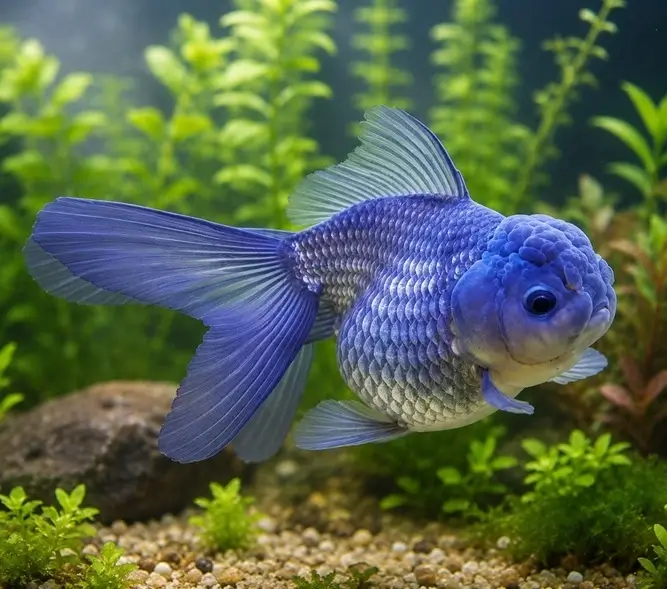
A goldfish that’s truly blue, rather than orange, red, or white, tends to stop people in their tracks, and the Blue Oranda Goldfish is one of the few fancy goldfish varieties that pulls it off convincingly. Like every other Oranda color, it isn’t a separate breed, it’s the same rounded-body, wen-headed Oranda everyone knows, carrying a color that most fish simply can’t produce.
Quick Answer: A Blue Oranda is a color variety of the Oranda Goldfish (Carassius auratus), showing a slate to steel-blue coloring that develops gradually, most start out light gray as juveniles and deepen into blue with age. They typically grow 6 to 8 inches, live 10 to 15 years, and are moderately difficult to keep. Blue coloring in goldfish comes from a combination of reduced dark pigment and a reflective layer beneath the scales, not a dedicated “blue pigment” the way red or orange color works, which is part of why the shade is uncommon and can shift over a fish’s lifetime.
Blue Oranda: Quick Facts
| Characteristic | Details |
|---|---|
| Scientific Name | Carassius auratus |
| Breed | Oranda Goldfish (color variety) |
| Japanese Name | Seibungyo or Seibun |
| Color | Slate to steel blue, sometimes lavender-tinged |
| Adult Size | 6–8 inches |
| Lifespan | 10–15 years |
| Difficulty | Moderate |
| Tank Size | 30 gallons minimum for one fish |
| Temperature | 65–75°F (18–24°C) |
| Diet | Omnivore |
| Price | $40–200+, depending on shade quality and size |
Quick Navigation
➜ Quick Facts
➜ What Is a Blue Oranda?
➜ Are Blue Oranda Goldfish Real or Fake?
➜ Appearance and Identification
➜ The Science Behind Blue Color
➜ Why Do Blue Orandas Change Color?
➜ Blue Oranda vs Black Oranda
➜ Buying Guide
➜ Blue Oranda Price
➜ Care Overview
➜ Frequently Asked Questions
What Is a Blue Oranda?
The Blue Oranda is a color variety of the Oranda Goldfish, not a separate breed. Every physical trait, the rounded body, the fleshy wen, the double tail, is identical to any other Oranda. What sets it apart is a truly rare color for a goldfish, a slate to steel-blue that ranges from a light bluish-gray to a deep, almost navy shade depending on the individual fish. Our Fancy Goldfish Types guide covers where Oranda and its many color varieties fit among the wider range of fancy goldfish.
Blue coloring emerged from the same centuries of selective breeding that produced every other Oranda color, and it remains one of the less common shades, most breeding programs naturally favor the brighter reds, oranges, and whites that are easier to stabilize and simpler to sell.
Are Blue Oranda Goldfish Real or Fake?
They’re absolutely real, a genuine, documented Oranda color variety, known in Japan as Seibungyo or Seibun, not a photoshopped or artificially colored fish. The confusion usually comes from the name itself, “blue” suggests a vivid, sky-blue fish, but the actual color is more subdued: a dusky, metallic gray-blue or silver-blue rather than a saturated bright blue. A photo showing an unusually vivid, uniform blue can be genuine under the right lighting, covered in the Science section below, but it’s also worth knowing the difference between this natural variety and actual dyed fish, a separate, real problem elsewhere in the aquarium trade.
➜ Dyed or “painted” fish are a genuine practice — some sellers inject unrelated species, most infamously certain tetras and glassfish, with artificial dye to create unnaturally vivid colors, this is a real, documented issue, but it’s a different fish and a different problem entirely from a legitimate Blue Oranda
➜ Dye fades unevenly, natural color doesn’t — an injected or dyed fish typically shows patchy fading, pale injection marks, or a color that looks flat and uniform in a way real biological pigmentation rarely does
➜ A real Blue Oranda has natural variation — different intensity across the body, a metallic sheen that shifts with light and angle, and the same wen and body traits as any other Oranda, rather than a single flat, unnatural shade
➜ Buy from a reputable breeder or seller — the surest way to avoid the (unrelated) dyed-fish problem entirely, and to get a fish whose color is what its genetics actually produced
Appearance and Identification
Blue Orandas aren’t a single uniform shade, the color varies noticeably from fish to fish and can shift as an individual matures.
➜ Slate blue — a muted, grayish-blue, the most common shade seen
➜ Steel blue — a slightly deeper, more saturated version
➜ Gray-blue — closer to the juvenile coloring many Blue Orandas start with before deepening
➜ Lavender-blue — a rarer, slightly purple-tinged variation
➜ Metallic sheen — most Blue Orandas carry a reflective, almost shimmering quality to the color rather than a flat, matte tone
➜ Wen — the same fleshy head growth found on every Oranda, sometimes a visibly different shade from the rest of the body
➜ Double tail — flows into a broad fan shape at rest, identical in structure to any other Oranda
➜ Adult size — typically 6 to 8 inches
The Science Behind Blue Color
Most Blue Oranda content covers the color without explaining what actually produces it, and it’s more interesting, and more complicated, than most people expect.
Blue Isn’t Produced the Way You’d Think
Fish skin does contain a genuine blue-pigment cell type, called a cyanophore, alongside the more familiar melanophores (black), xanthophores (yellow), and erythrophores (red). So blue in fish isn’t purely an illusion the way it often is in birds or butterflies, where blue is created entirely by light bouncing off microscopic structures with no blue pigment involved at all. That said, the specific slate or steel-blue seen in goldfish is generally understood to come from a different, related mechanism, not a saturated, dedicated blue pigment cell dominating the color.
Structural Coloration and Light Scattering
Underneath a goldfish’s scales sits a layer of iridophores, cells packed with crystalline guanine platelets that reflect light rather than absorbing it. This same layer is responsible for the shiny, metallic look seen across many goldfish varieties. When there’s dark pigment sitting over that reflective guanine layer, the eye reads it as black. When that dark pigment is diluted or reduced rather than absent entirely, the guanine reflection shows through as a smoky gray-blue instead, similar to how a genetic dilution produces “blue” coloring in cats or dogs, a lightened, diffused version of black rather than a true, separate blue pigment taking over.
Scale Type and Pigment Interactions
Metallic-scaled goldfish, which most Blue Orandas are, carry this guanine layer prominently, while nacreous or matte-scaled fish show it far less. The final color depends on the interaction between how much guanine reflection is present and how much (and which type of) pigment sits above it, which is why two Blue Orandas can show noticeably different shades even from a similar bloodline.
Genetics
Like wen size, blue coloring is understood as a polygenic trait rather than something controlled by one clean genetic switch, shaped by multiple genes affecting melanophore density and guanine deposition together. That’s part of why stable, consistent blue coloring is noticeably harder to breed true than more common colors, and why breeders who can reliably produce a deep, even steel-blue tend to charge a premium for it.
Why Does the Same Fish Look Different Under Different Lights?
If your Blue Oranda looks bright steel blue during the day but gray in the evening, that’s not your imagination. Since the color depends partly on reflected light rather than a saturated, dedicated pigment, different lighting conditions really do change how the fish appears.
➜ Cool white LED lighting — tends to enhance blue tones
➜ Warm lighting — tends to make the fish look gray or bronze instead
➜ Natural sunlight — can reveal subtle lavender or silver highlights not visible under artificial light
➜ Viewing angle — also changes how much reflected light reaches your eyes
This is also why photos of Blue Orandas often look noticeably different from the same fish seen in person, the camera and lighting setup both affect how much of that reflected color comes through.
Can Breeders Create Stable Blue Bloodlines?
Selective breeding has improved Blue Orandas considerably over many generations, but producing consistently blue offspring remains a real challenge. Color inheritance involves multiple genes rather than one single “blue gene,” and every spawning still produces natural variation. Some bloodlines reliably produce a higher percentage of blue juveniles than others, but even experienced breeders expect real differences in shade, metallic sheen, and long-term color stability among individual fish from the same spawning.
Did You Know?
A Blue Oranda doesn’t actually become blue because of blue pigment taking over. Its color comes from the interaction of dark pigment, reflective cells, and light, which is exactly why the same fish can look noticeably different every time the lighting changes.
Why Do Blue Orandas Change Color?
Color instability runs through nearly every Oranda variety, and Blue is no exception. Many hobbyists buy a beautiful steel-blue juvenile only to find the fish gradually turns gray, bronze, black, or even develops orange tones as it matures. This doesn’t usually mean anything is wrong, in most cases it’s a normal part of development driven largely by genetics, though age, lighting, diet, and overall health can all influence how noticeable the change becomes. Experienced keepers never judge a Blue Oranda purely by its juvenile coloring, since the adult fish can look quite different.
Why Does a Blue Oranda Turn Gray?
Gray is one of the most common outcomes in mature Blue Orandas, in fact, many fish sold under that name display shades of gray rather than a vivid blue at all. This happens because the reflective effect behind the blue coloring gradually shifts as the fish grows, small changes in pigment distribution, skin thickness, and scale reflectivity make the same fish look increasingly gray over time. The transition is usually slow, playing out over months or years rather than overnight.
Why Do Some Blue Orandas Become Bronze?
Bronze is another common transformation. As dark pigmentation decreases and the underlying yellow or orange pigments become more visible, a fish can develop a warm bronze or copper cast. This is usually genetic rather than a health concern, and many breeders actually expect some degree of bronze development in certain bloodlines as the fish matures.
Can a Blue Oranda Turn Black?
Yes. Some individuals develop darker pigmentation as they grow, especially around the back, fins, or head, as melanin production increases in those areas. This varies considerably from fish to fish and depends mostly on genetics rather than tank conditions.
Can a Blue Oranda Turn Orange?
Less commonly, yes. Some Blue Orandas develop orange or gold patches as they mature, as underlying carotenoid pigments become more visible while the reflective blue effect weakens. Some fish only pick up a few orange scales, others undergo a much more dramatic shift over several years.
Can a Blue Oranda Lose Its Blue Color Completely?
Yes, some individuals gradually lose nearly all trace of their original blue, ending up predominantly gray, bronze, or a mixed pattern that looks nothing like the juvenile that was originally purchased. It can catch first-time owners off guard, but it’s a normal outcome for many bloodlines rather than a sign of poor care.
Can the Blue Color Return?
Usually, no. If the shift was driven by normal genetic development, the original blue rarely comes back once it’s faded. Temporary dullness caused by lighting or stress can improve, but a permanent genetic color change generally doesn’t reverse. This is exactly why experienced keepers weigh body shape, wen quality, and overall health more heavily than assuming a juvenile’s current color is permanent.
What Causes Blue Orandas to Change Color Faster?
Genetics plays the dominant role, but several other factors influence how quickly a change becomes visible.
➜ Age — most color changes happen during the first two to three years
➜ Genetics — some bloodlines hold their blue coloring far longer than others
➜ Lighting — different lighting dramatically changes how the fish appears, covered in more depth above
➜ Diet — proper nutrition supports healthy pigmentation but can’t override genetics
➜ Water quality — poor conditions can dull existing color
➜ Stress — chronic stress or illness can temporarily reduce color intensity
Excellent care helps a Blue Oranda display its best possible color, but it can’t permanently prevent a genetically programmed change.
Can You Prevent Color Changes?
No, there’s no food, supplement, or treatment that permanently locks in a fish’s original blue if its genetics are set to shift with age. A healthy diet, stable water, and good lighting let the fish show its best natural color, but they can’t stop the underlying biological process. Most experienced keepers stop trying to preserve one particular shade and instead appreciate that no two Blue Orandas develop exactly the same way, which is part of what makes each adult fish one of a kind.
Blue Oranda vs Black Oranda
Both trace back to the same underlying pigment cells, but Black Oranda has full, undiluted melanophore density producing a true solid black, while Blue Oranda has that same dark pigment diluted, letting the guanine layer show through as blue-gray instead. Black tends to be one of the more stable Oranda colors once established, less likely to fade later in life than several other varieties.
Buying Guide
Color matters less here than most buyers expect. Since Blue Oranda coloring can and often does shift with age, body quality, swimming ability, and overall health are better indicators of long-term value than the exact shade in front of you right now.
➜ Watch how the fish swims — steady posture, a fully extended dorsal fin, and smooth, coordinated movement without floating, rolling, or struggling to stay upright
➜ Examine the wen closely — should be evenly developed, with a clean appearance and no ulcers, fungal patches, injuries, or excess mucus
➜ Check body symmetry — a deep, rounded body with smooth curves, balanced when viewed from above, avoid a curved spine, sunken abdomen, red sores, or missing scales
➜ Don’t buy on color alone — many beginners automatically pick the darkest blue fish in the tank, but remember Blue Orandas frequently change color as they mature, a fish with strong body shape is usually the better long-term investment
➜ Inspect the fins — fully spread, no tears, no white edges, no signs of fin rot, and both pectoral fins moving evenly
➜ Ask about the bloodline — many high-quality Blue Orandas come from specialist breeders in Thailand, China, and Japan, though never assume an imported fish is automatically better than a healthy domestically bred one that hasn’t just been through international shipping stress
➜ Watch a video before buying if you can — footage reveals swimming posture and balance far better than a still photo, and those qualities matter even after the color eventually changes
Blue Oranda Price
| Grade | Typical Price |
|---|---|
| Juvenile (color not yet set) | $20–$40 |
| Standard adult | $40–$80 |
| Deep, stable steel-blue | $80–$150 |
| Show quality | $150–$300+ |
Blue Oranda price typically cost more than the common colors, red, orange, or white, simply because stable blue coloring is harder to breed consistently, making truly blue individuals rarer in the supply chain.
Care Overview
Blue Oranda care follows the same requirements as any other Oranda: a minimum 30-gallon tank, stable temperatures between 65 and 75°F, gentle filtration with low current, a varied omnivore diet, and consistently clean water to protect both the wen and the fish’s color quality. For the full detailed breakdown, tank setup, water parameters, tankmates, and diet, see our Oranda goldfish guide, and for common Oranda health issues, our Goldfish Swimming Upside Down and Goldfish at the Top of the Tank guides cover the two most common problems in this body shape specifically.
Frequently Asked Questions
Are Blue Orandas rare?
Yes, relatively. Stable blue coloring is noticeably harder to breed consistently than red, orange, or white, so truly blue individuals make up a smaller share of the overall Oranda supply, which is also why they tend to cost more.
Why is my Blue Oranda turning black?
This usually means the fish’s melanin production is increasing rather than staying diluted, shifting the color from blue-gray toward true black over time. It’s a genetic color drift rather than a health problem on its own, though our Goldfish Turning Black guide is worth checking if it happens suddenly rather than gradually.
Why is my Blue Oranda turning bronze?
Some Blue Orandas naturally drift toward a bronze or brownish cast as part of the same underlying color instability that affects most Oranda varieties. If the fish is otherwise healthy and the change is gradual, it’s simply normal color drift rather than a symptom of illness.
How big do Blue Orandas get?
Most reach 6 to 8 inches in a home aquarium, following the same growth pattern as any other Oranda color variety.
Can Blue Orandas breed with Red Caps?
Yes, they’re the same species and breed, just different color varieties, so there’s no biological barrier to crossing them. The resulting offspring’s coloring is unpredictable, though, since color genetics from both parents mix, and fry can end up blue, red, white, a mix, or something else entirely depending on which genes come through.
Do Blue Orandas stay blue?
Not always. Some hold a stable blue for life, while others drift toward black, bronze, or a flatter gray as they age, depending on the individual fish’s color genetics.
Final Thoughts
The Blue Oranda earns its appeal from genuine rarity, blue is one of the harder colors to produce and stabilize in a goldfish, and the result is a fish that looks distinctly different from the reds, oranges, and whites that dominate the hobby. It carries the same friendly, rounded Oranda temperament and the same care needs as any other color, just wrapped in a shade most goldfish simply can’t display. For more on the wider Oranda color family, see our Oranda goldfish guide.
Explore More Oranda Varieties