
Over the many years, selective breeding has produced many different goldfish types, especially among fancy varieties. These range from the familiar Common Goldfish and long-tailed Comet to fancy varieties such as Orandas, Ranchus, Ryukins, and Pearlscales.
These variations can be seen in body shape, fins, scales, eyes, head growth (wen), and nasal growths. These physical features are often more useful for identifying a goldfish than its color alone.
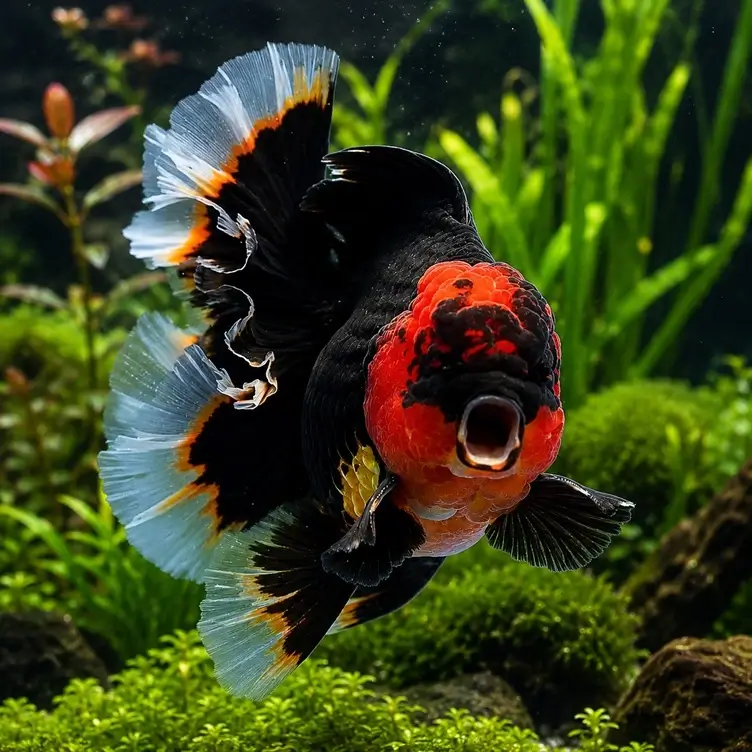
Some have long, streamlined bodies, while others are short and rounded. You will also notice differences in tail shapes, eye size, and whether they have a dorsal fin.
As breeders continued developing fancy goldfish, new strains with distinctive features emerged, and many became known by their own names. There are far more varieties and strains than we can cover in one article, so we have focused on 23 recognizable goldfish types with pictures, including some rare Japanese varieties.
Although people often call different goldfish types breeds or species, they all belong to the same species, Carassius auratus.
Quick Navigation
How to Identify Different Goldfish Types
The easiest way to identify a goldfish is to examine its physical features. Six features are particularly useful: body shape, fin variations, eye variations, scale types, head growth (wen), and nasal bouquets. Each goldfish variety may have a combination of these features.
1. Body Shape
Goldfish can have long, streamlined bodies, short rounded bodies, or deep bodies with prominent humps.
Common, Comet, and Shubunkin goldfish have streamlined bodies. Ranchus, Orandas, and Pearlscales generally have shorter, rounded bodies, while Ryukins have deep bodies and pronounced shoulder humps.
2. Fin Variations
The tail is one of the easiest features to examine. Goldfish may have single or double tails, which can be short, long, flowing, or deeply forked.
Common, Comet, and Shubunkin goldfish have single tails. Fantails, Veiltails, and most fancy varieties have double tails.
Some varieties have unusual tail shapes. The Jikin has a four-lobed Peacock tail that forms an X when viewed from behind, while the Tosakin has a broad tail with outer edges that curve forward.
The dorsal fin is another important clue. Ranchus, Lionheads, Lionchus, Bubble Eyes, and Celestial Eyes lack a dorsal fin. The standard Pompon variety also lacks one, although pompon growths can occur on other varieties.
3. Eye Variations
Most goldfish have normal eyes, but selective breeding has produced several unusual eye shapes.
Telescope Goldfish, including Black Moors and Butterfly Telescopes, have protruding eyes. Celestial Eyes have eyes that face upward, while Bubble Eyes develop delicate fluid-filled sacs beneath their eyes.
4. Scale Types
Goldfish generally have three main scale types:
Metallic: Shiny, reflective scales commonly seen in Common and Comet Goldfish.
Nacreous: A combination of reflective and translucent scales, often producing mottled calico patterns, as seen in Shubunkins.
Matte: Transparent scales without the metallic reflective shine. These fish may appear pale or pinkish, depending on their underlying pigmentation.
Pearlscale Goldfish have an additional distinctive feature: their scales are raised and dome-shaped, giving them a pearl-like appearance.
5. Head Growth (Wen)
Some fancy goldfish develop fleshy growths on their heads, commonly called a wen.
Orandas have a wen along with an upright dorsal fin. Ranchus, Lionheads, and Lionchus also develop head growths but lack dorsal fins.
The shape and extent of the wen can vary between varieties and individual fish.
6. Nasal Bouquets
Pompon Goldfish develop unusual fleshy, pom-pom-like extensions around their nostrils.
They are the defining feature of the standard Pompon variety, although similar growths can also occur in other fancy varieties, including Orandas and Telescope Goldfish.
Goldfish Types at a Glance
Here are 23 goldfish varieties and forms, with their most recognizable features. Click a name to jump to its description.
| Goldfish Type | Identification | Care Level |
|---|---|---|
| Single-tailed goldfish | ||
| Common Goldfish | Streamlined body, relatively short single tail | Beginner-friendly |
| Comet Goldfish | Streamlined body, long forked single tail | Beginner-friendly |
| Shubunkin Goldfish | Calico coloring, streamlined body and single tail | Beginner-friendly |
| Fancy and ornamental goldfish | ||
| Oranda | Fleshy head growth (wen), dorsal fin | Moderate |
| Ranchu | Arched back, wen, no dorsal fin | Moderate |
| Ryukin | Deep body with a pronounced shoulder hump | Beginner-friendly |
| Fantail | Broad, symmetrical double tail | Beginner-friendly |
| Black Moor | Black Telescope variety with protruding eyes | Moderate |
| Telescope | Distinctive protruding eyes | Advanced |
| Butterfly Telescope | Telescope eyes and butterfly-shaped tail | Advanced |
| Pearlscale | Rounded body with raised, pearl-like scales | Moderate |
| Lionhead | Prominent wen, flatter back, no dorsal fin | Moderate |
| Bubble Eye | Delicate fluid-filled sacs beneath the eyes | Advanced |
| Celestial Eye | Permanently upward-facing eyes, no dorsal fin | Advanced |
| Veiltail | Exceptionally long, flowing, square-edged tail | Moderate |
| Pompon | Distinctive fleshy nasal growths | Moderate |
| Tosakin | Broad tail that curves forward, best viewed from above | Advanced |
| Lionchu | Lionhead-style wen with a Ranchu-like back | Moderate |
| Wakin | Streamlined body with a divided double tail | Beginner-friendly |
| Watonai | Streamlined body with a long, flowing double tail | Moderate |
| Jikin | Distinctive four-lobed, X-shaped tail | Advanced |
| Izumo Nankin | Smooth, dorsal-less body and rounded tail | Advanced |
| Shukin | Dorsal-less body with a long, flowing tail | Advanced |
Note: The care levels are general guidelines, not official breed ratings. Even beginner-friendly goldfish need proper filtration and plenty of space. Some fish, such as Black Moor and Butterfly Telescope, are other forms of the same broader variety.
Common and Single-Tailed Goldfish Types
Common Goldfish, Comets, and Shubunkins have long, streamlined bodies and single tails. They are active swimmers, and all three need generous space as they grow large.
1) Common Goldfish
The Common Goldfish is the original goldfish variety from which many fancy strains were developed later. It has a streamlined body, an upright dorsal fin, and a relatively short single tail. It comes in orange, red, yellow, white, and other colors.
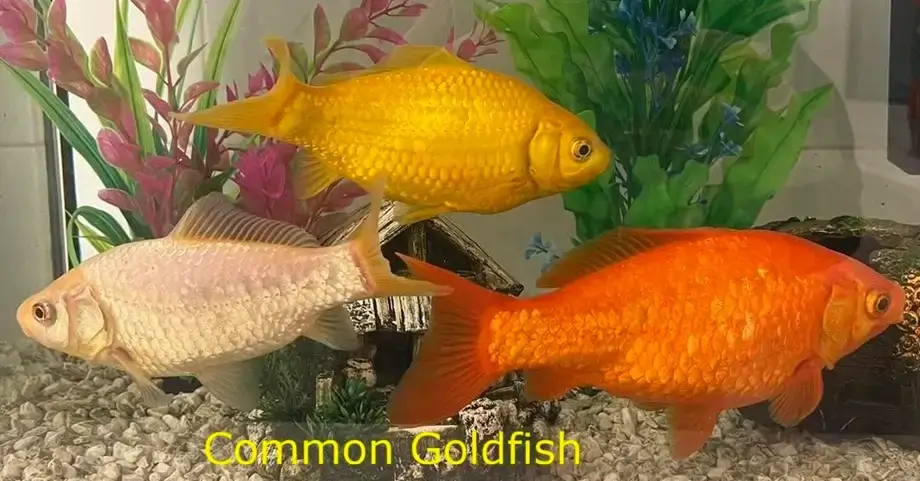
They are hardy, active fish that need plenty of swimming space. Adults can grow quite large and may live for many years in a spacious, well-maintained aquarium or pond.
Key identifying features: Long, streamlined body, short single tail, and upright dorsal fin
2) Comet Goldfish
The Comet Goldfish looks similar to the Common Goldfish but has a much longer, deeply forked tail with pointed tips. Its flowing tail is the easiest way to tell it apart from the Common Goldfish. Comets come in red, orange, white, yellow, and red-and-white combinations.
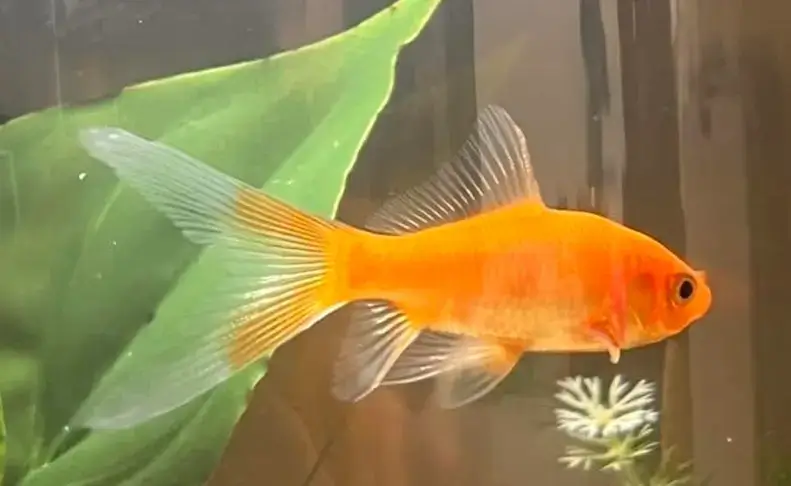
They are hardy, active swimmers that can withstand low temperatures. Comets also grow quite large and live for many years in a spacious and well-maintained aquarium or pond.
Key identifying features: Long, streamlined body, deeply forked single tail with pointed tips, and upright dorsal fin.
3) Shubunkin Goldfish
Shubunkins are single-tailed goldfish with a calico color pattern. Their colors often mix blue, black, orange, red, and white, so no two fish look exactly alike.
They are strong swimmers that suit large aquariums and ponds. There are three types of Shubunkin: London Shubunkin, Bristol Shubunkin, and American or Japanese Shubunkin.
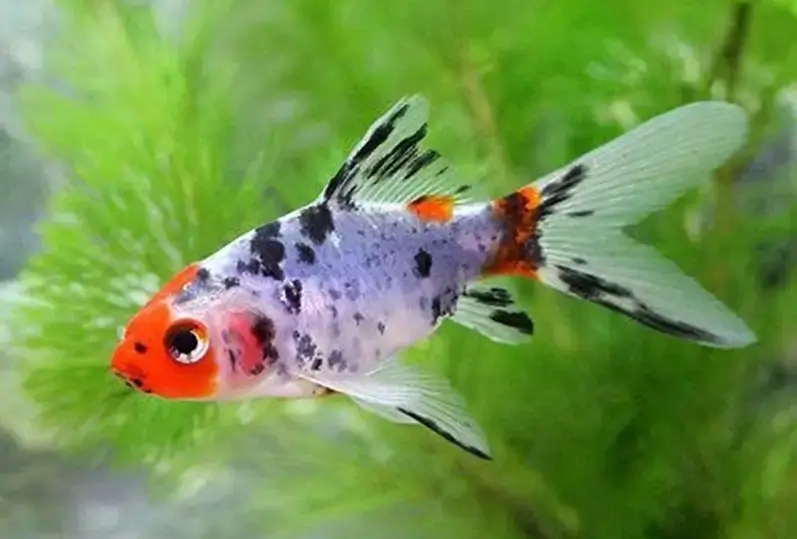
London Shubunkins have shorter tails like the Common Goldfish; Bristol Shubunkins have broad, heart-shaped tails; and American or Japanese forms tend to have longer tails with pointed ends.
Key identifying features: Calico coloring, streamlined body, and single tail.
20 Fancy Goldfish Types With Pictures
Fancy and ornamental goldfish have been bred for features such as double tails, rounded bodies, distinctive eyes, and head growths. Not all are round-bodied: Wakin, Watonai, and Jikin are good examples of streamlined ornamental types.
4) Oranda Goldfish
The Oranda Goldfish is best known for its fleshy head growth, called a wen. It also has a deep body, an upright dorsal fin, and a double tail. Young Orandas may have very little head growth, which develops as they mature.
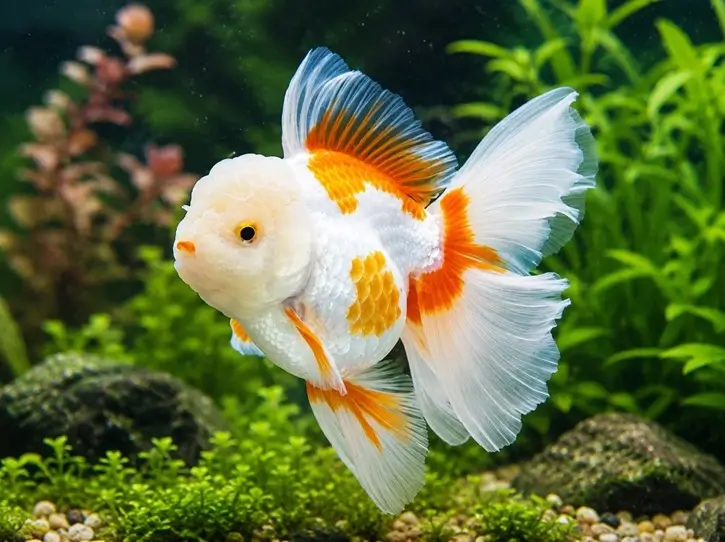
Orandas come in Red Cap, Panda, Black, Blue, Calico, and many other colors. Thai Orandas, the larger Orandas known for their particularly short bodies, large heads, and flowing tails, were selectively bred in Thailand. A large wen needs monitoring, especially if it begins to affect the fish’s vision. The wen needs to be trimmed.
Key identifying features: Wen, upright dorsal fin, and double tail.
5) Ranchu Goldfish
A Ranchu has a rounded body, a smoothly curved back, and no dorsal fin. The fleshy head growth usually extends over the head and cheeks. In Japan, the variety is often called the “King of Goldfish”.
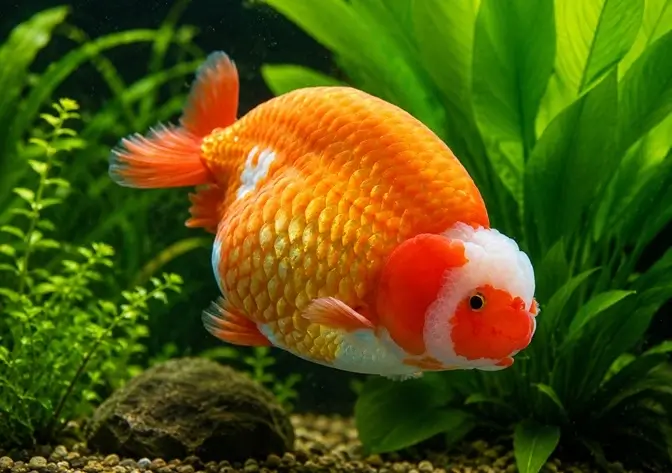
One of the easiest ways to tell a Ranchu from an Oranda is to look at the back: a Ranchu has no dorsal fin. Japanese Ranchu are also judged from above, where the back, tail set, and head shape are especially noticeable. The Ranchu and Lionhead goldfish look similar and are often mentioned together in many publications, though they are distinct varieties.
Key identifying features: Curved back, no dorsal fin, and a wen.
6) Ryukin Goldfish
The Ryukin is easy to recognize by the high shoulder hump behind its head and its unusually deep body. It has an upright dorsal fin and a double tail, which may be short or long depending on the strain. Ryukins are often stronger swimmers than the most delicate fancy varieties, although extremely deep-bodied fish may be less agile.
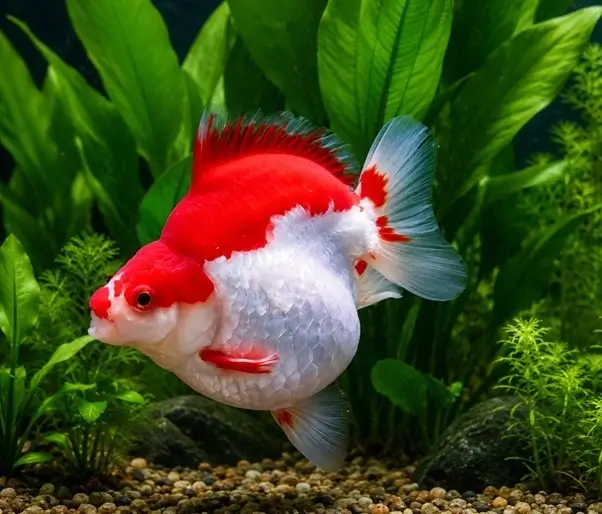
Their pronounced hump is a more useful identifying clue than their color. Ryukins are active swimmers and are quite hardy too.
Key identifying features: High shoulder hump, deep body, and dorsal fin.
7) Fantail Goldfish
Fantails have a rounded but fairly balanced body, an upright dorsal fin, and a broad double tail that spreads out like a fan. Compared with more extreme fancy varieties, their body shape is relatively straightforward.
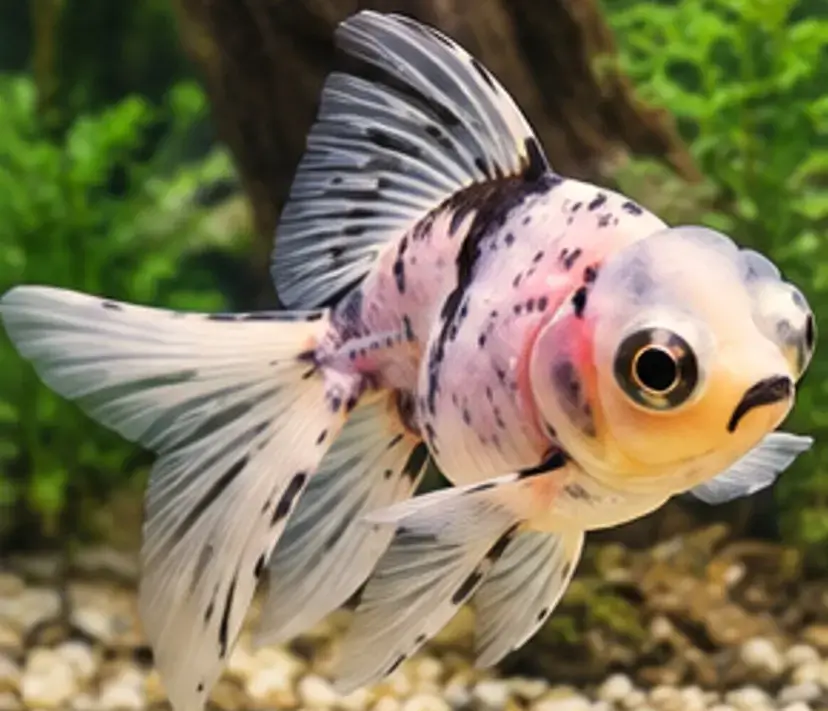
They are hardy and a good choice for someone interested in fancy goldfish keeping. They still need a spacious aquarium with good water quality maintained at all times.
Key identifying features: Fan-shaped double tail, dorsal fin, and balanced body.
8) Black Moor Goldfish
A Black Moor is a black form of the Telescope Goldfish, not a separate species. It has protruding eyes, a rounded body, and a double tail. Young fish may look bronze before developing a darker color.
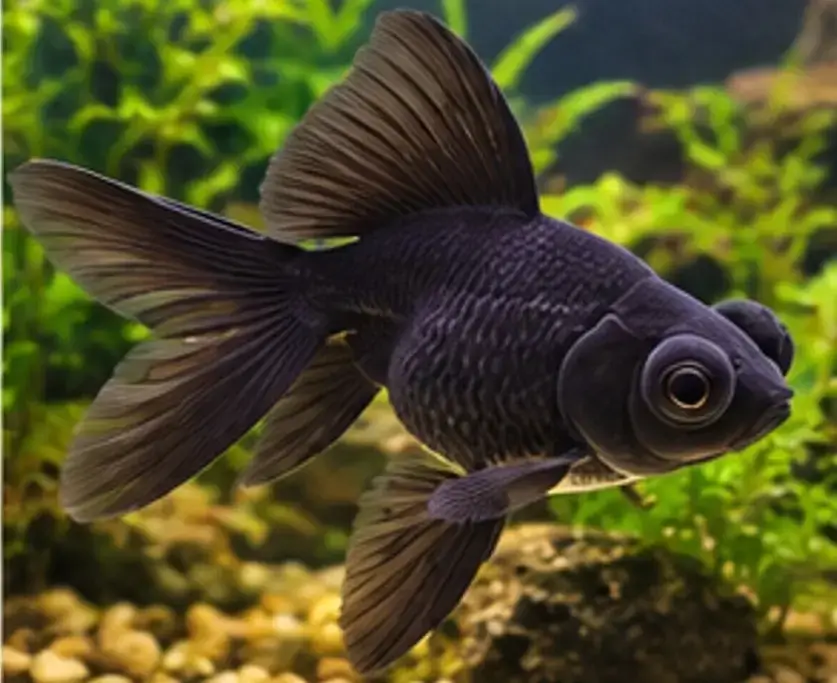
Not every Black Moor stays completely black throughout its life. Because its eyes can be easily injured and its vision is limited, keep decorations smooth and choose tankmates that will not take all the food before it can reach it.
Key identifying features: Dark body, protruding eyes, and double tail.
9) Telescope Goldfish
The Telescope Goldfish gets its name from the eyes projecting out from the sides of its head. Most have a deep body, an upright dorsal fin, and a double tail. The eye shape becomes more obvious as the fish grows. Telescope Goldfish come in several colors and tail forms, including the Black Moor and Butterfly Telescope.
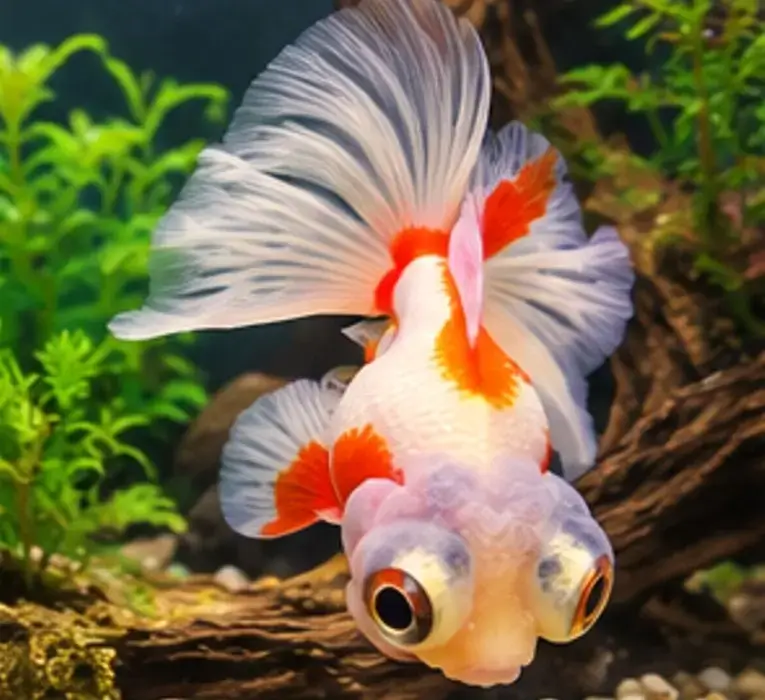
Their eyes make them vulnerable to injury, so sharp ornaments and very fast tankmates are best avoided.
Key identifying features: Protruding eyes, dorsal fin, and double tail.
10) Butterfly Telescope Goldfish
Look at a Butterfly Telescope from above and you will see why it has that name. Its paired tail spreads outward like butterfly wings, while the eyes have the familiar Telescope shape. Butterfly tails appear in black, red, calico, panda, and other colors.
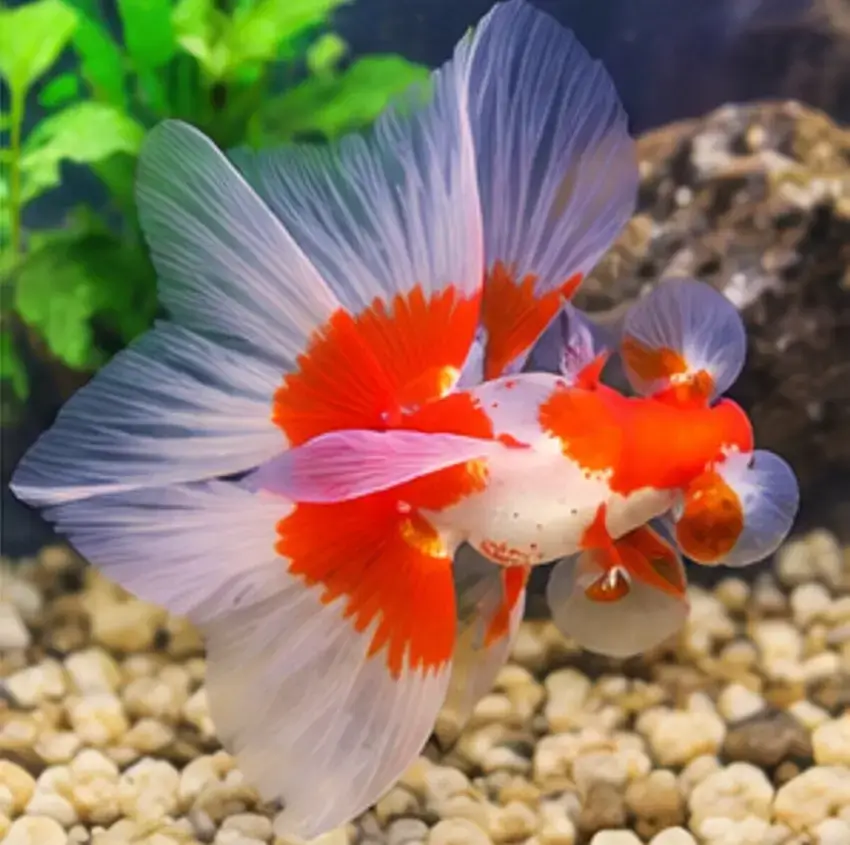
The spread of the tail is easiest to appreciate from above, but this variety still needs open swimming space and gentle tankmates.
Key identifying features: Telescope eyes and a wide, butterfly-shaped tail.
11) Pearlscale Goldfish
The Pearlscale has an almost spherical body covered in raised, dome-shaped scales that look like tiny pearls. Those scales, rather than any particular color, are what set the variety apart. Its compact body can make swimming slower and feeding more difficult, so similar-paced companions work best.
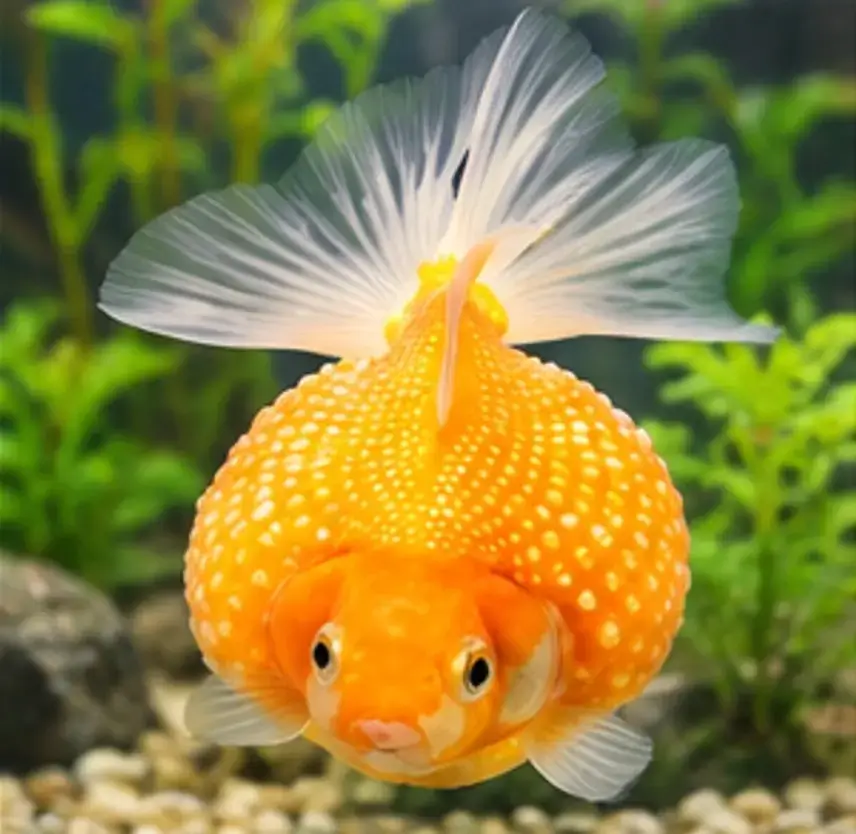
The Crowned Pearlscale, or Hama Nishiki, also has a fleshy growth on its head.
Key identifying features: Raised pearl-like scales, rounded body, and double tail.
12) Lionhead Goldfish
Lionheads have a fleshy head growth, or wen, and a rounded body without a dorsal fin. Their backs tend to be flatter than the smoothly arched backs associated with Ranchu.
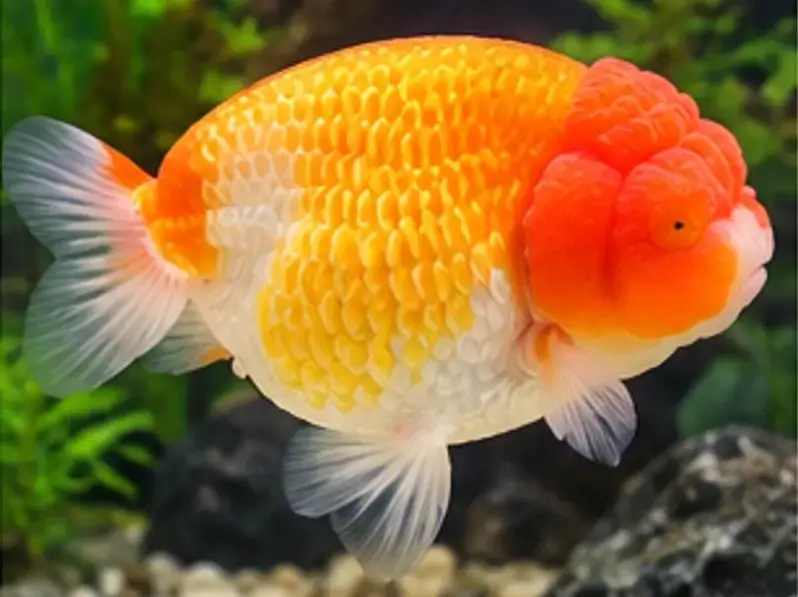
Young Lionheads and Ranchus can look very similar. Instead of relying on color, compare the outline of the back and how the head growth develops.
Key identifying features: Large wen, no dorsal fin, and a relatively flat back.
13) Bubble Eye Goldfish
The most noticeable feature of a Bubble Eye is the pair of fluid-filled sacs hanging beneath its eyes. It has an egg-shaped body and normally no dorsal fin. Those delicate sacs can be injured by sharp decorations, rough handling, and unsuitable filter intakes.
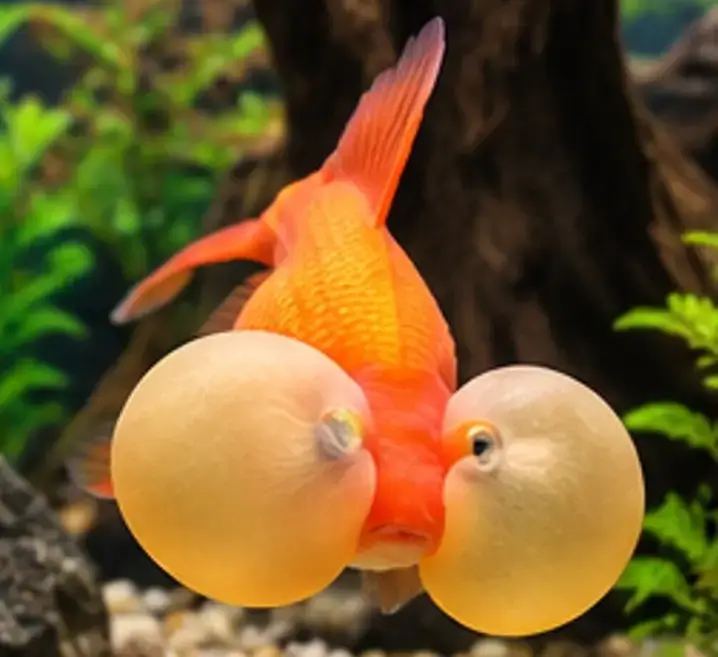
Bubble Eyes need a calm, uncluttered tank and companions that are equally slow at feeding.
Key identifying features: Fluid-filled eye sacs and no dorsal fin.
14) Celestial Eye Goldfish
A Celestial Eye Goldfish has eyes that point upward instead of forward or sideways. Its body is rounded, and it has no dorsal fin.
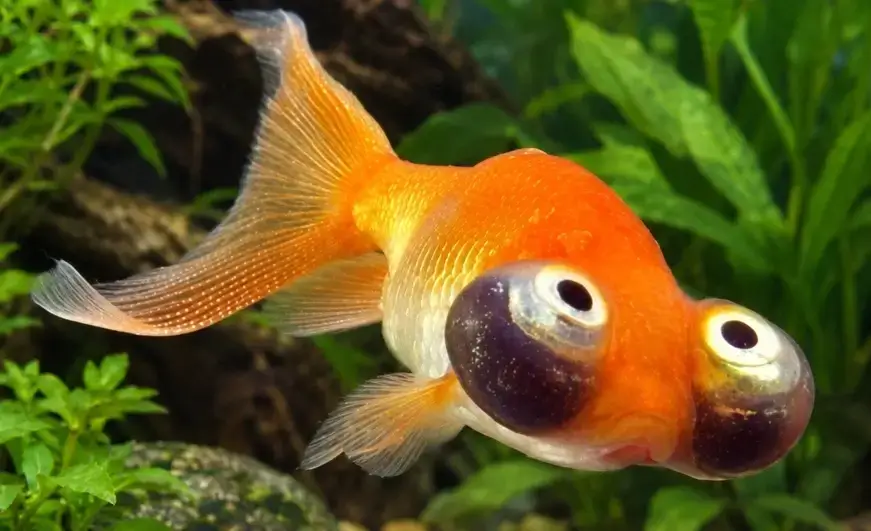
The unusual eye position limits what the fish can see around it. Avoid sharp obstacles and strong competition at feeding time; make sure each fish can find its food.
Key identifying features: Permanently upward-facing eyes and no dorsal fin.
15) Veiltail Goldfish
A true Veiltail has exceptionally long, flowing fins and a broad tail that hangs behind it like a veil. The tail has a relatively straight, square-looking trailing edge, and the dorsal fin is tall.
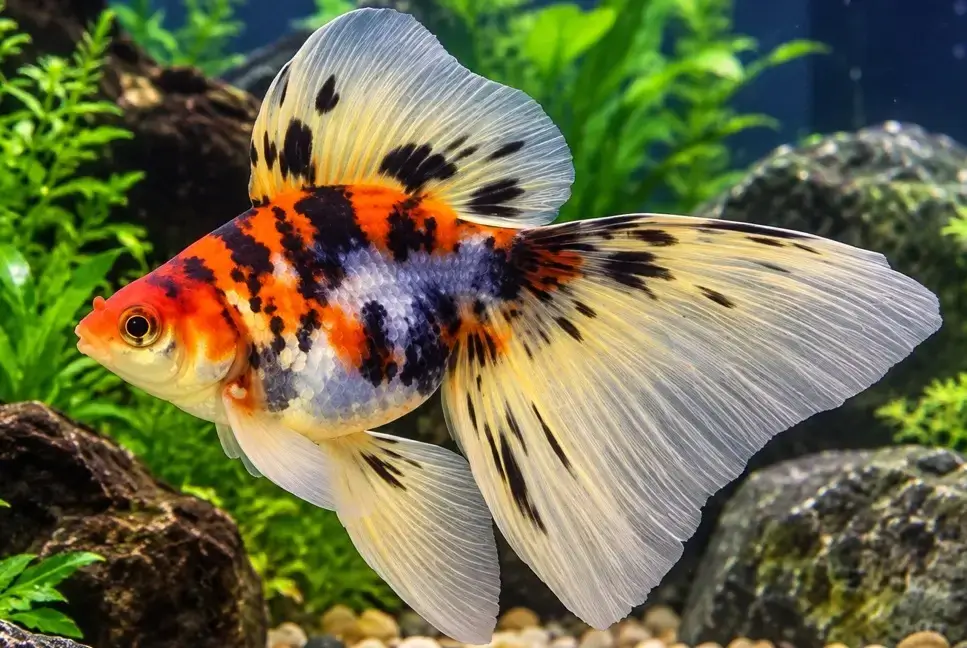
A long-finned Fantail is not automatically a Veiltail. Tail shape and fin proportions matter. Because those long fins are easily damaged, Veiltails do better with gentle tankmates and plenty of room to turn.
Key identifying features: Long, square-edged flowing tail and tall dorsal fin.
16) Pompon Goldfish
Pompons are named for the two fleshy, frilly growths around their nostrils. These nasal growths look like tiny pom-poms and are different from the wen found on an Oranda or Lionhead. Some Pompons have a dorsal fin, and others do not.
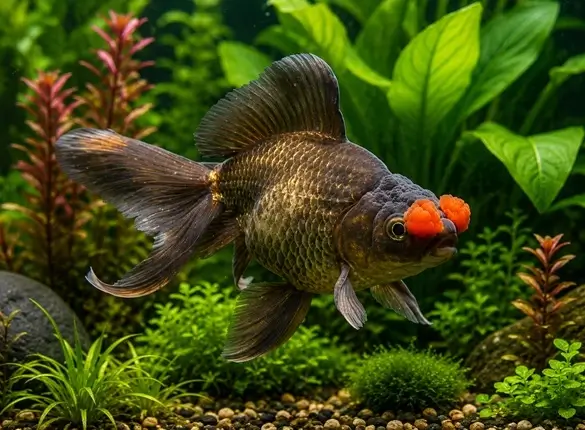
The nasal growths are the easiest way to identify them, and smooth decorations help prevent injuries to this soft tissue.
Key identifying features: Paired nasal pom-poms; dorsal fin may be present or absent.
17) Tosakin Goldfish
The Tosakin is a rare Japanese variety with a broad paired tail that spreads sideways and curls forward at the outer edges. Its tail is most striking when the fish is viewed from above.
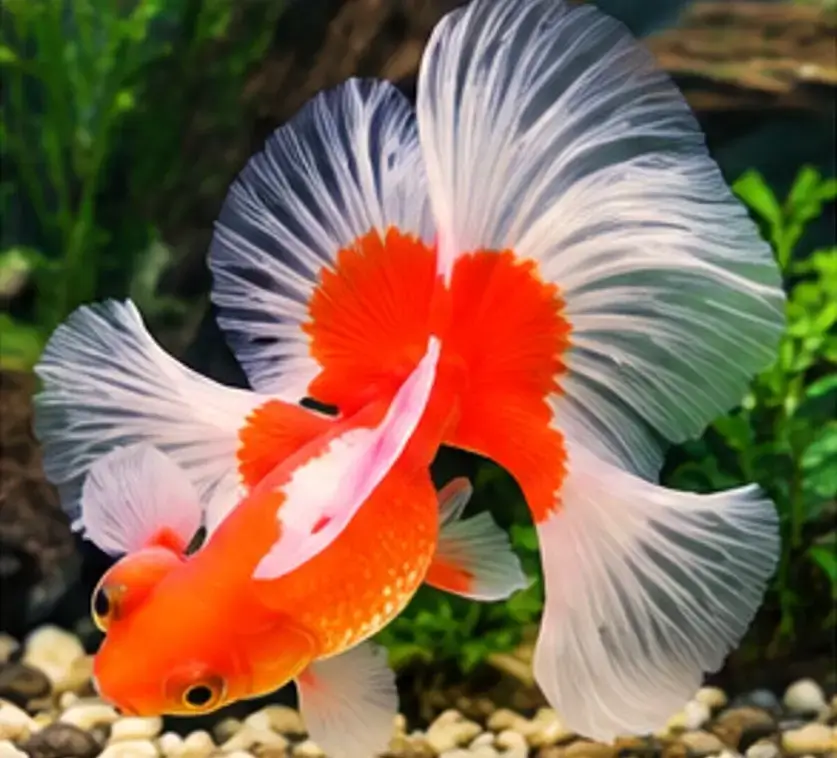
The unusual tail shape also makes it less efficient at swimming. Tosakins are traditionally raised in shallow, carefully maintained water with gentle movement and need attentive care.
Key identifying features: Broad horizontal tail with forward-curving edges.
18) Lionchu Goldfish
The Lionchu combines the heavy head growth associated with Lionheads and the curved back of a Ranchu. It has no dorsal fin. The balance between these traits varies from one bloodline to another.
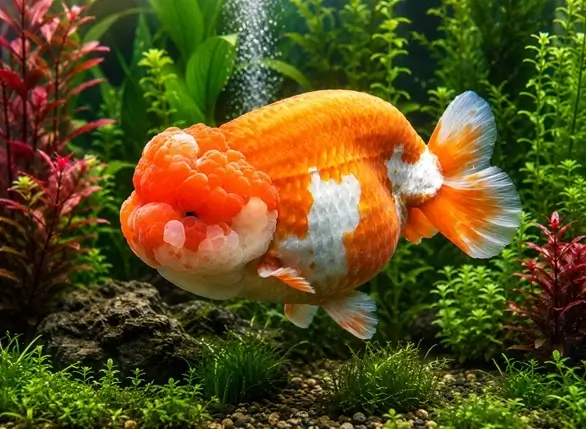
When comparing a Lionchu with other dorsal-less goldfish, look at the whole shape of the head and back rather than the size of the wen alone.
Key identifying features: Prominent wen, curved back, and no dorsal fin.
19) Wakin Goldfish
A Wakin looks streamlined at first glance, rather like a Common Goldfish, but its tail is divided into two lobes. It also has an upright dorsal fin.
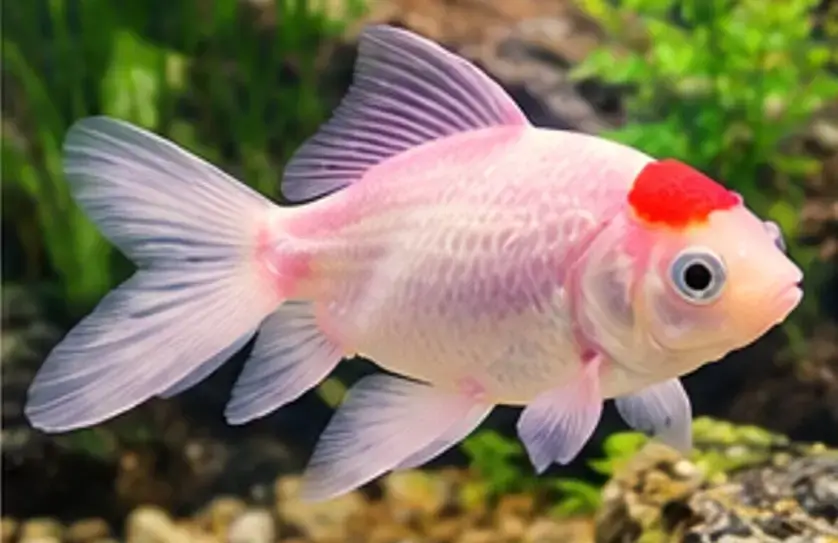
Wakins are active swimmers and are often kept in large aquariums or ponds. Their speed and enthusiasm at feeding time can make them unsuitable companions for slower, more delicate fancy goldfish.
Key identifying features: Streamlined body, divided double tail, and dorsal fin.
20) Watonai Goldfish
The Watonai has a fairly streamlined body and a long, flowing double tail. Compared with a Wakin, the tail is much more elaborate. The variety is associated with Wakin and Ryukin breeding lines. Watonai need space because they are active swimmers and can grow quite large.
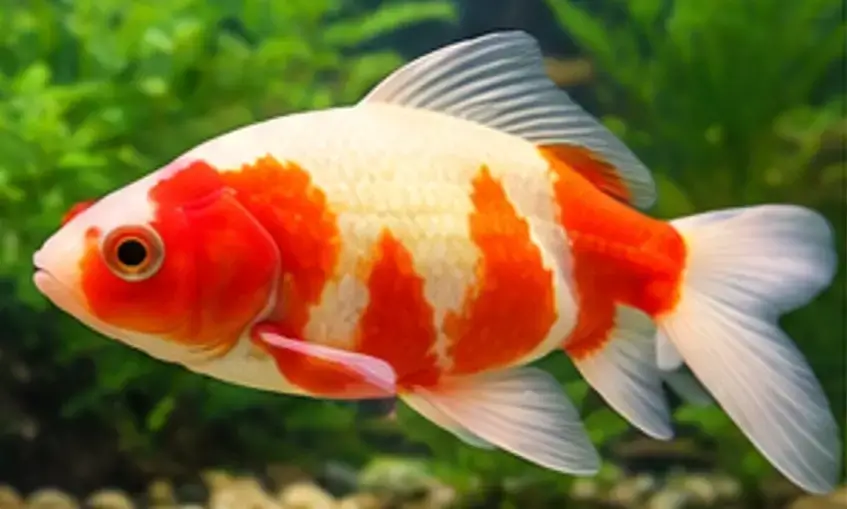
Their flowing tails look especially attractive in a well-maintained pond when viewed from above.
Key identifying features: Streamlined body with a long, flowing double tail.
21) Jikin Goldfish
The Jikin is a traditional Japanese goldfish with a distinctive four-lobed tail. Viewed from behind, the tail opens into an X shape, sometimes called a Peacock tail. Prize examples also have a carefully selected red-and-white pattern known as the Twelve Red Points.
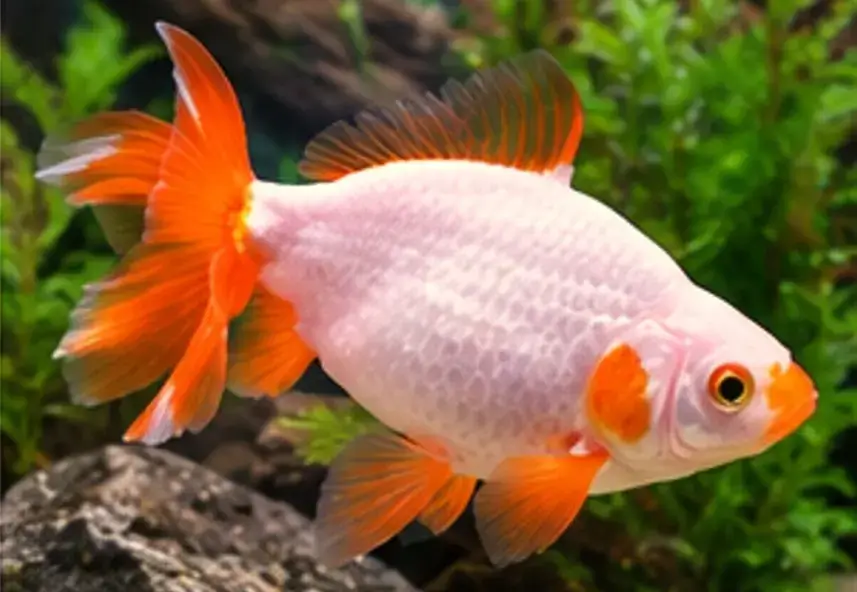
Not every young Jikin shows the finished pattern, so its unusual tail is the more useful identifying feature.
Key identifying features: Four-lobed, X-shaped Peacock tail.
22) Izumo Nankin Goldfish
The Izumo Nankin is a traditional Japanese variety from the Izumo region. It has a smooth, rounded body, no dorsal fin, and little or no fleshy head growth. Its shape separates it from Ranchu and Lionhead, which are known for prominent wens.
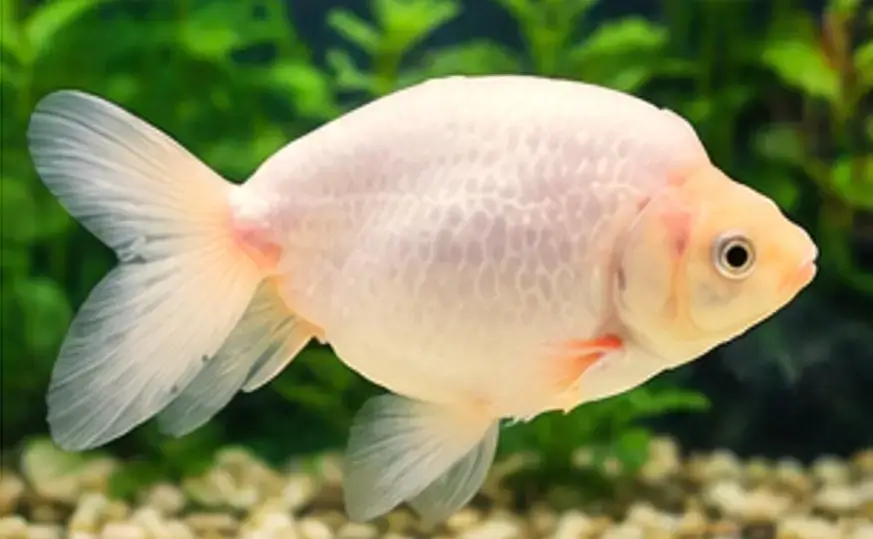
Izumo Nankin goldfish are usually appreciated from above and are more likely to be found through specialist breeders than ordinary fish stores.
Key identifying features: Rounded body, no dorsal fin, and little or no wen.
23) Shukin Goldfish
The Shukin is a lesser-known Japanese goldfish with an egg-shaped body, no dorsal fin, and a long, flowing double tail.
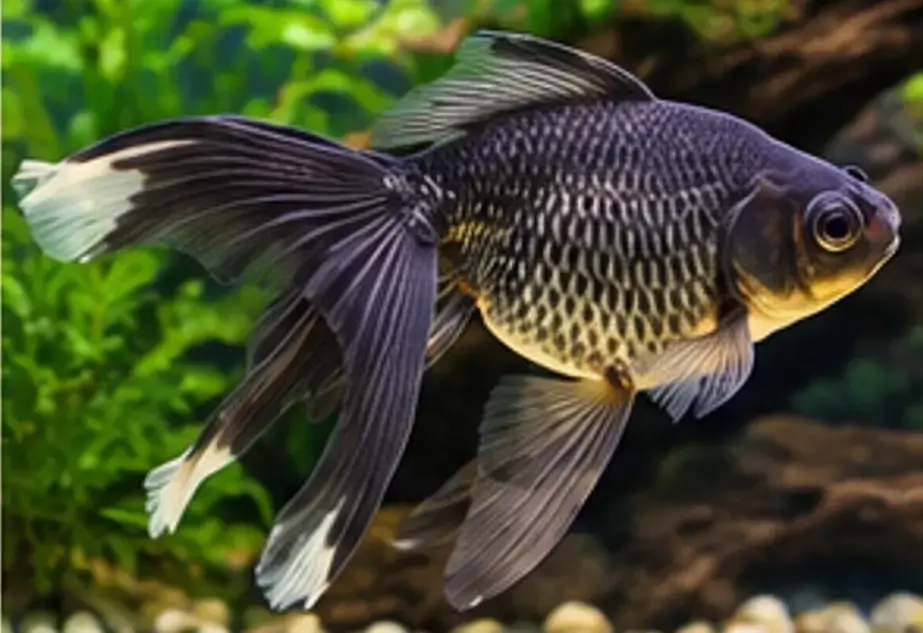
Its long tail makes it different from shorter-finned dorsal-less varieties. As with other specialized fancy goldfish, choose calm companions and an open layout that will not damage its fins.
Key identifying features: No dorsal fin, egg-shaped body, and long double tail.
Which Goldfish Type Is Right for You?
The best goldfish variety for you depends on the space available, your experience with keeping goldfish, and whether you plan to keep the fish in an aquarium or pond.
For large ponds or very spacious aquariums: Common Goldfish, Comets, and Shubunkins are active swimmers that need plenty of room. Wakin and Watonai are also worth considering if you prefer ornamental varieties with double tails.
For beginners interested in fancy goldfish: Fantails and Ryukins are generally more forgiving than varieties with delicate eye structures, round body shapes or unusually long fins. Orandas and Ranchus can also be suitable, provided they have good water quality, proper nutrition, and compatible tankmates.
For experienced keepers: Bubble Eyes, Celestial Eyes, and Tosakins require extra care. Their unusual eye structures or specialized tail shapes can make them more vulnerable to injuries and feeding difficulties. They need carefully arranged aquariums, suitable tankmates, and consistent maintenance.
Whichever variety you choose, remember that even a small young goldfish can grow much larger. Plan for its adult size and space requirements rather than its size in the shop.
Frequently Asked Questions
Where did goldfish originate?
Goldfish originated in China more than 1,000 years ago, where they were domesticated from wild crucian carp. The Common Goldfish is one of the earliest domesticated forms, retaining the streamlined body and single tail of its wild ancestor. The Comet Goldfish was developed in the United States in the 1880s, while the Shubunkin was developed in Japan around 1900 through selective breeding involving calico Demekin and Wakin goldfish.
What are the rarest goldfish varieties?
Rarity and availability are not quite the same. Some goldfish are difficult to find simply because few breeders or sellers offer them in certain countries. Japanese varieties such as Tosakin, Jikin, Izumo Nankin, Shukin, and Toukai Nishiki are examples, as they are not widely available outside Japan. Tamasaba can also be hard to find in some markets.
Certain colour strains are less commonly seen too. Well-marked Panda Orandas are prized and can be difficult to breed consistently, while Lemonhead Orandas are relatively uncommon. Ingot Orandas are another unusual type. The Meteor Goldfish is sometimes called the rarest goldfish, although its status as an established variety is disputed.
Can fancy goldfish live with Common Goldfish?
They can, but it is generally not recommended. Common Goldfish and Comets are faster swimmers and may outcompete slower fancy varieties for food. It is usually better to keep goldfish with companions that have similar swimming and feeding abilities.
How long do fancy goldfish live?
Many fancy goldfish live around 10–15 years with good care, although some can live for more than 20 years. Genetics, water quality, nutrition, and the particular variety all influence their lifespan.