
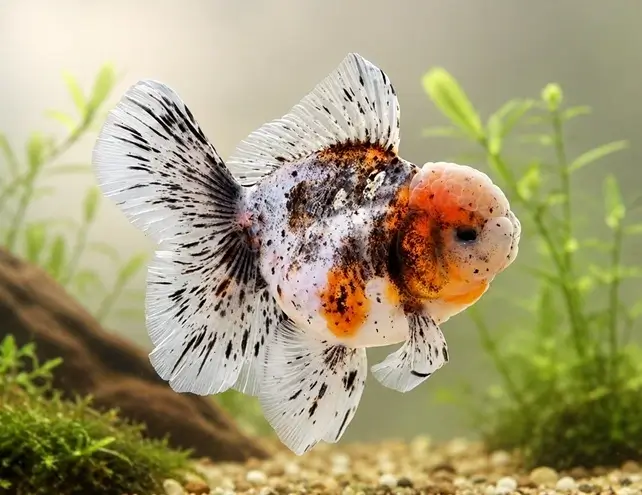
The Calico Oranda Goldfish has a mix of red, orange, black, and white markings, often with a blue-gray background. It has a rounded body, flowing double tail, and fleshy head growth known as a wen. Its markings extend across the body and fins, with the mix and placement of colors varying from fish to fish.
Quick Navigation
1) Calico Oranda Goldfish Quick Facts
2) Calico Oranda Goldfish Appearance
3) Blue Base Calico Oranda
4) Calico Oranda Goldfish Care
5) Frequently Asked Questions
Calico Oranda Goldfish Quick Facts
| Characteristic | Details |
|---|---|
| Scientific Name | Carassius auratus |
| Common Name | Calico Oranda Goldfish |
| Scale Type | Nacreous (a mix of reflective and translucent scales) |
| Adult Size | Typically 6–8 inches (15–20 cm); some grow larger |
| Lifespan | 10–15 years with good care; some live longer |
| Difficulty | Moderate |
| Temperament | Peaceful |
| Temperature | 68–79°F (20–26°C) |
| Tank Size | At least 30 gallons for one fish; larger is preferable |
| Diet | Omnivore |
Calico Oranda Goldfish Appearance
A Calico Oranda’s markings can range from small speckles to large, irregular patches. Some fish have more red or orange, while others show more black and white against a blue-gray background. Not every fish displays every color.
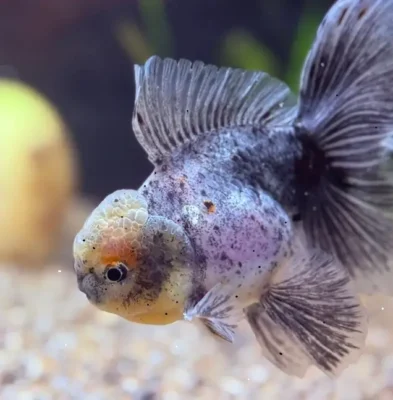
Calico Orandas have nacreous scales—a mix of shiny, reflective scales and more translucent ones. This gives parts of the body a pearly sheen while other areas look softer and less reflective.
Blue Base Calico Oranda
A Blue Base Calico Oranda has a blue-gray background beneath its red, orange, and black markings. “Blue base” describes its coloring rather than a separate breed.
The blue appearance comes from dark pigment deeper in the skin showing through the more translucent areas. Its strength varies between fish, and lighting can make it more or less noticeable.
Calico Oranda Goldfish Care
Calico Orandas need the same care as other Orandas. Provide at least 30 gallons for one fish, effective filtration with a gentle current, and regular water changes. Keep the temperature stable within 68–79°F (20–26°C), with ammonia and nitrite at 0 ppm.
Feed a balanced goldfish diet, using sinking pellets as the staple. Choose peaceful fancy goldfish with similar swimming abilities, and make sure each fish can reach its food.
For a full guide to tank setup, water parameters, feeding, and suitable companions, see our Oranda Goldfish Care Guide.
Frequently Asked Questions
Why do Calico Orandas change color?
A Calico Oranda’s markings can change as it grows. Black spots may fade, red or orange areas may become more noticeable, and the background may lighten. Inherited traits influence these changes, so a young fish may look different as an adult. Good care supports healthy colors but cannot keep the pattern fixed.
Gradual changes in an otherwise healthy fish are usually not a concern. If fading comes with poor appetite, clamped fins, or unusual behavior, check water quality and look for signs of illness.
Can two Calico Orandas produce solid-colored babies?
Yes. Two Calico Orandas can produce offspring with metallic, nacreous, or matte scales, and some may be solid-colored. The parents’ calico appearance does not mean every baby will have the same scale type or multicolored pattern.
Does food make Calico Orandas more colorful?
A balanced diet supports healthy coloring, and foods containing carotenoids can help strengthen red and orange tones. However, food cannot guarantee a particular pattern or prevent natural color changes.
What is the difference between a Calico Oranda and a Sakura Oranda?
Both have nacreous scales. Calico Orandas have a multicolored pattern that includes black markings, often with a blue-gray background. Sakura Orandas generally have red or orange and white coloring without black markings, giving them a softer appearance.
Explore More Oranda Varieties: