
Telling a male goldfish from a female isn’t always obvious, and unlike some fish, goldfish don’t show clear differences until they’re mature. Male vs female goldfish comes down to a combination of signs, a gentle belly-firmness check, breeding tubercles, vent shape, body shape, and behavior, and no single one is reliable on its own. Getting this right matters for more than curiosity, it affects breeding plans, stocking decisions, and even avoiding a common misdiagnosis that leads people to treat a perfectly healthy male fish for a disease he doesn’t have.
Quick Answer: The most direct check is gently feeling the belly area between the vent and the stomach, starting right at the vent and running upward along the underside toward the belly, a female feels soft and slightly spongy along that whole stretch, while a male feels firm, almost hard, by comparison, the same reason hand-spawning only works on a ripe female. Beyond that, male goldfish typically develop small white breeding tubercles on the gill covers and pectoral fins, have a narrow, slit-like vent, and a slimmer, more streamlined body. Females have a rounder, protruding vent, a deeper, plumper body (especially when full of eggs), and no breeding tubercles. None of these signs are fully reliable alone, and they only become visible once a goldfish reaches sexual maturity, usually around 9 to 12 months old.
Quick Navigation
➜ Male vs. Female Goldfish: Quick Comparison Table
➜ Goldfish Gender Identification
➜ Gently Pressing the Belly (Firmness Test)
➜ Breeding Tubercles
➜ Tubercles vs. Ich: Don’t Confuse the Two
➜ Vent Shape
➜ Body Shape and Size
➜ Pectoral Fin Shape
➜ Midline Ridge
➜ Chasing Behavior During Breeding Season
➜ The Only 100% Certain Method
➜ At What Age Can You Tell?
➜ Why Sexing Fancy Goldfish Is Harder
➜ Goldfish Male or Female: Pictures
➜ Quick Checklist: Sexing Your Goldfish
➜ Frequently Asked Questions
Male vs. Female Goldfish: Quick Comparison Table
A fast way to compare every method side by side before reading the full breakdown below.
| Method | Male | Female |
|---|---|---|
| Belly firmness (vent to stomach) | Firm, almost hard | Soft, slightly spongy |
| Vent shape | Narrow, slit-like, concave | Rounder, protruding, convex |
| Breeding tubercles | Common on gill covers and pectoral fins | Rare, occasionally one or two |
| Body shape | Slimmer, more streamlined | Rounder, deeper-bodied, plumper when gravid |
| Pectoral fin shape | Thicker first ray, more pointed | Rounder overall shape |
| Midline ridge | Pronounced, firm ridge | Faint or absent |
| Breeding season behavior | Does the chasing | Gets chased |
Goldfish Gender Identification
Identifying a goldfish’s gender comes down to checking a combination of physical and behavioral signs. The most direct method is gently pressing the belly, firm leans male, soft leans female.
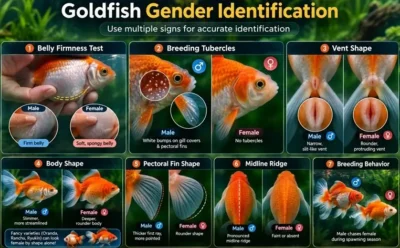
Breeding tubercles are one of the strongest signs available, small white bumps that develop on the pectoral fins and gill covers of males during breeding season. Vent shape is another reliable check, narrow and slit-like in males, rounder and protruding in females.
Body shape is more useful with standard goldfish than fancy varieties, though, round, short-bodied fancy goldfish like Oranda, Ranchu and Ryukin can look “female” by shape alone regardless of actual sex, which is exactly the kind of case where a fish appears female on shape but turns out male once you check firmness or tubercles instead. Pectoral fin shape, the midline ridge, and chasing behavior during spawning season round out the full picture, each covered in detail below with photos.
Gently Pressing the Belly (Firmness Test)
This is one of the more direct checks available, and it’s essentially a lighter, non-invasive version of the same principle behind hand-spawning, a technique real breeders use to help a ripe female release her eggs. Female goldfish have a naturally softer, more pliable belly than males, whether or not she’s currently carrying eggs, while a male’s stays consistently firm. That baseline anatomical difference is what makes the two feel distinct side by side, not just a temporary change during breeding season.
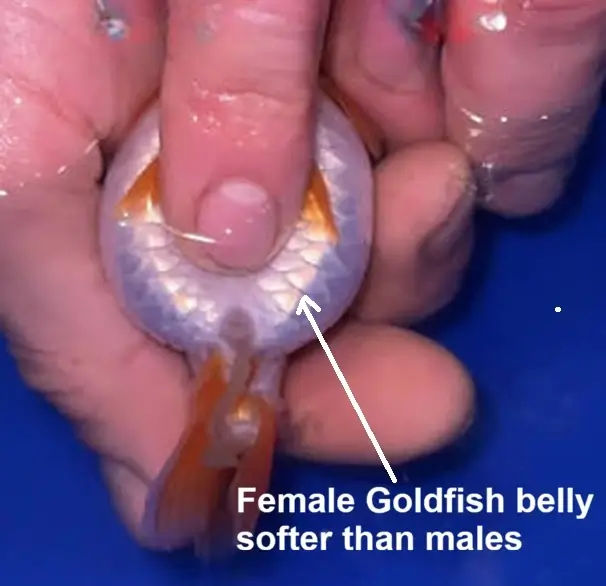
From Experience: The firmness test is more reliable than shape alone, especially with fancy goldfish. I’ve had fancy goldfish that looked rounder and more “female” by body shape, but turned out to be male once I actually felt the belly, firm and ridged, not soft. When shape and firmness disagree, trust the firmness test.
Where to check: the underside of the fish, starting right at the vent (the anal opening) and running upward along the belly toward the stomach, not a single spot, but that whole stretch between the vent and the lower belly.
➜ Female — that whole stretch from the vent up toward the belly feels soft and slightly yielding, almost spongy, when very gently pressed
➜ Male — the same stretch feels firm, sometimes noticeably hard by comparison, occasionally with the midline ridge covered below
➜ Use the lightest touch possible — this should feel like barely pressing at all, not a firm poke
➜ Never press hard — this area sits close to the reproductive organs and internal cavity, and real pressure can truly injure the fish, this is a gentle feel, not a squeeze test
Like every other sign in this guide, treat this as a strong clue rather than absolute proof, some long-bodied females can feel firmer than expected, so combining it with vent shape or tubercles gives a more confident read.
Breeding Tubercles
Breeding tubercles, sometimes called breeding stars, are small, hard nodules made of keratin, the same structural protein found in human fingernails and hair, that develop on a male goldfish during breeding season, spring through fall in most climates. They’re driven by rising testosterone and first appear on the leading edge of the pectoral fins, then spread to the gill covers and sometimes the face or body as the season progresses.
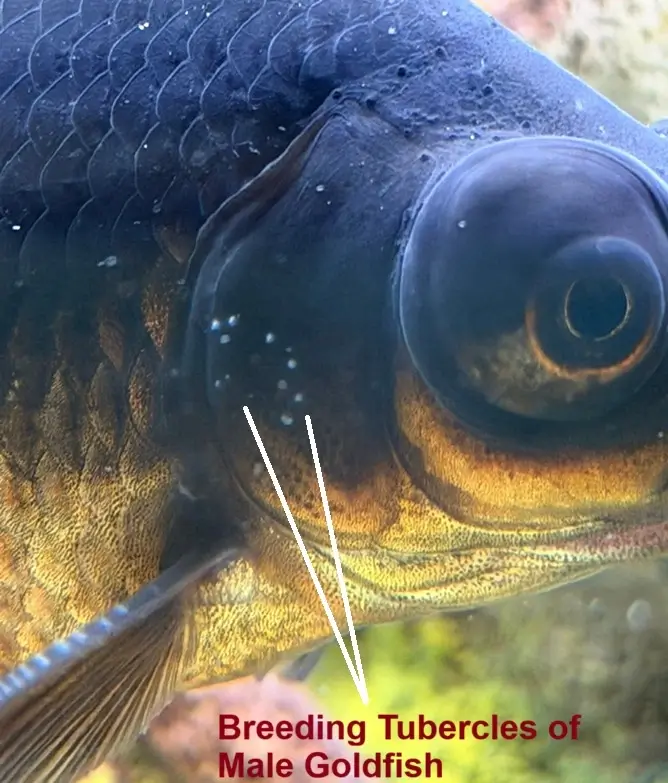
Tubercles aren’t just a cosmetic side effect of hormones, they serve a real function during courtship, helping a male maintain physical contact with a female while chasing and spawning. In some related fish species, a heavier tubercle count has also been linked to better overall health and dominance, functioning as a visible signal of a male’s condition to potential mates.
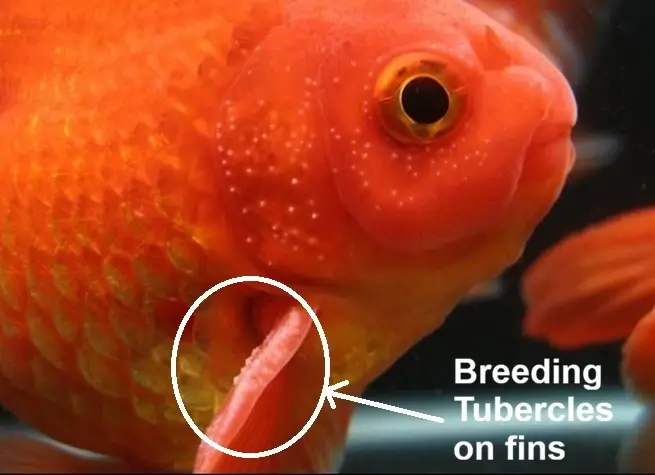
➜ Look at the pectoral fins first — the front ray is usually where tubercles show up before anywhere else
➜ Check the gill covers next — this is the second most common location
➜ In heavily wen-covered breeds like Lionhead — the wen can obscure the gill covers entirely, so pectoral fins may be the only visible location even on a confirmed male
➜ Don’t rule out male just because tubercles are absent — a meaningful number of healthy males never develop visible tubercles at all
➜ Older males may keep tubercles year-round — after several breeding seasons, some don’t fully lose them between cycles
Tubercles aren’t exclusive to males either, in rare cases, particularly in breeds like Ryukin or Black Moor, females can develop a tubercle or two, though nowhere near the number a mature male typically shows. Treat this as a strong clue, not proof on its own.
Tubercles vs. Ich: Don’t Confuse the Two
This is worth its own section because getting it wrong leads to a real, avoidable mistake, treating a healthy breeding male with medication for a parasite he doesn’t have. Both conditions cause small white spots, but they look and behave differently if you know what to check.
➜ Location matters — breeding tubercles stay confined to the gill covers and pectoral fin rays, Ich scatters randomly across the entire body, fins, and even the eyes
➜ Pattern matters — tubercles form a neat, organized pattern following the fin rays and scale contours, Ich looks like uneven, salt-like dust with no real structure
➜ Duration matters — tubercles come and go with lighting, temperature, and breeding season, easing off on their own, Ich is continuous and gets progressively worse unless actually treated
➜ Behavior matters — a fish with tubercles is usually energetic and actively chasing others, completely normal breeding behavior, a fish with Ich is more often sluggish or lethargic, and may flash or scratch against objects from irritation
If you’re at all unsure, waiting a day or two to see whether the spots stay confined to the typical tubercle locations, or start spreading and multiplying, is a reasonable way to tell them apart before assuming either explanation.
Vent Shape
The vent, the small opening near the base of the anal fin, is one of the more reliable signs once a goldfish is mature, though it’s still easiest to check during breeding season when the difference is most pronounced.
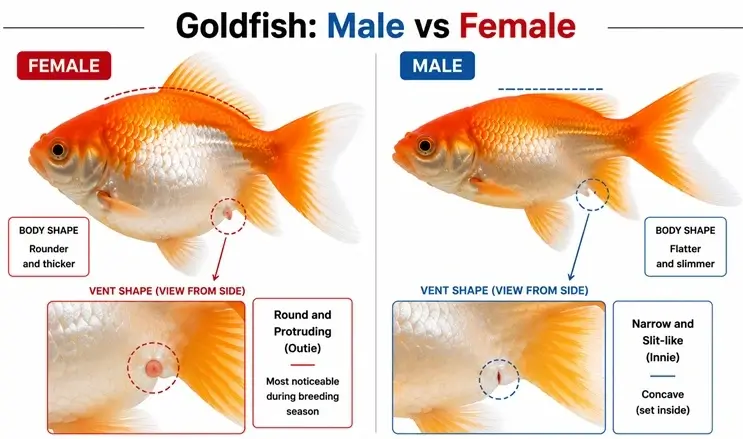
➜ Male vent — narrow, slit-like, and concave, sometimes described as an “innie”
➜ Female vent — rounder and protruding, sometimes described as an “outie,” most noticeable as breeding season approaches
➜ Check from the side, not directly from above — the protrusion on a female is often easier to spot in profile
➜ Exceptions exist here too — some females don’t show an obviously protruding vent, and some males show slight protrusion, so this works best alongside at least one other sign
Body Shape and Size
Females tend to be rounder, deeper-bodied, and plumper than males of the same age and variety, especially once they’re carrying eggs, when one side of the body can visibly bulge more than the other, giving a slightly asymmetrical look from above. Males are typically more slender and streamlined by comparison.
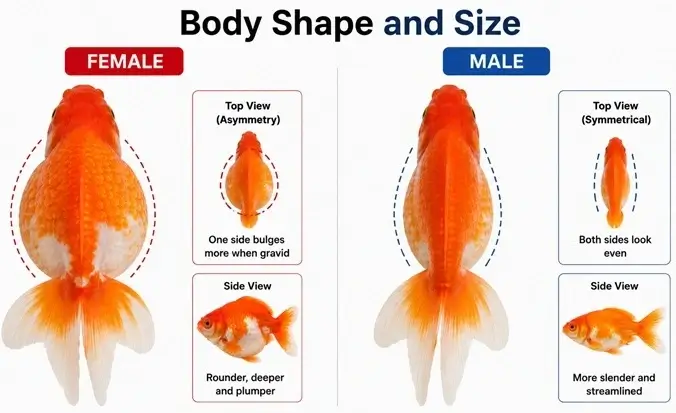
➜ Compare fish of the same age and variety — body shape differences are only meaningful between similar fish, not across different ages or breeds
➜ Look from above for asymmetry — a gravid female’s egg-filled side often bulges more than the other
➜ This method breaks down for round-bodied fancy varieties — Ranchu and Ryukin, for example, are naturally round and thick-bodied regardless of sex, making this sign close to useless for those breeds specifically
➜ A thin fish isn’t automatically male — an underfed or stressed female can look slimmer than she otherwise would, so don’t rely on this alone
Pectoral Fin Shape
Male goldfish often have a thicker first ray on the pectoral fins, ending in a more pointed shape, while females tend to have rounder pectoral fins overall.
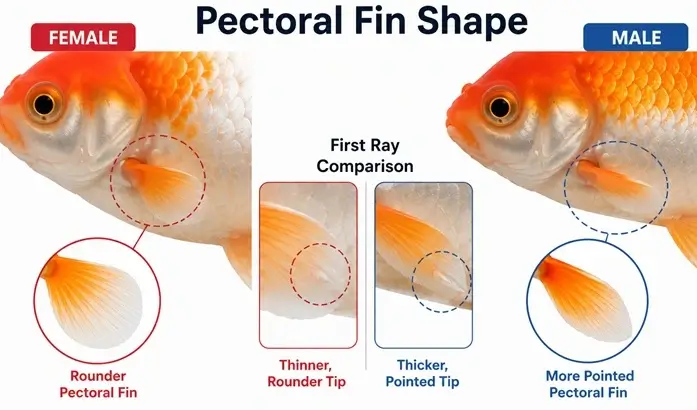
➜ Compare both fins side by side — pointed and elongated leans male, rounded leans female
➜ Combine with the tubercle check — the same fin location where tubercles first appear
➜ Treat this as a supporting sign — on its own it’s subtle and easy to misjudge
Midline Ridge
A raised ridge running along the underside of the body from the pelvic fins to the vent is typically more pronounced in males, while females usually show a faint ridge or none at all.
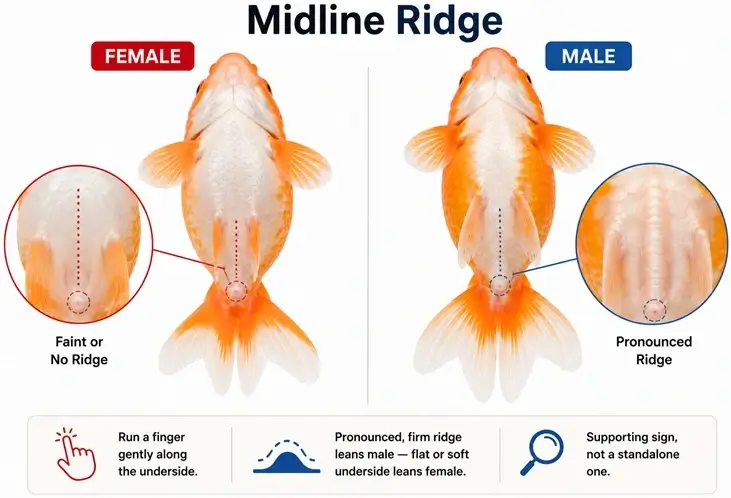
➜ Run a finger gently along the underside — or look closely under good lighting
➜ A pronounced, firm ridge leans male — a soft, flat underside leans female
➜ This is a supporting sign, not a standalone one — some long-bodied females can show a faint ridge too
Chasing Behavior During Breeding Season
During spawning season, male goldfish chase females, often nudging or bumping them repeatedly, sometimes hard enough to knock loose a scale or two. Seeing this pattern is a strong behavioral clue, the fish doing the chasing is very likely male, and the one being chased is very likely female.
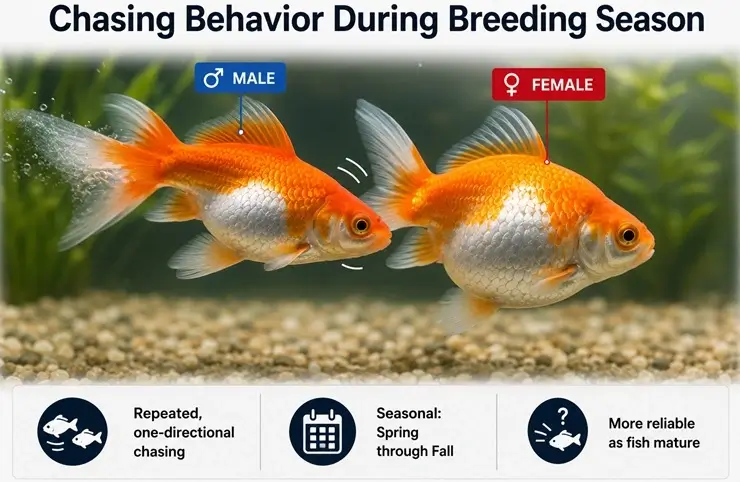
➜ Watch for repeated, one-directional chasing — not general activity or normal swimming together
➜ This is seasonal — it won’t be visible outside spring through fall in most climates
➜ Young fish can behave ambiguously — this sign becomes more reliable as fish mature, less so in younger goldfish still sorting out social dynamics
The Only 100% Certain Method
Every sign above is a strong clue, but the only fully definitive way to sex a goldfish is watching it actually spawn. A male releases milt, visible as faint, smoke-like white wisps in the water. A female releases eggs, visible as small, round, translucent dots. There’s no ambiguity once you’ve seen either happen directly.
At What Age Can You Tell?
Goldfish show no reliable sexual differences as juveniles, sexing a young fish is essentially guesswork, pet store claims included, short of genetic testing. Sexual maturity typically arrives around 9 to 12 months, though it can range from several months to a few years depending on the fish’s size, health, and growing conditions.
➜ Don’t attempt to sex juveniles — wait until the fish is clearly adult-sized and mature
➜ If you want both sexes, buy at least six — statistically, there’s roughly a 98% chance at least one will differ in sex from the rest
➜ Health affects accuracy — a stressed or malnourished fish may not show typical signs even at a mature age, so healthy, well-fed fish are easier to sex correctly
Why Sexing Fancy Goldfish Is Harder
Every sign in this guide gets less reliable the more a fancy goldfish’s body has been selectively bred away from the natural shape. Round-bodied varieties like Ranchu and Ryukin make body-shape comparisons nearly meaningless, since both sexes are naturally deep and round. Long-finned varieties like Veiltail make fin-based judgments harder too, since flowing fins obscure the fin-ray details that work reasonably well on plainer varieties. For these breeds specifically, lean more heavily on vent shape, tubercles, and breeding-season behavior rather than body or fin shape. The best way to sexing fancy goldfish by feeling the belly firmness underneath by gently pressing it. For females the belly underneath near the anus would be spongy and soft. For male it would be hard and solid.
Goldfish Male or Female: Pictures
Seeing real male and female goldfish side by side often makes the difference clearer than any written description. Here’s what to look for across varieties of Goldfish.
Common Goldfish Gender
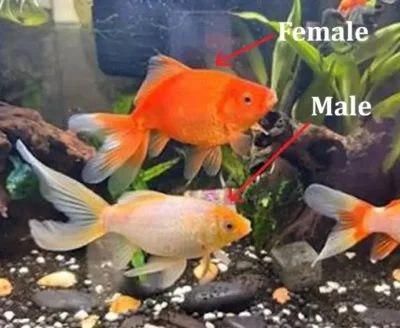
Oranda Goldfish Gender
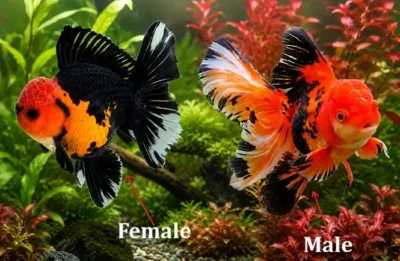
Ryukin Goldfish Gender
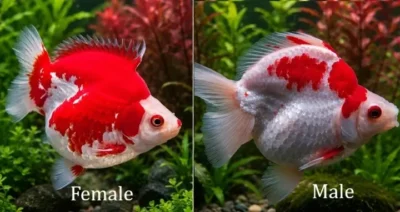
Ranchu Goldfish Gender
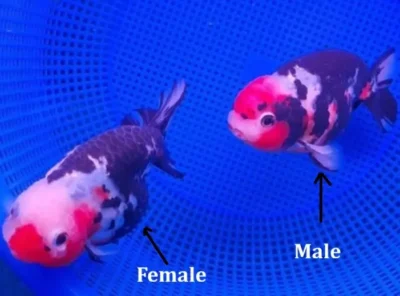
Comet Goldfish Gender
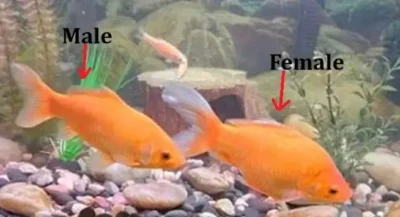
For the specific physical signs that tell them apart, see the full breakdown above, belly firmness, breeding tubercles, vent shape, body shape, fin shape, and the midline ridge, each covered with its own comparison photo.
Quick Checklist: Sexing Your Goldfish
➜ Confirm the fish is actually mature — sexing a juvenile isn’t possible with any reliability
➜ Gently check belly firmness first — soft and yielding leans female, firm and hard leans male, always with the lightest possible touch
➜ Check the vent shape next — narrow and concave leans male, round and protruding leans female
➜ Look for breeding tubercles — on the pectoral fins and gill covers, remembering their absence doesn’t rule out male
➜ Rule out Ich if you see white spots — check the pattern, size, and whether other fish are affected before assuming either explanation
➜ Compare body shape only within the same age and breed — and skip this method entirely for Ranchu or Ryukin
➜ Watch behavior during breeding season — persistent one-directional chasing is a strong supporting clue
➜ Combine at least two or three signs — before concluding either way with real confidence
Frequently Asked Questions
How do you tell a goldfish gender?
The clearest single check is gently pressing the belly, firm leans male, soft leans female. Combine that with vent shape, breeding tubercles, and body shape for a more confident read, since no one sign is foolproof by itself, though tubercles and firmness are the two strongest indicators available.
Is it safe to press a goldfish’s belly to check its gender?
Yes, if done correctly, this should be the lightest possible touch, closer to a gentle feel than any real pressure. This works because a female’s abdomen really softens as she develops eggs, the same reason the technique overlaps with hand-spawning. Pressing hard is unnecessary and can injure the fish, since this area is close to the reproductive organs and internal cavity.
Can you tell a goldfish’s gender without breeding season?
It’s harder but not impossible. Vent shape and body shape can sometimes still be judged by an experienced eye year-round, though breeding tubercles and chasing behavior are seasonal and won’t be visible outside spring through fall.
Do all male goldfish get breeding tubercles?
No. A meaningful number of healthy, confirmed males never develop visible tubercles, so their absence doesn’t mean a fish is female, it just means this one sign isn’t available to you.
How do you know if a goldfish is a boy or a girl?
Check a combination of signs rather than relying on just one: belly firmness (soft leans female, firm leans male), vent shape (rounder and protruding leans female, narrow and slit-like leans male), breeding tubercles (small white bumps on the gill covers and pectoral fins, common on males), and body shape (rounder and deeper leans female, though this is less reliable on round-bodied fancy varieties). None of these work reliably until the fish reaches sexual maturity, usually around 9 to 12 months old.
Can female goldfish get breeding tubercles too?
Rarely, yes, particularly in certain breeds like Ryukin or Black Moor. It’s uncommon enough that tubercles are still a strong male indicator, just not an absolute one.
How do I know if my goldfish is pregnant?
Goldfish don’t get pregnant in the mammal sense, they’re egg-layers. A gravid female full of developing eggs shows a rounder, sometimes visibly lopsided body as spawning approaches. Our Goldfish Not Eating guide covers this in more detail, including why appetite can dip slightly in a gravid female.
Are male or female goldfish more colorful?
Males are sometimes described as slightly brighter or more vibrant, but this is a weak, secondary sign at best, not something to rely on for an actual determination.
What if the white spots on my goldfish’s gills aren’t tubercles?
If the spots are randomly sized, scattered irregularly rather than clustered on the pectoral fins and gill covers, or paired with flashing and scratching, Ich is the more likely explanation. Our Goldfish Turning White guide covers Ich and how to tell it apart from harmless color and pigment changes.
Final Thoughts
No single sign reliably sexes a goldfish on its own, vent shape, tubercles, body shape, fin shape, and breeding behavior all work best combined rather than trusted individually, and every one of them only becomes visible once a fish reaches sexual maturity. The most important practical takeaway is the tubercle-versus-Ich distinction, since mistaking one for the other leads to unnecessary treatment of a perfectly healthy fish. For a gravid female showing the egg-related body changes covered here, our Goldfish Not Eating guide has more detail on that specific overlap.