
If you find fluffy, white or gray cotton-like growths on your goldfish’s body, fins, or mouth, it’s almost certainly a goldfish fungal infection — sometimes called cotton wool disease. It is one of the more common secondary problems in the hobby, usually showing up on a fish that’s already stressed, injured, or fighting something else. It is not unique to goldfish either. These are the same organisms that affect bettas, livebearers, koi, and many other freshwater fish in the hobby.
Quick Navigation
➜ What Is a Goldfish Fungal Infection?
➜ Goldfish Fungal Infection Quick Facts
➜ Goldfish Fungal Infection Symptoms
➜ The Different Types of Goldfish Fungal Infection
➜ Goldfish Fungus vs Mouth Rot?
➜ Goldfish Fungal Infection Causes
➜ Goldfish Fungal Infection Treatment
➜ How to Prevent Goldfish Fungal Infection
➜ FAQ
➜ Final Thoughts
What Is a Goldfish Fungal Infection?
Despite the name, what is commonly called “fish fungus” is usually caused by water molds rather than true fungi. Saprolegnia and Achlya are two of the most common culprits. They are grouped together colloquially because they look and behave similarly, forming raised, fluffy, cotton-like patches on the skin, fins, mouth, or gills.
These organisms are always present in aquarium water in spore form, and a healthy goldfish generally resists them without any issue. An infection takes hold specifically when something else has already weakened the fish’s immune system, like an injury, poor water quality, or general stress. This is why fungal infections are almost always secondary rather than the original primary problem.
Goldfish Fungal Infection Quick Facts
| Attribute | Details |
|---|---|
| Cause | Usually water molds (Saprolegnia, Achlya), often called fungus colloquially |
| Also Affects | Not goldfish-specific — common in bettas, livebearers, koi, and most freshwater fish |
| Main Symptoms | White, gray, or tan fluffy cotton-like patches on the body, fins, mouth, or gills |
| Usual Cause | A pre-existing injury, illness, or stress from poor water quality |
| Standard Treatment | Water change, aquarium salt, and methylene blue or an antifungal medication |
| Treatment Length | 1 to 2 weeks for the common skin form; the rare gill form is much harder to treat |
Goldfish Fungal Infection Symptoms
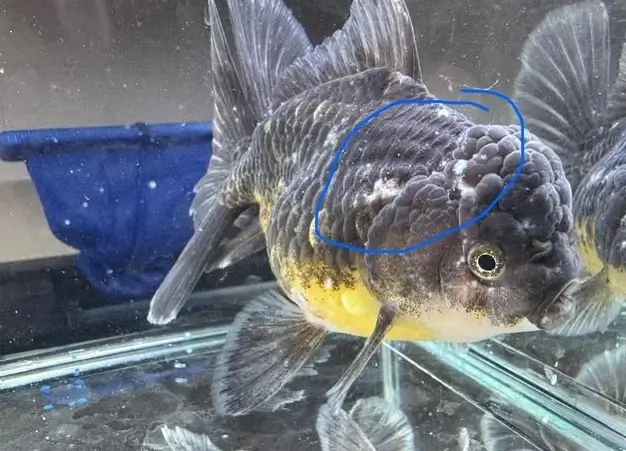
White spots limited only to the wen (the head growth on Orandas, Lionheads, and Ranchus) are usually just new tissue growth or shedding slime and are not real fungus. It’s likely harmless if the fish is active, eating, and there’s no redness or rotting look. Take it seriously if spots spread past the wen, turn red, or the area looks sunken.
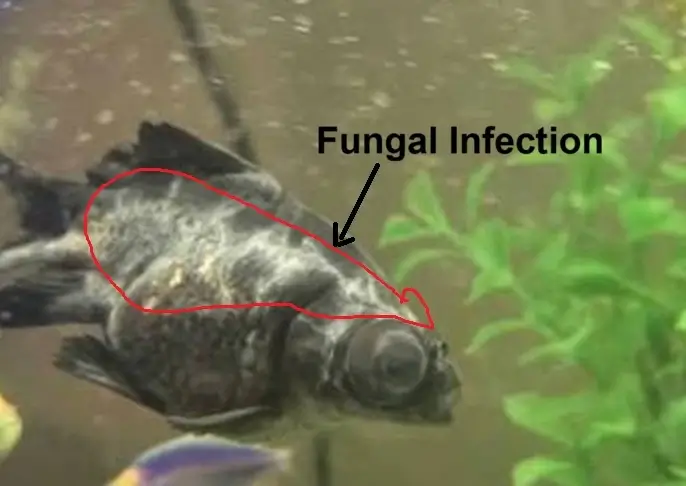
Here are some of the most common goldfish fungal symptoms:
• Fluffy, cotton-like patches in white or gray, sometimes taking on a reddish tinge as the infection worsens
• Those fluffy and cotton-like patches growing on the body, fins, mouth, eyes, or gills, usually developing right on top of an existing injury or weak spot
• Pale or mottled gills, particularly if the infection has reached the gills
• Rapid or labored breathing, sometimes with goldfish gasping at the surface in more serious gill-involved cases
• Lethargy, hiding, and loss of appetite
• Sudden death in severe or advanced cases, particularly with gill involvement
The Different Types of Goldfish Fungal Infection
Not all “fungal infections” carry the same risk, and it’s worth knowing which one you’re actually dealing with.
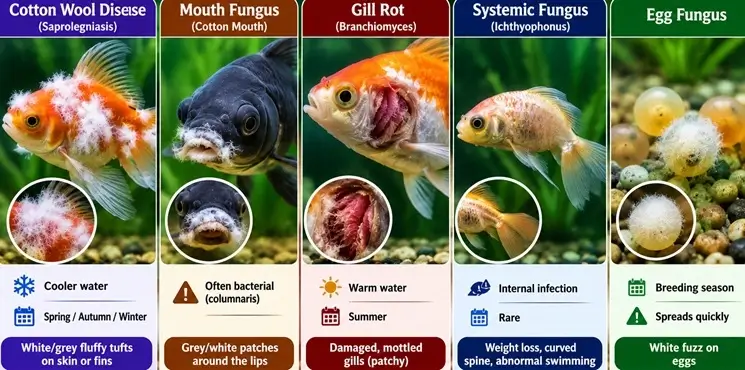
Below are some of the common fungal infections and conditions that can look like fungal infections:
Cotton wool disease (Saprolegniasis):
This is by far the most common type, showing up as white, gray, or occasionally green-tinged (if algae grows on top of it) fluffy tufts on the skin or fins.
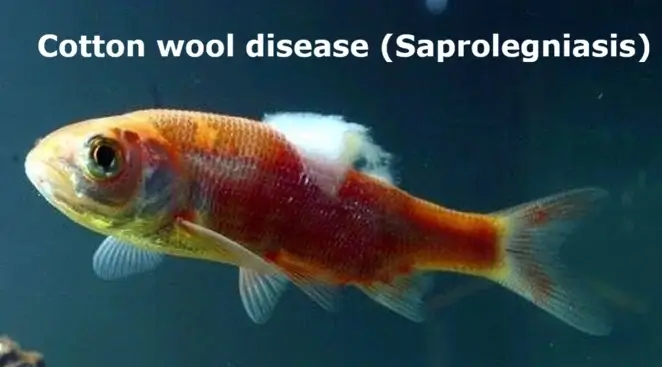
It tends to appear more in cooler water. Early spring, late autumn, and winter are the seasons it shows up the most. It often develops on tissue that has already been damaged by injury, parasites, or bacterial infections. While it needs treatment, it responds reasonably well once you treat it.
To detect cotton wool disease, look for raised, fluffy, white, gray, or greenish patches on the skin, fins, or mouth.
Mouth fungus:
Mouth fungus (cotton mouth or columnaris) looks like gray or white patches specifically around the lips.
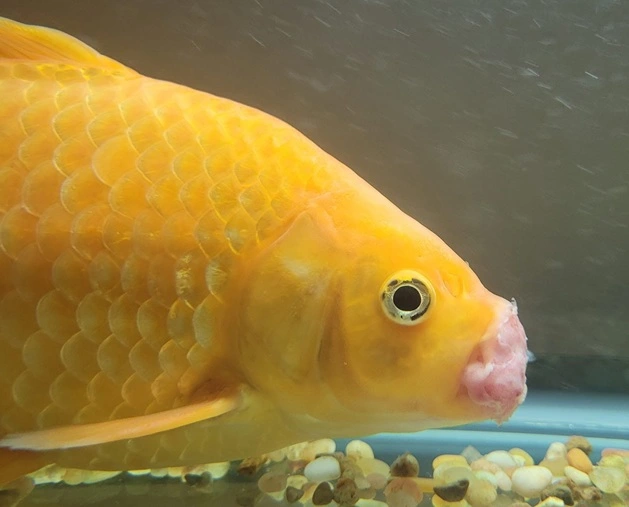
As covered in more detail below, this one is frequently a bacterial infection (columnaris) rather than a true fungal one, even though it looks and behaves similarly.
Detecting Columnaris (mouth rot) early requires looking for flat, grayish-white patches on a fish’s body, mouth, or fins rather than fuzzy, raised fungal tufts.
Gill Rot:
Gill rot is caused by the true fungus called Branchiomyces, which is a different situation entirely. It favors warm water, high waste levels, and overcrowded tanks, which is why it tends to show up in summer mostly. It destroys the gill tissues directly, causing them to die, and it is one of those diseases that is difficult to treat successfully.
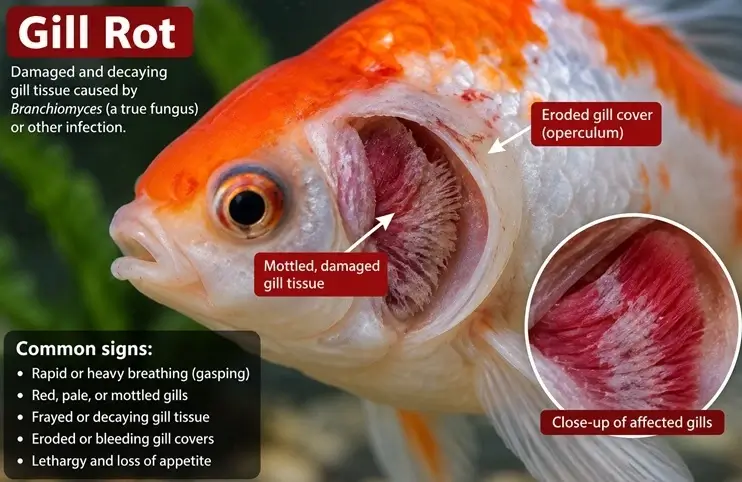
Common symptoms include rapid or heavy breathing, constant gasping, lethargy, and loss of appetite. The gills can appear red, pale, mottled, or patchy. The hard gill covers can also become eroded or thin, or begin to bleed.
To detect gill rot (often caused by fungi like Branchiomyces or bacterial/environmental issues), look for severe respiratory distress paired with discolored, mottled, or decaying gills.
Systemic infection (Ichthyophonus):
Ichthyophonus infection is rare and attacks internal organs and muscle tissue rather than the skin, so there is often no visible growth at all. Instead, it can cause chronic wasting, loss of appetite, weakness, spinal curvature, erratic or unbalanced swimming, and general lethargy as the disease progresses.
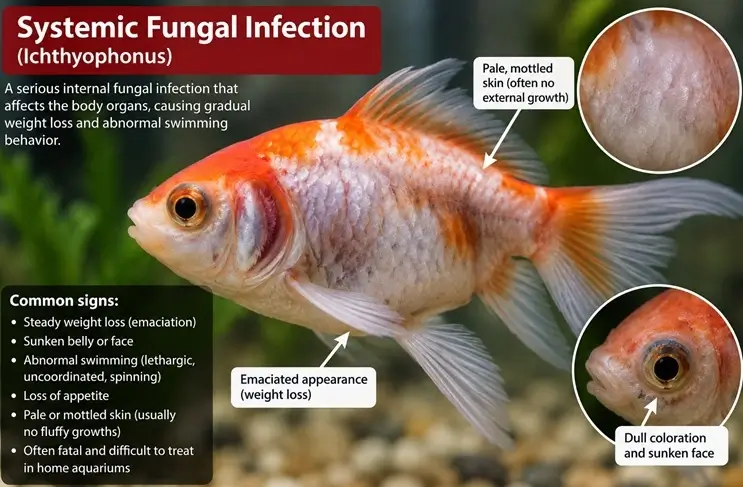
It is usually difficult to treat in a home aquarium and may only be confirmed after the fish has died. If your goldfish is steadily losing weight, swimming abnormally, and has no visible external growth, a vet can help determine whether it could be a systemic infection rather than a typical external fungal infection.
A definitive diagnosis usually requires microscopic examination of internal tissues after the fish dies. Ichthyophonus is very rare in aquarium fish and is commonly identified by examining these tissues.
Egg fungus:
Egg fungus is a separate situation entirely for anyone breeding goldfish. Unfertilized or dead eggs are highly vulnerable to fungal growth, and an infected egg can spread a white fuzz to healthy eggs nearby if it isn’t removed.
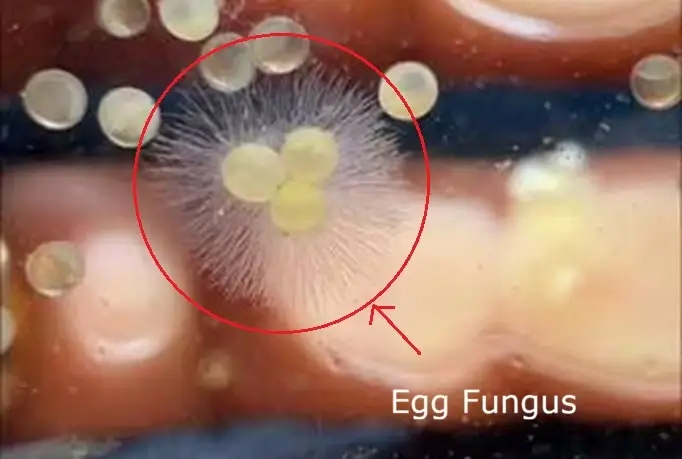
The water molds responsible for egg fungus, such as Saprolegnia, can also affect living goldfish when their skin or slime coat has been damaged. Injuries, parasite wounds, fin damage, and poor water quality can make it easier for the mold to take hold. On a live fish, it usually appears as the same white, gray, or cotton-like growth seen with cotton wool disease.
To detect egg fungus, look for white, gray, or fuzzy growth developing on dead or unfertilized eggs, often spreading to nearby eggs.
Goldfish Fungus vs Mouth Rot?
Growths specifically around the mouth are commonly mistaken for fungus when they’re actually mouth rot — a bacterial infection caused by columnaris, not a fungal one at all. The two can look remarkably similar at a glance, both showing up as off-white or gray patches around the lips.
The distinction matters because the treatments are completely different. True fungal patches respond to antifungal medication and salt, while bacterial mouth rot needs an antibiotic instead. If you’re not sure which you are looking at, treating for mouth rot first is generally the safer assumption, since it’s the more common cause of mouth-specific growths and antibiotics won’t cause harm if the actual issue turns out to be fungal.
Goldfish Fungal Infection Causes
• An existing injury — a scrape, torn fin, or wound from fighting gives the organism a foothold it wouldn’t otherwise have
• Poor water quality, including waste buildup, elevated ammonia or nitrate, and infrequent cleaning
• An existing parasite or disease, such as ich or a fluke infestation, which damages the skin or gills enough to let fungal spores take hold on top of it
• Overcrowding and general stress from incompatible or aggressive tank mates
• A poor or repetitive diet, which weakens overall immune resilience over time — and moldy food itself, often from handling it with wet fingers, can introduce spores directly
• Age or a weakened immune system generally, including fish already recovering from another illness
Goldfish Fungal Infection Treatment
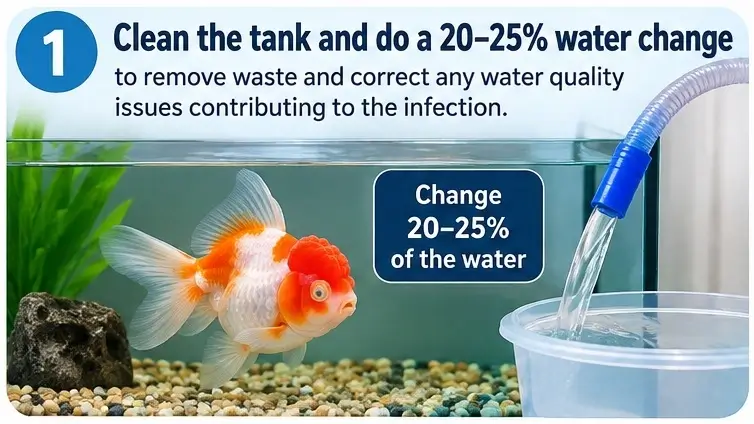
1) Clean the tank and do a 20–25% water change to remove waste and correct any water quality issues contributing to the infection.
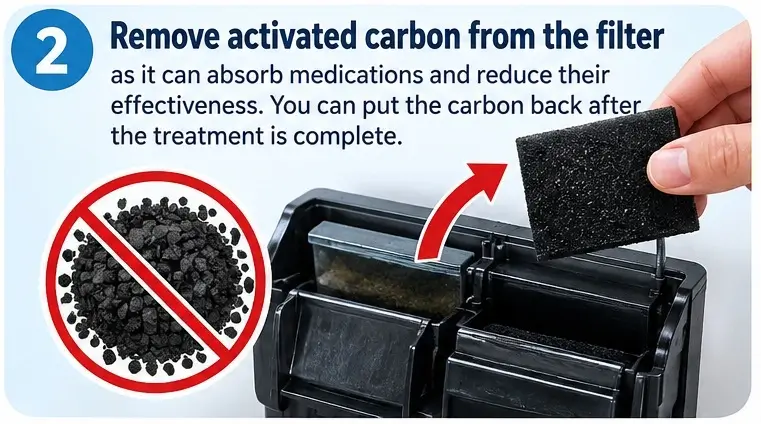
2) Remove any activated carbon from the filter before medicating, as it can absorb some medications and reduce their effectiveness. You can put the carbon back after the treatment is complete and the medication has been removed from the water.
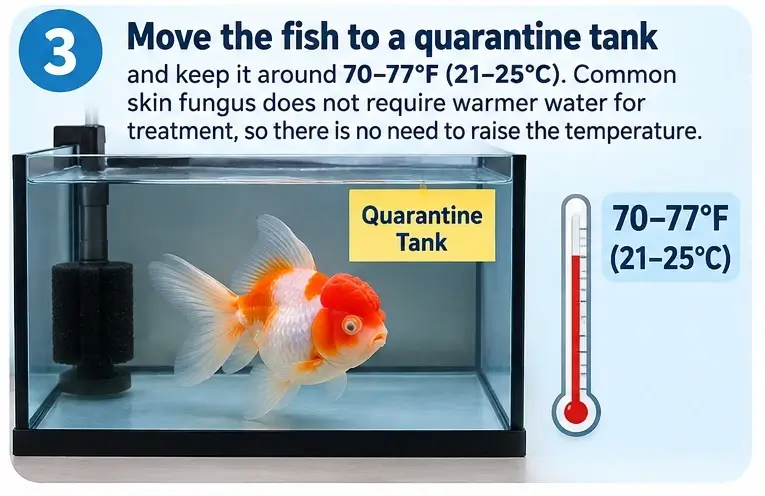
3) Move the fish to a quarantine tank and keep it around 70–77°F (21–25°C). Unlike some bacterial infections, common skin fungus does not require warmer water for treatment, so there is no need to raise the temperature. Some fishkeepers do warm the water slightly, since it can speed up how quickly certain medications work, but this isn’t necessary for a straightforward case, and goldfish generally do better kept in their normal comfortable range while recovering.
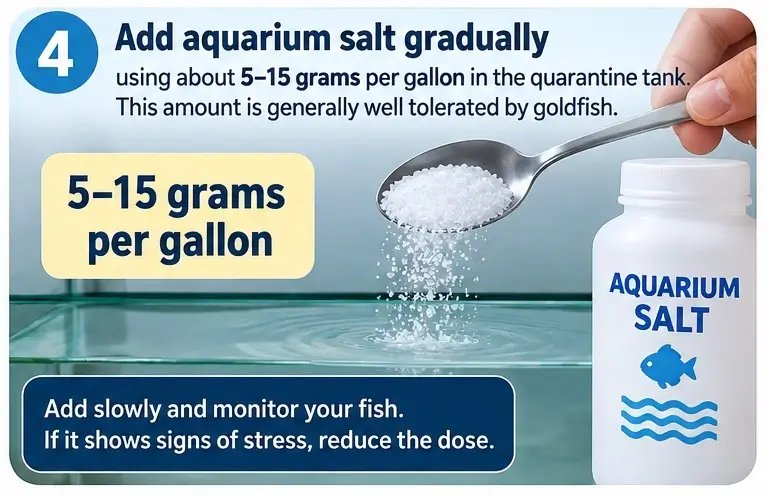
4) Add aquarium salt gradually, using about 5–15 grams per gallon in the quarantine tank. This amount is generally well tolerated by goldfish. Some experienced fishkeepers use stronger doses for stubborn cases, but these should be added very slowly over 24 hours or more. If the fish starts losing its balance, remove it immediately and reduce the salt dose by half. Another option is a short salt bath using about 15 grams of salt per gallon for 10 to 15 minutes, repeated every other day.
5) Add methylene blue to the water alongside the salt, or swab it directly onto a small, localized patch with a cotton swab for spot treatment.
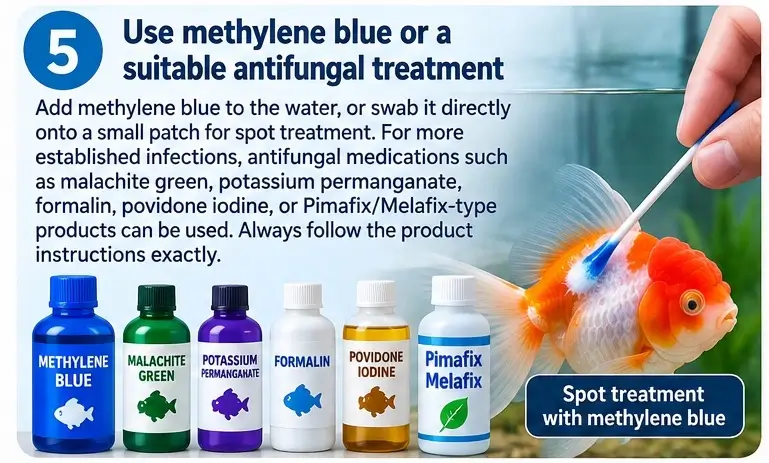
For a more established infection, a proper antifungal treatment can be added. Malachite green, potassium permanganate, formalin, and povidone iodine are all commonly used options, alongside Pimafix/Melafix-type formulas. Malachite green in particular is effective but truly harmful if overdosed or used on an already weak fish, so follow product instructions exactly rather than estimating.
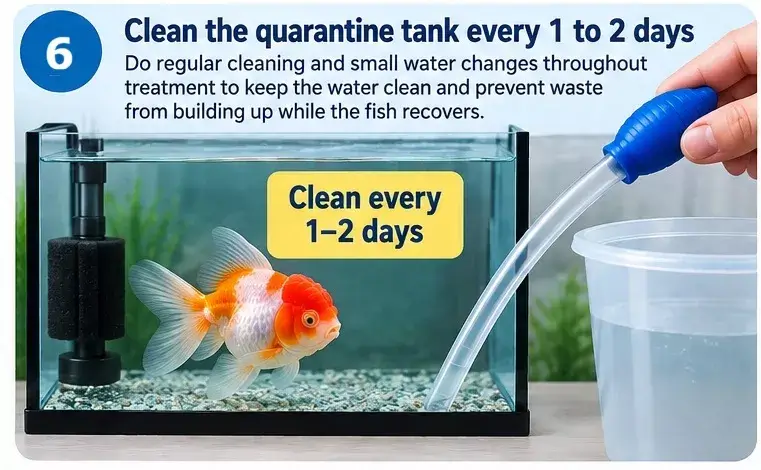
6) Clean the quarantine tank every 1 to 2 days throughout treatment to keep conditions as sterile as possible while the fish recovers.
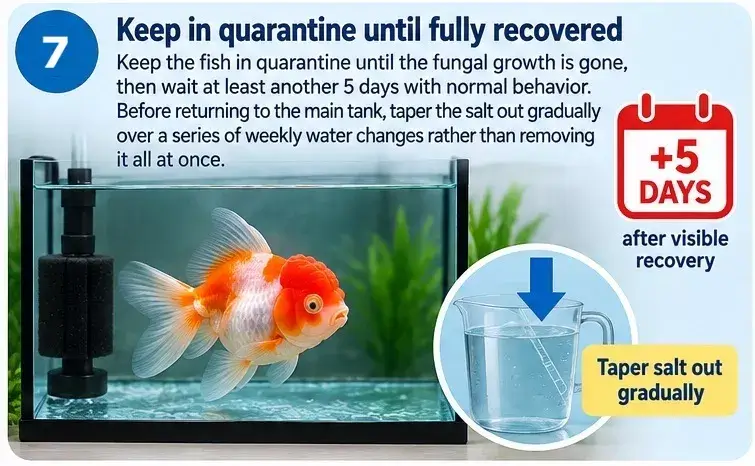
7) Keep the fish in quarantine until every trace of the growth is gone, then wait at least another 5 days after it’s visibly cleared and the fish is swimming, eating, and behaving normally. Before returning the fish to the main tank, it is better to taper the salt out gradually over a series of weekly water changes rather than removing it all at once.
8) If the infection has reached the gills and is true Branchiomyces gill rot, it needs a different and more aggressive treatment. It can be difficult to treat successfully, so getting help from an aquatic vet is recommended. In severe cases where the fish does not respond to treatment, humane euthanasia may be the kindest option to prevent prolonged suffering.
Feed live or high-quality food throughout treatment if the fish is still eating, since good nutrition speeds up the recovery meaningfully. When you do reintroduce the fish, keep an eye on the rest of the tank for a few days afterward in case any other fish show signs of the same infection.
How to Prevent Goldfish Fungal Infection
• Keep water quality high with regular water changes and proper filtration for your goldfish’s actual bioload
• Treat any injury, parasite, or other illness promptly, since fungal infections are almost always a secondary problem riding on top of something else
• Avoid overcrowding and remove aggressive or fin-nipping tank mates
• Feed a varied, fresh diet, and avoid handling food with wet fingers or leaving opened food exposed to moisture for long periods, since both let mold spores in directly
• Remove dead fish, uneaten food, or decaying plant matter from the tank promptly
• Feed smaller portions 2 to 3 times a day rather than one large feeding — excess uneaten food is a major source of the organic waste that lets fungal spores take hold
• Do a thorough, top-to-bottom tank cleaning at least once a month — rinsing gravel and décor and scrubbing the glass keeps organic buildup from accumulating between routine water changes
• Quarantine new fish before adding them to your main tank
FAQ
Is a Goldfish Fungal Infection Contagious?
Not directly. Fungal spores are already present in most aquariums, and healthy fish usually don’t develop an infection simply from sharing the same water. Fungal infections usually take hold when a fish is stressed, injured, or weakened by poor water quality. Quarantine is still a good idea to treat the affected fish and correct any problems in the tank.
Can a Fungal Infection Kill My Goldfish?
Yes. If left untreated, a fungal infection can sometimes be fatal. Common skin infections are rarely deadly when caught early and treated, but gill rot can be much more serious because it damages the gill tissue the fish needs to breathe.
Is This Fungus, or Ich, or Velvet?
Texture is the giveaway. Fungus looks raised and cottony or fluffy. Ich looks like distinct, hard, salt-grain-like dots. Velvet looks like a fine, gold or rust-toned dust rather than a raised growth at all. If you’re seeing an actual fluffy patch rather than dots or dust, fungus is the more likely answer.
Can I Treat Fungus With Salt Alone?
For a mild, early case, salt alone sometimes clears it, especially combined with better water quality. For anything more established, pairing salt with methylene blue or a proper antifungal gives a much more reliable result than salt by itself.
How Long Does Treatment Take?
Common skin-level infections typically clear within 1 to 2 weeks of consistent treatment. Gill rot takes much longer if it responds at all, and some cases don’t recover despite aggressive treatment.
Final Thoughts
Most goldfish fungal infections affect the skin and are treatable when caught early. They are rarely fatal. Clean water, proper treatment, and good care usually help the fish recover.
Gill rot is different. It is rare but serious because it damages the gills and can make it hard for the fish to breathe. If your goldfish is constantly gasping and its gills look damaged, act quickly and consider getting help from a vet.
See our complete goldfish diseases guide on all other disease symptoms, pictures, and treatment for all of them.