Goldfish gill flukes (Dactylogyrus) are tiny parasitic flatworms that attach to the delicate tissues of the gills, where they can interfere with breathing and cause significant irritation. Some species are only around 0.3–0.5 mm long, making them too small to identify reliably with the naked eye. These microscopic parasites can be difficult to eliminate because Dactylogyrus lays eggs that can survive treatment, allowing new parasites to hatch after the initial treatment. Heavy infestations can severely damage the gills and become life-threatening. Gill flukes are not exclusive to goldfish and can infect many other freshwater fish, including guppies, mollies, and bettas.
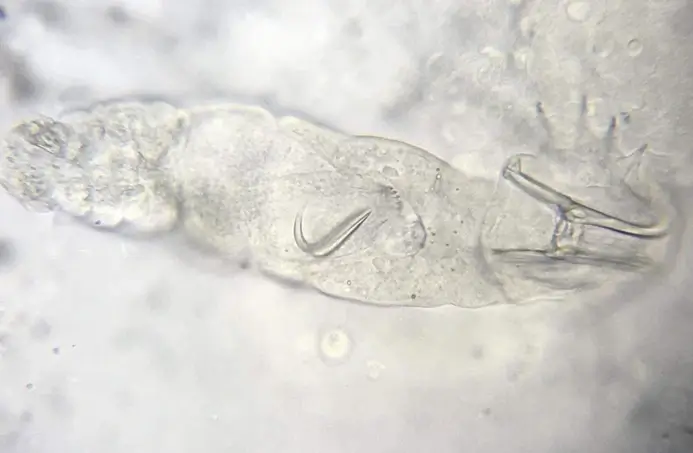
Most fish keepers never actually see the worm itself. Instead, they notice their goldfish gasping at the surface, breathing rapidly, or scraping against decorations. The good news is that gill flukes can be treated, with praziquantel being one of the medications commonly used against these parasites.
Quick Navigation
1) What Are Gill Flukes?
2) Gill Flukes Quick Facts
3) Gill Flukes Symptoms
4) Gill Flukes Causes
5) Gill Flukes Treatment
6) How to Prevent Goldfish Gill Flukes
7) FAQ
8) Final Thoughts
What Are Gill Flukes?
Gill flukes (Dactylogyrus) are tiny parasitic flatworms called monogeneans. They attach to the delicate tissues of a fish’s gills using a specialized attachment organ called a haptor, which contains hooks that help the parasite remain attached to its host.
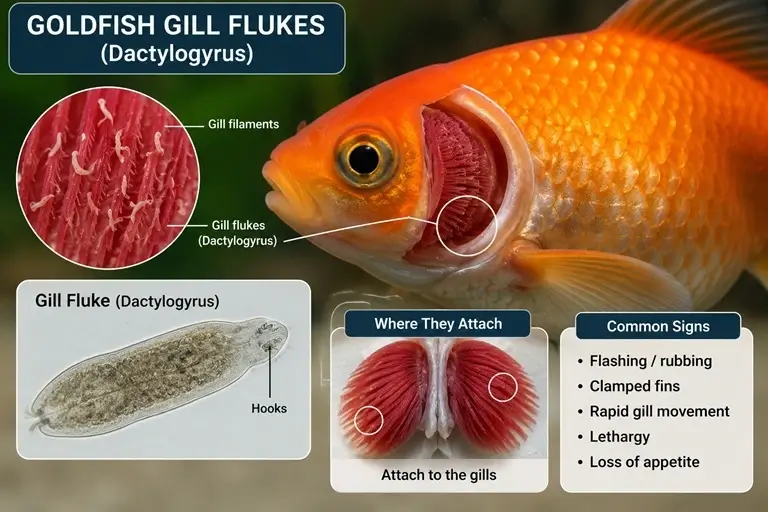
• Gill flukes live primarily on the gills. They attach to the gill tissue, where heavier infestations can cause irritation, tissue damage, and interference with normal breathing.
• They reproduce by laying eggs. These eggs are one of the reasons gill flukes can be difficult to eliminate, since treatment may kill susceptible stages of the flukes while eggs survive the medication and hatch later.
• They are extremely small. Gill flukes are best identified under a microscope rather than by trying to see the parasite on the fish.
• They have a direct life cycle. Gill flukes do not need an intermediate host such as a snail to complete their life cycle, allowing the parasite to spread between susceptible fish in the same aquarium or pond.
Gill Flukes Quick Facts
| Attribute | Details |
|---|---|
| Type | External parasitic flatworm (monogenean) |
| Parasite | Dactylogyrus spp. |
| Main Location | Gills |
| Reproduction | Egg-laying |
| Main Symptoms | Rapid breathing, gasping, flashing/rubbing, excess gill mucus, lethargy and reduced appetite |
| Can It Spread? | Yes — gill flukes have a direct life cycle and can spread between fish |
| Main Treatment | Praziquantel is commonly used; follow the specific product directions |
| Repeat Treatment? | Often necessary because eggs may survive treatment and hatch later |
| Confirmed Diagnosis | Microscopic examination of gill tissue or mucus by a fish veterinarian or experienced fish-health professional |
Gill Flukes Symptoms
• Rapid or labored breathing — the gills may visibly move faster than normal, and the gill covers may appear more widely distended.
• Gasping at the surface — heavy infestations can damage the gills and make it harder for the fish to take up enough oxygen from the water.
• Flashing or rubbing against objects — irritation caused by the parasites may make a goldfish scrape itself against the substrate, rocks, plants, or decorations.
• Excess mucus around the gills — irritated gill tissue may produce increased mucus, particularly in heavier infestations.
• Pale, swollen, or irritated gills — these changes become more noticeable as the infestation and gill damage worsen.
• Faded coloration — heavily affected fish may become noticeably paler or lose some of their normal color.
• Lethargy and reduced appetite — a badly affected goldfish may become less active, spend more time near the surface, or stop showing its normal interest in food.
In the early stages, gill flukes can look a lot like other problems that affect the gills, including poor water quality, ich, velvet, or bacterial gill disease. Symptoms alone cannot confirm gill flukes, so check your water parameters first and consider microscopic examination when the cause is unclear.
Gill Flukes Causes
• Introducing an infected fish without quarantine is one of the main ways gill flukes enter an aquarium or pond. A newly purchased goldfish may carry the parasite without obvious symptoms and introduce it to other fish.
• Contaminated wet equipment can potentially move gill flukes between tanks. Nets, siphons, containers, or other equipment moved while still wet from an affected aquarium can provide another route for the parasite to reach a new tank.
• Stress can turn a low-level infestation into a more serious problem. A goldfish may carry a small number of gill flukes without showing obvious symptoms. Poor water quality, overcrowding, inadequate nutrition, shipping, or other stressors can weaken the fish’s ability to cope with the parasites, allowing the infestation to become more noticeable or severe.
If one goldfish is confirmed to have gill flukes, other fish sharing the same system should be considered exposed, even if they are not yet showing symptoms.
Gill Flukes Treatment
Gill flukes are treatable, and praziquantel is one of the preferred medications for monogenean parasites such as Dactylogyrus. For most goldfish keepers, treating the aquarium or pond water is more practical than treating only the fish showing symptoms.
Because Dactylogyrus lays eggs, a single treatment may not eliminate the infestation. Some eggs can survive and hatch later, making repeat treatment important.
1. Test the Water First
Before adding medication, test ammonia and nitrite and make sure the water is well oxygenated.
Poor water quality and low dissolved oxygen can cause rapid breathing and surface gasping similar to a gill problem. They can also make a goldfish with damaged gills much less able to cope with an infestation.
If ammonia or nitrite is present, correct the water-quality problem first. If the fish is already breathing rapidly or gasping, increase aeration before treatment.
2. Treat the Whole Aquarium
Use a praziquantel-based medication intended for aquarium fish and follow the manufacturer’s dosage for the actual volume of water in your aquarium.
If one goldfish has confirmed gill flukes, other fish sharing the same system should be considered exposed. Treating the whole aquarium also exposes newly hatched parasite stages to the medication.
Don’t increase the dose in an attempt to kill the flukes faster. Praziquantel products differ in concentration and formulation, so follow the directions for the product you are using.
3. Remove Activated Carbon Before Treatment
Remove activated carbon from the filter before adding the medication. Activated carbon can remove medication from the water and reduce the concentration available for treatment.
However, don’t turn off the entire filter.
Keep biological filtration, mechanical filtration and water circulation operating unless the medication instructions say otherwise. This helps control ammonia and nitrite while also allowing medicated water to circulate throughout the aquarium system, including through the filter.
Gill-fluke eggs can remain in the aquarium environment and hatch later, so keeping the system circulating helps expose susceptible parasite stages to the medication.
Other chemical filtration media that remove medications should also be handled according to the product instructions.
4. Increase Aeration
Keep the aquarium well oxygenated throughout treatment.
Gill flukes damage the gills, so heavily affected goldfish may already have difficulty taking up enough oxygen. An air stone or increased surface agitation can help while the fish recovers.
This is particularly important when several fish are breathing heavily or gathering near the surface.
5. Complete the Full Treatment Schedule
Don’t stop treatment simply because the goldfish stops flashing or begins breathing normally.
Dactylogyrus is an egg-laying parasite. Praziquantel can kill susceptible flukes while some eggs survive and hatch later, so repeat treatment is often necessary to break the cycle.
In some protocols, repeat treatments are spaced several days apart, often around 3–5 days, but the correct interval depends on the product and treatment conditions. Always follow the schedule on the praziquantel product you are using.
Water temperature also matters. Gill-fluke eggs generally develop and hatch faster in warmer water and more slowly in cold water.
Treating Gill Flukes in Goldfish Fry and Juveniles
Goldfish fry and juveniles can also get gill flukes and may require treatment when an infestation is present.
Don’t automatically reduce the medication dose simply because the fish are small. Use a praziquantel product suitable for the fish being treated and follow its directions.
Very young fry can be more sensitive to medication and changes in water quality, so maintain strong aeration and excellent water quality and monitor them closely. If the product provides no guidance for very young fry, don’t guess at a reduced dose.
Should You Use a Concentrated Praziquantel Bath?
Praziquantel can also be given as a higher-concentration immersion bath, but this is not usually necessary when the whole aquarium can be treated effectively.
A separate bath treats parasites on the fish during exposure, but it doesn’t treat the main aquarium, where gill-fluke eggs may remain and hatch later.
For most home aquariums, treating the whole system and completing the repeat treatments is the more practical approach. Concentrated baths are better reserved for situations where a specific product protocol or fish-health professional recommends one.
Treating Gill Flukes in a Goldfish Pond
Gill flukes can be harder to spot in a pond because you cannot examine the fish as closely. One warning sign is goldfish repeatedly gathering near the surface and gasping or gulping for air, particularly when accompanied by rapid breathing, flashing or rubbing, reduced feeding, or lethargy.
However, surface gasping alone doesn’t confirm gill flukes. Low dissolved oxygen, poor water quality and other gill diseases can cause similar behavior. If many pond fish suddenly start gasping, especially early in the morning, check oxygen and water quality before assuming parasites are responsible.
Calculate the actual pond volume as accurately as possible and use a praziquantel product suitable for ornamental ponds. Follow its dosage and repeat-treatment schedule.
If the pond filter contains activated carbon or other chemical media that can remove the medication, remove that media as directed. Keep biological filtration, water circulation and strong aeration running.
Gill-fluke eggs generally develop more slowly in cold water, so don’t automatically copy a warm-aquarium treatment interval when treating an outdoor pond.
After Treatment
Continue watching for rapid breathing, gasping, flashing, abnormal gill movement, lethargy or reduced appetite.
After the full treatment course is complete, follow the medication instructions for the recommended water changes. Partial water changes will gradually dilute and remove residual medication from the aquarium. If you normally use activated carbon, fresh carbon can also be returned to the filter after treatment to help remove any medication that remains.
If symptoms continue after the complete treatment course despite good water quality, reconsider the diagnosis. Other gill problems can produce very similar symptoms, and microscopic examination is the most reliable way to confirm whether gill flukes are still present.
How to Prevent Goldfish Gill Flukes
• Quarantine new fish for at least 4 weeks before adding them to your main aquarium or pond. A newly purchased fish can carry gill flukes without showing obvious symptoms, so quarantine gives you time to spot flashing, rapid breathing or other signs before the fish joins your existing stock.
• Don’t share wet equipment between quarantine and established tanks. Nets, siphons, buckets and other equipment can potentially transfer parasites between systems. Keep separate equipment where possible, or properly clean and dry it before reuse.
• Maintain good water quality and avoid overcrowding. Clean, well-oxygenated water doesn’t prevent a goldfish from being exposed to gill flukes, but it reduces stress and helps fish cope better if parasites are introduced.
• Watch new fish closely during quarantine. Rapid breathing, flashing, excessive gill movement or surface gasping should be investigated before moving the fish into your main aquarium or pond.
FAQ
Can gill flukes survive without a fish?
Gill flukes cannot live indefinitely without a host, but Dactylogyrus eggs can remain in the aquarium or pond environment until they hatch. Newly hatched larvae then need to find a suitable fish host to continue their development.
Can gill flukes come in on aquarium plants?
Plants themselves are not hosts for gill flukes, but wet plants, water, or material transferred from a system containing infected fish could potentially introduce parasite eggs or free-swimming stages. This is another reason to be careful about transferring wet items between aquariums.
Can gill flukes infect humans?
No. The Dactylogyrus species that parasitize fish are not human parasites, so you cannot catch goldfish gill flukes from handling your fish or aquarium water. Normal handwashing after aquarium maintenance is still recommended.
Can gill flukes come back after treatment?
Yes. A goldfish can appear better after treatment and then develop symptoms again if eggs survived the initial treatment and subsequently hatched. Reinfection can also occur if an infected fish or contaminated wet material is later introduced into the aquarium.
Can gill flukes live in an empty aquarium?
An aquarium without fish cannot maintain a gill-fluke population indefinitely because the parasite ultimately requires a fish host. However, eggs may remain in the environment for a period of time, with their development and hatching strongly influenced by water temperature.
Final Thoughts
Goldfish gill flukes can be difficult to spot because the parasites themselves are tiny and the early symptoms can resemble other gill problems. The good news is that gill flukes are treatable, with praziquantel being one of the preferred medications. The key is recognizing the symptoms early, checking water quality, treating the shared aquarium or pond, and completing the full repeat-treatment schedule so newly hatched flukes aren’t missed.
For more on keeping your goldfish healthy, see our complete guide to goldfish diseases.