
Despite the name, goldfish anchor worm isn’t actually a worm, it’s a parasite, a distant relative of shrimp and crabs. This is one of the very few parasites in this hobby which is large enough to spot without a microscope. If you have noticed a small white thread poking out from under a scale, this is almost certainly what you are looking at.
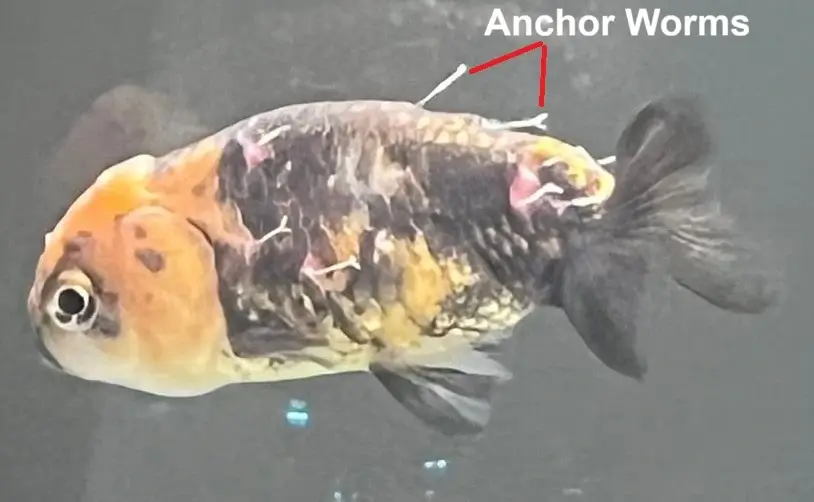
It looks worse than it really is. If you remove the anchor worm early, treat the tank properly, and keep the wound clean, most goldfish recover without any lasting problems. I have saved many goldfish in my hobby simply by removing anchor worms carefully with tweezers.
Quick Navigation
1) What Is Goldfish Anchor Worm?
2) Goldfish Anchor Worm Quick Facts
3) Goldfish Anchor Worm Symptoms
4) Anchor Worm Life Cycle
5) What Causes Anchor Worm in Goldfish?
6) Goldfish Anchor Worm Treatment
7) How to Prevent Goldfish Anchor Worm
8) Goldfish Anchor Worm FAQ
9) Final Thoughts
What Is Goldfish Anchor Worm?
Anchor worm (Lernaea species) is not really a worm. It is a parasite that is more closely related to crabs, lobsters, and shrimp.
• The part you see outside is the adult female. After mating, the female attaches herself to the fish by burying her anchor-shaped head into the muscle. The rest of her body sticks out from the fish, with two egg sacs at the end. This is the part that looks like a small worm.
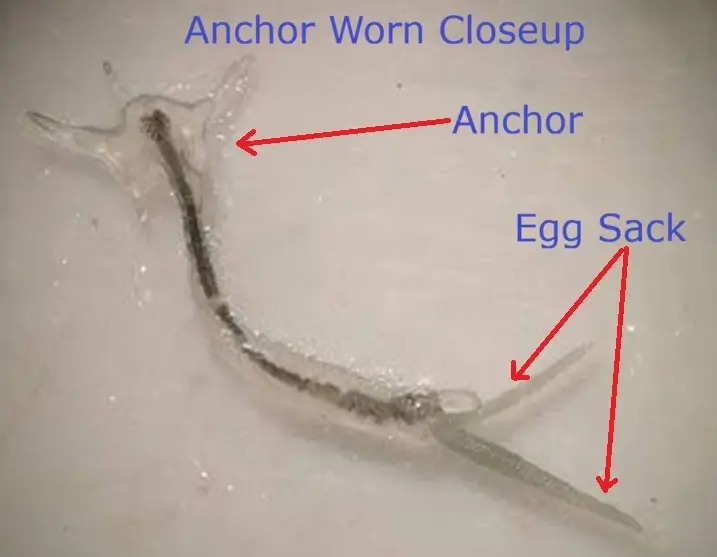
• Only the female anchor worms attach to fish. The males do not attach to the fish. They mate with the females and die within about 24 hours.
• Anchor worms are especially common in goldfish and koi. They can also affect many other freshwater fish and, less commonly, amphibians.
• The visible parasite can grow quite large. It can reach almost an inch in length and is usually white, grey, or greenish in color.
Goldfish Anchor Worm Quick Facts
| Attribute | Details |
|---|---|
| Type | Parasitic copepod (crustacean), not a true worm |
| Visible? | Yes — one of the few goldfish parasites visible without a microscope |
| Common Attachment Sites | Skin, fins, gills, and occasionally the mouth |
| Contagious? | Yes — spreads readily through shared water once established |
| Full Life Cycle | Roughly 18–25 days at warm temperatures |
| Main Treatment | Manual removal plus diflubenzuron (Dimilin) or potassium permanganate |
| Treatment Length | Several weeks, to catch every life stage |
Goldfish Anchor Worm Symptoms
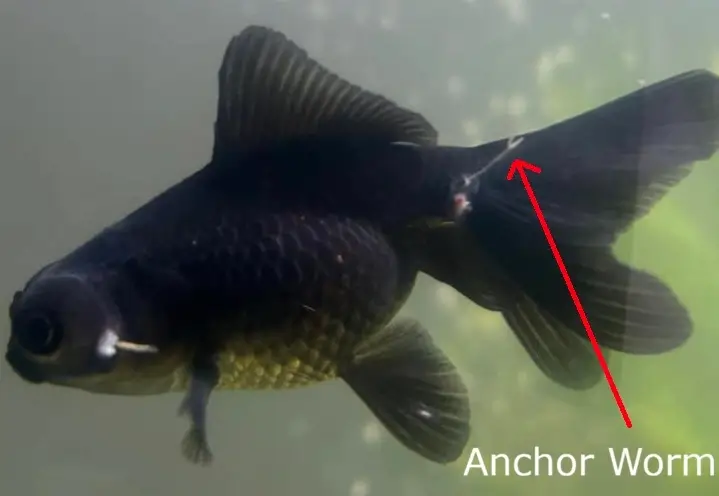
• A visible thread-like structure protruding from the skin, often near the fins, sometimes with one or two small egg sacs attached at the tip.
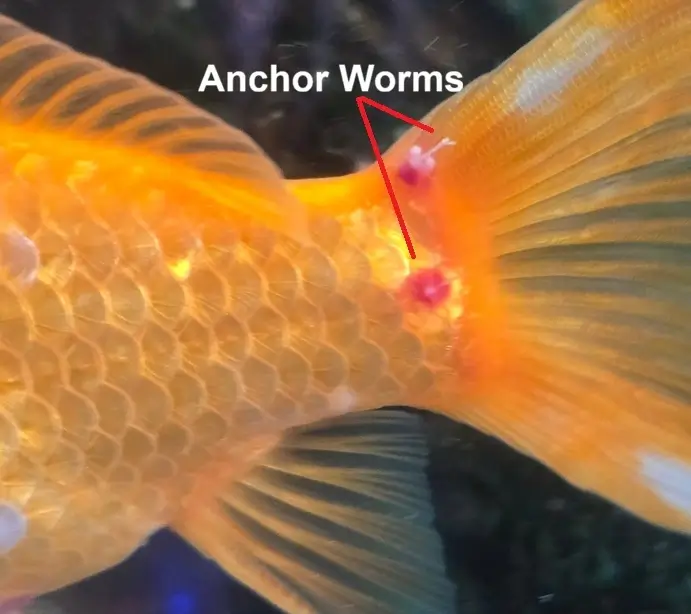
• Red, inflamed, or bloody tissue around the attachment site, sometimes visible before the worm itself is easy to spot.
• Flashing and rubbing against decorations, gravel, or tank walls, as the fish tries to relieve the irritation.
• Lethargy or heavy, labored breathing, especially if the parasite has attached to or near the gills.
• An unusual “baleen” appearance around the mouth in less common cases where the parasite attaches inside the oral cavity.
• Small red lesions with no visible worm can also appear after a worm has already dislodged or been removed — a sign that the wound site itself needs attention, not that the infestation is over.
Anchor Worm Life Cycle
Knowing the life cycle helps explain why one treatment is usually not enough. Anchor worms go through several stages, and the treatment may not kill every stage at the same time.
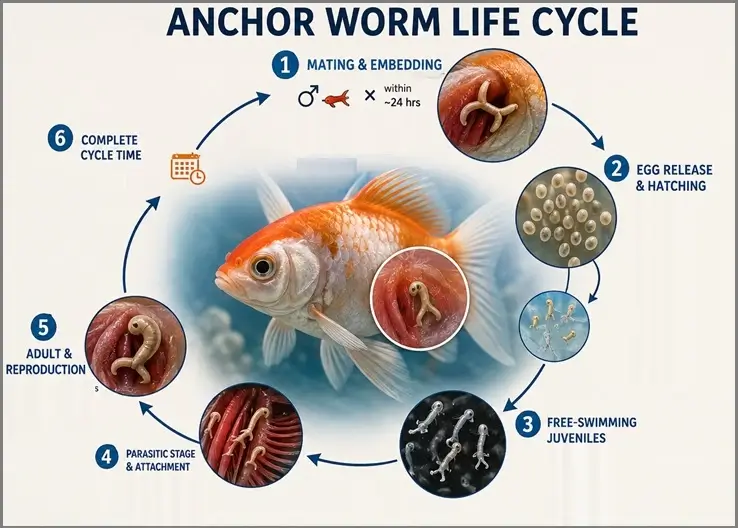
• After mating, the male dies within about 24 hours. The fertilized female bores into the fish and embeds her anchor permanently. This is the stage at which the worm becomes visible.
• Once mature, she can release eggs within 24 hours, and each batch hatches 24–36 hours later. A single female can produce up to 250 juveniles roughly every two weeks, for as long as 16 weeks, in water around 77°F (25°C).
• Newly hatched juveniles are free-swimming and non-parasitic at first, developing through several stages over about 11 days before becoming parasitic and attaching to a host — often on the gills initially.
• The whole cycle, egg to reproducing adult, takes roughly 18–25 days at warm temperatures.
• Temperature controls the pace. The parasite’s optimal range is about 79–82°F (26–28°C). Below 68°F (20°C), juveniles can’t complete development, and below 57°F (14°C), females stop reproducing entirely. The adult females can survive attached to a fish through winter and resume reproducing once the water warms back up.
What Causes Anchor Worm in Goldfish?
• Introducing a new fish without quarantine is the most common source by far. A single infected fish carrying juveniles or an already-attached female can seed an entire tank.
• Live plants can also carry it, either directly or via free-swimming juveniles in the surrounding water, even if the plant itself looks clean.
• Once one fish is confirmed infected, assume the whole tank is exposed. Free-swimming juvenile stages spread through shared water well before symptoms show up on every fish.
• Warm, stagnant, or slow-moving water favors outbreaks, which is part of why anchor worm shows up more often in ponds during summer than in a well-filtered indoor tank.
Goldfish Anchor Worm Treatment
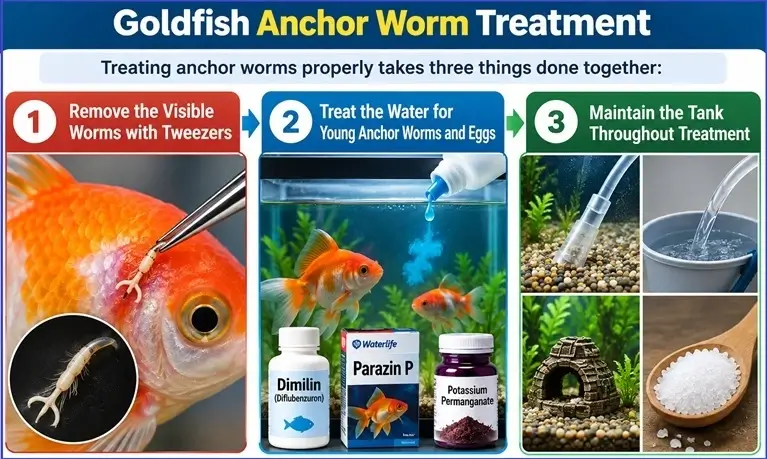
Treating anchor worms properly takes three things done together:
1) Remove the Visible Worms with Tweezers
2) Treat the Water for Young Anchor Worms and Eggs
3) Maintain the Tank Throughout Treatment
1. Remove the Visible Worms with Tweezers
• Grip the worm firmly with clean tweezers, as close to where it enters the skin as possible, and pull it straight out smoothly in one steady motion. Don’t twist or yank sharply. The goal is to remove the whole parasite intact, since leaving the embedded head behind can prolong irritation and infection risk. Remove all the visible worms from the fish.
• Immediately after removal, treat the site with a mild antiseptic to prevent infection while it heals.
2. Treat the Water for Young Anchor Worms and Eggs
• Remove any activated carbon from your filter before dosing, carbon will absorb the medication and make treatment far less effective. The filter itself can keep running, letting medicated water pass through it actually helps treat any parasites hiding in the filter media itself.
• If you have an air stone, run it too. It helps the medication disperse evenly and mix through the whole tank rather than settling in one spot.
• Medicate the whole tank, not just the fish with visible worms. Young anchor worms may already be present on other fish or in the tank even though you can’t see them yet.
• Most regular anti-parasite or anti-ich medicines don’t work well against anchor worms. Anchor worms are related to shrimp and crabs and belong to a group of animals called crustaceans. You need a medicine made to treat crustacean parasites.
• Diflubenzuron, sold as Dimilin and found in products such as Waterlife Parazin P, works by stopping anchor worms from developing normally. Young anchor worms need to shed their outer covering as they grow from one stage to the next. Diflubenzuron prevents this molting process, so the young parasites can’t develop into adults and reproduce. It can also affect adult anchor worms when they molt.
• Potassium permanganate can be used if diflubenzuron isn’t available. It doesn’t usually kill adult anchor worms directly, but it can help weaken the parasite and make it easier to remove by hand. It works best alongside manual removal rather than as the only treatment. Because potassium permanganate can harm fish at the wrong concentration, follow the dosage instructions on the product label and watch the fish closely during treatment.
• If the fish is seriously affected, move it to a small quarantine tank instead of treating the whole main tank. Keep an air stone running there for oxygen and even medication dispersal. If you are also running a filter in the quarantine tank, pause it during dosing and resume it after a few hours, once the medication has had time to work.
• Do a 25-30% water change the day after dosing to reduce the medication’s own toxicity in the water.
• Treat the tank again every 7–10 days for a total of 2–3 treatments, with another 25-30% water change alongside each new round. Some anchor worm eggs may survive the first treatment and hatch during this period, the second and third treatments target these newly hatched parasites before they mature and reproduce.
3. Maintain the Tank Through Treatment
• While doing your scheduled water change, vacuum the substrate and clean decorations or plants, since dormant eggs and larvae can settle there between treatments
• A mild, ongoing salt dose (roughly 1 teaspoon per gallon) can help protect open wounds from secondary infection, though salt alone isn’t reliable enough to clear an established infestation on its own.
• Check every removal site daily for redness, fuzz, swelling, and any signs of a secondary infection that would need separate antibiotic treatment.
How to Prevent Goldfish Anchor Worm
Anchor worms usually get into an established tank from outside. They can come in with a new fish, new plants, or contaminated water. In outdoor ponds, they can also be brought in by wildlife such as birds or frogs. The best way to prevent anchor worms is to be careful about what you add to your tank or pond.
• Quarantine every new fish for 2–4 weeks before adding it to your main tank or pond, even if it looks healthy. This gives you time to spot anchor worms or other parasites that may not be visible when the fish first arrives.
• A short preventive dip, up to about 30 minutes in a mild parasite or antiseptic treatment, can add extra protection when you first put the fish in quarantine. But it does not replace the full quarantine period itself.
• Quarantine new plants too. A quick 10–20 minute dip in diluted hydrogen peroxide (the same antiseptic used for cuts) or potassium permanganate (a purple disinfectant sold at pet and pond stores) can help remove parasites and eggs from the plants. If you don’t want to use chemicals, keep the plants in a separate fishless setup for at least a week.
• Keep an eye on stocking density and water quality. Poor conditions don’t cause anchor worm to appear on their own, but a stressed, immune-suppressed fish is far more likely to let an introduced parasite successfully take hold and spread once it’s already present.
• Never skip the nitrogen cycle when doing water changes. Removing too much filter media or beneficial bacteria at once can cause an ammonia spike, which stresses your fish and makes them more vulnerable to infections.
Goldfish Anchor Worm FAQ
Will salt kill anchor worms?
Not reliably. Salt alone usually won’t kill anchor worms, especially adult worms. A mild salt dose is more useful for helping protect the wound after the worm is removed than for killing the parasite.
Do anchor worms kill goldfish?
Yes, they can. A small number of anchor worms usually won’t kill a goldfish by themselves. But a heavy infestation can damage the gills and make it hard for the fish to breathe. The wounds can also become infected with new bacteria or fungus.
Can anchor worms live in the tank without a fish?
Free-swimming juvenile stages can survive temporarily in the water, but they cannot complete their life cycle without a fish host.
How do I know if my goldfish has anchor worms?
Look for a white, gray, or greenish thread-like parasite protruding from the skin, often with redness or a small wound around the attachment point. Flashing and rubbing can also occur.
Where do anchor worms attach to goldfish?
They can attach to the skin, fins, gills, or occasionally inside the mouth. Attachments near the gills can cause more serious breathing problems.
Can anchor worms spread to all the fish in my tank?
Yes. Once anchor worms are found, it is safest to assume that all the fish in the tank have been exposed. Young anchor worms swim freely in the water before attaching to a fish.
How long can anchor worms live on a goldfish?
An adult female can remain attached and continue producing offspring for an extended period. Under warm conditions, reproduction can continue for up to about 16 weeks.
Will anchor worms go away on their own?
Don’t rely on this. Adult females can remain attached and continue reproducing, while younger stages develop in the water. Without treatment, the infestation can continue cycling through the tank and infect all the fish.
Can anchor worms infect other types of fish?
Yes. Although especially common in goldfish and koi, Lernaea parasites can affect many freshwater fish and, less commonly, amphibians.
Should I treat the whole tank if I only see one anchor worm?
Yes. A visible adult is only one stage of the parasite’s life cycle. Free-swimming juveniles may already be present even when other fish look completely healthy.
Can anchor worms cause secondary infections?
Yes. Removing an anchor worm leaves an open wound that can become infected with bacteria or fungi. Watch the removal site closely while it heals.
Final Thoughts
Anchor worm looks unsettling the first time you spot one, but it is also one of the more straightforward goldfish parasites to catch early, precisely because you can actually see it. Removing visible worms promptly, treating the whole tank with a crustacean-specific medication like diflubenzuron, watching wound sites closely afterward, and following through on the full multi-week treatment schedule resolve the large majority of cases without lasting harm. See our complete goldfish diseases guide for any other goldfish related dieseases.