
White or grey cotton-like fuzz around your goldfish’s lips, sometimes with red, eroded tissue underneath, is a common sign of goldfish mouth rot — a bacterial infection often associated with columnaris and confusingly called “mouth fungus,” despite not being a fungus at all. It’s a serious condition that can make it difficult for a fish to eat if it isn’t caught early, but it can be treated successfully when identified and treated promptly.
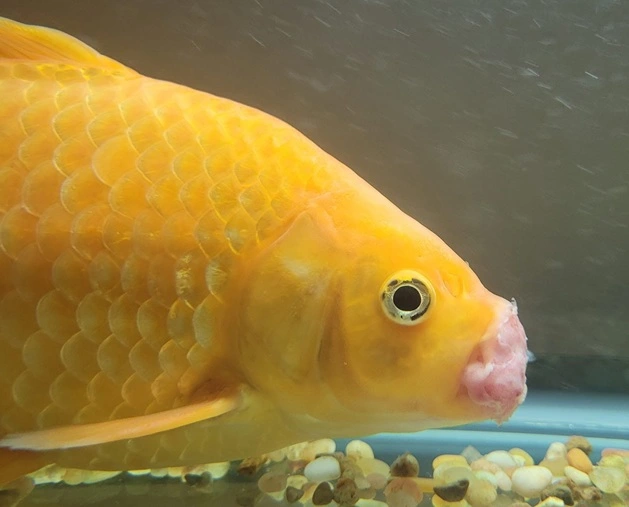
Mouth rot isn’t specific to goldfish. It can affect many other freshwater fish, including bettas, livebearers, cichlids, and catfish.
Table of Contents:
1) What Is Mouth Rot (Mouth Fungus)?
2) Mouth Rot – Quick Facts
3) Mouth Rot Symptoms
4) Why Is My Goldfish’s Mouth Stuck Open?
5) Mouth Rot vs. True Fungal Infection
6) Mouth Rot Causes
7) Mouth Rot (Mouth Fungus) Treatment
8) How to Prevent Goldfish Mouth Rot
9) FAQ
10) Final Thoughts
What Is Mouth Rot (Mouth Fungus)?
Despite the common nickname “mouth fungus,” mouth rot is usually a bacterial infection, not a fungal one. One of the best-known causes is Flavobacterium columnare, the bacterium responsible for columnaris. The infection can damage the tissue around the lips and jaw of the fish, producing the white or grey patches and erosion commonly associated with mouth rot.
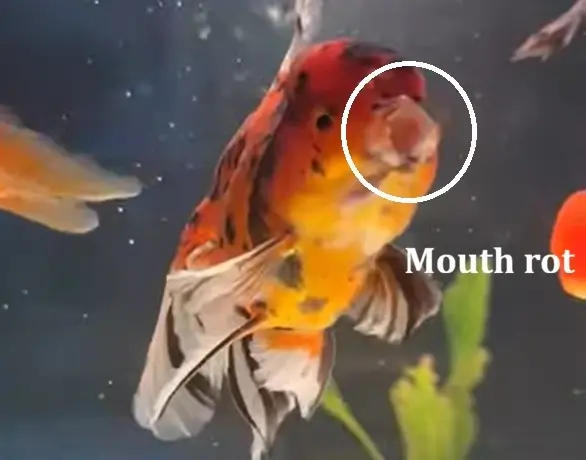
It isn’t a goldfish-only problem either. Flavobacterium columnare is a bacterium that can affect many freshwater fish. In goldfish, mouth rot is particularly associated with poor water quality, overcrowding, stress, and injuries around the mouth, which can make it easier for bacterial infections to take hold.
Mouth Rot – Quick Facts
| Cause | Usually bacterial; columnaris caused by Flavobacterium bacteria is a common cause |
| Also Affects | Not goldfish-specific — many other freshwater fish can develop similar infections |
| Main Symptoms | Off-white or grey patches or fuzzy growth around the lips, redness, swelling, and eroded mouth tissue |
| Common Risk Factors | Poor water quality, overcrowding, stress, and injuries around the mouth |
| Treatment | Improve water quality and use an appropriate antibacterial medication when needed |
| Treatment Length | Depends on the medication used; always complete the full treatment course |
Mouth Rot Symptoms
Mouth rot tends to become more obvious as the infection progresses. Watching how the mouth tissue and the fish’s behavior change can help you judge how serious the infection has become.
Early stage:
• A faint pink or red area around the lips, or a thin greyish-white film that can be easy to miss unless you are looking closely.
• Behavior may still be mostly normal, although some fish may rub their mouth against gravel, decor, or the glass.
Moderate stage:
• Off-white, grey, or yellowish patches or fuzzy growth appear around the mouth, and the tissue may begin to erode.
• The fish may struggle to grab and hold food even when it is still trying to eat.
• Lethargy and appetite loss may develop as the infection worsens.
Advanced stage:
• Deep tissue erosion, open sores, and extensive damage around the lips and jaw.
• Severe infections can destroy mouth tissue and damage the jaw, sometimes leaving the mouth permanently open.
• The fish may stop eating completely, lose weight, become very lethargic, and develop rapid or labored breathing.
• Lesions may also appear on other parts of the body or fins if columnaris is involved.
Some columnaris infections can progress very quickly, with severe tissue damage developing within only a few days. This is why suspected mouth rot should be treated promptly rather than waiting to see whether it clears on its own.
Why Is My Goldfish’s Mouth Stuck Open?
A goldfish with its mouth stuck open doesn’t necessarily have mouth rot. Gravel or another small object can become lodged in the mouth, especially when goldfish sift through substrate for food. An injury to the mouth or jaw can also make it difficult for the fish to close its mouth.
Check for white or grey patches, fuzzy growth, redness, swelling, or eroding tissue, which are more suggestive of an infection. If the mouth is simply stuck open without these signs, look carefully for a foreign object or injury.
If you can clearly see something lodged deep in the mouth, don’t force it out or risk damaging the jaw or gills. If it cannot be removed easily and safely, veterinary help is the better option.
Mouth Rot vs. True Fungal Infection
Bacterial mouth rot can look fungal because columnaris may produce grey-white, cotton-like patches around the mouth. True fungal infections can also produce cottony growth, making them difficult to distinguish by appearance alone.
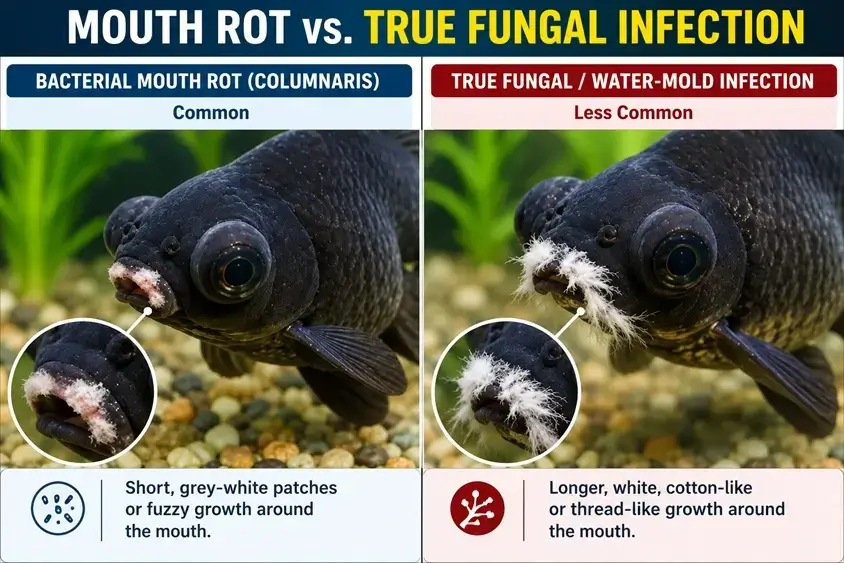
Generally, fungal growth tends to look longer, whiter, and more thread-like, while columnaris lesions are often flatter or shorter and greyish-white. If you’re unsure or the fish isn’t responding to treatment, a veterinarian can confirm the cause through microscopic examination.
Mouth Rot Causes
• Injuries around the mouth — from fighting, fin-nipping, or sharp decor can damage the protective tissue and make infection easier.
• Poor water quality — especially elevated ammonia or nitrite, can stress fish and increase their susceptibility to bacterial infections.
• Overcrowding or inadequate filtration — particularly important with goldfish because of their relatively high waste production.
• Chronic stress — from incompatible tank mates, unstable conditions, or poor nutrition can reduce the fish’s ability to resist infection.
Mouth Rot (Mouth Fungus) Treatment
1. Check the water first
Test ammonia and nitrite before starting treatment. Both should be at 0 ppm. If either is detectable, perform a partial water change and correct the underlying water-quality problem. Good water quality is important because damaged mouth tissue will have a harder time healing if the fish remains stressed.
2. Move the affected goldfish to a hospital tank if possible
A hospital tank makes medication easier to control and avoids unnecessarily exposing healthy fish and the main aquarium’s biological filter to antibiotics. Keep the hospital tank well aerated and maintain a stable temperature.
3. Treat with an antibacterial medication
Products containing kanamycin (such as KanaPlex) or minocycline (such as Maracyn 2) are commonly used aquarium medications for bacterial infections. Follow the product’s exact dosage and treatment schedule.
Don’t combine different antibiotics or increase the dose in an attempt to make treatment work faster. If the infection continues to worsen despite treatment, a fish veterinarian can help determine whether a different antibiotic is needed.
4. Remove activated carbon during treatment
Remove activated carbon from the filter while using medication that can be removed by carbon. Otherwise, the carbon may reduce the amount of medication remaining in the water.
Keep normal filtration and water circulation running unless the medication instructions specifically tell you otherwise. If you are treating the main aquarium, monitor ammonia and nitrite because some antibacterial treatments can affect biological filtration.
5. Keep the water well aerated
Run an air stone or maintain good surface agitation throughout treatment. Sick goldfish benefit from well-oxygenated water, particularly if they are already showing rapid or labored breathing.
6. Complete the full treatment course
The exact treatment period depends on the medication. Many aquarium antibiotic courses run for roughly 5–10 days, but always follow the schedule on the product you are using rather than stopping at a fixed number of days.
Even if the mouth starts looking better after a few days, complete the full course unless the medication instructions or a veterinarian tell you otherwise.
7. Remove the medication after treatment
Once the full treatment course is complete, follow the medication instructions for the recommended water changes. Partial water changes will gradually dilute and remove medication remaining in the aquarium.
If you normally use activated carbon, add fresh activated carbon back to the filter after treatment to help remove residual medication.
Continue monitoring ammonia and nitrite while the fish recovers.
What About Aquarium Salt?
Aquarium salt can be used as supportive care in some situations, but it shouldn’t replace an appropriate antibacterial medication for established mouth rot. If you are already using an antibiotic, check its instructions before combining it with salt or other treatments.
If the mouth continues to erode, the fish stops eating, or there is no improvement after completing the recommended treatment, professional diagnosis is the safest next step.
How to Prevent Goldfish Mouth Rot
• Cycle new aquariums properly before adding goldfish, and quarantine new fish before introducing them to an established tank.
• Avoid overcrowding and provide adequate filtration — goldfish produce a considerable amount of waste, so good filtration and regular maintenance are important.
• Keep ammonia and nitrite at 0 ppm and test the water regularly rather than waiting for visible problems.
• Avoid aggressive or fin-nipping tank mates and separate fish that are being bullied or injured.
• Remove sharp or rough décor that could injure the mouth or body and provide an entry point for infection.
• Feed a balanced, species-appropriate diet to support overall health and resistance to disease.
FAQ
Is Goldfish Mouth Rot Contagious?
Columnaris can spread between fish, particularly when fish are stressed, injured, or kept in poor water conditions. If possible, isolate a visibly infected goldfish and avoid sharing nets or other wet equipment between tanks.
Will My Goldfish’s Mouth Heal Completely?
Mild cases can heal well when treated early. If significant mouth or jaw tissue has already been destroyed, the fish may be left with permanent changes to the shape of its mouth.
Why Is My Goldfish’s Mouth Red?
A red mouth can result from irritation, injury, or an early bacterial infection. Look for other signs such as swelling, grey-white patches, fuzzy growth, or tissue erosion before assuming it is mouth rot.
What’s a White Spot on My Goldfish’s Mouth?
A single small white spot isn’t necessarily mouth rot. If it looks like a grain of salt and similar spots appear on the body or fins, ich is more likely. Mouth rot usually produces patches, discoloration, or eroding tissue rather than isolated salt-like dots.
Do Goldfish Have Barbels?
No. Goldfish don’t have the whisker-like barbels found on koi and many catfish. Not seeing barbels around your goldfish’s mouth is completely normal.
Final Thoughts
Mouth rot can cause serious damage if left untreated, but early treatment with the right antibacterial medication and good water quality gives the fish a much better chance of recovery.
Just as importantly, correct the conditions that contributed to the infection — such as poor water quality, overcrowding, stress, or injury — to reduce the chance of mouth rot returning.