
Guppy ammonia poisoning happens when waste, uneaten food, and decaying matter build up faster than your tank’s bacteria can process them. Even a small amount of ammonia is dangerous, it burns the gills, and a serious spike can kill a guppy within hours. The good news is that it’s also one of the most preventable problems in the hobby, and most cases are caught in time if you know what to look for.
Quick Answer: Ammonia should always read 0 ppm. Anything above that is a real problem, and anything above 1 ppm is an emergency.
Signs of ammonia poisoning: red or bleeding gills, lethargy, clamped fins, gasping at the surface, and dark, burn-like patches on the body.
If you test and find ammonia, stop feeding immediately and do a partial water change with dechlorinated, temperature-matched water. Don’t panic-dose the whole tank with chemicals.
The most common causes are an uncycled new tank, overfeeding, overcrowding, and a tank that’s gone too long between water changes.
Quick Navigation
➜ What Is Guppy Ammonia Poisoning?
➜ Guppy Ammonia Burn: What It Looks Like
➜ Symptoms of Ammonia Poisoning
➜ Ammonia vs Nitrite: Telling Them Apart
➜ What Causes an Ammonia Spike?
➜ Emergency Steps If You Find Ammonia
➜ New Tank Syndrome and Cycling
➜ Preventing Ammonia Spikes
➜ Frequently Asked Questions
What Is Guppy Ammonia Poisoning?
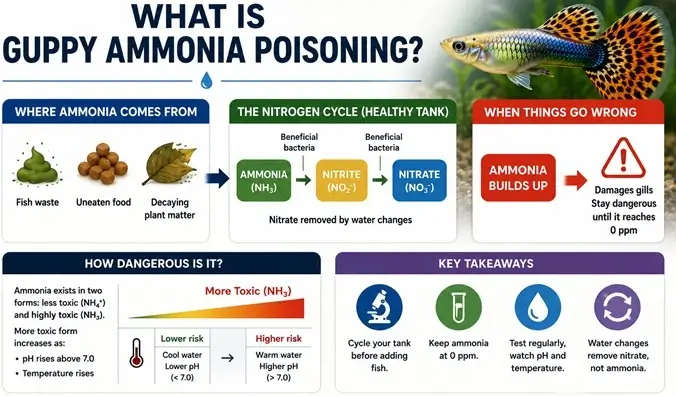
Fish waste, uneaten food, and decaying plant matter all break down into ammonia. Here’s how that plays out in a tank:
➜ The nitrogen cycle. In a healthy, established tank, beneficial bacteria convert ammonia into nitrite, then into nitrate, which is far less harmful and gets removed through regular water changes. This is the whole reason a tank needs time to mature before it can safely hold fish.
➜ When the cycle breaks down. When that bacteria colony isn’t established yet, or gets overwhelmed by too much waste, ammonia builds up faster than it can be processed. Even a small amount damages a guppy’s gills directly, and it stays dangerous until something brings the level back down to zero.
➜ Why pH and temperature matter. Ammonia exists in two forms in water, a less toxic one and a much more toxic one, and the balance shifts toward the dangerous form as pH rises above 7.0 and as temperature climbs. The same 1 ppm reading is a bigger threat in warm, alkaline water than in cooler, more neutral water, which is part of why keeping pH and temperature in their normal ranges (covered in our guppy pH guide and temperature for guppies guide) matters for more than just comfort. It’s also part of why a water change in a neglected tank can sometimes make things worse before they get better, covered in more detail in our why guppies die after water changes guide.
Guppy Ammonia Burn: What It Looks Like
A guppy ammonia burn shows up as dark, blotchy, sometimes red patches on the body, often along with red or inflamed gills.
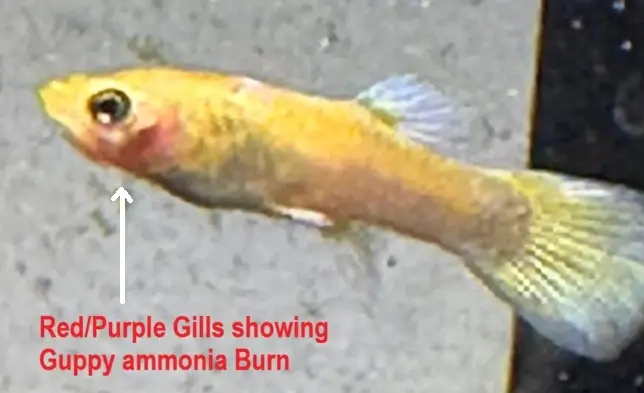
It’s not a separate disease (see our common guppy diseases guide for infectious causes), it’s literally a chemical burn, ammonia damaging skin and gill tissue directly on contact. The gills are usually hit first and worst, since they’re in constant, direct contact with the water, and a fish with a real burn often breathes harder and faster than normal as a result.
A mild case can look like nothing more than slightly redder gills than usual. A severe one shows clear dark patches across the body alongside labored breathing and clamped fins. Either way, a visible burn means the exposure has already been going on for a while, not something that appeared in the last few minutes.
Symptoms of Ammonia Poisoning
The visible signs build up roughly in this order, though a bad spike can cause several at once:
➜ Red, inflamed, or bleeding gills
➜ Lethargy and reduced activity, often sitting still at the bottom or near the filter
➜ Clamped fins, sometimes turning ragged over time
➜ Gasping at the surface or near the filter outflow
➜ Loss of appetite
➜ A cloudy or hazy look to the eyes
➜ Excess mucus, making the fish look slightly grey or dull
➜ Dark, blotchy, burn-like patches on the body (commonly called ammonia burns)
By the time several of these show up together, the ammonia has usually been present for a while already. Clear water doesn’t mean safe water, ammonia is invisible, so the only real way to catch it early is testing rather than waiting for symptoms.
Ammonia vs Nitrite: Telling Them Apart
Ammonia and nitrite cause different damage and look different on a sick fish, which makes them easier to tell apart than people expect.
➜ Ammonia burns the gills directly. The classic sign is gills that look red, inflamed, or visibly bleeding, along with the dark body patches mentioned above.
➜ Nitrite works differently. It gets into the bloodstream and stops it from carrying oxygen properly, a condition called brown blood disease. Instead of red or bleeding gills, nitrite poisoning typically shows up as gills and blood turning a dull brown color, with the fish gasping at the surface even though the water has plenty of oxygen in it, because the problem is internal, not a lack of oxygen in the tank.
Red and bleeding points to ammonia. Brown and suffocating-looking points to nitrite. Either way, both call for the same first move: test the water and act on what you find rather than guessing.
What Causes an Ammonia Spike?
A few mistakes show up again and again:
An uncycled tank. A brand new aquarium has no established bacteria yet, so there’s nothing to process the ammonia fish waste produces from day one. This is the classic “new tank syndrome” case.
Overfeeding. Uneaten food breaks down into ammonia just as much as fish waste does. Feed only what’s eaten in a couple of minutes.
Overcrowding. Too many fish means more waste than the bacteria colony can keep up with, even in an otherwise healthy tank.
A neglected tank. Going too long without water changes lets ammonia and the conditions that make it more dangerous build up quietly. See our why guppies die after water changes guide for the full mechanism behind this one.
Killing off the bacteria colony. Rinsing filter media in tap water, using strong cleaning chemicals, or certain medications can wipe out the bacteria that process ammonia, even in a tank that was previously stable.
Decaying plant matter. Dead or dying leaves break down just like uneaten food, adding to the ammonia load. In a planted tank, pulling out decaying leaves by hand as part of routine maintenance is an easy, often-overlooked source to cut out.
Emergency Steps If You Find Ammonia
If a test comes back showing ammonia, work through this in order:
1. Scale your water change to the severity. For a moderate reading (up to around 1 ppm), do a 50% water change with dechlorinated, temperature-matched water. For a severe reading (above 2 ppm, or fish visibly gasping or showing burns), go up to 70–75%. Avoid going higher than that in a single change, a total or near-total water change adds a second shock on top of the ammonia stress and can strip out what’s left of your beneficial bacteria. The math is simple either way, a 50% change roughly cuts the ammonia level in half. If you’re reading 2.0 ppm, a 50% change brings you to around 1.0 ppm, still high enough to need another change the next day.
2. Remove the source. Check for uneaten food, decaying plant matter, or a dead fish hiding behind decorations, any of these can single-handedly keep a spike going no matter how much water you change. Check your filter for clogs while you’re at it.
3. Add a conditioner that detoxifies ammonia. Seachem Prime is widely used for exactly this situation, since it temporarily binds ammonia into a less toxic form for about 36–48 hours, buying time for the real fix to catch up. It needs re-dosing on that schedule until the underlying cause is sorted, it’s a stopgap, not a cure.
4. Boost your biological filtration. If the bacteria colony has died off or was never established, adding a bottled live bacteria supplement (such as Seachem Stability or FritzZyme 7) directly to the filter helps it catch back up faster than waiting on it alone.
5. Increase aeration. An air stone or extra surface agitation helps while the fish’s gills are already compromised and working less efficiently.
6. Reduce stress while you fix the water. Turn the tank lights off for a bit, this small thing helps a guppy that’s already struggling.
7. Consider aquarium salt for extra support. A small dose, around 1 teaspoon per gallon, can help a guppy cope with ammonia stress, since livebearers tolerate salt well. Skip this if you keep scaleless fish in the same tank, like certain catfish, since they’re more sensitive to it.
8. Re-test every 12–24 hours until it reads zero. If it’s still above 0.25 ppm, repeat a 25–30% water change and re-dose your conditioner. Don’t assume one water change solved it, confirm it.
9. Don’t add new fish or medicate reflexively. Adding more fish increases the bioload during an active crisis, and antibiotics aren’t appropriate for ammonia poisoning itself, they just give an already-stressed fish another chemical to process for no real benefit.
New Tank Syndrome and Cycling
A new aquarium typically takes about 2 to 6 weeks to fully cycle, meaning enough bacteria has established to reliably handle the ammonia a normal fish load produces. Adding fish before that point is sometime risky.
➜ Fishless cycle. Dose ammonia directly and let bacteria build up before any fish go in.
➜ Fish-in cycle. Use a small number of very hardy fish, along with a lot of patience and regular testing.
➜ Speed it up. Adding a bit of filter media or substrate from an already established tank introduces a working bacteria colony rather than starting from zero.
Preventing Ammonia Spikes
Most ammonia problems trace back to the same handful of habits:
➜ Feed only what’s eaten in a couple of minutes
➜ Don’t overstock the tank
➜ Keep to a regular water change schedule rather than waiting for things to look bad
➜ Never rinse filter media in tap water
➜ Test weekly, so a problem shows up on a number before it shows up on the fish
One trick worth building into that routine: during a normal 25–50% change, use a gravel siphon to pull trapped waste out of the substrate directly, rather than just draining water off the top. Done gently, this removes a real source of ammonia without stirring up the gravel or clouding the water, and tanks kept this way tend to stay visibly cleaner between changes, not just chemically better.
None of this is complicated, it’s just consistency, and it’s far easier than treating a spike after the fact.
Frequently Asked Questions
What’s a safe guppy ammonia level?
0 ppm. Anything detectable is treated as a problem, and anything above about 0.5 ppm is a real emergency.
How fast can ammonia kill a guppy?
At high concentrations, within hours. Lower-level chronic exposure does its damage more slowly, weakening the fish and making it far more vulnerable to disease over time.
Can a guppy recover from ammonia poisoning?
Often, yes, if it’s caught early and the water is corrected quickly. Gill damage doesn’t fully reverse, but a fish with mild to moderate exposure can heal and go on to live normally once conditions stabilize.
Can guppies tolerate ammonia?
Not really, not for long. Guppies are hardy in a lot of ways, but ammonia tolerance isn’t one of them, even small amounts damage the gills. They can sometimes survive a brief, low-level spike if it’s caught and fixed fast, but “tolerate” isn’t the right way to think about it, every bit of exposure does some damage.
How long does it take for an ammonia burn to heal?
Mild gill damage can improve within a week or two once water conditions are corrected, since gill tissue does regenerate to some degree. Severe burns or repeated exposure cause damage that doesn’t fully reverse, and the fish stays more vulnerable to infection afterward even once the water is fixed.
Why do I have ammonia even though I do water changes?
Usually overstocking, overfeeding, or a filter that isn’t established or was recently disrupted. A water change dilutes ammonia temporarily but doesn’t fix whatever’s producing too much of it.
Final Thoughts
Ammonia poisoning is dangerous mainly because it’s invisible until a fish is already showing real symptoms. The fix isn’t complicated, it’s testing regularly, not overfeeding or overstocking, and giving a new tank the time it needs to cycle before adding fish. Read our complete common guppy diseases guide for all guppy related illnesses.
For the full picture of everything else guppies need alongside ammonia control, see our guppy water parameters guide.