Guppy diseases are one of the most common reasons beginner fishkeepers lose fish unexpectedly — and in most cases, the illness was preventable or treatable if caught early enough.
The challenge in diagnosing guppy health problems is that guppies are small fish and their symptoms can be subtle at first. Sick guppies that are hiding more than usual, showing clamped fins, breathing faster than normal, or scratching against decorations is telling you something is wrong. By the time the signs become obvious — visible spots, rotting fins, bloating, or abnormal swimming — the disease has often already progressed significantly.
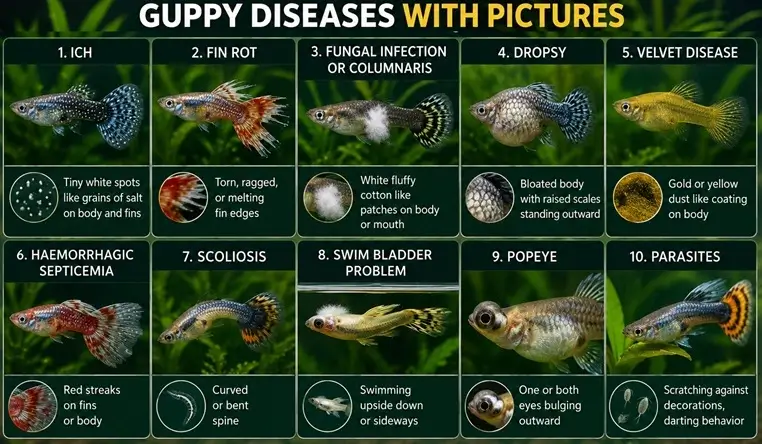
The good news is that many common guppy sickness and diseases can be treated successfully if detected early. In this Guide you will learn all the guppy fish diseases with pictures. The guppy diseases pictures are shown along with explanation on how to diagnose each and every disease.
Quick Navigation
➜ What Causes Guppy Diseases?
➜ Guppy Disease Chart
Bacterial Guppy Diseases: Symptoms & Treatment
➜ Guppy Fin Rot and Tail Rot
➜ Guppy Mouth Rot (Mouth Fungus / Columnaris)
➜ Guppy Red Pest (Hemorrhagic Septicemia)
Fungal Guppy Diseases: Symptoms & Treatment
➜ Guppy Fungal Infection
Parasitic Guppy Diseases: Symptoms & Treatment
External Parasites
➜ Guppy Ich (White Spot Disease)
➜ Guppy Velvet Disease (Gold Dust Disease)
➜ Guppy Skin Flukes
➜ Guppy Gill Flukes or Gill Worms
Starts External, Turns Internal
➜ Guppy Tetrahymena Disease
Internal Parasites
➜ Guppy Camallanus Worms
➜ Guppy Hexamita
Other Guppy Health Problems: Symptoms & Treatment
➜ Guppy Dropsy — Bloated Guppy
➜ Guppy Popeye (Exophthalmia)
➜ Guppy Swim Bladder Problem
➜ Guppy Bent Spine (Scoliosis)
➜ How to Dose Medication Correctly: A Practical Protocol From Experience
➜ Frequently Asked Questions
What Causes Guppy Diseases?
Most guppy illnesses are almost the end result of stress, and stress traces back to something wrong with the tank environment. A guppy in clean, stable water is remarkably resistant to disease; the same fish in poor conditions becomes vulnerable to almost everything.
• Poor water quality is the single biggest cause. Ammonia and nitrite burn the gills, damage organs, and suppress the immune system at once.
• Sudden temperature changes don’t directly cause disease, but a drop of even a few degrees slows immune activity and thins the protective slime coat, letting bacteria and parasites already in the tank take hold.
• Overfeeding — uneaten food sinks and breaks down rapidly, releasing ammonia directly into the water.
• Overcrowding compounds every other problem — more waste, less oxygen, and chronic stress that keeps immune systems permanently suppressed.
• Aggressive tank mates cause physical injuries through fin nipping and chasing — even small tears become entry points for bacterial infections like fin rot.
• Dirty substrate and filters release accumulated waste slowly, often unnoticed until fish start showing symptoms.
• A dead fish left in the tank starts leaching ammonia almost immediately, and can spread infection directly to tank mates that nibble at it. Remove any dead fish as soon as you spot it.
• Old tank syndrome — topping off evaporated water without actually removing old water lets organic acids build up, and pH can crash suddenly, sometimes below 6.0.
Treating a disease without fixing the underlying cause almost always fails — the fish relapses or develops a secondary infection once medication stops. Improper water changes are a surprisingly common trigger; see our guide on why guppies die after water changes to avoid these mistakes.
Guppy Disease Chart
Use this as a fast comparison once you’ve narrowed things down to a couple of possibilities. Full detail on each one is in its own section below.
| Disease | Type | Key Sign | Contagious? | Main Treatment |
|---|---|---|---|---|
| Ich | Parasitic | White salt-grain spots | Yes | Heat + malachite green/formalin |
| Velvet | Parasitic | Fine gold dust (flashlight test) | Yes | Heat + copper/malachite green |
| Fin Rot | Bacterial | Ragged, melting fin edges | Low risk | Water change + antibacterial |
| Fungal Infection | Fungal | Fluffy cotton-like patches | Low risk | Antifungal medication |
| Mouth Fungus (Columnaris) | Bacterial | Flat patches around mouth | Yes | Cool water + antibacterial |
| Gill Flukes / Gill Worms | Parasitic | Gasping, bleeding gills | Yes | Praziquantel |
| Tetrahymena | Parasitic | Slimy grey patches near eyes | Yes | Metronidazole, often poor prognosis |
| Camallanus Worms | Parasitic | Red worms at anal opening | Yes | Levamisole |
| Hexamita | Parasitic | White stringy feces, weight loss | Yes | Metronidazole |
| Red Pest | Bacterial | Bright red streaks | Yes | Antibacterial, act within 24 hrs |
| Dropsy | Multiple causes | Pinecone scales | No | Antibacterial, often poor prognosis |
| Swim Bladder | Multiple causes | Swimming upside down/sideways | No | Fasting + pea |
| Bent Spine (Scoliosis) | Multiple causes | Visible C or S curve | No (unless TB) | None — quality of life only |
| Popeye | Multiple causes | Bulging eye(s) | Depends on cause | Epsom salt + treat underlying cause |
Bacterial Guppy Diseases: Symptoms & Treatment
These are caused by bacteria that are present in almost every aquarium at low levels and only become a problem once a fish’s immune system is weakened.
Guppy Fin Rot and Tail Rot
Fin rot is one of the most common bacterial infections in guppies. Many fishkeepers assume torn or ragged fins mean the fish has been attacked by tank mates, but true fin rot is a bacterial infection that progressively destroys fin tissue from the edges inward.
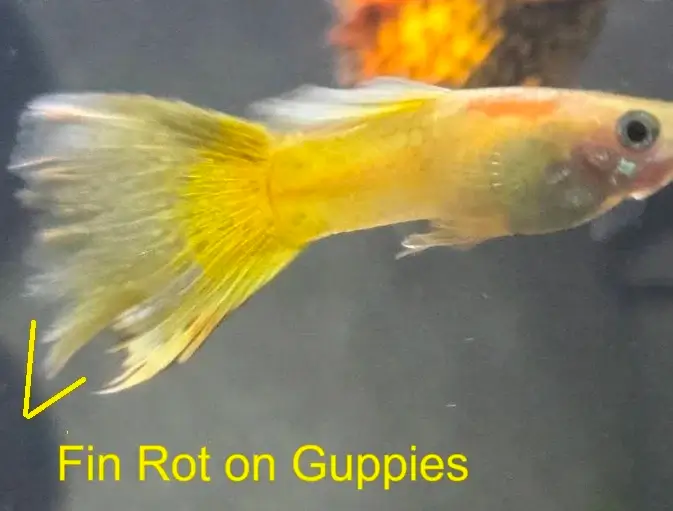
• Physical injury can be a trigger, but that’s different from the bacterial infection itself — left untreated, fin rot won’t stop at a few torn edges, it eats through the fin until nothing remains.
• The bacteria responsible — most commonly Aeromonas and Pseudomonas species — are present in almost every aquarium and only become a problem once a fish is already weakened.
• The perfect target is a stressed guppy with a compromised immune system, or one with a small physical injury from fin nipping that gives the bacteria an entry point.
Fin Rot and Tail Rot Symptoms:
➜ Fin edges appear torn, ragged, or frayed
➜ White or slightly transparent edges on fins
➜ Red or inflamed streaks at the base of affected fins
➜ Fins appear to be shrinking or melting
➜ Tail deterioration progressing toward the body
➜ Clamped fins
➜ Reduced activity and appetite in advanced cases
How to Tell Fin Rot from Fin Nipping or Injury:
This is worth checking before you treat, since the two look similar at a glance but need completely different fixes.
• Fin nipping produces clean tears or chunks missing from the fin, and it happens instantly — you’ll often notice it after one specific incident, not gradually.
• Fin rot looks progressively ragged and frayed rather than cleanly torn, and it worsens over days, not all at once.
• Discoloration is the biggest tell. Nipped fins stay their normal color at the tear. Fin rot typically shows white, milky, or darkened edges, sometimes with redness at the base — nipping alone doesn’t cause this.
• If you’re unsure, watch the fin for a few days rather than treating immediately. A nipped fin that isn’t reinjured will hold steady or start healing on its own. A fin rot infection will keep progressing without treatment.
Stages of Fin Rot:
Understanding the stages helps you act at the right time.
Early stage: fin edges look slightly ragged or discolored. This is the easiest stage to treat and often resolves with water quality improvements alone.
Middle stage: fin tissue is visibly shrinking and red inflammation may appear at the base. Medication is usually needed here.
Advanced stage: large sections of fin are gone and the infection may be approaching the body. This is a medical emergency and aggressive treatment is required immediately.
What Causes Fin Rot:
➜ Poor water quality, the most common cause by far
➜ Stress from overcrowding, aggressive tank mates, or unstable parameters
➜ Physical injuries from fin nipping that create entry points for bacteria
➜ Sudden temperature drops that suppress immune function
Fin Rot Treatment:
Test water parameters: Check for zero ammonia, zero nitrites, and nitrates under 40 ppm.
Water change: 30–40% water changes daily or alternate days. Also vacuum clean the substrate to get toxins down. In many early-stage cases this alone is enough to let the fish recover on its own.
Remove aggressive fish or sharp objects: Remove sharp objects or aggressive fish if it is contributing to fin rot.
Medicate if it’s past the early stage with a product containing erythromycin, kanamycin, nitrofurazone, or a combination such as Seachem KanaPlex or API Fin & Body Cure. Dose exactly to the product label for your actual tank volume, most require redosing every 24–48 hours across several days, check your specific product’s instructions for the exact schedule.
Optional salt support for mild cases: around one tablespoon per three to five gallons, dissolved in a cup of tank water first, can help alongside water changes. Use cautiously in planted tanks, since it can stress live plants.
Watch for a secondary fungal infection. Fin rot damage is a common entry point for fungus — if you see fluffy, cotton-like growth develop on top of the affected fin while treating with antibacterial medication, see our fungal infection section for the antifungal treatment needed alongside it.
Not sure how to actually apply the medication? See our medication dosing section below for filter handling, aeration, and the post-treatment water change every treatment needs.
Continue treatment for at least 3–5 days even after the fin visibly stops deteriorating and inflammation clears. Stopping the moment the fish looks improved is one of the more common reasons fin rot relapses shortly after treatment ends.
After treatment ends, do a water change to clear the medication from the water before returning to a normal maintenance schedule.
Guppy Mouth Rot (Mouth Fungus / Columnaris)
Despite its common name, mouth fungus or guppy mouth rot is not actually a fungal infection at all — it’s bacterial.
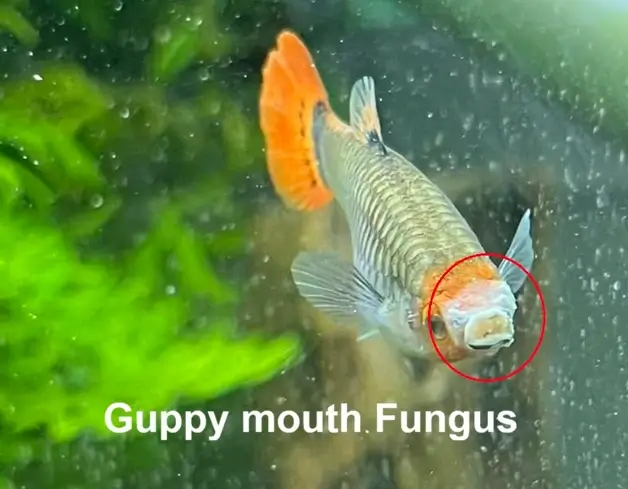
• Columnaris is caused by the bacterium Flavobacterium columnare, and this distinction matters enormously — antifungal medication has no effect on it whatsoever.
• Many fishkeepers lose valuable treatment time using the wrong medication, since the white patches around the mouth look so convincingly fungal. It’s also highly contagious.
• Columnaris is one of the more aggressive bacterial infections guppies can develop. In warm water above 77°F (25°C) it can progress with alarming speed and a fish that looks mildly affected in the morning can deteriorate significantly by evening. In cooler water it moves more slowly, but that doesn’t mean it’s less serious.
Mouth Rot Symptoms:
➜ White or grey cotton-like patches around the mouth, the most distinctive sign
➜ Patches may spread along the body and fins as the infection progresses
➜ Rapid fin deterioration, fins can appear to melt or fray quickly
➜ Saddle shaped lesion across the back behind the dorsal fin in some cases
➜ Rapid or labored breathing
➜ Lethargy and weakness
➜ Loss of appetite
➜ Sudden death in severe or fast progressing cases
How to Distinguish Columnaris from True Fungus:
This is the most important diagnostic step. Columnaris lesions tend to be flatter and more defined with a yellowish tinge in some cases, and they spread rapidly, particularly along the mouth and back. True fungal infections produce softer, fluffier, more irregular growths that look more like actual cotton wool. Columnaris also progresses significantly faster than a true fungal infection, sometimes visibly worsening over just a few hours in warm water.
What Causes Mouth Rot:
➜ Poor water quality, the most consistent trigger
➜ Sudden temperature changes that suppress immune function
➜ Overcrowding and chronic stress
➜ Physical injuries that create entry points for the bacteria
➜ Introducing infected fish without quarantine
Mouth Rot Treatment:
Speed is critical with Columnaris. Don’t wait to see if it improves on its own, it almost never does, and can turn fatal fast in warm water.
• Isolate the fish immediately in a quarantine tank as the disease is contagious.
• Water change: 30–40% in the main tank, and test ammonia, nitrite, and nitrate to protect the fish in the rest of the tank.
• Lower the quarantine temperature slightly to 72–74°F (22–23°C) if the fish can tolerate it. Columnaris is more aggressive in warm water, so cooling things down buys time for the medication to work.
• Medicate with kanamycin, nitrofurazone, or erythromycin — kanamycin combined with nitrofurazone works particularly well. Products like Seachem Paraguard or API MELAFIX are worth looking into. Dose to the product label for your actual tank volume, and redose on the schedule specified, typically every 24–48 hours.
• Optional salt support alongside antibiotics: around 1 teaspoon per gallon, dissolved in tank water first. It’s genuinely effective as a complement to medication for livebearers like guppies specifically, though it’s not a substitute for antibiotics on its own. Avoid it if scaleless fish, sensitive catfish, or live plants share the tank.
• A gentle early-stage option some keepers use alongside antibiotics is a brief potassium permanganate dip, but this doesn’t replace antibiotic treatment once the infection has progressed past the very earliest stage.
• See our medication dosing section below for filter handling, aeration, and the post-treatment water change every treatment needs.
• Continue treatment for the full labeled course, then 3–5 days past the point every lesion has visibly cleared, before considering the fish recovered.
• After treatment ends, do a water change to clear the medication before resuming normal maintenance.
Recovery is possible if treatment begins early, before the infection spreads past the mouth or deep into tissue. Fish with extensive lesions have a lower chance of full recovery but are still worth treating aggressively.
Guppy Red Pest (Hemorrhagic Septicemia)
Hemorrhagic Septicemia, commonly called Red Pest in the fishkeeping hobby, is a serious bacterial infection that causes internal bleeding throughout the body.
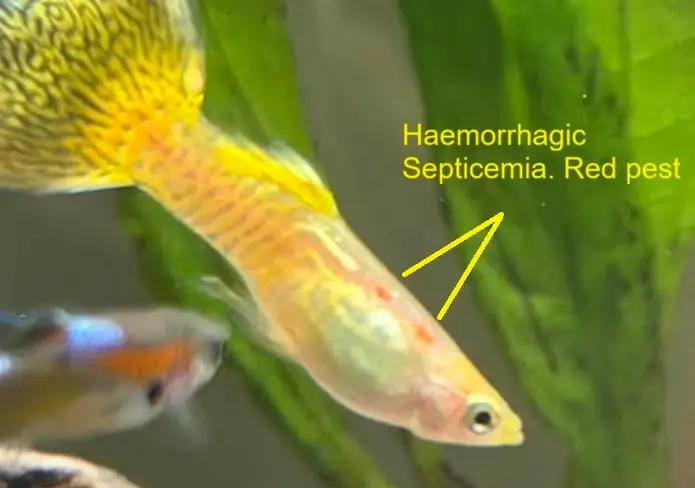
• The name comes from its most visible symptom: bright red streaks on the fins, body, and sometimes the eyes, as blood vessels rupture beneath the skin from bacterial toxins attacking the circulatory system.
• Caused by Aeromonas hydrophila and related bacteria present in most aquariums at low levels — like most opportunistic bacterial infections, it becomes dangerous once a fish is already stressed or immunocompromised.
• Once established it can progress quickly and become fatal if not treated promptly.
Red Pest Symptoms:
➜ Bright red streaks on fins, body, or tail, the most distinctive sign
➜ Red or inflamed patches on the skin surface
➜ Bloodshot or reddened eyes in some cases
➜ Hemorrhaging visible beneath the skin in advanced cases
➜ Rapid or labored breathing
➜ Lethargy and weakness
➜ Loss of appetite
➜ Swollen abdomen in severe cases where internal bleeding is extensive
How to Distinguish Red Pest from Other Conditions:
The bright red streaking pattern of Haemorrhagic Septicemia is fairly distinctive but can be confused with severe fin rot that has progressed to the base of the fins, or with physical injuries from aggressive tank mates. The key difference is that Red Pest produces streaks that radiate outward from the body into the fins rather than starting at the fin edges and working inward as fin rot does. The streaks in Red Pest are caused by ruptured blood vessels, they have a vivid bright red color that is different from the darker red inflammation seen at the base of fins in severe fin rot.
What Causes Red Pest:
➜ Severe bacterial infection with Aeromonas hydrophila or related species
➜ Chronic poor water quality that allows bacterial populations to build to dangerous levels
➜ Long term stress that keeps immune function suppressed
➜ Physical injuries that allow bacteria direct entry into the bloodstream
➜ Introducing infected fish without quarantine
➜ Sudden environmental changes that shock the fish and create vulnerability
Red Pest Treatment:
Red Pest requires immediate, aggressive treatment. Because the bacteria attack the circulatory system directly, a water change alone won’t turn things around, though it’s still an essential first step.
• Isolate the fish immediately in a quarantine tank with clean, well-oxygenated water at a stable temperature.
• Water change: 40–50% in the main tank, and test ammonia, nitrite, and nitrate before adding any medication, to protect the other fish in the tank.
• Medicate with kanamycin and nitrofurazone, the most commonly recommended antibiotics, available in most US fish stores. Erythromycin is also used with good results. Dose to the product label for your actual tank volume, and follow its redosing schedule without interruption. Products worth looking into include API Fin & Body Cure, Seachem KanaPlex, and Fritz Maracyn.
• Medicated food is worth using if the fish is still eating. Infuse a regular flake or pellet food with antibiotic and feed it — mix a small amount of the same antibiotic you’re dosing in the water into a paste with the food, or soak the food briefly in a concentrated solution before feeding. Since Red Pest attacks internally, food-delivered medication reaches the digestive system and internal tissue directly, which a water-column treatment alone may not reach as effectively.
• Optional salt support: around 1 tablespoon per 5 gallons, dissolved in tank water first. It helps reduce stress and guards against a secondary fungal infection setting in on open wounds. Avoid it if catfish or other salt-sensitive species share the tank.
• See our medication dosing section below for filter handling, aeration, and the post-treatment water change every treatment needs.
• Continue the complete labeled course, then 2–4 days past the point streaking and other visible symptoms have fully cleared, before considering the fish recovered.
• Supportive care: daily small water changes of 10–15% in the quarantine tank, stable temperature at 76–78°F (24–26°C), and small amounts of high-quality food to support recovery. A fish still eating has a noticeably better prognosis.
• After treatment ends, do a water change to clear the medication before resuming normal maintenance.
Prognosis: cases caught early, streaking limited to the fins, fish still active and eating, respond reasonably well. Extensive internal hemorrhaging, a swollen abdomen, or severe lethargy mean a lower survival rate. Acting within the first 24 hours gives the best outcome.
Fungal Guppy Diseases: Symptoms & Treatment
Guppy fungus are almost always secondary, meaning the fungus takes hold on tissue that’s already damaged or weakened, rather than attacking a healthy fish directly.
Guppy Fungal Infection
Fungal infections are one of the most visually distinctive diseases in guppies, but they are also one of the most commonly misidentified.
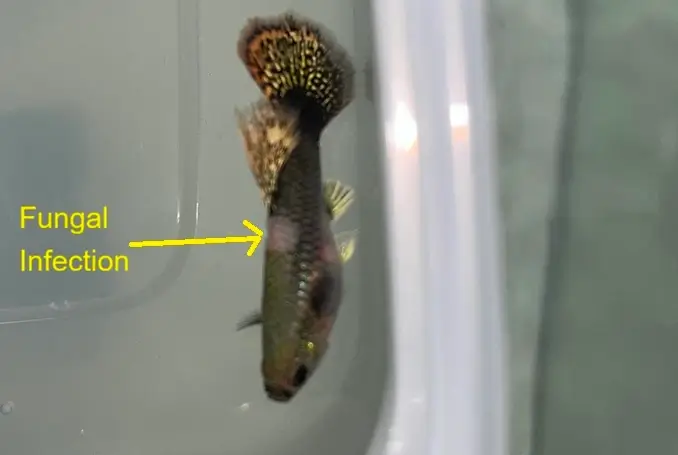
• The white fluffy cotton-like growths that characterize a true fungal infection look very similar to Columnaris, which is actually a bacterial infection, covered in the Bacterial Diseases section above.
• Getting the diagnosis right matters — antifungal and antibacterial medications work through completely different mechanisms, and using the wrong one wastes time while the infection progresses.
• True fungal infections are almost always secondary, meaning the fungus takes hold on tissue that’s already damaged or weakened rather than attacking a healthy fish directly.
• An injury, a healing wound, a fin rotted by bacteria, or skin damaged by parasites all create the perfect entry point for fungal spores that are present in virtually every aquarium.
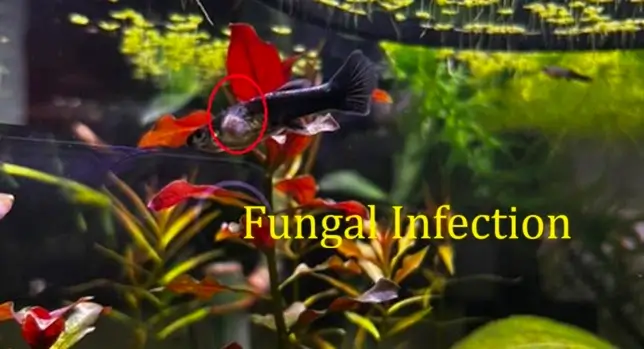
Fungal Infection Symptoms:
➜ White or grey fluffy cotton-like patches on the body, fins, or mouth
➜ Patches have a soft irregular texture, unlike the flat white spots of ich
➜ Affected areas may appear slightly raised from the skin surface
➜ Weakness and reduced activity
➜ Loss of appetite
➜ Hiding behavior
➜ In advanced cases the underlying skin beneath the growth may appear red or ulcerated
How to Tell Fungus from Columnaris:
This is the key diagnostic question because both look similar but need different treatment. Fungal growths tend to be soft, fluffy, and irregular, almost like a tuft of cotton wool attached to the skin. Columnaris lesions tend to be flatter, more defined, and often appear around the mouth specifically, spreading rapidly along the body. Columnaris also progresses much faster than a true fungal infection, sometimes causing visible deterioration within hours in warm water.
If you are unsure which you are dealing with, a combination antibacterial and antifungal treatment is available and covers both possibilities.
What Causes Fungal Infections:
➜ Pre-existing injuries or wounds from fin nipping or decoration scratches
➜ Damaged skin from bacterial infections like fin rot
➜ Chronically poor water quality that weakens the immune system and damages the slime coat
➜ Stress from overcrowding, temperature swings, or aggressive tank mates
➜ Weak or recently ill fish whose immune systems are not fully recovered
Fungal Infection Treatment:
• Quarantine the affected fish for treatment, it reduces stress, makes dosing more accurate, and prevents spread.
• Water change: If not quarantined, a 25–30% water change and check all parameters first. Fungal infections thrive in dirty, poorly oxygenated water, and medication won’t work well if that’s not addressed.
• Fix the underlying stressor, not just the water. Overcrowding, aggressive tank mates, and unstable temperature are all real contributors — treating the infection while the original stressor is still present makes relapse likely.
• Medicate with a product containing methylene blue or malachite green, the standard antifungal treatments in the US. Dose to the product label for your actual tank volume, and follow its redosing schedule, most call for repeat dosing every 1–3 days across a full course.
• Continue treatment for 2–4 days after the growth is fully gone and the skin underneath looks normal, not just until it looks smaller. Fungal spores that remain after the visible growth clears can restart the infection if treatment stops too early.
• Optional salt support: start at around one tablespoon per three gallons, always dissolved in a cup of tank water first, never sprinkled in dry. Salt only leaves through water changes, so re-dose only for the water you actually replace. Use cautiously in planted tanks, since it can stress live plants.
• Not sure how to actually apply the medication? See our medication dosing section below for filter handling, aeration, and the post-treatment water change every treatment needs.
• After treatment ends, do a water change to clear the medication before resuming normal maintenance.
• If the infection is extensive or not responding within a few days, reassess whether Columnaris or another bacterial infection may be involved instead.
• Honest note on prognosis: most fungal infections on the body or fins respond well to treatment — the growth gradually disappears and the underlying tissue heals over the following weeks, though scarring may remain in severe cases. If the growth involves the gills specifically, the outlook is considerably more serious — gill fungus progresses fast and is much harder to treat successfully, so get treatment started immediately rather than waiting to see if it improves.
Parasitic Guppy Diseases: Symptoms & Treatment
Guppy Parasites are living organisms that actively seek out a host, rather than simply taking advantage of an already-weakened fish the way most bacteria do.
➜ External parasites live on the skin, fins, and gills.
➜ Internal parasites infect the digestive system and organs.
Both can be present at once, and both need different treatment, which is why identifying which type you’re dealing with matters before reaching for medication.
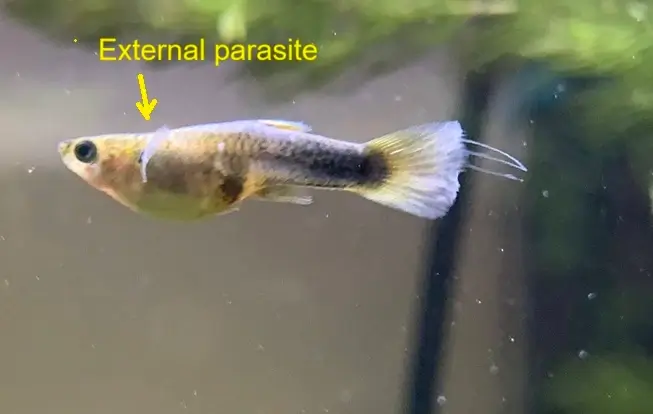
Parasitic Infection Symptoms:
➜ Scratching or rubbing against decorations, substrate, or tank walls, called flashing
➜ Darting or erratic swimming behavior
➜ Sudden twitching or shivering movements
➜ Clamped fins held tight against the body
➜ Rapid or labored breathing
➜ Loss of appetite despite otherwise normal behavior
➜ White stringy feces hanging from the body
➜ Visible weight loss despite eating normally
➜ Sunken belly appearance over time
Guppy Parasites – External
These live on the skin, fins, or gills — outside the body. They’re generally easier to spot early and to treat, since medication can reach them directly through the water.
Guppy Ich (White Spot Disease)
Ich is one of the most common and contagious diseases in the freshwater fishkeeping hobby, caused by a parasite called Ichthyophthirius multifiliis.
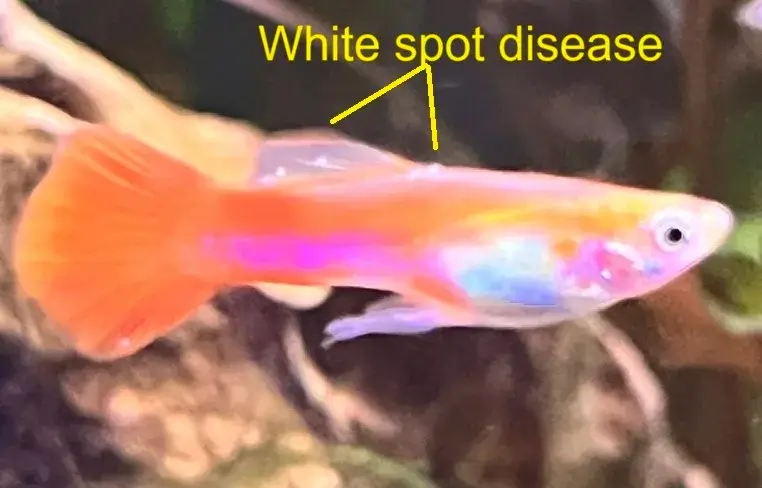
• The parasite completes part of its life cycle on the fish’s body, appearing as tiny white spots that look almost exactly like grains of salt scattered across the fins and skin.
• What makes ich particularly dangerous is how quickly it spreads. The white spots you see are actually the parasite in its feeding stage, embedded in the skin and consuming tissue.
• When matured, each spot drops off the fish, sinks to the substrate, and divides into hundreds of free-swimming offspring that immediately seek a new host — a tank with one or two spotted fish today can have an entire population infected within days.
Ich (White Spot Disease) Symptoms:
➜ Tiny white spots on body and fins resembling salt grains
➜ Scratching or rubbing against decorations and substrate
➜ Rapid breathing or gasping at the surface
➜ Clamped fins held tight against the body
➜ Hiding and reduced activity
➜ Loss of appetite
What Causes Ich:
Ich is almost always triggered by stress. The parasite exists in most aquariums at very low levels that healthy fish can resist. When something stresses the fish, a sudden temperature drop, poor water quality, introduction of a new aggressive or infected fish, or an overcrowded tank, their immune response weakens and ich takes hold. This is why outbreaks often appear after adding new fish, doing a large water change with cold water, or during cooler weather.
Ich (White Spot Disease) Treatment:
• Confirm the diagnosis first if you’re not certain. Ich and velvet can look similar early on. If in doubt, wait 24 hours and check again — ich spots stay distinct like individual grains of salt, while velvet spreads as a much finer, uniform dusting.
• Water change: 25–30% daily or on alternate days if treating in the main tank, to help keep parasite levels down for fish not yet showing spots. Vacuum the substrate thoroughly while you’re at it, since that’s where the parasite multiplies.
• Remove shrimp and snails to a separate holding container before medicating, not the fish. Ich is already present throughout the tank’s water by the time spots are visible, so isolating the fish doesn’t protect the others — but malachite green and formalin are toxic to invertebrates specifically, so they’re the ones that need to come out.
• Raise the temperature gradually to 82–86°F (28–30°C), no more than 1–2°F per hour. Heat speeds up ich’s life cycle, pushing it faster into the vulnerable stage where medication can reach it. Add extra aeration at the same time, since warmer water holds less oxygen. Hold it there for the full treatment — cooler water means a longer treatment time.
• Medicate with a product containing malachite green or formalin, widely available in the US. Dose to the product label for your actual tank volume, most call for daily redosing across several days.
• Treat the whole tank, not just the visibly affected fish — by the time spots are visible, the free-swimming stage is almost certainly present throughout the water, ready to infect fish that haven’t shown symptoms yet.
• Not sure how to actually apply the medication? See our medication dosing section below for filter handling, aeration, and the post-treatment water change every treatment needs.
• Continue treatment for 2–3 days after the last visible spot disappears, not just until spots are gone. The parasite is still present in the water in its free-swimming stage even after the visible spots have dropped off, and stopping early is one of the most common reasons ich comes back within a week.
• No improvement after 5 days of proper treatment? Reconsider the diagnosis — it’s likely not ich, and continuing the same medication won’t help. Stop treatment, let it clear through normal water changes, and re-examine the fish.
• Watch for secondary infection after treatment. Ich damages skin tissue on its way out, which can leave an opening for fungus or bacteria to move in. If new symptoms appear once the spots are gone, check the fungal and bacterial sections above.
Recovery time: Most cases resolve within 7 to 10 days with proper treatment. Fins and skin recover fully in the weeks after.
Guppy Velvet Disease (Gold Dust Disease)
Velvet is one of the most dangerous and easily missed diseases in the guppy keeping hobby, caused by Oodinium pilularis (also called Piscinoodinium).
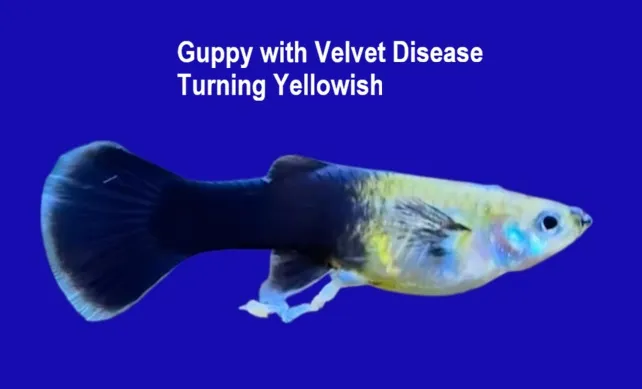
• The parasite attaches to the skin and fins in particles so fine they’re almost invisible under normal lighting.
• The flashlight test is the giveaway. Shine a torch directly onto the fish in a darkened room — the gold or yellow dust-like coating that gives the disease its name only becomes clearly visible this way, a simple diagnostic step every fishkeeper should know.
• By the time it’s visible under normal tank lighting, the infection is already well established — that’s what makes velvet particularly insidious.
• Like ich, velvet completes part of its life cycle on the fish and part in the water column, and it spreads through a tank with alarming speed once established.
Velvet Disease Symptoms:
➜ Fine gold, yellow, or rust colored dust-like coating on the body and fins, most visible under direct flashlight in darkness
➜ Scratching or rubbing against decorations and substrate
➜ Clamped fins held tightly against the body
➜ Rapid or labored breathing, the gills are often heavily affected
➜ Lethargy and reduced activity
➜ Loss of appetite
➜ Skin may appear slightly velvety or textured under close inspection
➜ In advanced cases the skin may peel or ulcerate as tissue is damaged
How to Diagnose Velvet:
The flashlight test is the most reliable way to confirm velvet. Turn off all tank lights and shine a small flashlight or phone torch at a low angle directly onto the fish in a darkened room. Velvet will appear as a fine shimmering gold or yellowish dust covering parts of the body, most commonly the head, back, and sides.
How to Distinguish Velvet from Ich:
Both velvet and ich produce small particles on the body but they look and behave differently. Ich produces larger, more distinct white spots that look like individual grains of salt. Velvet produces a much finer, more uniform dusting that looks like the fish has been lightly coated in gold powder rather than having individual spots.
What Causes Velvet:
➜ Introduction of infected fish or plants without quarantine, the most common cause
➜ Stress from poor water quality, overcrowding, or temperature instability that lowers immune resistance
➜ The Oodinium parasite can survive in a tank for extended periods without a host, making reintroduction after apparent clearance a real risk
➜ Sudden temperature drops that both stress the fish and can accelerate the parasite’s life cycle
Velvet Disease Treatment:
• Turn off tank lights completely for several days, not just dim them. Oodinium is photosynthetic during one life stage and depends on light for energy, so total darkness starves it and slows reproduction, helping medication work.
• Water change: 25–30%, and vacuum the substrate thoroughly to remove parasite cysts.
• Remove shrimp and snails to a separate holding container before medicating with copper, not the fish. Like ich, velvet is already present throughout the tank’s water by the time it’s visible, so isolating the fish doesn’t protect the others — but copper is toxic to invertebrates specifically, so they’re the ones that need to come out.
• Raise temperature gradually to 82–86°F (28–30°C) if tolerated, this pushes the parasite faster through its vulnerable free-swimming stage. Increase aeration significantly, since warm water holds less oxygen.
• Medicate with a copper-based treatment, the most effective option against Oodinium. Dose to the product label carefully and use a copper test kit if you have one, copper is toxic at higher concentrations, so don’t estimate the dose. If copper isn’t safe for your setup, acriflavine or malachite green are workable alternatives.
• Optional salt support: around 1 tablespoon per 5 gallons, dissolved in tank water first. It can help reduce stress and support slime coat recovery, provided no salt-sensitive plants or invertebrates remain in the tank.
• Treat the whole tank, not just the visibly affected fish, by the time velvet is visible, the free-swimming stage is almost certainly present throughout, infecting fish that haven’t shown symptoms yet.
• Continue the full labeled course, at least 10–14 days total. The attached stage on the fish is protected from medication; stopping early before all free-swimming parasites are gone leads to reinfection.
• See our medication dosing section below for filter handling, aeration, and the post-treatment water change every treatment needs.
Prognosis: velvet caught early, before significant gill damage, responds well to treatment. Severely compromised breathing or an already-weak fish has a lower survival rate.
Guppy Skin Flukes
Skin flukes are tiny microscopic parasites, live-bearing flatworms, most commonly Gyrodactylus turnbulli in guppies.
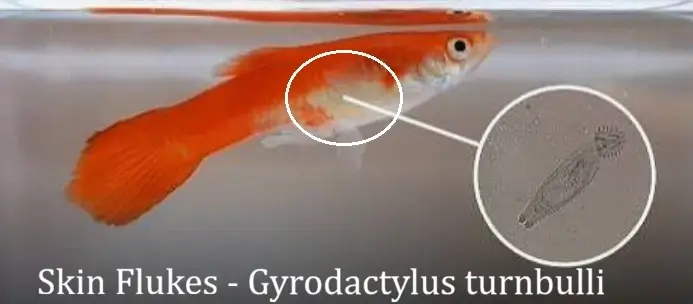
• They anchor to the skin and fins rather than the gills specifically.
• Nicknamed “Russian-doll parasites,” since a fully grown embryo develops inside the mother even before birth — one adult can produce several generations in rapid succession, which is why an infestation can overwhelm a fish so quickly.
Skin Flukes Symptoms:
➜ Flicking, scratching, or rubbing against tank decor and substrate
➜ Clamped fins and erratic swimming
➜ Excessive greyish-white mucus on the skin and fins
➜ Inflamed patches or open wounds, which frequently lead to secondary fungal or bacterial infections
➜ Lethargy and reduced activity
Skin flukes are often invisible to the naked eye in the early stage, so a fish flashing constantly with no visible spots should still be suspected of having them. If you have access to a stereo microscope, flukes can sometimes be directly observed on the fins or skin for confirmation.
What Causes Skin Flukes:
➜ Introducing new fish or plants without quarantine, by far the most common source
➜ Poor water quality, which weakens resistance and lets flukes take hold
Skin Flukes Treatment:
• Isolate the visibly affected fish in a quarantine tank if possible. Gyrodactylus spreads mainly through direct contact — fish-to-fish or via shared decor and nets — rather than a free-swimming stage in the water, so isolation genuinely helps limit further spread.
• Also medicate the main tank as a precaution, since transmission may have already happened before symptoms became visible. Use a product containing praziquantel (such as API General Cure, Sera Tremazol, or Fritz ParaCleanse), the most effective conventional treatment, and one that’s gentle on your beneficial filter bacteria. Dose to the product label for your actual tank volume.
• Re-dose per the product label. Because Gyrodactylus gives birth to live offspring rather than laying eggs into the substrate, the redosing goal is catching newly matured offspring rather than waiting out an egg-hatch window — check your specific product’s label for its exact interval.
• Keep ammonia and nitrite at zero and nitrate low throughout treatment with partial water changes. Fluke damage leaves the skin raw and vulnerable, and poor water quality on top of that significantly raises the risk of a secondary bacterial infection setting in.
• Optional regular aquarium salt bath as a faster adjunct: a short, high-concentration dip (around 25g/L of aquarium salt for 10–15 minutes) can force flukes to detach quickly. This is a brief, separate bath, not the same as the low, ongoing aquarium salt dosing used elsewhere in this guide, don’t confuse the two.
• Watch for secondary infection. Fluke wounds can get infected easily, if you see red sores or ulcers after the parasites are gone, treat with an antibacterial medication next.
• Not sure how to actually apply the medication? See our medication dosing section below for filter handling, aeration, and the post-treatment water change every treatment needs.
Fish caught early generally recover well. Heavier infestations with extensive skin damage take longer and carry a higher risk of secondary infection.
Guppy Gill Flukes or Gill Worms
Gill flukes or Gill worms, most commonly Dactylogyrus, are egg-laying flatworms that specifically target the gill tissue, and in some cases are just visible to the naked eye as thin white worms. They cause real damage fast, since the gills are where oxygen exchange happens.
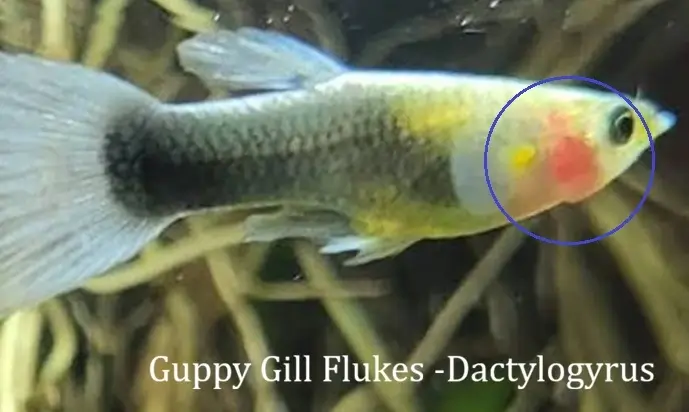
Gill Flukes/Gill worms Symptoms:
➜ Gasping at the surface or rapid gill movement, sometimes holding one or both gill covers flared open wider than usual
➜ Bleeding or visibly damaged gills in heavier infestations
➜ Flashing, rubbing against decorations or substrate
➜ Sitting at the bottom struggling to breathe
➜ Pale gills, in some cases visible thin white worms
➜ Ragged fins or raw, red patches on the skin, often a sign of secondary bacterial infection setting in on top of the flukes
Flukes are often invisible to the naked eye in the early stage, so a fish flashing constantly with no visible spots should still be suspected of having them.
What Causes Gill Flukes:
➜ Introducing new fish or plants without quarantine, by far the most common source
➜ Poor water quality, which weakens resistance and lets flukes take hold
Gill Flukes / Gill Worms Treatment:
• Isolate the visibly affected fish in a quarantine tank if possible. Like skin flukes, Dactylogyrus spreads mainly through direct contact and proximity rather than a free-swimming water-column stage, so isolation genuinely helps limit further spread.
• Also medicate the main tank as a precaution, since transmission may have already happened before symptoms became visible. Use a product containing praziquantel (such as API General Cure, Sera Tremazol, or Fritz ParaCleanse), the most effective treatment against gill flukes. Dose to the product label for your actual tank volume.
• Vacuum the substrate thoroughly before and during treatment to remove eggs and offspring, since Dactylogyrus lays eggs rather than giving birth to live offspring.
• Increase aeration during treatment, beyond just what the medication itself requires. Damaged gills already struggle with oxygen exchange, so a fish fighting gill flukes has less breathing capacity to spare than one with an external skin or fin issue.
• Keep ammonia and nitrite at zero throughout treatment with partial water changes. Damaged gill tissue is already compromised, and poor water quality on top of that puts extra strain on a fish that’s struggling to breathe.
• Re-dose is mandatory, not optional. Dactylogyrus eggs typically hatch in 4 to 5 days, and a single dose only kills the adults present at the time, missing whatever’s still in the egg stage. Plan on repeated dosing across roughly 7 to 10 days total to break the full cycle, and check your specific product’s label for its exact re-dose interval, since this varies by formulation.
• Watch for secondary infection. Fluke wounds can get infected easily, if you see red sores or ulcers after the parasites are gone, treat with an antibacterial medication next.
• See our medication dosing section below for filter handling, aeration, and the post-treatment water change every treatment needs.
Fish caught early, before the gills start bleeding, generally recover well. Once the gills are visibly damaged, the outlook is much worse.
Parasites that Starts External, Turns Internal
Tetrahymena doesn’t fit neatly into either category above. It begins as a surface parasite but can invade muscle tissue and internal organs directly, which is exactly why it’s more dangerous and harder to treat than the external parasites above.
Guppy Tetrahymena Disease
Tetrahymena is one of the most dangerous and least understood diseases in the guppy keeping hobby, caused by Tetrahymena corlissi.
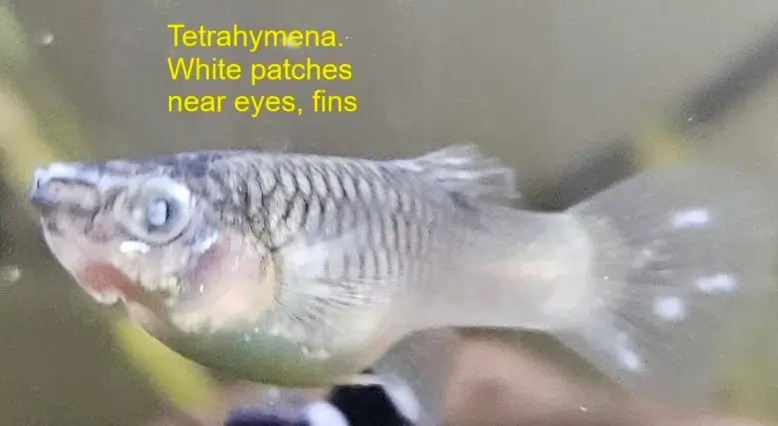
• Particularly deadly to guppies specifically, causing little to no harm to most other aquarium fish. Once symptoms appear, a fish can decline and die within as little as 24 to 48 hours.
• This species specificity is one reason it’s so often missed. Tank mates may appear completely healthy while guppies are dying, which can make the cause look mysterious.
• What makes it especially dangerous is how quickly it progresses in a weakened fish. Unlike ich, which has a visible and predictable life cycle, Tetrahymena can invade muscle tissue and internal organs directly, not just the skin surface.
• By the time visible symptoms appear, the infection is often already deep-seated and difficult to treat successfully.
Tetrahymena Symptoms:
➜ Grey or white mucus patches on the body, fins, or near the eyes
➜ Patches have a slightly slimy appearance rather than the fluffy texture of fungus
➜ Rapid and labored breathing
➜ Weakness and difficulty swimming normally
➜ Loss of appetite
➜ Skin may appear to erode or ulcerate beneath the patches in advanced cases
➜ Sudden deterioration and death, sometimes within 24 to 48 hours of first symptoms appearing
What Causes Tetrahymena:
➜ Chronic stress from poor water quality, overcrowding, or unstable parameters
➜ Weak immune systems in young fry or recently ill fish
➜ Purchasing fish from overcrowded or unhealthy pet store tanks
➜ Introduction of infected fish or contaminated water without quarantine
➜ Heavily inbred fancy guppies with naturally weaker immune systems
Tetrahymena Treatment:
Tetrahymena is notoriously difficult to treat once it’s progressed beyond the very early stage, which makes fast action critical. If the parasite is still only on the surface of the fish, treatment has a real chance, once it has moved inside the fish, the outlook becomes much worse.
• Isolate the fish immediately in a quarantine tank, this also protects other guppies from exposure.
• Water change: 40–50% in both the main tank and quarantine tank, since Tetrahymena thrives in poor water.
• Do not raise the temperature. Unlike ich, warmer water doesn’t help here — research on this specific parasite found its optimum reproduction range is actually 77–95°F (25–35°C), so heating the tank keeps it in favorable conditions rather than pushing it toward a vulnerable stage. Keep temperature stable at your normal target instead.
• Treatment mainly reaches the parasite’s free-swimming stage in the water, not the stage already inside the fish, which is why a combination approach works better than one medication alone:
• Medicate the water with a malachite green and formalin combination product (such as Ich-X or Rid-Ich Plus) to clear free-swimming parasites from the water column before they invade further.
• Feed medicated food containing metronidazole alongside the water treatment, since this parasite invades internally and metronidazole delivered through food reaches tissue the water treatment can’t. Dose to the product label or feeding instructions for the number of days specified.
• Copper-based treatments are a possible alternative to malachite green/formalin, but remove shrimp and snails first, copper is toxic to invertebrates.
• Increase aeration significantly throughout treatment — affected fish already experience respiratory stress, and several of the treatments above further reduce dissolved oxygen.
• Continue treatment for the full labeled course, even if the fish looks like it’s improving, surface-stage infections can still have parasites present internally that aren’t yet visible.
• See our medication dosing section below for filter handling, aeration, and the post-treatment water change every treatment needs.
Honest Prognosis: Tetrahymena has a high mortality rate once established and visible, and even with the best current treatment approaches, results are inconsistent — this is a genuinely difficult disease to cure reliably. Fish caught very early with just minor surface patches have a reasonable chance with aggressive treatment. Fish showing rapid deterioration, ulceration, or internal symptoms have a much lower survival rate. Strict quarantine of all new fish is far more reliable than treatment after infection.
Guppy Parasites – Internal
These live inside the digestive tract or organs rather than on the surface. They’re harder to catch early, since there’s often nothing visible on the fish until the infestation is already advanced, and treatment usually needs to reach the fish internally — through medicated food, not just the water.
Guppy Camallanus Worms
Camallanus worms are one of the most serious internal parasites found in guppies, and one of the most commonly missed until the infestation is already advanced.
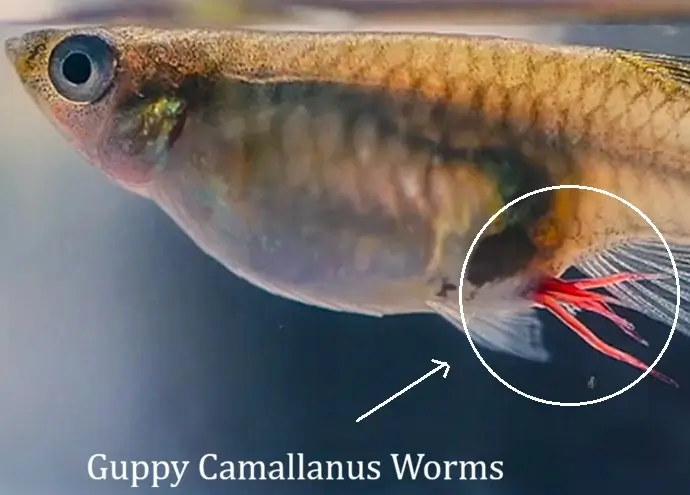
Unlike external parasites, there’s often nothing visible on the fish at all in the early stages.
Camallanus Worms Symptoms:
➜ Thin, reddish worms protruding from the anal opening in advanced infestations, a disturbing but unmistakable sign once visible
➜ Visible weight loss despite normal or even increased appetite
➜ Sunken or hollow belly appearance over time
➜ Weakness and reduced activity
➜ Pale coloration in later stages
What Causes Camallanus Worms:
➜ Introducing new fish without quarantine, by far the most common source
➜ Contaminated live food, particularly live worms or brine shrimp from unknown sources
➜ Adding plants, decorations, or substrate from an already-infected tank
Camallanus Worms Treatment:
• Medicate with a product containing levamisole (such as Fritz Expel-P), the standard and most effective treatment. It works by paralyzing the worms rather than killing them in place, so the fish expels them naturally. Dose to the product label for your actual tank volume — 1 packet of Expel-P per 10 gallons is the typical starting point.
• Dose the water rather than the food. Some guides suggest medicated food instead, but dosing the tank directly is more reliable — a sick fish that’s lost its appetite won’t get a proper dose from food, while the whole tank still gets treated through the water regardless of who’s eating.
• Turn off tank lights during treatment. Levamisole breaks down under light, so keeping the tank dark helps the medication stay effective for its full course.
• 24 hours after dosing, do a 25–50% water change and vacuum the substrate thoroughly to physically remove the paralyzed worms the fish has expelled. This step matters — the medication doesn’t kill the worms outright, so removing them is what actually clears the infestation.
• Treat the whole tank, not just the visibly affected fish, since the worms’ eggs are typically already present more broadly by the time any fish shows visible worms.
• Continue treatment for the full labeled course, typically repeated 1–2 weeks later to catch a second generation of worms that hatch from eggs the first dose couldn’t reach — check your specific product’s label, since some call for a third dose a week after that.
• Feed lightly with high-quality food during recovery to help the fish regain weight and support the digestive system while it recovers.
• Sanitize nets, siphons, and shared equipment separately after use, worm eggs can survive on damp equipment and spread the infestation to other tanks.
• Watch for secondary infections in a fish that’s already weakened by a heavy infestation — an antibacterial or antifungal treatment may be needed alongside the dewormer if new symptoms appear.
• Not sure how to actually apply the medication? See our medication dosing section below for filter handling, aeration, and the post-treatment water change every treatment needs.
Fish caught before significant weight loss generally respond well. Once a fish is severely emaciated, recovery is less certain even with correct treatment, since the internal damage from a heavy, prolonged infestation doesn’t always fully reverse.
Guppy Hexamita
Hexamita is an internal protozoan parasite that attacks the digestive system. It’s easy to miss early, since the first signs look a lot like ordinary poor nutrition rather than a parasite.
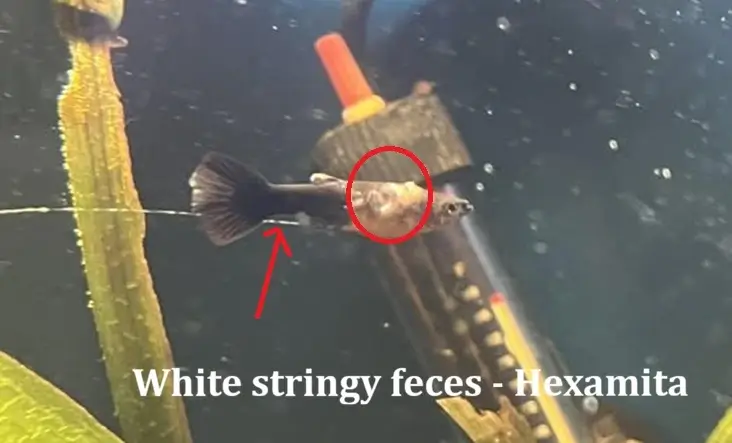
Hexamita Symptoms:
➜ White or pale, stringy feces or poop.
➜ In severe cases, pitting or erosion around the sensory pores on the head
➜ Chronic weight loss despite normal feeding behavior
➜ Gradual, general deterioration over time
➜ Reduced activity and lethargy
What Causes Hexamita:
➜ Introducing infected fish without quarantine
➜ Chronic stress from poor water quality or overcrowding, which allows the parasite to take hold in a fish that would otherwise resist it
Hexamita Treatment:
• Medicate with a product containing metronidazole (such as Seachem MetroPlex or API General Cure), the standard treatment, ideally delivered through medicated food since Hexamita is an internal, digestive-tract parasite that external water treatment reaches less effectively. Dose to the product label or feeding instructions for the number of days specified.
• If the fish won’t eat, dose metronidazole directly into the water instead as a fallback — less effective against this specific parasite than the food route, but better than no treatment for a fish that’s refusing food.
• Raise the temperature slightly to 82–84°F if tolerated. Unlike Tetrahymena, warmth doesn’t favor Hexamita directly — it improves how effectively metronidazole works against it.
• Optional Epsom salt support: around 1 teaspoon per 10 gallons, dissolved in tank water first. It can help ease digestive-tract swelling alongside the medication, but it’s supportive, not a cure on its own.
• Improve water quality alongside treatment, a water change and full parameter check, since ongoing poor water undermines recovery even with the right medication.
• Continue treatment for the full labeled course, typically 5 to 10 days, even once feces return to normal — stopping the moment symptoms improve is a common reason for relapse.
• Not sure how to actually apply the medication? See our medication dosing section below for filter handling, aeration, and the post-treatment water change every treatment needs.
Caught early, before significant weight loss, Hexamita responds reasonably well to treatment. Advanced, long-term infections have a much lower recovery rate.
Other Guppy Health Problems: Symptoms & Treatment
Unlike the diseases above, these aren’t caused by a single type of organism. Each one can come from a bacterial infection, an internal problem, a genetic issue, or something else entirely, which is why treatment depends heavily on figuring out the actual underlying cause first, rather than reaching for one standard medication.
Guppy Dropsy — Bloated Guppy
Dropsy is one of the most serious and heartbreaking conditions a guppy keeper can encounter. It is not a disease in itself but a symptom of severe internal organ failure, most commonly kidney failure.
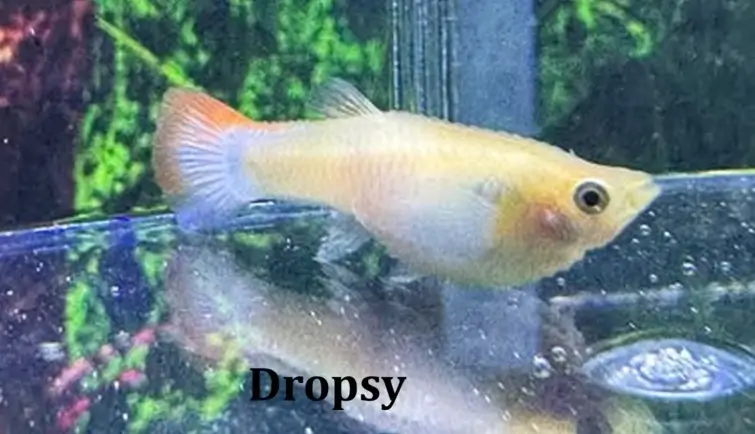
• Fluid accumulates inside the body cavity as organ function fails. The abdomen swells dramatically and the scales are forced outward away from the body, creating the characteristic pinecone appearance that makes advanced dropsy immediately recognizable.
• Dropsy is very difficult to treat successfully once it reaches the pinecone stage. That appearance means internal organ damage is already severe.
• This isn’t a reason to give up immediately — some fish do recover with early, aggressive intervention. But it’s important to be honest about the prognosis so you can make an informed decision about treatment.
Male Guppy with Dropsy:
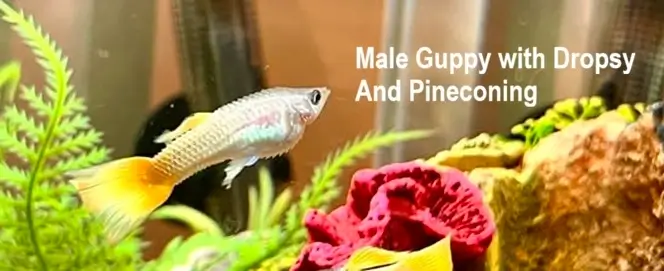
Dropsy Symptoms:
➜ Visibly swollen or bloated abdomen
➜ Scales standing outward from the body in a pinecone pattern, the most definitive sign of dropsy
➜ Difficulty swimming, the swelling affects balance and movement
➜ Loss of appetite
➜ Lethargy and reduced activity
➜ Pale or faded coloration
➜ Eyes may appear to bulge slightly outward in advanced cases
Dropsy vs Pregnant Guppy vs Bloating:
A swollen belly does not always mean dropsy, this is one of the most common points of confusion for beginner fishkeepers. A pregnant female guppy will have a rounded belly that grows gradually over weeks, a visible dark gravid spot near the anal fin, and will otherwise behave normally. A bloated guppy from overfeeding will have a rounder belly but no raised scales and will typically return to normal after fasting. Dropsy is distinguished by the raised pinecone scales, if the scales are lying flat, dropsy is unlikely regardless of how swollen the belly appears. Read our guide on bloated guppy for a full comparison.
What Causes Dropsy:
Dropsy is almost always the end result of long term chronic stress rather than a single acute cause. The most common underlying factors are:
➜ Severe bacterial infection, particularly Aeromonas bacteria that attack internal organs
➜ Chronic poor water quality that damages kidneys over time through constant toxin exposure
➜ Long term stress that keeps the immune system permanently suppressed
➜ Viral infection in some cases
➜ Organ failure from age or genetic weakness in heavily inbred fancy varieties
Dropsy Treatment:
• Isolate the fish immediately in a quarantine tank with clean, well-oxygenated, properly heated water.
• Water change: 30–40% in the main tank, and test all parameters even if it looks fine, poor water quality is almost always a contributing factor.
• Medicate with a product containing kanamycin or nitrofurazone, commonly recommended for dropsy and available in most US fish stores. Minocycline is a reasonable alternative if those aren’t available. Dose to the product label for your actual tank volume, and redose on the schedule specified, typically every 24–48 hours.
• Optional Epsom salt support, not aquarium salt, at around one tablespoon per five gallons of quarantine water, fully dissolved before the fish goes in. It works through osmosis, drawing excess fluid out of the body to ease swelling — supportive, not a cure.
• Continue the full labeled course, then watch closely for another few days — dropsy that’s going to respond usually shows some reduction in swelling within the first week; if there’s no change at all by then, the prognosis is poor regardless of how much longer you continue.
• Not sure how to actually apply the medication? See our medication dosing section below for filter handling, aeration, and the post-treatment water change every treatment needs.
Prognosis. A fish showing early swelling without fully raised scales has a reasonable chance with prompt treatment. A fish with fully raised pinecone scales and bulging eyes has a much lower chance of survival.
Prevention is far more achievable than treatment. Maintaining excellent water quality, avoiding chronic stress, feeding a varied high quality diet, and avoiding overcrowding are the most effective ways to prevent the internal organ stress that leads to dropsy.
Guppy Popeye (Exophthalmia)
Popeye is when one or both eyes swell and bulge outward, sometimes with a cloudy look. It’s not a disease on its own, it’s a sign that something else is wrong, whether that’s poor water, an injury, or an internal infection.
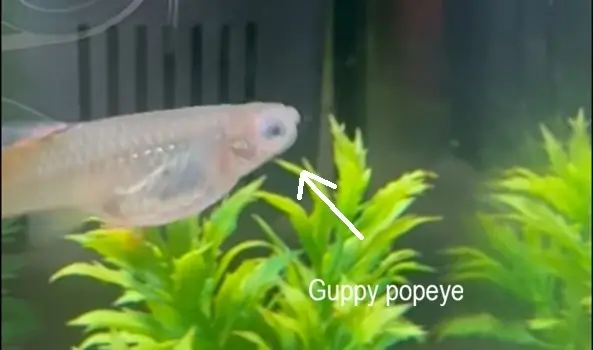
Key signs based on which eyes are affected:
➜ One eye: usually points to something local, physical injury from sharp decor, or a targeted attack from a bullying tank mate.
➜ Both eyes: usually points to something systemic, poor water quality, organ trouble, or a more serious internal bacterial infection.
Popeye Treatment:
• Isolate the fish in a quarantine tank, both to treat it properly and to protect it from further bullying while it’s vulnerable.
• Use Epsom salt for the swelling itself, around one tablespoon per five gallons in the quarantine tank, fully dissolved first. Epsom salt draws excess fluid out through osmosis, which is what actually reduces the swelling. Aquarium salt doesn’t do this — it may offer some general support for a physical injury specifically, but it isn’t a substitute for Epsom salt here.
• Treat with a broad-spectrum antibiotic containing erythromycin, kanamycin, or a similar active ingredient if a bacterial infection seems likely, especially in bilateral cases. Dose to the product label, and continue the full labeled course even if the swelling starts going down quickly.
• Test your main tank’s water — ammonia, nitrite, and nitrate — and do a water change if anything’s off. Keep testing daily throughout treatment, since ongoing poor water quality slows recovery even with the right medication.
• Check for hazards in the tank — sharp decorations, rough rocks, or an aggressive tank mate — if it’s just one eye affected.
• Minor cases from physical injury alone sometimes resolve on their own with clean water and a good diet, without needing antibiotics — worth a few days of close observation before assuming medication is necessary, especially for a single-eye case with no other symptoms.
• Not sure how to actually apply the medication? See our medication dosing section below for filter handling, aeration, and the post-treatment water change every treatment needs.
Popeye isn’t always curable, since it depends entirely on the underlying cause, but addressing that cause early gives the best chance of the swelling going down.
Guppy Swim Bladder Problem
The swim bladder is an internal gas-filled organ that allows fish to control their buoyancy — rising, sinking, and hovering at different water depths without constant swimming effort.
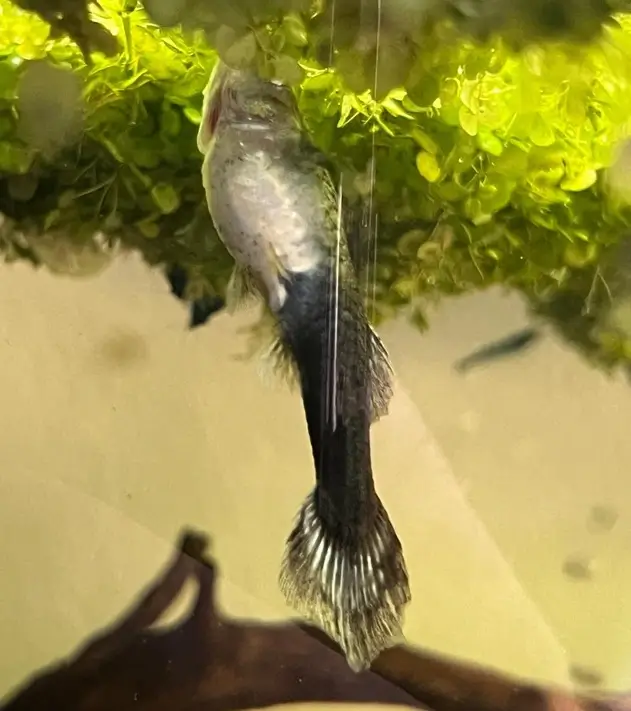
• When something goes wrong with this organ, a guppy loses the ability to regulate its position in the water, and the results are immediately visible and often alarming to watch.
• Swim bladder problems aren’t a single disease — they’re a symptom that can have several different underlying causes. This matters because treatment depends entirely on what’s actually causing the problem.
Swim Bladder Symptoms:
➜ Swimming upside down or on their side
➜ Floating involuntarily at the surface
➜ Sinking to the bottom and struggling to rise
➜ Swimming at a tilted or diagonal angle
➜ Difficulty maintaining a normal position while resting
➜ Lethargy and reduced appetite
If your guppy is struggling to swim normally read our detailed guide on why guppies swim upside down for a full breakdown of causes and solutions.
What Causes Swim Bladder Problems:
Overfeeding is the most common cause in guppies. When a guppy is consistently overfed, the digestive tract becomes enlarged and presses directly against the swim bladder, compressing it and disrupting normal function.
Constipation goes hand in hand with overfeeding. Fasting the fish for 24 to 48 hours and then offering a small piece of blanched, deshelled pea, which acts as a natural laxative for fish, often resolves constipation related swim bladder issues surprisingly quickly.
Poor water quality and temperature instability can cause swim bladder dysfunction through general organ stress.
Physical injury or infection can also damage the swim bladder directly, though this is less common.
Genetic or congenital defects, some guppies, particularly heavily inbred fancy varieties, are born with swim bladder abnormalities that manifest as they grow. These cases are unfortunately not treatable.
Swim Bladder Treatment:
• Fast the fish for 24–48 hours. This alone resolves a surprising number of cases by letting the digestive system clear and easing pressure on the swim bladder.
• Offer a small piece of blanched, deshelled pea afterward. The soft fiber helps move any blockage through naturally, many keepers see improvement within 24 hours.
• Lower the water level slightly if the fish is struggling to reach the surface. A fish that can’t control its buoyancy has to work much harder in deep water, and reducing the distance to the surface eases that strain while it recovers.
• Improve water quality with a partial water change, and confirm temperature is stable at 76–78°F (24–26°C).
• Reduce feeding going forward, smaller portions twice daily rather than large ones, and soak dry food briefly before feeding so it doesn’t expand inside the fish.
• Switch from floating flakes to sinking pellets going forward if overfeeding or air-swallowing seems to be a recurring cause. Fish that gulp air at the surface chasing floating food can end up with air in the digestive tract, adding to swim bladder pressure.
• If symptoms don’t improve within a few days of fasting and dietary changes, an internal infection may be responsible. A product containing kanamycin or a similar broad-spectrum antibiotic, dosed to the label with the full course completed, is worth trying at that point.
Cases caused by genetic defects or severe physical damage unfortunately don’t respond to treatment, and the fish may need to be monitored for quality of life.
Guppy Bent Spine (Scoliosis)
Scoliosis is a spinal deformity that causes a guppy’s backbone to curve into a visible C or S shape.
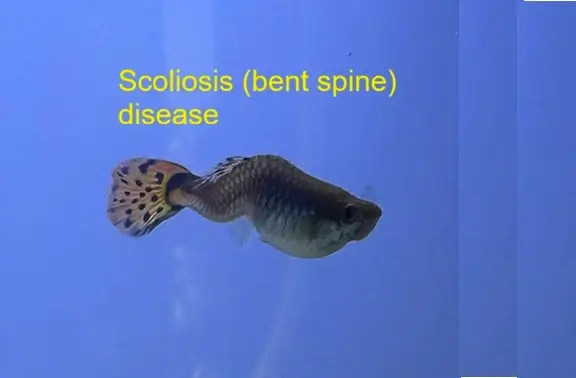
• Unlike most other conditions in this guide, scoliosis is not an infection and cannot be caught or spread to other fish. It’s a structural physical problem, and unfortunately in most cases it’s permanent.
• Severity varies widely. Many guppies with mild scoliosis live relatively normal lives — the range runs from a slight curve that barely affects swimming to a severe bend that significantly impairs movement and quality of life.
Bent Spine (Scoliosis) Symptoms:
➜ Visible curve in the spine, C shaped or S shaped depending on severity
➜ Difficulty swimming normally, the fish may swim at an angle or struggle to maintain direction
➜ Reduced activity compared to healthy tank mates
➜ Slower growth in affected young fish
➜ In severe cases difficulty reaching the surface to feed
What Causes Scoliosis:
Inbreeding is the most common cause in captive guppies. Fancy guppies are selectively bred for color and fin shape over many generations, and genetic diversity is often sacrificed in the process. This is why scoliosis is seen far more commonly in fancy guppy lines than in wild type or hardier varieties.
Tuberculosis, fish TB caused by Mycobacterium bacteria, can cause spinal deformities as a symptom of the infection. This is an important distinction because fish TB is contagious and potentially dangerous. If multiple fish in a tank develop bent spines alongside other symptoms like wasting, lethargy, and skin lesions, fish TB should be suspected. Fish TB is also one of the few fish diseases that can theoretically be transmitted to humans through open cuts, always wear gloves when handling fish or tank water if TB is suspected.
Poor nutrition during early development, particularly vitamin C and D deficiencies, can affect spinal development in growing fry.
Viral infections in some cases can cause spinal curvature, particularly in fry that survive an infection during early development.
Bent Spine (Scoliosis) Treatment:
There is no treatment for established scoliosis. The spinal curve is a physical structural deformity and cannot be reversed with medication or environmental changes.
• Focus on quality of life instead. Ensure the affected fish can reach food easily — if severe curvature prevents normal swimming to the surface, target feeding with a syringe or pipette can help.
• Isolate the fish in a separate or breeder tank if tank mates start bullying or nipping at it, since a slower-moving fish is an easy target and the added stress makes everything harder on it.
• Keep water quality excellent and stress levels low. Avoid housing a fish with severe scoliosis alongside aggressive tank mates that may bully it.
• Consider humane euthanasia if the fish is struggling to swim, can’t reach food even with help, or shows ongoing signs of distress. Clove oil is the standard, peaceful method — see our FAQ below for the full guidance on this decision.
Prevention: Avoid purchasing fish that already show signs of spinal curvature. When breeding guppies, rotate breeding stock regularly and introduce unrelated fish periodically to maintain genetic diversity. Feed breeding pairs and fry a varied diet that includes live or frozen foods rich in vitamins and nutrients.
How to Dose Medication Correctly: A Practical Protocol From Experience
A sick guppy fish needs medication for a parasite or bacterial infection rather than just a water quality fix, and how you dose it matters as much as which medication you choose. This is the approach that’s worked reliably in practice, and it isn’t something you’ll find spelled out clearly in most online guides.
Before you start:
➜ Don’t combine medications without checking they’re compatible. Some treatments, like methylene blue, interfere with the beneficial bacteria in your filter and shouldn’t be mixed casually with other medications or used in the main tank if you can avoid it.
Treating in the main tank (lower parasite or bacterial load):
➜ Turn the filter off before adding any medication. This is the most important step, and it’s easy to overlook, if the filter keeps running, it will pull the medication out of the water through the filter media before it ever gets the chance to reach the fish
➜ Keep an air stone running the whole time instead, so the medication still circulates evenly through the tank rather than sitting in one spot, and it also helps enough oxygen dissolve into the water, which matters even more for a sick fish
➜ Leave the filter off for a few hours while the medication works, then turn it back on, running the filter afterward helps the medication reach and treat parasites or bacteria hiding in the filter media itself, not just the fish
Treating in a separate quarantine tank (more serious cases):
➜ Move the fish to a small quarantine tank, even a 2 to 5 gallon container works well for a guppy, with an air stone running
➜ Add the medication and leave it for a few hours, the same as above
➜ Afterward, do a complete water change with properly matched parameters, medicated water becomes toxic over time, and you can’t leave a fish sitting in it indefinitely, especially one that’s already struggling to breathe from illness
➜ Repeat this cycle, dose, wait a few hours, full water change, as many times as needed until the fish actually improves
Whichever tank you’re treating in:
➜ Follow the label’s full course, not just until symptoms disappear. Stopping early because the fish looks better is one of the single most common causes of relapse across nearly every disease in this guide.
➜ Plan on a 25 to 30 percent water change the day after treatment ends, to clear out the medication’s own toxicity, on top of whatever specific stopping rule that disease’s own Treatment section already gave you. More than that, even a full change, is fine if you’re willing to put in the extra effort.
➜ Even if you’re treating a fish separately in quarantine, don’t neglect the main tank, whatever caused the illness in the first place is usually still present there, so it needs its own water changes or treatment too.
➜ Any sick guppy needs to be well-oxygenated throughout treatment, an air stone isn’t optional here, illness and medication both put extra strain on a fish’s ability to breathe.
Frequently Asked Questions
Can guppy fins grow back?
Yes, guppy fins have a remarkable ability to regenerate if the infection is stopped before it reaches the body. New fin tissue typically begins appearing within 2 to 3 weeks of successful treatment, though full regrowth can take a month or more depending on the severity.
Why is my guppy scratching against decorations?
This behavior is called flashing and is almost always caused by external parasites irritating the skin and gills. Ich and velvet are the most common culprits but flukes and other external parasites cause the same response. Do the flashlight test in a darkened room to check for velvet and examine the fish closely under good lighting for white spots. A water quality check is also worth doing immediately as ammonia and nitrite irritation can cause similar behavior.
Why is my guppy hiding and not eating?
A guppy that is hiding and refusing food is almost always sick or severely stressed. These two symptoms together are one of the clearest early warning signs that something is seriously wrong. Check your water parameters immediately, ammonia and nitrite spikes are the most common cause. Observe the fish closely for any visible symptoms like spots, fin damage, or abnormal swimming that might help identify the specific problem.
Why are my guppy’s fins shrinking?
Shrinking or receding fins almost always indicate fin rot, a bacterial infection that progressively destroys fin tissue from the edges inward. The early stage looks like slightly ragged or transparent fin edges. As it progresses the fins visibly shrink. Aggression from tank mates can cause similar looking damage but fin rot has a characteristic soft deteriorating edge rather than a clean tear. Improve water quality immediately and consider antibacterial medication if the deterioration is ongoing.
Can guppies recover from disease?
Yes, many common guppy diseases respond well to treatment when caught early. Ich, fin rot, fungal infections, and mild parasite infestations all have good recovery rates with prompt appropriate treatment. Diseases involving internal organ damage, like advanced dropsy or severe Haemorrhagic Septicemia, have lower survival rates. The single biggest factor in recovery is how quickly treatment begins. A disease caught on day one is far easier to treat than the same disease caught on day five.
How do I keep guppies healthy long term?
The foundation of long term guppy health comes down to four things done consistently, stable clean water, appropriate stocking levels, a varied nutritious diet, and strict quarantine of all new fish. None of these are complicated but all four need to be maintained consistently rather than occasionally. Weekly water testing, regular partial water changes, and daily observation of your fish’s behavior catch problems before they become serious. Guppies kept in truly good conditions with low stress levels are remarkably hardy and long lived.
Why is my guppy breathing fast?
Rapid breathing, where the gills are visibly moving faster than normal, is a sign that something is seriously wrong and needs immediate attention. The most common causes are low dissolved oxygen levels, ammonia or nitrite poisoning, gill parasites like flukes or velvet, and bacterial gill infections. Check your water parameters immediately. If ammonia or nitrite is elevated do a large water change straight away. If parameters are fine suspect gill parasites and treat accordingly. Increase aeration while you investigate to support oxygen levels.
Why is my guppy staying at the bottom of the tank?
A guppy sitting on the substrate and barely moving is one of the most serious behavioral warning signs. Healthy guppies are active mid-water swimmers, bottom sitting indicates significant illness, severe stress, or weakness. Check water parameters immediately. Common causes include ammonia poisoning, disease, extreme cold, swim bladder problems, or a fish that is simply too weak from illness to swim normally. Read our dedicated guide on why guppies stay at the bottom for a full breakdown.
Why is my guppy staying at the top of the tank?
Guppies that hover near the surface are usually seeking oxygen. This indicates that dissolved oxygen levels in the tank are insufficient, most commonly caused by high water temperature, poor surface agitation, overcrowding, or an ammonia spike that is damaging the gills. Increase surface movement immediately by adjusting the filter outlet or adding an air stone. Test water parameters and perform a water change if ammonia or nitrite is elevated. Read our guide on why guppies stay at the top of the tank for more detail.
What does white stringy poop mean in guppies?
White stringy feces that trail behind a guppy rather than breaking off normally is one of the clearest signs of internal parasites, particularly protozoan infections like Hexamita or intestinal worm infestations. Healthy guppy feces is darker and more compact. White stringy waste indicates that the digestive system is not absorbing nutrients properly, which is why affected fish often lose weight despite eating normally. Treatment with metronidazole or other antiparasitic medications is usually required.
Why is my guppy losing color?
Faded or washed out coloration in a guppy that was previously vibrant is almost always a sign of chronic stress or illness. Poor water quality is the most common cause, guppies living in chronically elevated nitrates or unstable parameters gradually lose their color as the body prioritises survival over pigmentation. Disease, parasites, poor nutrition, and aggression from tank mates all cause the same response. A sudden dramatic color loss accompanied by other symptoms suggests active illness. Gradual fading over weeks or months usually points to chronic environmental stress. Read our guide on guppy losing color for a detailed breakdown.
What is the most common disease in guppies?
The most common guppy diseases include ich (white spot disease), fin rot, fungal infections, velvet disease, dropsy, swim bladder disorder, and bacterial infections. Most are linked to poor water quality, stress, or introducing infected fish.
Why do guppies suddenly die without any visible symptoms?
Sudden deaths are often caused by ammonia or nitrite poisoning, temperature shock, severe stress, internal bacterial infections, or parasites that show few external signs until the disease is advanced.
When should I use medication for guppy diseases?
Medication should be used only after identifying the disease correctly. Using the wrong medicine may stress the fish further and delay recovery.
Can healthy-looking guppies carry diseases?
Yes. Newly purchased guppies may carry bacteria, parasites, or viruses without showing symptoms, which is why quarantine is recommended.
Can guppies spread diseases to other fish?
Yes, several common guppy diseases are contagious and can spread to other fish in the tank. Ich and velvet spread rapidly through free-swimming parasite stages in the water column and will infect every susceptible fish in the tank if left untreated. Columnaris and Hemorrhagic Septicemia can spread through the water particularly in stressed overcrowded tanks. Internal parasites like Camallanus worms can spread through the water and through infected fish being eaten by others. Non-contagious conditions like scoliosis, swim bladder problems, and dropsy do not spread between fish.
Are guppy diseases contagious to humans?
Almost all guppy diseases are not a risk to humans. The one exception is fish tuberculosis (Mycobacterium), the bacteria sometimes behind severe cases of Dropsy or Scoliosis, which can rarely infect humans through open cuts, a condition called “Fish Tank Granuloma” or “Fish Fancier’s Finger.” It’s a low risk, but real, always wash your hands after working in an aquarium, and wear gloves if you suspect fish TB specifically.
Why is my guppy rubbing against gravel or decorations?
Rubbing or flashing behavior, where a fish darts and scrapes its body against surfaces, is almost always caused by something irritating the skin or gills. External parasites are the most common cause, particularly ich in its early stage before white spots are clearly visible, velvet which may not be visible without a flashlight test, and gill flukes which are invisible to the naked eye. Poor water quality causing skin irritation can produce similar behavior. If you see flashing behavior assume parasites until proven otherwise and begin investigation and treatment promptly.
Why is my guppy isolating itself?
Guppies are naturally social and active fish. A guppy that separates itself from the group, hides in a corner, or avoids interaction with tank mates is almost certainly unwell or severely stressed. This is one of the earliest behavioral changes to appear before visible disease symptoms develop. Check water parameters, observe the fish closely for any physical symptoms, and consider whether it may be being bullied by tank mates. Early isolation and observation in a quarantine tank is often the best response, it removes the fish from potential stressors and allows close monitoring.
Why is my guppy gasping at the surface?
Surface gasping, where a guppy repeatedly comes to the top and gulps air, is an emergency sign that requires immediate action. The most common causes are critically low dissolved oxygen levels, ammonia or nitrite poisoning that is damaging the gills, gill parasites preventing normal oxygen absorption, and bacterial gill infections. Increase surface agitation immediately by adjusting the filter outlet or adding an air pump. Test water parameters and perform a large water change if ammonia or nitrite is detected. If parameters are fine and gasping continues suspect gill parasites and treat accordingly.
What is the first thing I should do when I notice a sick guppy?
The very first step is always to test your water, ammonia, nitrite, nitrate, and temperature. The majority of guppy diseases are triggered or worsened by poor water conditions, and no medication will work effectively in a tank with elevated toxins. While waiting for test results observe the fish carefully and note every symptom you can see, location of spots or growths, swimming behavior, fin condition, belly shape, and breathing rate. This information helps narrow down the diagnosis significantly before you commit to a treatment.
How do I know if my guppy is dying or just sick?
A guppy that is still swimming, even poorly, eating occasionally, and responding to stimuli has a fighting chance with proper treatment. A guppy that is lying on the substrate motionless, showing no response when approached, has lost all color, and is breathing very slowly or erratically is likely in the final stages of illness. In these cases humane euthanasia using clove oil is kinder than prolonging suffering through further treatment. The decision is never easy but a fish that cannot recover should not be made to suffer longer than necessary.
Should I treat the whole tank or just the sick fish?
This depends entirely on the disease. Contagious conditions like ich, velvet, and columnaris should be treated in the entire tank because free-swimming parasite stages or bacteria are already present throughout the water even if other fish appear healthy. Non-contagious conditions like swim bladder problems, scoliosis, or dropsy only require treatment of the individual fish in a quarantine tank. When in doubt about contagiousness treat the whole tank, the cost of unnecessary whole-tank treatment is far lower than the cost of a disease spreading to every fish because only one was treated.
How long should a sick guppy stay in quarantine before going back to the main tank?
Complete the full course of whatever medication you’re using, then wait an additional 3 to 5 days after the fish is fully symptom-free before moving it back. This is shorter than the 2 to 4 week quarantine used for brand new fish, since you’re confirming an already-diagnosed illness has cleared, not watching for an unknown one to appear.
Final Thoughts
Guppy diseases are rarely as mysterious as they first appear. In almost every case there is an identifiable cause, a logical treatment, and, most importantly, a preventable set of conditions that allowed the disease to take hold in the first place.
The fishkeepers who lose the fewest guppies to disease are not the ones with the most expensive equipment or the most elaborate medication cabinets. They are the ones who test their water consistently, observe their fish daily, quarantine every new addition without exception, and act quickly when something does not look right. These habits cost very little and prevent the vast majority of disease outbreaks before they ever begin.
If your guppy is sick right now, start with the water. Test ammonia, nitrite, nitrate, and temperature before anything else. Fix whatever you find. Then identify the disease using the symptoms and photos in this guide and begin appropriate treatment promptly. Most common guppy diseases respond well when caught early and treated correctly.
If your guppies are currently healthy, keep them that way through consistency. Stable water, appropriate stocking, varied nutrition, and strict quarantine of new fish are the four pillars of long term guppy health. None of them are complicated. All of them matter.
For more help keeping your guppies healthy read our guides on guppy water parameters, guppy tank setup, and guppy care guide.