
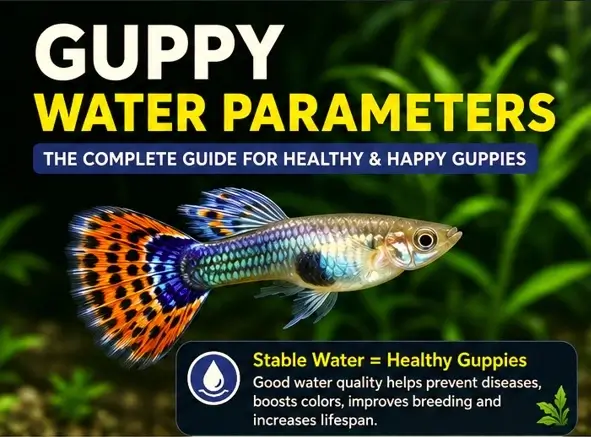
The most important guppy water parameters to monitor are temperature, pH, GH, KH, ammonia, nitrite, and nitrate. For most guppies, aim for 76–78°F (24–26°C), a pH of 7.0–8.0, and 0 ppm ammonia and nitrite.
Poor water quality is one of the most common causes of stress, disease, and unexplained deaths in guppy tanks. Whether you keep fancy guppies, Endlers, or a community tank, understanding these parameters is the foundation of keeping your fish healthy.
Quick Navigation:
➜ Ideal Guppy Water Parameters Chart
➜ Guppy Water Temperature: Ideal Temperature & Range
➜ Guppy pH: Ideal pH Level & Range
➜ Guppy Water Hardness (GH & KH)
➜ Ammonia, Nitrite & Nitrate for Guppies
➜ Why Water Changes Matter?
➜ How Often to Change Water in a Guppy Tank?
➜ Signs Your Water Parameters Are Bad
➜ Endler Guppy Water Parameters
➜ Frequently Asked Questions
Ideal Guppy Water Parameters Chart
The table below covers the key water parameters every guppy keeper should know. While guppies can tolerate a range of conditions, staying within these values gives them the best chance of a long, healthy life.
| Parameter | Acceptable Range | Ideal Range |
|---|---|---|
| Temperature | 72°F–82°F (22°C–28°C) | 76°F–78°F (24°C–26°C) |
| pH | 7.0–8.0 | 7.2–7.8 |
| GH | 8–12 dGH | 8–12 dGH |
| KH | 4–8 dKH | 4–8 dKH |
| Ammonia | 0 ppm | 0 ppm |
| Nitrite | 0 ppm | 0 ppm |
| Nitrate | Below 40 ppm | Below 20 ppm |
Each of these parameters is covered in detail in the sections below.
Guppy Water Temperature: Ideal Temperature & Range
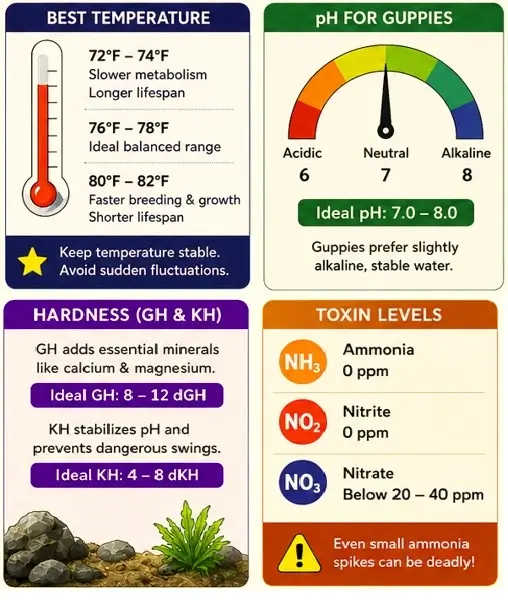
The ideal guppy water temperature is between 76°F and 78°F (24°C–26°C), with a wider tolerated range of 72°F to 82°F (22°C–28°C) depending on your goals.
• Cooler water within that range slows metabolism and can extend lifespan.
• Warmer water speeds up growth and breeding, at the cost of a shorter lifespan.
• For most keepers, 76–78°F is the best long-term choice — the balanced middle ground between the two.
• Consistency matters as much as the number itself. Sudden swings, even small ones, stress guppies and weaken their immune response far more than sitting a couple of degrees outside the ideal range ever does.
For the full breakdown of cold vs. warm tradeoffs, breeding and fry temperature, and heater sizing by tank, see our temperature for guppies guide.
Guppy pH: Ideal pH Level & Range
The ideal pH for guppies is between 7.0 and 8.0, slightly alkaline. This reflects their natural habitat — wild guppies live in mineral-rich freshwater, so they’re naturally suited to alkaline conditions rather than soft, acidic water.
• Guppies can tolerate a pH from 7.0 to 8.5, but there’s no narrower sweet spot worth chasing inside that range.
• Stability matters more than the exact number. A guppy living in a steady 7.8 is healthier than one swinging between 7.0 and 8.0 day to day.
• If your pH won’t sit still, low KH is almost always the reason — covered in the next section.
For the full breakdown, including how to raise or lower pH safely, what counts as too high, and what pH to aim for in a planted tank, see our guppy pH guide.
Guppy Water Hardness (GH & KH)
Water hardness is one of the most overlooked aspects of guppy care, particularly among beginners. Most fishkeepers learn to test for ammonia and pH fairly quickly, but GH and KH often get ignored — and that oversight can quietly cause a range of problems.
• GH (General Hardness) measures dissolved calcium and magnesium, the minerals guppies need for growth, fin condition, color, and breeding. Aim for 8–12 dGH.
• KH (Carbonate Hardness) is what actually keeps your pH steady — it buffers against the acids that build up in a tank over time, and when KH runs too low, pH can drift or crash without warning. Aim for 4–8 dKH.
For the full picture, including how to raise hardness naturally, whether your water can be too hard, and the signs your water is too soft, see our hard water guide.
Ammonia, Nitrite & Nitrate for Guppies
Of all the water quality issues that affect guppies, toxic nitrogen compounds are the most dangerous and the most common cause of unexpected illness and death in fish tanks. Understanding how ammonia, nitrite, and nitrate relate to each other is one of the most valuable things a fish keeper can learn.
Nitrite: 0 ppm
Nitrate: below 20–40 ppm
The basic cycle: Fish waste → Ammonia → (beneficial bacteria) → Nitrite → (beneficial bacteria) → Nitrate → removed by plants and water changes.
• Ammonia is the most immediately deadly of the three. It’s produced constantly through fish waste, uneaten food, and decaying matter, and even a small amount damages a guppy’s gills and weakens its immune system. The target is always zero. Live plants help by using ammonia directly as a nutrient source, alongside the beneficial bacteria that convert it. For more, read our guppy ammonia guide.
• Nitrite is produced when beneficial bacteria break down ammonia. It’s less immediately lethal but still highly toxic — it interferes with a guppy’s ability to carry oxygen in its blood, causing suffocation even in well-oxygenated water. Like ammonia, the only acceptable level is zero.
• Nitrate is the end product of the cycle and far less toxic. Keep it below 20 ppm ideally, though up to 40 ppm is generally tolerable for healthy adults. Fry and pregnant females do better at the lower end.
Why Water Changes Matter?
Water changes physically remove nitrate, dissolved organic waste, and other compounds that filtration and plants cannot completely eliminate. A healthy biological filter converts toxic ammonia and nitrite into nitrate, but it does not make nitrate disappear.
Regular partial water changes also help restore water quality without destroying the established biological filtration on surfaces inside the aquarium. The goal is not to replace all the water; it is to keep the chemistry stable and waste levels controlled.
Always use dechlorinated replacement water and match its temperature closely to the aquarium. Avoid unnecessary large water changes that can create sudden shifts in temperature, pH, or hardness.
How Often to Change Water in a Guppy Tank?
There is no single water change schedule that works for every guppy tank. The right frequency depends on several factors working together, and understanding them helps you customize it.
• Tank size: larger tanks dilute waste and toxins across a greater volume of water, so parameters stay stable for longer. A small tank sees ammonia and nitrate rise fast with just a few fish inside; the same fish in a larger tank give you considerably more breathing room between changes.
• Stocking ratio: stay within the standard guppy stocking guidelines for your tank size — roughly 5–8 in a 10 gallon, 12–20 in a 20 gallon, 15–25 in a 30 gallon, and scale up proportionally from there. A tank stocked at the upper end of its range needs water changed more often than one lightly stocked, regardless of size.
• Filtration quality: a high-quality filter running efficiently keeps water cleaner for longer than a basic or undersized one struggling to keep up. Even the best filter doesn’t replace water changes entirely — it just extends the window between them.
• Live plants: a well-planted tank actively absorbs nitrates and other harmful compounds around the clock, slowing how quickly parameters deteriorate between changes.
Taking all of these factors together, here’s a practical schedule by tank size:
• 10 gallon (stocked at 5–8 guppies): weekly water changes of 25% to 30%. Smaller volumes are unforgiving, and parameters can shift quickly if stocked near the upper end.
• 20 gallon (stocked at 12–20 guppies): weekly water changes of 25% to 30% at moderate stocking, or every 10 to 14 days if lightly stocked with good filtration and live plants.
• 30 gallon (stocked at 15–25 guppies): every 10 to 14 days at around 25% to 30% is generally sufficient with adequate filtration.
• 30 gallon and above: with good filtration, light stocking, and live plants, water changes every 10 to 15 days of around 30% are generally adequate — provided weekly water testing confirms parameters remain stable.
When in doubt, test your water rather than guessing. The numbers will always tell you more accurately than a schedule whether a water change is overdue.
Signs Your Water Parameters Are Bad
Fish cannot tell you when something is wrong with their water parameters, but they show it clearly through behavior and appearance.
• Gasping at the surface — usually low oxygen, an ammonia or nitrite spike, or both. Test immediately. See our guppy ammonia guide for emergency steps.
• Clamped fins — held tight against the body instead of open and flowing, an early sign of stress or illness, often triggered by poor water quality.
• Shimmying — a side-to-side rocking motion, most often from cold water, a sudden temperature drop, or unstable GH and KH. See our guppy shaking and shimmying guide for the full diagnosis.
• Faded colors — chronic stress from poor water gradually suppresses pigmentation over time.
• Loss of appetite — especially alongside clamped fins or gasping, a strong sign water quality is the problem.
• Cloudy or hazy water — often a bacterial bloom from a recent ammonia spike, overfeeding, or a tank that hasn’t finished cycling. Test parameters right away rather than waiting for it to clear on its own.
• Sudden unexplained deaths — often an ammonia spike, a pH crash, or oxygen depletion that went undetected.
• Foul or rotten-egg smell — healthy and clean water should not smell like much of anything. A sour or rotten-egg odor usually means something’s decaying in the substrate — check for uneaten food or a dead fish, and test your water immediately.
Whenever you notice any of these, test your water before reaching for medication. In most cases a water change and fixing the underlying parameter problem does more good than any medicine — and medicating an already-stressed fish in poor water can make things worse.
Endler Guppy and Fancy Guppy Water Parameters
Endler guppies, often called Endlers or Endler’s livebearers are closely related to common guppies and share very similar water requirements.
• Temperature: 72°F–80°F
• pH: 7.0–8.0
• Water type: moderately hard water preferred, same GH/KH attention as regular guppies — see our guppy pH guide and hard water guide
• Toughness: generally hardier than fancy guppies — closer to their wild ancestors, so they handle minor parameter shifts with less stress. Still, stable water is the foundation either way.
Fancy guppies need extra attention:
• Same core parameters as standard guppies, but selective breeding for color and large finnage has made them more sensitive to fluctuations.
• Minerals matter more for color. Calcium and magnesium (GH) directly support vibrant coloration, and since fancy strains are bred specifically to maximize color, staying on the higher end of the 8–12 dGH range helps them show their best.
• Stability is non-negotiable. Their large fins and modified bodies handle sudden swings worse than a hardier wild-type or Endler.
Frequently Asked Questions
Can guppies live in cold water?
Guppies can survive temporarily in cooler water, but cold temperatures below 68°F (20°C) weaken their immune system, slow their metabolism, and make them significantly more vulnerable to bacterial infections, parasites, and fungal diseases. Long term exposure to cold water almost always leads to illness and a shortened lifespan.
Is 82°F too hot for guppies?
82°F sits at the upper edge of the acceptable range and is not immediately dangerous, but it is not ideal for long term keeping. Warmer water holds less dissolved oxygen, places more strain on the body, and accelerates waste breakdown in the tank.
How often should I test water parameters?
For an established, stable tank, testing once a week is sufficient. During the first few weeks of a new tank cycle, or any time your fish are showing unusual behavior or when you have done a water change.
Can I use bottled water for guppies?
Technically yes, but it is not recommended as a long term solution. The mineral content of bottled water varies widely between brands, making it difficult to maintain consistent parameters. Properly dechlorinated tap water treated with a quality water conditioner is more reliable, more consistent, and far more cost effective for regular water changes.
Can water parameters affect guppy colors?
Yes, significantly. Guppies kept in clean, stable, mineral rich water display their most vivid coloration. Poor water quality, unstable pH, or chronic low level ammonia stress all suppress natural pigmentation over time, causing fish to look dull, pale and washed out.
Do guppies need oxygen in the tank?
Yes. Like all fish, guppies breathe dissolved oxygen from the water through their gills. Adequate surface movement is essential for gas exchange — it allows oxygen to enter the water and carbon dioxide to escape. A filter outlet, air stone, or gentle surface agitation is sufficient for most tanks. Signs of low oxygen include guppies gasping at the surface, reduced activity, and rapid gill movement.
What’s the best test kit for guppy water?
A liquid test kit — the API Freshwater Master Test Kit is the standard choice in the US, covering ammonia, nitrite, nitrate, and pH in one kit. A digital thermometer and a GH/KH test kit are worth adding too, since hardness problems are easy to miss with ammonia and pH testing alone.
Can unstable water parameters kill guppies?
Yes, and it happens more often than most fishkeepers realize. Sudden swings in temperature, pH crashes, or unexpected ammonia spikes can kill guppies within hours in severe cases. Even less dramatic fluctuations that happen repeatedly over time create chronic stress that gradually weakens fish and shortens their lives.
Do baby guppies need different water parameters?
Fry thrive in the same parameter ranges as adult guppies, but they are far less tolerant of deviations. Even mild ammonia or nitrite levels that an adult fish might handle with minimal visible effect can be fatal to newborn fry. Clean, stable water with nitrates kept as low as possible — ideally below 10 ppm which gives fry the best chance of growing out healthy.
How long does it take for a guppy tank to cycle?
A new aquarium typically takes between 4 and 6 weeks to fully cycle — meaning enough beneficial bacteria have established to reliably convert ammonia through nitrite and into nitrate. The process can be accelerated by adding a small amount of substrate or filter media from an already established tank, which introduces an existing bacterial colony to the new environment.
What is the safest way to add new water to a guppy tank?
Always dechlorinate tap water with a quality water conditioner before it touches the tank. Match the temperature of the new water as closely as possible to the existing tank water within one or two degrees is ideal. Add the new water slowly rather than pouring it in all at once, particularly after larger water changes, to minimize the disruption to water chemistry and temperature stability.
Can low oxygen levels stress guppies?
Yes. Low dissolved oxygen is one of the most stressful conditions a guppy can experience and one of the hardest to detect without testing. The most visible sign is guppies repeatedly surfacing to gulp air. Causes include high water temperature, poor surface agitation, overcrowding, and excessive organic waste in the tank. Improving surface movement and addressing the underlying cause usually resolves the issue quickly.
Do guppies prefer still water or flowing water?
Guppies naturally inhabit slow moving or still bodies of water and strongly prefer gentle flow in the aquarium. Strong currents stress fancy guppies, damage their large fins over time, and exhaust fry and weaker fish. A sponge filter or a baffled hang-on-back filter that diffuses the outlet flow is ideal for most guppy setups.
Final Thoughts
Maintaining stable guppy water parameters is not complicated, but it does require consistency and attention. Temperature, pH, hardness, and toxin levels all work together — when one falls out of range, the others are usually not far behind. The fishkeepers who have the most success with guppies are not necessarily the ones with the most expensive equipment or the largest tanks. They are the ones who test their water regularly, respond to problems early, and understand that prevention is always easier than treatment.