
Seeing tiny guppy fry swimming around your aquarium for the first time is one of the most exciting moments in fishkeeping. Then the panic sets in. They are hiding, disappearing, not eating, or dying — and you have no idea why. Guppy fry are among the most delicate fish you will ever keep, but they are also among the fastest growing. Get the first few weeks right and you will have healthy, colorful juveniles before you know it. Get them wrong and even a large healthy batch can disappear within days.
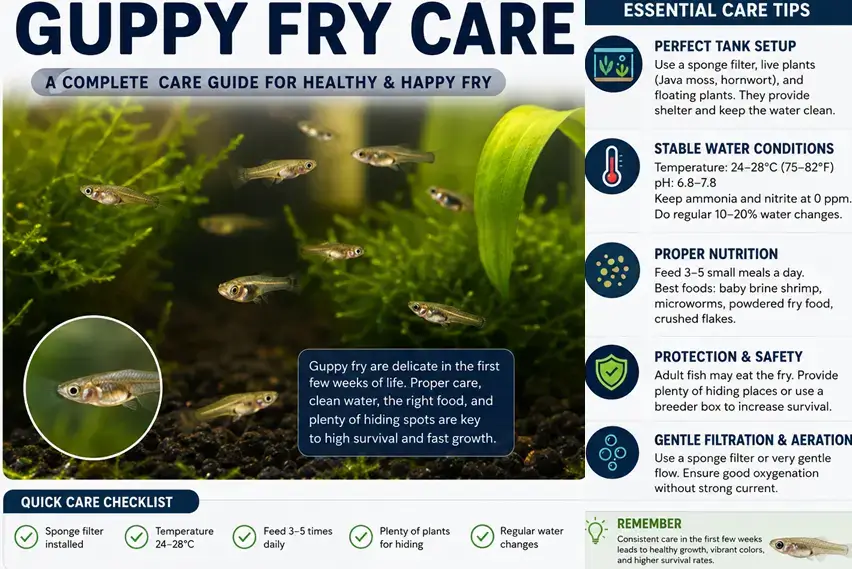
This guide covers everything you need — from the first 24 hours after birth through feeding, tank setup, growth stages, color development, sexing, and the most common reasons fry die suddenly.
In this guide:
➜ What guppy fry are
➜ What to do during the first 24 hours
➜ Best tank setup for guppy fry
➜ What guppy fry eat
➜ Guppy fry growth stages
➜ When guppy fry get their color
➜ Male vs female guppy fry
➜ Why guppy fry die suddenly
➜ Fish that eat guppy fry
➜ How to help guppy fry grow faster
➜ Frequently asked questions
What Are Guppy Fry?
Guppy fry are newborn guppies born fully alive and free-swimming rather than hatching from eggs. Guppies are livebearers — the female carries fertilized eggs internally and gives birth to fully formed, independent fish. A newborn fry is typically around 1/4 inch long and capable of swimming and feeding immediately after birth.
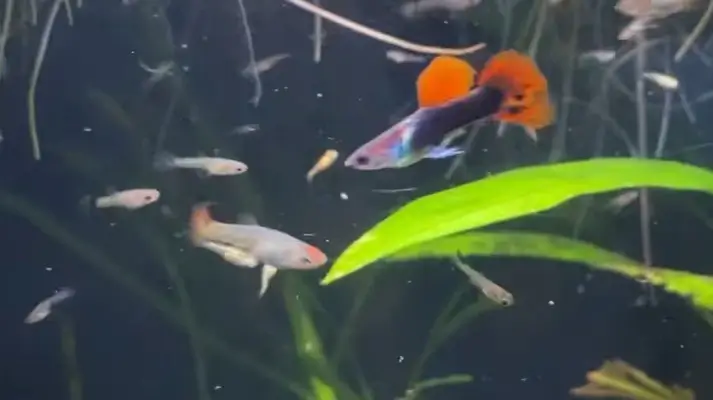
Unlike egg-laying species where the fry are protected in an egg until they develop further, guppy fry enter the world completely exposed from the moment they are born. Within seconds of birth they begin swimming instinctively toward shelter — plants, decorations, any cover available — because every fish in the tank, including their own mother, may attempt to eat them.
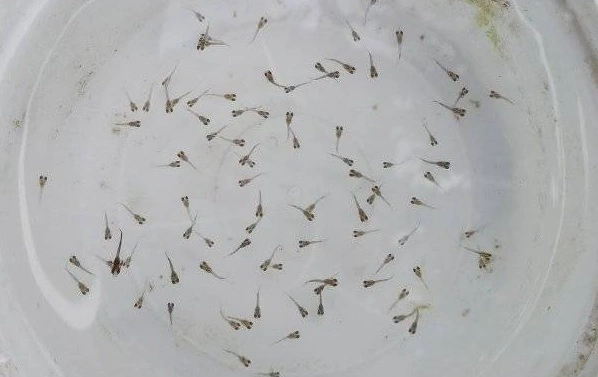
This is not bad parenting or abnormal behavior. It is exactly what guppies do naturally. In the wild, fry scatter into dense vegetation immediately and survival depends on how quickly they find cover. In an aquarium, replicating that cover is one of the most important things you can do.
Healthy newborn guppy fry:
➜ Swim within minutes of birth
➜ Move immediately toward plants and hiding spots and remain stationary for few hours.
➜ Start Swiming more actively after 6 to 10 hours
➜ Begin searching for food
➜ Are sensitive to any sudden change in water parameters
The first two weeks of life are the most critical. Immune systems are still developing, bodies are tiny, and even minor problems in the tank — a small ammonia spike, a temperature drop, a current that is slightly too strong — can wipe out a batch of fry that looked perfectly healthy the day before.
First 24 Hours After Guppy Fry Are Born
The first 24 hours after birth are when most beginner mistakes happen — and also when most fry losses occur. What you do in these first hours depends on where the birth happened and how your tank is set up.
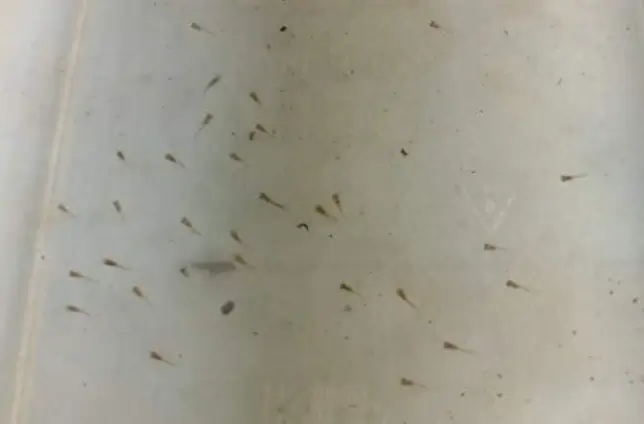
What is completely normal in the first 24 hours:
➜ Fry hiding constantly among plants and decorations — correct behavior, not illness
➜ Fry staying near the surface or floating plants — they naturally gravitate toward surface cover
➜ Some fry appearing smaller or weaker than others — size variation within a batch is normal
➜ Fry not feeding immediately — newborns often have a small yolk sac and may not feed for the first few hours
If the female gave birth in the main community tank
Remove the mother and any other adult fish from the tank as soon as you notice fry — or move the fry carefully using a cup or container rather than a net, which can injure them. Do not use a net on newborn fry.
If removing all adults is not possible, feed the adult fish a small amount of food immediately. A fish with a full stomach is significantly less likely to hunt fry. This buys the fry time to find cover. It is not a perfect solution but it meaningfully improves short-term survival in a community tank.
Dense planting done earlier is your best ally here — java moss, guppy grass, and floating plants give fry immediate places to hide where adults cannot easily reach them.
If the female gave birth in a breeder box
A breeder box keeps the female separated from the rest of the tank during birth, with fry dropping through a mesh bottom away from the mother. Once birth is complete — you can tell when the female stops producing fry and begins moving normally again — remove the mother promptly and return her to the main tank. Leaving her in the box after birth causes unnecessary stress.
The fry can stay in the breeder box for the first few hours while they gain strength. Once they are swimming actively and confidently — usually within 3–6 hours of birth — move them to a dedicated fry tank. Do not leave them in the breeder box for more than 12–24 hours. Space is too limited, waste builds up quickly, and the small water volume inside a breeder box becomes toxic faster than you expect.
When moving fry from the breeder box to a fry tank:
→ Match the water temperature of the fry tank exactly to the breeder box water before transferring — even a 1–2 degree difference shocks newborn fry
→ Use a cup or container to scoop fry across — never a net
→ Add a large amount of water from the breeder box to the fry tank during transfer to help with parameter matching and benefical bacteria growth
→ Keep the fry tank water as close as possible to the same pH and hardness as the main tank
General first 24 hour rules regardless of setup
→ Keep lights dim or off for the first few hours — bright light stresses newborn fry
→ Do not do a water change in the first 24 hours — stability is everything right now
→ Offer the first feeding after 6–12 hours — crushed flake powder or powdered fry food, a tiny amount
→ Make sure any filter intake is covered — even a gentle HOB filter can trap and kill newborn fry
→ Keep temperature stable — use a reliable heater, do not let room temperature drops affect the tank overnight
The single biggest cause of fry deaths in the first 24 hours is overfeeding. Beginners want to feed well and feed often immediately. But uneaten food in a small fry tank or breeder box breaks down into ammonia within hours. Tiny amounts, starting after the first 6–12 hours, is the right approach.
Best Tank Setup for Guppy Fry
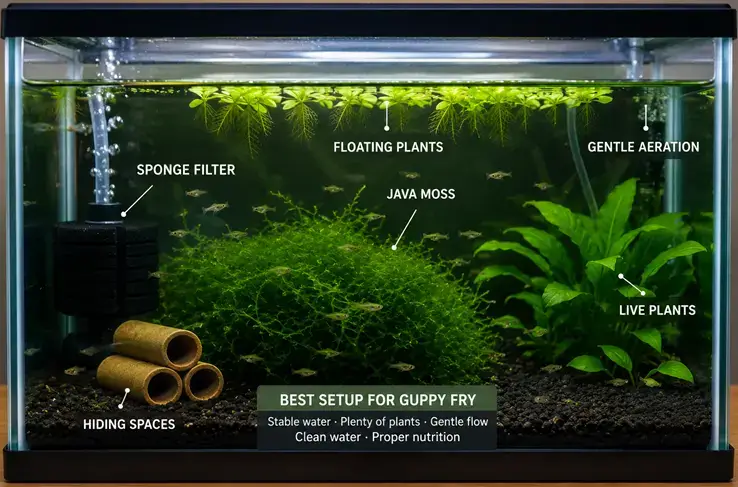
Guppy fry do not need an elaborate setup — they need a stable, safe, clean one. The most common cause of fry deaths is not lack of equipment, it is instability. Temperature swings or a filter current that is too strong can wipe out fry that would otherwise have thrived.
Tank Size
A 5–10 gallon tank works well for raising a batch of fry. A 5-gallon is perfectly adequate for a typical batch — fry are tiny, they eat tiny amounts, and their waste output in the first few weeks is minimal. A 10-gallon gives you more buffer and is the better choice if you regularly get large batches of 80–100+ fry.
Filter
For the first two weeks, a healthy batch of fry in a 5-gallon tank with minimal feeding actually produces very little waste. A sponge filter is ideal when you do add one — it provides gentle biological filtration with no intake risk — but it is not urgently needed from day one in a lightly stocked clean fry tank.
The more important rule is this: if you are running any filter at all, keep the flow extremely gentle. Newborn fry are tiny and weak. A current they cannot escape exhausts them, slows growth, and causes stress. A small sponge filter running on the lowest airflow setting is perfect. Avoid HOB filters entirely in a fry tank — if you must use one, cover the intake with a sponge pre-filter.
From around 2 weeks onward as the fry grow and eat more, adding a sponge filter becomes more worthwhile.
Temperature
Keep the fry tank at 76°F–80°F. This range supports active feeding, healthy immune function, and good growth without overheating. Stability matters more than the exact number — a tank holding steady at 77°F every day is far healthier than one swinging between 74°F and 82°F overnight due to room temperature changes.
Plants
Java moss is the single most valuable addition to any fry tank. Newborn fry instinctively swim into java moss immediately after birth and hide within its dense structure. Without cover, fry spend energy stressed and exposed rather than feeding and growing. Floating plants like Amazon frogbit and guppy grass add surface cover and mid-water shelter. Plants also absorb the small amount of nitrate the fry produce, helping keep the water naturally clean.
Water Changes
In a 5-gallon fry tank with tiny fry eating tiny crushed amounts of food, the waste load in the first two weeks is very low. A 10–15% water change once every 10 days is usually sufficient during this early period. You do not need daily or every-other-day changes at this stage.
What matters most is how you do the water change — not how often. Always match the replacement water temperature exactly to the tank before adding it. Even a 1–2 degree difference shocks newborn fry. Use a thin airline tube or a small syringe rather than a siphon to avoid accidentally removing fry with the water.
As fry grow larger and start eating more — from around 3–4 weeks onward — increase the frequency to once every 7 days.
For detailed water parameter guidance, read our guppy water parameters guide. For a full aquarium setup walkthrough, read our guppy tank setup guide.
What Do Guppy Fry Eat?
The first thing to understand about feeding guppy fry is that they do not need food immediately after birth. Newborn fry carry a small yolk sac that provides nutrition for the first 10–12 hours of life. During this time they are not looking for food — they are hiding, resting, and absorbing that yolk sac while they gain strength.
After 12 hours — sometimes up to 24 hours depending on the batch — fry will begin swimming more actively and start searching for food. You will notice them picking at particles near the bottom and sides of the tank. This is the signal that they are ready to eat. Until you see this behavior, there is no benefit to feeding and uneaten food will only foul the water.
Once they are actively feeding, guppy fry grow rapidly and need frequent high-protein food that fits in their tiny mouths. The right food in the right amounts is one of the most important factors in fry survival and growth rate.
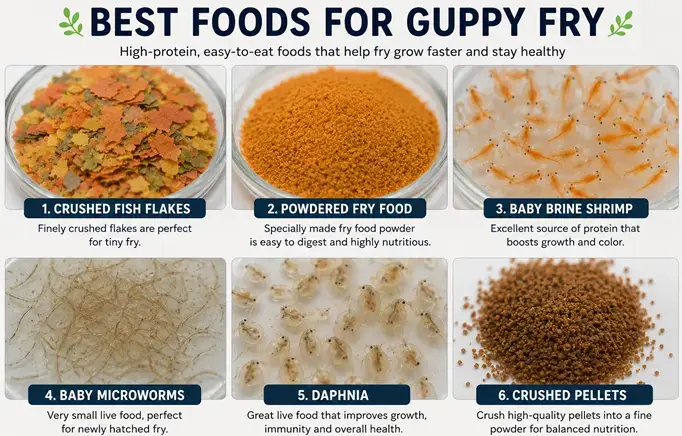
For the first few days, crushed micro pellets or finely crushed flakes are actually the best starting food. Very young fry have not yet developed the coordination and hunting skills to chase and catch moving prey effectively. Crushed flakes or micro pellets that sink slowly or rest on the substrate are far easier for them to find and eat at this stage. After about a week, once fry are swimming more confidently and actively hunting, you can introduce live foods like baby brine shrimp and microworms with much better results.
Best foods for guppy fry:
Baby brine shrimp — the gold standard once fry have developed their hunting skills at around 7–10 days old. Highly nutritious, perfectly sized, and the stimulation of chasing live prey encourages active feeding behavior. Fry fed regular baby brine shrimp grow noticeably faster than those fed crushed flakes alone. You can hatch your own from brine shrimp eggs using a simple DIY hatchery — a worthwhile investment if you breed guppies regularly.
Microworms — tiny live worms that are easy to culture at home, stay alive in the water column for extended periods, and provide excellent protein. A good transition food between crushed flakes and baby brine shrimp as fry develop their movement and hunting ability.
Crushed flake food — grind high-quality adult flakes into a fine powder between your fingers. The powder should be nearly invisible on the water surface. This is the most accessible option and works well as a staple between live food feedings.
Powdered fry food — commercially available fine-particle food formulated specifically for small fry. A good option to keep on hand.
Infusoria — microscopic organisms that very young fry can consume in the first 48–72 hours. More effort to culture but useful if you have it available during the earliest stage.
Vinegar eels — tiny live food suitable for newborn fry, easy to culture at home, and stay alive in fresh water long enough for fry to eat them at their own pace.
How Often Should Guppy Fry Be Fed?
Feed fry 3–5 small portions per day once they are actively searching for food. More frequent small feedings consistently produce faster growth and higher survival rates than one or two large feedings. The key word is small — each portion should be consumed within 2–3 minutes. Anything left over needs to be removed before it decays and spikes ammonia.
Many breeders feed fry on a rotating schedule — live baby brine shrimp in the morning, crushed flakes midday, microworms in the evening. Variety improves both nutrition and color development.
For more food recommendations, read our best guppy food guide.
Guppy Fry Growth Stages
Guppy fry grow remarkably fast when conditions are right. Here is a quick overview of what to expect:
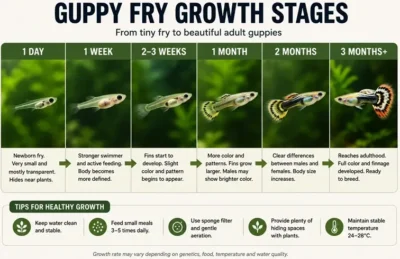
Day 1: Transparent, hiding near plants, barely moving — completely normal behavior.
Week 1: Actively swimming and feeding, noticeably stronger.
Week 2–3: Body shape becomes visible, transparency fades, fins developing.
Week 4: Early coloration appears, males and females start looking different.
Week 6: Sex differences are clear — separate males and females now.
Month 2: Near adult size, males brightly colored, large enough for the main tank.
For a detailed week-by-week breakdown with photos at every stage, read our guppy fry growth guide.
When Do Guppy Fry Get Their Color?
Transparent fry that stay transparent for weeks are one of the most common sources of beginner worry. In almost all cases this is completely normal.
Most guppy fry begin developing visible coloration between 3–6 weeks of age, with males coloring up earlier and more dramatically than females. The timeline varies significantly between strains — some fancy guppy varieties develop color very slowly compared to hardier wild-type fish.
Factors that influence color development speed:
➜ Genetics — the most important factor. Some strains are slow to color regardless of care.
➜ Nutrition — fry fed a varied high-protein diet with live foods color up faster. Baby brine shrimp in particular are well-documented to improve color development.
➜ Water temperature — slightly warmer water at 78°F–80°F speeds up metabolism and color development.
➜ Water quality — clean, stable water allows fry to put energy into growth and color rather than stress response.
➜ Light — adequate lighting during the day supports color development. 8–10 hours of light with full darkness at night is the right balance.
If fry reach 8 weeks old with no color development at all and poor growth despite good feeding and clean water, genetics may be the limiting factor — particularly in heavily inbred fancy strains.
Male vs Female Guppy Fry
Identifying male and female guppy fry as early as possible matters for two reasons — preventing uncontrolled sibling breeding and managing population growth. Male fry can impregnate females from as early as 6–8 weeks old.
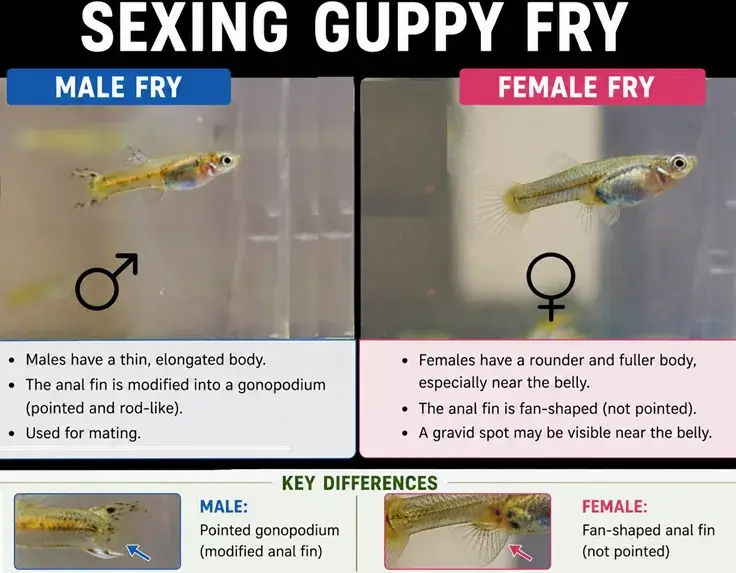
The most reliable way to sex fry is by the anal fin. In males this develops into the gonopodium — a long, narrow, pointed structure. In females it remains fan-shaped and rounded throughout life.
Male Fry Signs
→ Slimmer, narrower body
→ Gonopodium developing from around 3–4 weeks
→ Color developing on the tail and body by 4–6 weeks
→ More active and darting behavior
→ Smaller overall body size than females
Female Fry Signs
→ Larger, rounder body
→ Fan-shaped anal fin that remains consistent
→ Dark gravid spot developing near the lower abdomen
→ Less colorful — body usually stays grey or pale
→ Slower to develop visually but grow larger
Gender differences are usually reliably visible by 4–6 weeks. Separate male and female fry into different tanks as soon as you can confidently identify the sexes — waiting longer increases the chance of unintended pregnancies. For a full comparison with photos, read our male vs female guppy guide.
Why Are My Guppy Fry Dying?
Fry dying suddenly is the most common and most frustrating problem in guppy keeping. The cause is almost always one of the following — and almost always preventable.
Ammonia spike — the most common cause. Fry tanks are small, fry produce waste, and uneaten food rots quickly. Even a small ammonia rise that adult guppies could tolerate can kill fry within hours. Test water parameters immediately if fry start dying. Do a 20% water change right away as an emergency response.
Temperature fluctuation — fry are far more sensitive to temperature swings than adult guppies. A drop of just 2–3 degrees overnight from a room temperature change or air conditioning can kill fry within a day. Always use a reliable heater in a fry tank.
Strong filter current — fry are tiny and weak. Even a gentle HOB filter can create a current that exhausts fry trying to fight it. Sponge filters are the correct choice. If using any other filter, baffle the outlet.
Overfeeding — directly causes ammonia spikes. Less food, more often.
Premature or weak fry — first-time mothers often produce smaller, weaker batches. Some fry from any batch are naturally less viable than others. Some losses in every batch are normal and not something you caused.
Parasites or disease — ich, velvet, and bacterial infections move through fry populations extremely fast because fry immune systems are undeveloped. Quarantine new plants and equipment before adding them to fry tanks. If your fish are showing symptoms, read our common guppy diseases guide.
Stress from transfer — moving fry between tanks without matching temperature and parameters causes shock. Always acclimate carefully and match temperatures exactly.
Can Adult Guppies Eat Fry?
Yes — and they will if given the opportunity. This includes the mother. Adult guppies eating fry is not unusual behavior — it is completely natural. The solution is not to stop it happening, it is to make sure fry have enough cover that most survive regardless.
Best fry protection methods in order of effectiveness:
→ Separate fry tank — no adults present at all
→ Breeding box — fry born separately, then moved to grow-out tank
→ Dense java moss, guppy grass, and floating plants — allows a meaningful number of fry to survive naturally
Fish That Eat Guppy Fry
Almost any fish large enough to fit a guppy fry in its mouth will eat one. This is not aggressive behavior — it is simply the nature of aquarium fish.
Fish that commonly eat guppy fry:
➜ Angelfish — will hunt fry actively and efficiently
➜ Bettas — particularly aggressive toward fry
➜ Larger tetras — serpae tetras and others will eat fry they can catch
➜ Gouramis — will eat fry given the opportunity
➜ Adult guppies — including the fry’s own parents
➜ Corydoras — generally safe with adult fry, but may eat very newborn fry if they encounter them on the substrate
Will kuhli loaches eat guppy fry?
Kuhli loaches may eat very weak or dead fry they find near the bottom but they are not active hunters of healthy fry. In a planted tank with decent cover, most fry survive alongside kuhli loaches without significant losses.
The most reliable solution for any community tank is dense planting — java moss, floating plants, and guppy grass together give fry enough cover to escape most casual predators.
How to Help Guppy Fry Grow Faster
Growth rate in guppy fry is directly tied to food quality, water quality, and stress levels. Remove any of these and growth slows noticeably.
Feed live food regularly — baby brine shrimp produce the fastest growth of any fry food. Even three live feedings per week alongside crushed flake as a staple produces visibly faster development compared to flakes alone.
Frequent small water changes — clean water reduces stress and lets fry put their energy into growth rather than dealing with waste buildup. 10–15% daily or every other day is better than a large weekly change.
Stable warm temperature — 78°F–80°F accelerates metabolism, digestion, and growth. Stability matters more than the exact number.
Reduce competition — in a crowded fry tank smaller fry lose out on food to faster, larger siblings. Separate batches by size if growth is very uneven, or target feed smaller fry with a pipette.
Heavy planting — fry in heavily planted tanks spend less energy hiding and more energy feeding. Reduced stress directly improves growth.
Avoid overcrowding — too many fry in a small tank means more waste, faster water quality deterioration, more competition, and slower growth for everyone.
Frequently Asked Questions
How fast do guppy fry grow?
Under good conditions guppy fry grow rapidly — most reach juvenile size within 4–6 weeks and approach adult size by 2–3 months. Growth speed depends heavily on feeding frequency, food quality, water cleanliness, and temperature.
What is the best food for guppy fry?
Baby brine shrimp produce the fastest growth and best color development. Microworms, crushed flake food, and powdered fry food are all good staple options. Variety produces better results than any single food.
When can guppy fry join the main tank?
When they are too large to fit in an adult fish’s mouth — typically around 6–8 weeks old, sometimes longer depending on the size of the adult fish in the tank.
Do guppy fry need a filter?
Yes. A sponge filter is the safest option because it provides biological filtration with no intake current that can trap or kill fry.
Can guppy fry survive without separation?
Some fry survive in heavily planted community tanks without separation, but survival rates are much lower than in a dedicated fry tank.
How many fry can a guppy have?
A single female produces 20–80 fry per batch depending on her age, size, and genetics. Larger, older females typically produce the biggest batches.
Why are my guppy fry hiding all the time?
This is completely normal behavior. Newborn fry instinctively hide among plants and decorations to avoid predators. It does not indicate illness or stress — it indicates healthy survival instinct.
Do guppy fry need light at night?
No. Guppy fry benefit from a normal day and night cycle — 8–10 hours of light and full darkness at night. Leaving lights on continuously stresses fry and disrupts their natural behavior.
Can guppy fry survive in a community tank?
Some fry survive in heavily planted community tanks but survival rates are lower. A dedicated fry tank or breeding box gives the best results.
How long do guppy fry stay small?
Most fry grow noticeably within the first 2–3 weeks and reach juvenile size by 4–6 weeks under good conditions.
Can guppy fry eat regular fish food?
Yes — but grind adult flakes into a fine powder first. Whole flakes are too large for young fry to eat effectively.
Why are some guppy fry growing faster than others?
Size variation within a batch is normal. Males and females develop at different rates. Feeding competition in the tank means larger, faster fry get more food. Genetics also plays a role.
Do guppy fry need an air pump?
Gentle aeration helps maintain oxygen levels, especially in crowded fry tanks. Strong airflow should be avoided as the current exhausts tiny fry.
Can guppy fry live without plants?
Yes, but survival rates are lower and stress is higher without plant cover. Java moss in particular significantly improves fry survival.
Why are my guppy fry staying at the bottom?
Occasional resting is normal. Constant bottom sitting in young fry usually indicates ammonia poisoning, low oxygen, temperature problems, or disease. Test water parameters immediately.
How many guppy fry usually survive?
In a community tank without separation, as few as 10–20% may survive. In a dedicated fry tank with sponge filtration, regular feeding, and stable water, survival rates of 70–90% are achievable.
When should I separate male and female fry?
At 4–6 weeks old — as soon as you can reliably identify the sexes. Males can impregnate females from as early as 6–8 weeks old, so separating early prevents uncontrolled breeding.
Final Thoughts
Raising guppy fry is mostly about stability and patience during the first two weeks. The fish are doing everything right — they are hiding, they are searching for food, they are developing at their own pace. Your job is to keep the water clean, the temperature steady, the filter gentle, and the food coming in small frequent amounts.
Get those fundamentals right and guppy fry are surprisingly resilient. Most losses happen because of something wrong with the environment, not because of anything wrong with the fry themselves.
For more detail on how fry develop week by week, read our guppy fry growth guide. For complete care guidance, read our guppy care guide and guppy breeding guide.