
Guppy breeding is one of the most rewarding parts of the aquarium hobby and one of the easiest. Guppies are livebearers that reproduce quickly and naturally, making them the ideal breeding project for beginners and a satisfying ongoing challenge for experienced hobbyists developing specific strains.
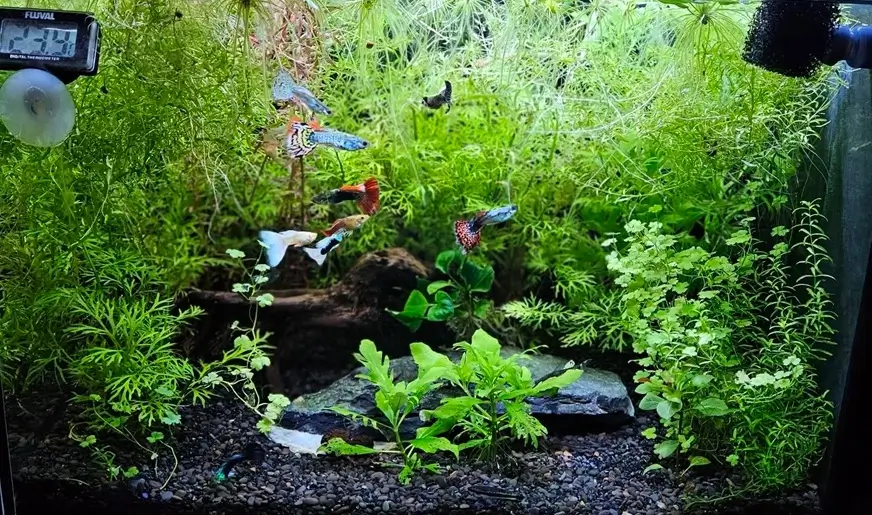
If it is done right, guppy breeding produces healthy, colorful and stable strains. Done wrong, it leads to weak genetics, fry cannibalism, disease outbreaks, and overcrowded tanks that spiral out of control within weeks.
Quick Navigation
➜ 1. How Guppy Breeding Works
➜ 2. Choosing Healthy Breeding Pairs
➜ 3. Guppy Breeding Tank Setup
➜ 4. Guppy Breeding Behavior
➜ 5. Pregnancy and Gestation Period
➜ 6. Raising Guppy Fry
➜ 7. Line Breeding Guppies
➜ 8. Cross Breeding Guppies
➜ 9. Colony Breeding Guppies
➜ Frequently Asked Questions
1. How Guppy Breeding Works
Guppies are livebearing fish, which means females carry fertilized eggs internally and give birth to fully formed, free-swimming fry rather than laying eggs. This is why guppy breeding happens so naturally and so often. Put healthy males and females together in good water conditions and breeding will happen on its own.
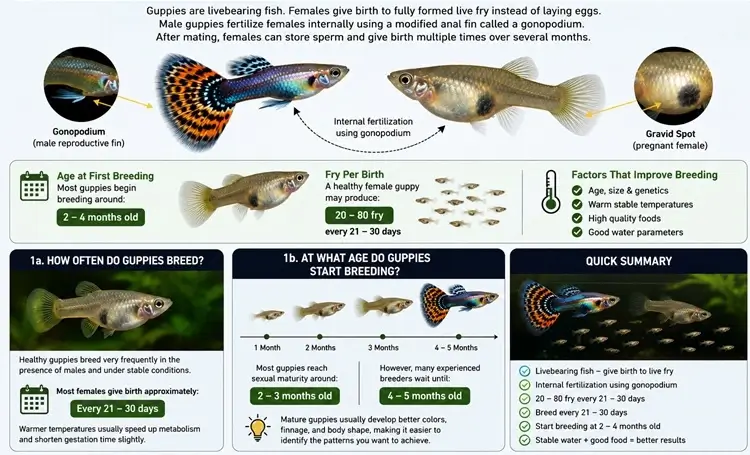
Male guppies fertilize females internally using a modified anal fin called a gonopodium which is a long, pointed structure which also diffrentiates between males from females. The gonopodium transfers sperm directly into the female, and fertilization takes place inside her body.
One of the most remarkable aspects of guppy reproduction is sperm storage. After a single mating, a female can store viable sperm internally and use it to fertilize multiple successive pregnancies over several months. This is why a female guppy bought from a pet store can surprise you by giving birth in your tank with no males present meaning she was almost certainly already mated at the store.
How Often Do Guppies Breed?
Healthy guppies breed very frequently. Most females give birth approximately every 21–30 days. Warmer water at 78°F–80°F speeds up the metabolism and can shorten the interval slightly, while cooler water or stress extends it.
Because females store sperm, they continue producing fry after every birth cycle without needing to mate again each time. In practice this means a single mating event can produce multiple batches of fry over several months.
At What Age Do Guppies Start Breeding?
Most guppies reach sexual maturity around 2–3 months old and are technically capable of breeding from this point. However, many experienced breeders wait until fish are 4–5 months old before pairing them for selective breeding.
The reason is simple — younger fish have not yet fully developed their colors, finnage, and body shape. Waiting until the fish mature makes it much easier to identify which individuals carry the traits you actually want.
Key breeding facts:
➜ Guppies reach sexual maturity at 2–3 months old
➜ Most experienced breeders wait until 4–5 months for selective breeding — mature fish show better color, finnage, and body structure, making it easier to identify the traits worth preserving
➜ A healthy female produces 20–80 fry per batch
➜ Females give birth approximately every 21–30 days
➜ Warmer water speeds up the breeding cycle slightly; cooler water slows it
For full water parameter guidance, read our guppy water parameters guide.
2. Choosing Healthy Breeding Pairs
The quality of your breeding Parents determines everything downstream. Weak, sick, or genetically poor breeding fish produce weak fry, unstable strains, and frustrating results no matter how good your setup is. Choosing the right parent fish before you start is the single most impactful decision in guppy breeding.
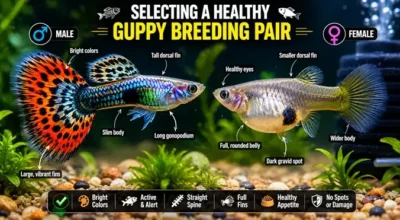
Signs of a healthy breeding parent guppy:
➜ Bright and vivid coloring
➜ Active swimming behavior
➜ Straight spine — any curvature is a genetic or health red flag
➜ Full and undamaged fins
➜ Healthy appetite
➜ No white spots, fin damage, or signs of disease
Many beginner breeders focus entirely on color and ignore overall health. This is one of the most common early mistakes.
How to Tell Male from Female Guppies
Identifying males and females correctly before setting up breeding pairs is essential.
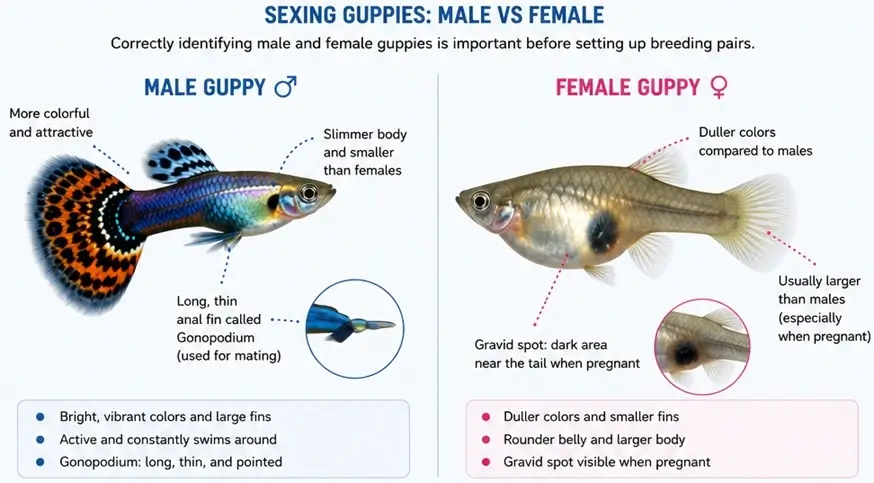
Male guppies:
➜ Smaller and slimmer body
➜ More colorful with decorative flowing tails
➜ Long, pointed gonopodium (modified anal fin)
➜ More active and constantly pursuing females
Female guppies:
➜ Larger and rounder body
➜ Less colorful — usually grey or pale with some color on the tail
➜ Fan-shaped anal fin
➜ Visible dark gravid spot near the anal fin when pregnant
Young guppies can be difficult to sex until they mature at around 6–8 weeks. Patience here pays off.
For a detailed comparison with photos, read our male vs female guppy guide.
Best Male to Female Ratio for Breeding Guppies
The male to female ratio is one of the most important and most frequently misunderstood factors in guppy breeding. Male guppies pursue females constantly and this is their natural breeding behavior.
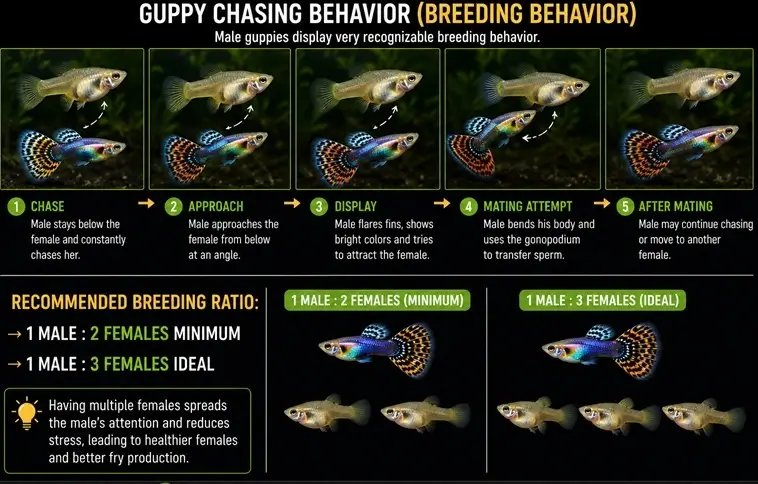
When there are too many males relative to females, individual females are pursued continuously with no rest. This can causes chronic stress and physical exhaustion.
Recommended ratio:
➜ 1 male to 2 females — acceptable minimum
➜ 1 male to 3 females — ideal for most breeding setups
3. Guppy Breeding Tank Setup
A dedicated breeding tank gives you control over genetics, fry survival, and water quality that is simply not possible in a community tank. Many hobbyists start breeding in their main display tank and quickly discover a separate setup produces far more better results.
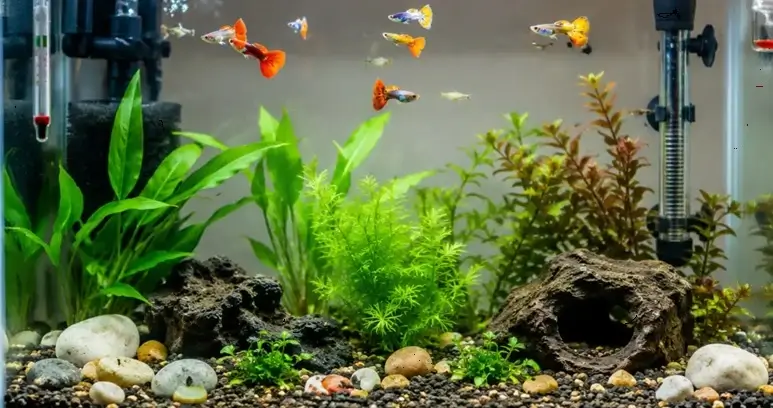
A stable aquarium setup is essential before starting any breeding project. For a complete tank setup walkthrough, read our guppy tank setup guide.
Best Tank Size for Breeding Guppies
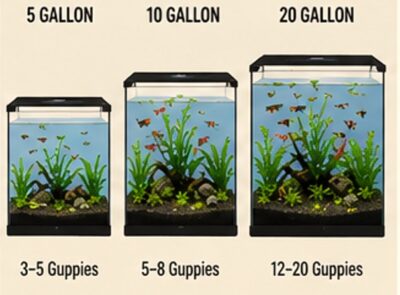
➜ 5 gallon: Works for a single breeding trio (1 male, 2 females). Requires careful water maintenance and frequent changes as waste accumulates quickly in small volumes. I would avoid using a 5 gallon tank setup if you are really pursuing for breeding guppies.
➜ 10 gallon: The most practical starting point for most breeders. Accommodates a small breeding group comfortably with more space and stable water parameters.
➜ 20 gallon: Ideal for more serious breeding projects, colony breeding, or raising fry in the same tank as adults with heavy plant cover.
Always choose a long, wide tank over a tall, narrow one. Guppies are horizontal swimmers and benefit far more from swimming length than depth. A 20-gallon long tank is significantly better than a 20-gallon tall tank for guppies.
Best Filter for Breeding Tanks
Sponge filters are the best choice for guppy breeding tanks. They provide excellent biological filtration with gentle water flow — and most importantly for breeding tanks, they have no powerful intake that can suck in newborn fry.
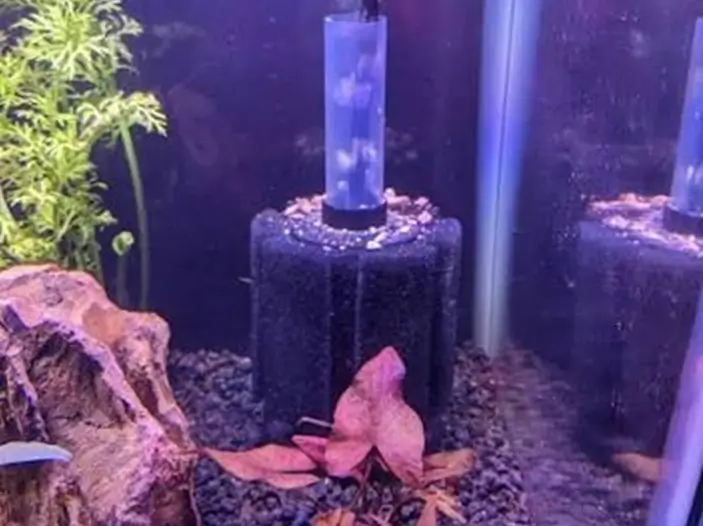
Newborn guppy fry are tiny — within hours of birth a standard hang-on-back filter suckup guppy fry and kill them. A sponge filter eliminates this risk entirely while maintaining clean, oxygenated water.
Benefits of sponge filters for breeding:
➜ Gentle water flow — safe for fancy guppies and newborn fry
➜ Excellent biological filtration
➜ No intake risk for newborn fry
➜ Affordable and easy to maintain
➜ Rinse in old tank water monthly — never under tap water
If using a hang-on-back filter, always cover the intake with a pre-filter sponge to protect fry.
Best Plants for Breeding Guppies
Plants serve two critical functions in a breeding tank — they give pregnant females shelter during the late stages of pregnancy, and they give newborn fry immediate hiding spots the moment they are born. Without plant cover, Your adult guppies including the mother will eat the fry within minutes.
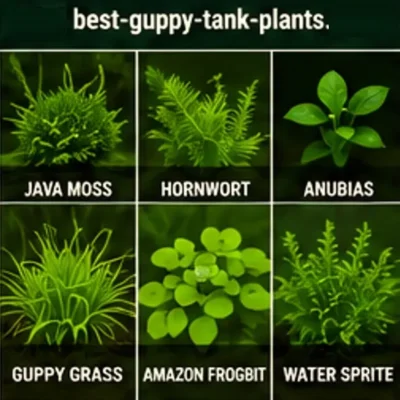
➜ Java moss — the most valuable breeding plant. Newborn fry instinctively swim into java moss immediately after birth. Dense clumps dramatically improve fry survival.
➜ Guppy grass — fast-growing, feathery, creates excellent mid-water fry cover
➜ Hornwort — grows rapidly, absorbs nitrates, provides good hiding cover
➜ Water sprite — works rooted or floating, soft leaves that fry shelter among
➜ Amazon frogbit — floating plant providing surface cover where fry naturally congregate after birth
The more densely planted the tank, the higher the fry survival rate without needing separation.
Breeding Boxes vs Separate Tanks
A breeding box is a plastic container that sits inside the main tank, with mesh that allows tank water to flow through while keeping the female separated. The female gives birth inside the box and fry drop through the mesh bottom, separating them from the mother immediately.
Breeding box advantages: Convenient, inexpensive, keeps female in the same water parameters without a stressful tank transfer.
Breeding box disadvantages: Confined space stresses females, particularly if placed in the box too early. Fry must be moved to a grow-out tank quickly as numbers accumulate. Overcrowding inside the box causes can stress guppy fry.
Separate fry tank: Gives fry maximum space, stable water, and no competition from adults. Produces the best growth rates and survival rates which is the preferred method for serious breeders.
The best approach for most breeders is to move the female to a heavily planted separate tank in the final days before birth, then transfer the female into the community or Guppy tank. I would not transfer the Guppy fry to another tank because even a small marginal change in water parameter can kill the entire batch of fry.
Temperature for Guppy Breeding
Temperature plays a direct role in guppy breeding activity, gestation length, and fry development. Slightly warmer water stimulates breeding behavior and speeds up the gestation period, while cooler water slows everything down.
Ideal guppy breeding water parameters:
Temperature: 76°F–82°F (78°F–80°F optimal for active breeding)
pH: 7.0–7.8
GH: 8–12 dGH (moderately hard)
Ammonia: 0 ppm
Nitrite: 0 ppm
Nitrate: Below 20 ppm
The 78°F–80°F range specifically encourages active male courtship, shortens gestation slightly, and supports healthy fry development.
Temperatures below 72°F slow breeding activity significantly and weaken fry immune systems.
Temperatures above 82°F stress fish, deplete oxygen, and shorten lifespan. Stability matters more than hitting an exact number. Avoid Sudden temperature ups and downs.
Choosing the Right Heater:
Once you know your target temperature, the heater itself needs to match your tank size and hold that number reliably — not just heat the water once and drift away.
Always choose a fully submersible, adjustable heater over a preset one. A preset heater locks you into whatever temperature the manufacturer chose, usually around 76°F–78°F, with no way to fine-tune it into the 78°F–80°F breeding sweet spot.
Wattage Guide:
• 5 gallon tank: 25–50 watts
• 10 gallon tank: 50 watts
• 20 gallon tank: 100 watts
Place the heater near the filter outflow so warm water circulates evenly through the tank instead of pooling in one spot while the rest stays cooler.
Safety precautions worth taking seriously:
Never trust the heater’s built-in dial. Keep a separate glass or digital thermometer on the opposite side of the tank and check it daily — dials are notoriously inaccurate and can drift over time.
Protect newborn fry from the heater itself. Fry can get trapped between the heater and the glass, especially in smaller tanks. A heater guard, or simply positioning the heater away from tight corners, prevents this.
Watch for a stuck-on heater. This is the single most dangerous heater failure. It keeps heating with no shutoff, and in a small breeding tank the water can climb into lethal territory within hours. If the tank ever feels warmer than expected, unplug the heater immediately and check the actual temperature before doing anything else.
4. Guppy Breeding Behavior
Understanding normal breeding behavior helps you distinguish healthy courtship from harmful stress and act on the difference before it damages your females.
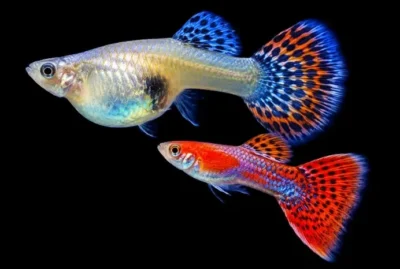
Normal male courtship behavior:
➜ Males are in constant pursuit of females
➜ Flashing and displaying colors — males intensify coloring during courtship
➜ Spreading and fanning the tail to display to females
➜ Side-to-side shimmy movements alongside the female
➜ Gonopodium extension as mating attempts occur
This is all normal and expected. Male guppies pursue females almost continuously — this is their natural reproductive behavior and it does not indicate a problem on its own.
5. Pregnancy and Gestation Period
Recognizing pregnancy early gives you time to prepare adjusting the tank, setting up a breeding box or fry tank, and ensuring the female has adequate nutrition and shelter before birth.
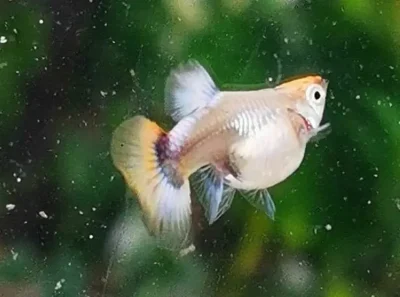
Common signs of a pregnant guppy:
Enlarged belly — starts as subtle rounding, becomes increasingly boxy and squared as pregnancy progresses
Darkening gravid spot — the dark patch near the anal fin deepens in color over the weeks
Behavioral changes — pregnant females slow down, rest more, and begin avoiding active males
Reduced appetite — often drops noticeably in the final days before birth
Hiding behavior — females seek quiet sheltered spots as birth approaches
Most pregnancies last 21–30 days, with the timeline shaped a little by temperature, stress, and genetics. For the full week-by-week breakdown, exactly how many fry to expect, and the specific signs that labor is hours away, our complete pregnant guppy guide covers all of it in depth.
When to Separate a Pregnant Female
Most breeders move the female to a breeding box or separate tank around 3–5 days before the expected birth, once the belly has gone boxy and she’s hiding more. See the pregnant guppy guide above for the full stage-by-stage timeline that tells you when you’re in that window.
How Birth Actually Happens
Once labor starts, it follows a fairly predictable pattern. Contractions begin — visible body flexing, sometimes with the shivering mentioned above — and fry are released one at a time rather than all at once, each one curled into a tight ball that unfurls and swims off within moments. A full birth typically takes 2–6 hours, though a stressed female can take considerably longer.
Remove the mother as soon as birth is finished, or as soon as you’re confident it’s done else she will eat the fry if left in the tank with them. For the complete birth timeline, signs labor has started, and what to do if something looks off, see our guppy giving birth guide.
6. Raising Guppy Fry
Newborn guppy fry are fully formed and capable of swimming and feeding immediately after birth. They are also immediately vulnerable to adult fish, including their own mother which will eat them if given the opportunity. The first 24–48 hours are the most critical period for fry survival. You can start feeding your fry after the first 24 hours.
Proper fry care is extremely important during the first few weeks. Our guppy fry guide explains feeding, growth, and survival tips in detail. You can also read about guppy fry growth stages to understand how fry develop over time.
Best Guppy Fry Foods
Fry need small, protein-rich food that fits in their tiny mouths. They would start looking for foos after 24 hours after birth or even sooner.
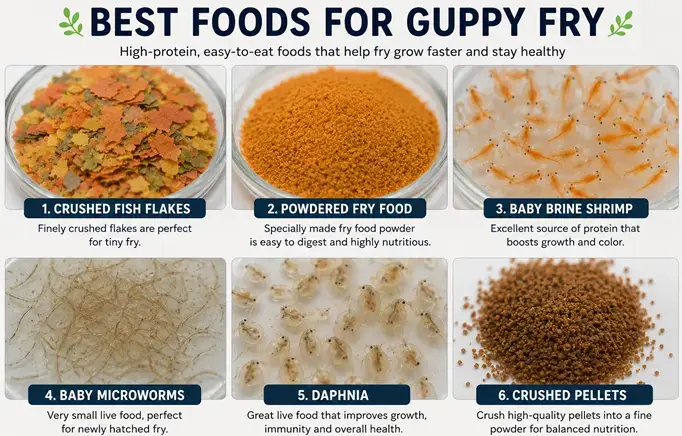
The best options:
Baby brine shrimp — This is the gold standard. Highly nutritious, appropriately sized, and the stimulation of chasing live prey encourages active feeding from day one
Microworms — easy to culture at home, excellent protein source, stay alive in the water column for extended periods
Crushed flake food — grind high-quality adult flakes to a fine powder between your fingers.
Infusoria — microscopic organisms ideal for the first 1–2 days when fry are at their very smallest
Vinegar eels — tiny live food well-suited to newborn fry, easy to culture at home
How Often Should You Feed Guppy Fry?
Feed fry 3–5 small portions per day. More frequent small feedings support faster growth and produce larger, healthier juveniles than one or two large daily feedings. Only feed what they finish within a few minutes because uneaten food fouls fry tanks rapidly. A slight dip in watre parameter can kill the entire batch of fry.
Frequent feeding combined with clean water and stable temperature usually produces the fastest and healthiest growth.
How to Improve Fry Survival
Separate fry tank — This is the most reliable method. A 5–10 gallon sponge-filtered tank with no adult fish gives fry the best possible start
Dense plant cover — java moss, guppy grass, and floating plants give fry natural hiding spots where adults cannot easily reach them. Remeber not to leave your guppy fry before it gets atlest 2 weeks old. A 2 week old fry is faster , can escape adult guppies and it doesnt fit the mouth of adult guppies. If your tank is a community tank a minimum of 4 weeks is need for fry survival.
Stable water temperature — temperature swings are more dangerous to fry than to adults. Keep temperature consistent at 77°F–80°F
Frequent small water changes — change 10–15% every day or two rather than large weekly changes that shock fry
Sponge filter only — no HOB intakes that can pull fry in. If you have only HOB then cover the filter inlet with a mesh.
When Should Fry Be Separated?
Separate male and female fry at approximately 4–6 weeks old — as soon as you can reliably identify the sexes. Males develop color and a visible gonopodium; females grow larger and rounder.
Separating early prevents uncontrolled sibling breeding and gives you control over which fish reproduce in the next generation. In a selective breeding program this step is essential — letting siblings breed freely degrades your strain rapidly.
7. Line Breeding Guppies
Line breeding is the most widely used method among serious guppy breeders for developing and stabilizing specific strains. The goal is to selectively breed fish that share desirable traits over multiple generations until those traits reproduce consistently and predictably in offspring.
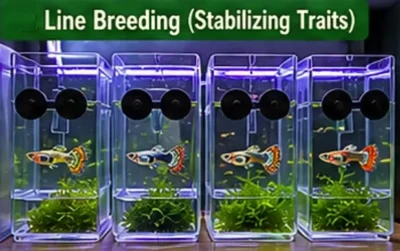
Most experienced breeders maintain at least two parallel breeding lines from the same strain — Line A and Line B. These two lines should share the same target traits but come from different genetic backgrounds.
Fish from Line A are occasionally crossed with Line B to refresh genetic diversity while keeping the core traits stable. This is called rotational breeding — rotating which lines you cross over time — and it is one of the most effective ways to prevent the gradual weakening that comes from breeding the same related fish repeatedly.
The key is that your parallel lines should not just be two fish from the same batch. They should represent truly different genetic backgrounds of the same strain — ideally sourced from different breeders or different original bloodlines. This gives you real genetic diversity to draw from when you need to refresh a line.
Traits commonly targeted through line breeding:
➜ Color saturation and pattern coverage
➜ Tail shape — delta, fan, sword, lyre, veil
➜ Dorsal fin length and spread
➜ Body shape and size
➜ Color distribution across fins and body
Benefits of Line Breeding
➜ Produces consistent, predictable offspring that closely resemble the parent fish
➜ Allows progressive improvement of specific traits across generations
➜ Essential for producing show-quality fish
➜ Helps identify which individual fish reliably carry and pass on the target traits
➜ Stable, recognizable strains that hold their value in the market
Risks of Excessive Inbreeding
Breeding closely related fish repeatedly without introducing outside genetics eventually causes problems. The warning signs appear gradually — which is exactly what makes them dangerous. By the time the damage is obvious, several generations may already be affected.
Watch for these signals that your line needs an outcross:
➜ Batch sizes getting noticeably smaller over successive pregnancies
➜ More females failing to carry fry to full term
➜ Increasing number of bent or curved spines in offspring
➜ Fish becoming more susceptible to disease than previous generations
➜ Overall size shrinking across the line
➜ Fry appearing weaker or dying earlier than expected
When you see any of these signs, do not wait. Introduce an unrelated fish that carries the same target traits — from a different breeder or a different bloodline — and cross it into your Line A or Line B. This outcross refreshes genetic diversity without throwing away the work you have done. The F1 offspring from the outcross may look slightly less consistent, but by the second and third generation you will have a healthier, more vigorous line with the target traits restored.
8. Cross Breeding Guppies
Cross breeding involves deliberately pairing guppies from different strains to create new color combinations, improve specific traits, or introduce genetic diversity into a weakening line.
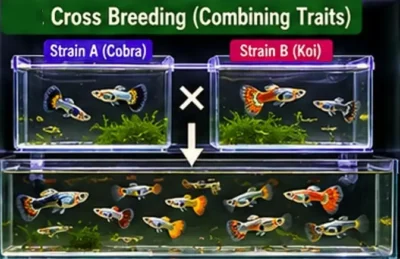
Common cross breeding goals:
➜ Adding color from one strain to the tail shape of another
➜ Introducing genetic diversity to a weak or declining line
➜ Creating entirely new pattern combinations
➜ Improving finnage, body size, or overall vigor
Hybrid vigor — the hidden benefit of cross breeding
One of the most important and least talked-about effects of cross breeding is hybrid vigor, also called heterosis. When you cross two genetically different strains, the offspring often outperform both parents. This can show up as faster growth rates, larger batch sizes, stronger immune systems, and better overall survival. It is the opposite of what happens with excessive inbreeding.
This is why experienced breeders sometimes use a strategic cross not to create a new strain, but simply to breathe life back into a line that has become sluggish or disease-prone. A single well-chosen cross can dramatically improve the vigor of subsequent generations.
Genetic compatibility matters
Not every cross works equally well. The more genetically different the two strains are, the higher the risk of reduced fertility or failed crosses. Strains that are closely related — both descended from similar original bloodlines — tend to cross more reliably. Strains with very different genetic histories may produce crosses where some females fail to conceive or deliver smaller than expected batches. If a cross is not producing results after a few attempts, genetic incompatibility may be the cause.
Popular cross breeding combinations:
➜ Cobra × Moscow — intricate pattern detail combined with deep metallic body color
➜ Tuxedo × Koi — classic contrast pattern with multi-color overlay
➜ Snakeskin × Dumbo Ear — intricate body pattern with large distinctive pectoral fins
➜ Endler × Guppy — documented to produce unique color patterns and fin shapes; note that Endlers and guppies are closely related species and cross readily, producing fertile offspring
Are Crossbred Guppies Predictable?
No — and this is the most important thing to understand before attempting cross breeding. The first generation (F1) of a cross is almost always highly variable. Offspring show a wide range of appearances that may not closely resemble either parent. Many F1 fish look like mixed or unstable pattern fish — sometimes called mutt guppies.
This is not a failure. It is exactly what happens when two different genetic backgrounds combine for the first time. The diversity in F1 is actually a sign that the cross worked.
Stabilizing a new strain from a cross requires selecting the most promising F1 offspring and breeding them selectively over multiple generations — typically four to six generations — before the target traits become consistent and predictable. This is a long-term project that requires patience, good record keeping, and willingness to cull fish that do not meet your goals. The breeders who succeed at cross breeding are the ones who commit to the process rather than abandoning it after one or two disappointing generations.
9. Colony Breeding Guppies
Colony breeding is the most natural approach — guppies reproduce freely inside a planted aquarium without selective pairing, strain control, or separation of individuals. The tank manages itself as a self-sustaining community with ongoing fry production.
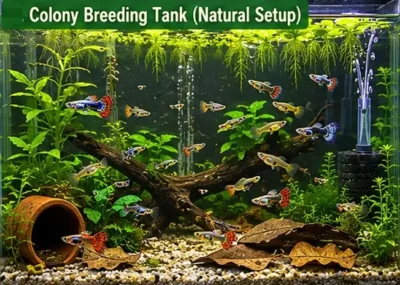
Colony breeding is popular among hobbyists who want a beautiful, lively planted aquarium with ongoing fry without the management overhead of a selective breeding program. It works well — but it has a hidden long-term risk that many hobbyists do not notice until it is well underway.
Genetic drift in colony tanks
In a closed colony where the same fish breed freely over many generations, random chance starts to determine which traits survive rather than deliberate selection. Rare beneficial traits can disappear entirely from the colony simply because the fish carrying them did not breed at the right time. Meanwhile, less desirable traits can become more common by the same random process. This is called genetic drift, and it is one of the reasons colony-bred guppies tend to look increasingly dull and mixed over time — not because anything went wrong, but because no one was selecting for anything.
The practical solution is simple — every 6 to 12 months, introduce one or two unrelated fish from outside the colony. This brings in fresh genetic material, restores some of the diversity that drift has eroded, and keeps the colony healthy and visually interesting. Choose fish with traits you want to see more of in the colony, and let them breed naturally into the population.
How to set up a colony breeding tank:
Start with a 20-gallon long tank — this gives enough space for a self-sustaining colony without the water quality problems that come with overcrowding in a smaller volume. Stock with 6–8 females and 2–3 males to begin. The 1:3 male to female ratio keeps females from being constantly stressed while still producing regular fry batches.
Plant the tank heavily before adding fish — aim for at least 60–70% of the substrate covered. Java moss and guppy grass are the most important plants because fry hide in them immediately after birth. Floating plants like frogbit add surface cover where newborn fry naturally gather. The denser the planting, the more fry survive without any intervention from you.
Run a sponge filter — no HOB intakes in a colony tank with fry. Do weekly 20–25% water changes to keep nitrate under control as the population grows. The colony will begin producing visible fry within 3–4 weeks of the first batch being born.
Once the colony is running, watch the population size. In a 20-gallon tank, 20–25 adult fish is the comfortable maximum. If numbers grow beyond this, rehome or sell the excess rather than letting the tank become overcrowded. Overcrowding is the most common reason colony tanks fail — water quality deteriorates, stress rises, and disease follows.
Every 6–12 months introduce 1–2 unrelated fish to prevent genetic drift. Choose fish with traits you want to see more of and simply add them to the colony. They will breed naturally into the population.
Advantages of Colony Breeding
➜ Natural, low-intervention approach
➜ Beautiful planted display tank that breeds itself
➜ Lower equipment and maintenance requirements
➜ Less time commitment than selective breeding programs
➜ Guppies display more natural behavior in a colony setting
➜ Self-sustaining once established — fry appear regularly without any management
Disadvantages of Colony Breeding
➜ Fry survival rates are significantly lower than in separated setups — many fry are eaten by adults before they can reach shelter
➜ No control over which fish breed with which — strains mix freely over time
➜ Genetic drift causes the colony to lose visual diversity and vigor gradually over many generations without new fish being introduced
➜ Population can grow rapidly and unexpectedly if fry survival is higher than anticipated
➜ Impossible to maintain strain purity in a mixed colony setting
Colony breeding is ideal for hobbyists who enjoy watching guppies behave naturally and want a low-maintenance self-sustaining tank. It is not suitable for anyone trying to develop or maintain specific strains.
Frequently Asked Questions
Can guppies breed in a community tank?
Yes, but fry survival rates are much lower. Most adult fish — including the guppy parents — will eat newborn fry on sight. Dense planting with java moss, guppy grass, and floating plants improves survival, but a dedicated fry tank or breeding box gives significantly better results.
How long are guppies pregnant?
Most pregnancies last 21–30 days. Warmer water at 78°F–80°F shortens the gestation period slightly. Cooler water or stress can extend it. See our pregnant guppy guide for the full week-by-week timeline.
What is the best temperature for guppy breeding?
78°F–80°F is the ideal range for active breeding. It encourages courtship behavior, supports healthy fry development, and keeps gestation within the normal 21–30 day window.
Why do guppies breed so much?
It comes down to their reproductive biology. Guppies are livebearers that reach sexual maturity in just 2–3 months, give birth every 21–30 days, and produce 20–80 fry per batch. On top of that, females store sperm internally and can keep producing fry for months from a single mating — so the population compounds fast without any extra intervention needed.
Why won’t my guppies breed?
The most common causes are an unbalanced ratio (too few males, or a single stressed female with no rest), water that’s too cold, poor water quality, or fish that simply aren’t sexually mature yet. Check temperature first — guppies breed far less actively below 72°F — then review the male-to-female ratio and water parameters before assuming something’s wrong with the fish themselves.
How many fry do guppies have per birth?
Between 20–80 fry depending on the female’s age, size, and genetics. Larger, older, well-nourished females produce the biggest batches. First-time mothers usually deliver on the lower end.
Do guppies eat their own babies?
Yes — adult guppies will eat newborn fry immediately if given the opportunity. This includes the mother. Dense plant cover, breeding boxes, or a separate fry tank are the most effective ways to improve fry survival.
Can sibling guppies breed together?
Yes — guppies breed readily regardless of relationship. Occasional sibling breeding is fine for strain development, but repeated close inbreeding over many generations weakens immune systems and produces genetic defects.
What is line breeding in guppies?
Line breeding is a selective breeding method where you breed fish sharing desirable traits over multiple generations to stabilize those traits. It is the primary method used by serious breeders to develop show-quality strains.
What plants are best for guppy fry survival?
Java moss is the most valuable — fry instinctively hide in it immediately after birth. Guppy grass, hornwort, and floating plants like Amazon frogbit provide additional cover at different water levels.
Can guppies breed without a male present?
A female can give birth multiple times after a single mating because guppies store sperm internally. A female bought from a pet store is likely already pregnant and can produce several batches of fry with no male in your tank.
How fast do guppy fry grow?
Under ideal conditions with frequent feeding and good water quality, fry begin developing visible color within 3–4 weeks and reach juvenile size by 6–8 weeks.
When should I separate male and female fry?
Separate at approximately 4–6 weeks old as soon as you can reliably identify the sexes. Early separation prevents uncontrolled sibling breeding and gives you control over who reproduces in the next generation.
What fish can live with breeding guppies?
In a dedicated breeding tank, no other fish should be present. In a colony breeding setup, only peaceful species that will not eat fry are suitable. Corydoras catfish are a safe bottom-dwelling option. Read our guppy tank mates guide for full compatibility details.
Conclusion
Guppy breeding is rewarding at every level — whether you are watching your first batch of fry appear in a planted community tank, carefully managing a line breeding program to stabilize a specific strain, or developing fish good enough to sell or show.
The foundation is always the same: healthy breeding stock, the right male to female ratio, stable water quality, adequate plant cover for fry, and consistent feeding and maintenance. Get these fundamentals right and guppies will breed successfully for years.
For the full picture of everything else guppies need beyond breeding, see our guppy care guide.