Skip to content
Exotic Fish Hub Exotic Fish Hub

  • Goldfish
    • oranda goldfish
    • Black Oranda Goldfish
    • Ranchu Goldfish: Care Guide, Size, Lifespan & Price
    • Thai Oranda Goldfish: Care Guide, Size, Lifespan & Price
  • Guppies
    • Blue Guppy Fish
    • How Long Do Guppies Live? Guppy Lifespan Explained
    • Snow White Guppy
    • Electric Blue Guppy
    • Red Dragon Guppy
    • 17 Stunning Fancy Guppy Varieties You will Love
  • Betta
  • Molly Fish
    • Dalmatian Molly
  • Discus Fish
  • Contact
Exotic Fish Hub
Exotic Fish Hub

Guppy Care Guide: Tank Setup, Feeding, and Water Tips

Guppy care is more straightforward than most aquarium fish, which is why guppies are one of the most popular freshwater fish in the world. They are colorful, social, and genuinely forgiving of beginner mistakes — but only when you have the fundamentals in place.
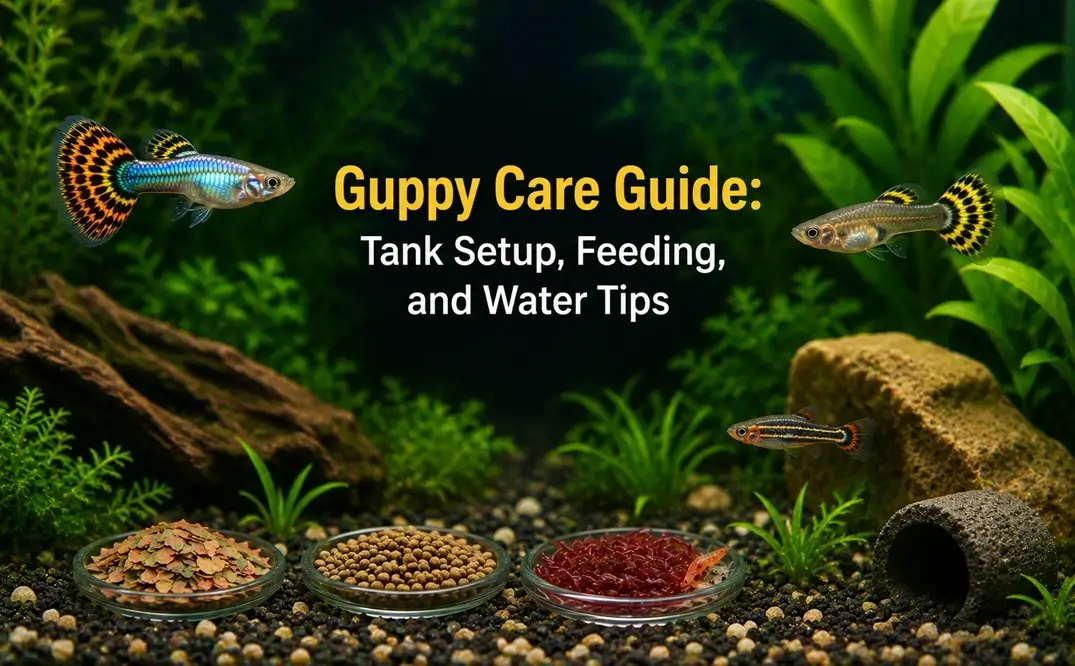
guppy care hero image

Get the basics right — stable water, proper feeding, the right tank — and guppies will reward you with beautiful colors, active behavior, and successful breeding for years. You get them wrong and you will spend weeks troubleshooting stress, disease, and unexplained losses that all trace back to setup mistakes.

This guide covers everything a beginner needs to know, from tank setup and cycling through to water parameters, feeding, plants, tank mates, breeding, pregnancy, baby care, diseases, and maintenance — in the exact order a new guppy keeper needs to learn it.

Quick Navigation

Guppy Species Overview
Basic Guppy Care Requirements at a Glance
Are Guppies Easy to Care For?
Best Tank Size for Guppies
Cycling Your Tank Before Adding Guppies
Best Filter for Guppy Tanks
Do Guppies Need a Heater?
Best Plants for Guppy Tanks
Lighting for Guppy Tanks
Guppy Water Parameters
Best Temperature for Guppies
What Do Guppies Eat
Guppy Feeding Schedule
Guppy Tank Mates
Fancy Guppy Care
Endler Guppy Care
Guppy Breeding Basics
Is My Guppy Pregnant?
Baby Guppy Care
Common Guppy Diseases and Warning Signs
Common Guppy Care Mistakes
Guppy Care Maintenance Schedule
Frequently Asked Questions


Guppy Species Overview

Guppies (Poecilia reticulata) are small freshwater fish native to the warm rivers, streams, and coastal waterways of South America and the Caribbean — including Venezuela, Trinidad, Guyana, and Barbados.

In the wild they live in shallow, slow-moving water with plenty of vegetation. This background explains exactly what guppies need in an aquarium — warm, stable, well-planted tanks with gentle water flow that closely matches their natural habitat.

Key facts about guppies:

Scientific name: Poecilia reticulata
Adult size: Males 1–1.5 inches, females 1.5–2.5 inches
Lifespan: 1–3 years with good care
Temperament: Peaceful, social, active
Breeding type: Livebearers — give birth to live fry rather than laying eggs
Origin: South America and the Caribbean
Tank level: Mid to upper water column
Minimum tank size: 10 gallons

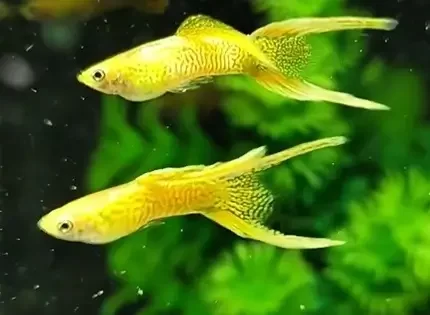
Male guppies are smaller but far more colorful, with flowing colorful tails in almost every color imaginable. Females are larger, plainer, and rounder — especially when pregnant. This makes sexing guppies one of the easiest tasks in fishkeeping and something beginners pick up within days of observation.

Guppies have been selectively bred for decades, producing an enormous variety of fin shapes, color patterns, and strains — from tuxedo and cobra patterns to fancy guppies with enormous amount of ornamental tails. For a full look at the different types available, read our fancy guppy varieties guide.


Basic Guppy Care Requirements at a Glance

Care AreaRequirement
Tank Size10 gallon minimum
Temperature72°F–82°F (74°F–78°F ideal)
pH7.0–7.8
GH8–12 dGH
KH4–8 dKH
Ammonia0 ppm always
Nitrite0 ppm always
NitrateBelow 20 ppm
Feeding1–2 times daily, small amounts
Water Changes20–25% weekly
FilterRequired
HeaterRecommended for most climates
Group Size4–6 minimum
Lifespan1–3 years
TemperamentPeaceful community fish

Are Guppies Easy to Care For?

Yes — guppies are  one of the most beginner-friendly freshwater fish available. They are adaptable, colorful, and forgiving of minor mistakes in a way that many other aquarium fishes are not.

That said, they are not maintenance-free. Even hardy fish develop problems when the fundamentals are ignored. In the begining i missed many guppies with my mistakes.

Guppies still need:

→ A properly cycled tank with stable water quality
→ Correct feeding — not too much, not too little
→ Regular weekly water changes
→ Adequate swimming space for their group size
→ A  filter and a heater

The good news for you is that none of these requirements are complicated or expensive. Overfeeding and skipping the nitrogen cycle are the two biggest causes of beginner guppy losses — both are completely preventable with the right knowledge, which is exactly what this guide covers.


Best Tank Size for Guppies

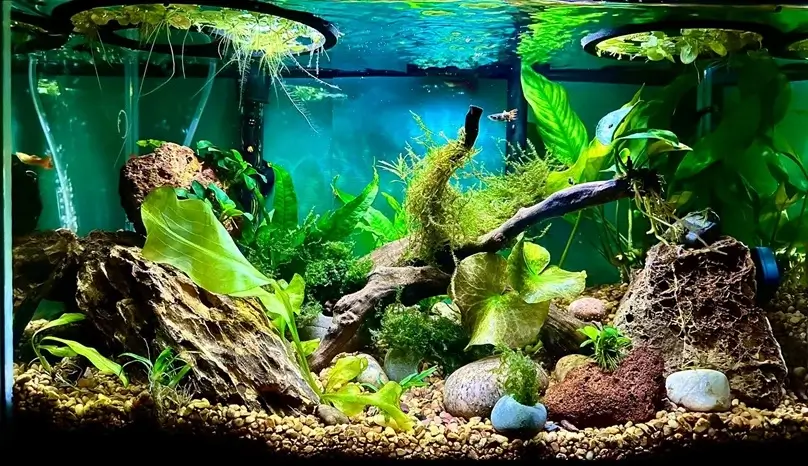
A 10-gallon tank is the most commonly recommended starting point for guppies and works well for a small group of 4–6 fish. It is affordable, widely available, and large enough to maintain stable water parameters — the single most important quality a beginner tank needs to have. I also started with a 10 Gallon Tank.

10 gallon guppy tank

The most common beginner mistake is starting too small. A tiny tank might seem easier to manage but the opposite is true. Small tanks are far less stable — water parameters shift faster, ammonia builds up more quickly, and there is very little margin for error. A small problem in a 5-gallon tank can become a crisis within hours. The same issue in a 20-gallon tank gives you time to respond.

Larger tanks — 15 or 20 gallons — are actually easier to manage, not harder. More water volume means more stability, better oxygen levels, and a healthier group of fish. If you have the space and budget, always go one size bigger than you think you need.

One thing most beginners do not consider is tank shape. A long, wide tank is almost always better than a tall, narrow one for guppies. Guppies are horizontal swimmers that spend most of their time in the middle and upper water layers. They benefit far more from swimming length than from depth.

Stocking guide by tank size:

5 gallon: 3–5 guppies (male-only recommended)
10 gallon: 5–8 guppies
20 gallon: 12–20 guppies

Remember that guppies breed easily and rapidly. What starts as a comfortable stocking level can double within weeks if you keep males and females together. Factor breeding into your stocking plan from the beginning. Guppies were my fisrt fish to breed and i had plenty of them within 2 months.

For detailed stocking guidance, read our guide on how many guppies fit in a 10 gallon tank.


Cycling Your Tank Before Adding Guppies

This is the step most beginners skip — and it causes more guppy deaths than almost anything else. During the first instance of my aquarium setup i missed this step and lost a lot of fishes.

Tank cycling is the process of establishing a colony of beneficial bacteria in your filter media and substrate. These bacteria convert toxic ammonia — produced constantly by fish waste and uneaten food — into nitrite, and then into the much less harmful nitrate. Without this bacterial colony in place, ammonia spikes can kill fish within days.

cycling guppy tank

A brand new tank has no bacteria at all. Add fish too early and ammonia from their waste will spike with nothing to process it. This is called new tank syndrome — ammonia and nitrite climb to dangerous levels within days, causing stress, disease, and death even in fish that looked perfectly healthy at the store. The water may look crystal clear and still be lethally toxic within.

How to cycle a new tank:

→ Set up the tank with filter, heater, and dechlorinated water
→ Run the filter continuously — never switch it off during cycling
→ Add a source of ammonia — a small pinch of fish food daily works well
→ Add established filter media or substrate from a healthy existing tank if available — this dramatically speeds up the process
→ Test ammonia and nitrite every few days with a liquid test kit
→ Ammonia spikes first, then nitrite rises, then both drop to zero as the cycle completes
→ When ammonia and nitrite both read 0 ppm consistently across two or three consecutive tests, the tank is ready

A full cycle takes 4–6 weeks naturally from scratch. Adding media from an established tank can shorten this to as little as 24–48 hours. Never add guppies before both ammonia and nitrite read zero.

For more on what goes wrong in new tanks, read our guide on why guppies die after water changes.


Best Filter for Guppy Tanks

A filter is not optional in a guppy tank. Without filtration, ammonia from fish waste builds up rapidly and becomes toxic within days even in a lightly stocked aquarium. I found it difficult to maintain fishes without a filter. So it is better off the buy one in the first hand.

A good guppy filter performs three functions:

Biological filtration — beneficial bacteria in the filter media convert toxic ammonia into nitrite and then into nitrate. This is the most critical function. Never switch the filter off, even overnight — starving the bacteria of oxygen kills a significant portion of the colony within hours.
Mechanical filtration — removes particles, debris, and waste from the water, improving clarity and reducing the organic load that feeds ammonia production
Water circulation — keeps oxygen levels consistent throughout the tank and prevents stagnant dead spots

Sponge Filters

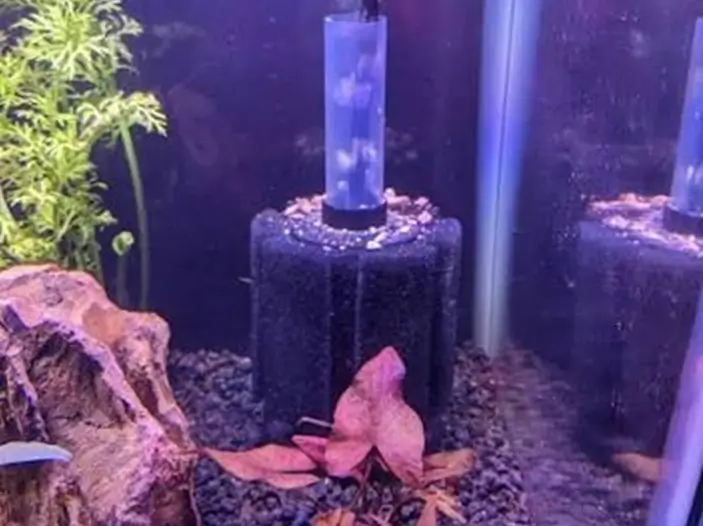
Sponge filters are the best all-round option for most guppy tanks. They provide excellent biological filtration through a porous sponge colonized by beneficial bacteria, with gentle water flow that does not stress guppies or endanger the fry.

For breeding tanks and fry tanks a sponge filter is close to essential. Newborn guppy fry are tiny — a hang-on-back filter with an open intake can suck them in and kill them within hours of birth. A sponge filter eliminates this risk entirely.

sponge filter in guppy tank

Benefits of sponge filters:

→ Gentle flow — safe for fancy guppies and newborn fry
→ Excellent biological filtration
→ Affordable and easy to maintain
→ Rinse in old tank water monthly — never under tap water
→ Can be seeded from an established tank to speed up cycling

Hang-On-Back Filters

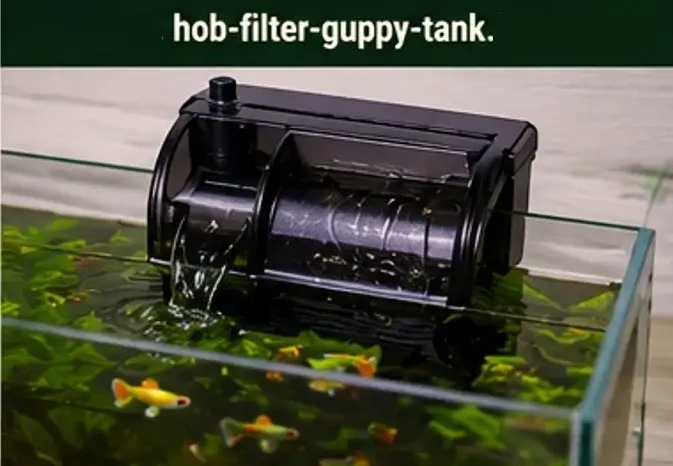
HOB filters provide stronger mechanical filtration and noticeably clearer water, making them popular for display tanks where appearance matters. If using a HOB in a breeding tank, always add a sponge pre-filter over the intake tube to prevent fry losses.

hob filter guppy tank

Watch the outlet flow — some HOB models create a strong current that exhausts fancy guppies and damages their fins over time. Baffle the outlet by angling it toward the tank wall or placing a sponge over it to diffuse the flow without reducing filtration efficiency.

Recommended filter by tank size:

5 gallon: Small sponge filter
10 gallon: Sponge filter or HOB filter
20 gallon: HOB filter or dual sponge filter

For larger tanks many experienced hobbyists run both together — a sponge filter for biological filtration and fry safety, and a HOB for mechanical clarity. For a full tank setup walkthrough, read our guppy tank setup guide.


Do Guppies Need a Heater?

In most home aquarium setups, yes. Guppies are tropical fish from warm Caribbean and South American waters. They thrive in stable temperatures between 72°F and 82°F — but it is the consistency of temperature that matters most, not just the number.

Room temperatures fluctuate more than most people realize. A room that feels comfortably warm during the day can drop several degrees overnight, during air conditioned hours, or in cooler seasons. These swings — even just 3 to 4 degrees — are enough to stress guppies, suppress their immune systems, and trigger disease outbreaks that would not otherwise happen.

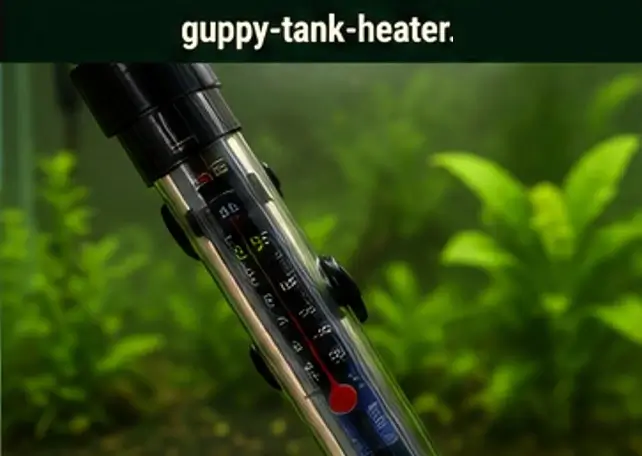
guppy tank heater

In tropical climates where room temperature stays consistently between 74°F–80°F year round, guppies can survive without a heater. Many fishkeepers in India, the Philippines, and parts of Southeast Asia keep guppies successfully without one. But for most fishkeepers — particularly in temperate climates or air-conditioned homes — a reliable adjustable heater is one of the best investments you can make.

Always choose an adjustable heater over a cheap fixed-temperature model. Fixed heaters are unreliable and can cause the very fluctuations you are trying to avoid. Never switch a heater on before the tank is filled with water — running a heater dry even briefly can permanently damage the element.

Recommended heater sizes:

5 gallon tank: 25W heater
10 gallon tank: 50W heater
20 gallon tank: 75W–100W heater

Fancy guppies are particularly sensitive to temperature fluctuations. Their highly modified bodies and large fins make them more vulnerable than wild-type guppies — for anyone keeping fancy varieties, a heater is non-negotiable regardless of climate.


Best Plants for Guppy Tanks

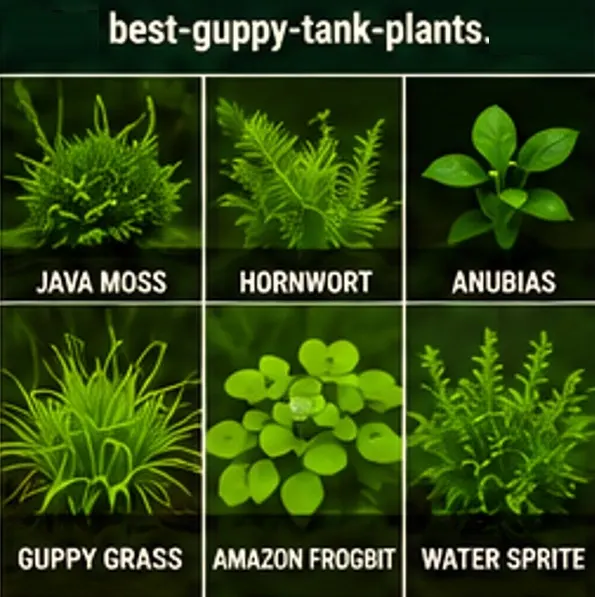
Live plants are one of the best additions you can make to any guppy tank. They absorb nitrates, compete with algae for nutrients, oxygenate the water, and create a natural environment where guppies feel genuinely secure. A well-planted tank is more stable and easier to maintain than a bare one — not just more attractive. It also reduces the stress of a fish to a large extent and the fishes look more colorful when you have plants around.

Most guppy plants do not need CO2 injection or special fertilizers. The plants below grow well under basic LED lighting, making them ideal for beginners.

best guppy tank plants

Java Moss is arguably the most useful plant in a guppy tank. It attaches to driftwood, rocks, and decorations without needing substrate, grows in almost any lighting, and requires no special care. Newborn fry instinctively hide inside java moss the moment they are born — in a community tank, java moss dramatically improves fry survival rates without needing a separate breeding box. If you only add one plant, make it java moss cluster.

Guppy Grass (Najas guadalupensis) is named after guppies for good reason. It grows into dense feathery clumps that fry hide inside immediately after birth. Fast-growing and undemanding, it also absorbs nitrates rapidly.

Hornwort is one of the fastest-growing and most effective nitrate absorbers available. It grows vigorously in most lighting, competes aggressively with algae, and needs no substrate — it floats or can be weighted down.

Anubias Nana is virtually indestructible. It tolerates low light, wide parameter ranges, and inconsistent maintenance without complaint. It attaches to driftwood or rocks rather than rooting in substrate. Never bury the rhizome — it will rot.

Water Sprite works equally well rooted or floating, absorbs nitrates rapidly, and provides good cover for both adults and fry.

Amazon Frogbit is a floating plant that provides excellent surface cover for shy guppies and pregnant females. Its dangling roots are particularly valuable for newborn fry who naturally swim near the surface after birth.

Java Fern is almost indestructible — it tolerates low light, wide parameter ranges, and neglect without complaint. Like anubias it attaches to hardscape rather than substrate.

One important warning — if any plant begins to rot, remove it immediately. Rotting plant matter releases ammonia just like uneaten food and can cause dangerous spikes in smaller tanks.

Best plants for guppy fry survival:

 Java moss — fry hide inside it immediately after birth
Guppy grass — dense cover at mid-water level
Amazon frogbit — surface cover where fry naturally congregate
Hornwort — additional mid-water shelter


Lighting for Guppy Tanks

Guppies do not have demanding lighting requirements but getting it right makes a noticeable difference to both plant health and fish appearance. Good lighting brings out the full color range in guppies and supports healthy plant growth without encouraging algae. Lighting is must if you go for a planted setup.

For most beginner guppy tanks a basic LED aquarium light is all you need. LED lights are energy-efficient, long-lasting, produce low heat, and are available in intensities suitable for everything from low-light to heavily planted aquariums.

How long should lights be on?

Most guppy tanks do well with 8–10 hours of light per day. Less than 8 hours slows plant growth noticeably. More than 10 hours almost always leads to algae problems without any benefit to fish or plants.

Using a timer is strongly recommended. Consistent lighting hours reduce stress in fish by establishing a predictable day and night cycle, and remove the risk of accidentally leaving lights on too long. Guppies need darkness to rest — leaving lights on 24 hours suppresses natural behavior and causes chronic low-level stress.

If algae is becoming a problem, reducing light hours to 7–8 per day is usually the first and most effective fix before trying anything else.


Guppy Water Parameters

Stable water is the single most important factor in guppy health. Guppies can handle a range of conditions but sudden changes in any parameter cause stress and open the door to disease. Consistency matters more than hitting a perfect number — a tank holding steady at slightly imperfect parameters is far healthier than one where parameters swing daily.

Ideal guppy water parameters:

Temperature: 72°F–82°F (74°F–78°F ideal)
pH: 7.0–7.8
GH (General Hardness): 8–12 dGH
KH (Carbonate Hardness): 4–8 dKH
Ammonia: 0 ppm always
Nitrite: 0 ppm always
Nitrate: Below 20 ppm ideally, below 40 ppm maximum

Test your water weekly using a liquid test kit — strip tests are notoriously inaccurate. Ammonia and nitrite should always read zero in an established tank. Any detectable level is dangerous and needs immediate action — a partial water change is the fastest response.

Guppies prefer slightly hard water. If your tap water is very soft, adding a small amount of crushed coral or a Wonder Shell raises GH and KH naturally and can visibly improve guppy color and vitality over time.

Nitrate builds up gradually even in well-maintained tanks. High chronic nitrate — even below the immediately dangerous threshold — weakens the immune system over months and makes guppies more vulnerable to disease. Regular water changes and live plants are the most effective tools for keeping nitrate low.

For a complete breakdown of every parameter and how to adjust them, read our guppy water parameters guide.


Best Temperature for Guppies

The ideal guppy water temperature is 74°F–78°F (23°C–26°C). Within this range guppies are active, display their best coloration, breed reliably, and maintain stronger immune systems. It is the sweet spot where everything works as it should.

Temperature affects guppy health in both directions:

Too cold (below 68°F): Cold water slows the immune system dramatically. Guppies become sluggish, lose color, and become highly vulnerable to ich, fin rot, and bacterial infections. Prolonged cold exposure can be fatal even without obvious disease.

Too hot (above 84°F): Warm water holds significantly less dissolved oxygen. Guppies gasp at the surface, metabolism speeds up unsustainably, and lifespan shortens noticeably. High temperature also accelerates waste breakdown and ammonia production, making water quality harder to maintain.

Stability matters more than the exact number. A tank that holds steady at 76°F every day is far healthier than one swinging between 72°F and 80°F due to room temperature changes overnight. These daily swings — even of just 3 to 4 degrees — are enough to stress guppies chronically and trigger disease outbreaks.

Guppy breeding temperature: Slightly warmer water at 78°F–80°F encourages breeding activity and speeds up fry development. If you are actively trying to breed guppies, raising the temperature slightly within the safe range supports this naturally.

Always verify temperature with a digital probe thermometer. Cheap stick-on thermometers measure the glass surface, not the water — readings can differ by several degrees from the actual water temperature.


What Do Guppies Eat

Guppies are omnivores and eat a wide variety of foods in the wild — small insects, algae, plant matter, zooplankton, and larvae. In the aquarium, replicating this variety produces visibly healthier, more colorful, and more active fish than a single-food diet.


What Do Guppies Eat in a Tank?

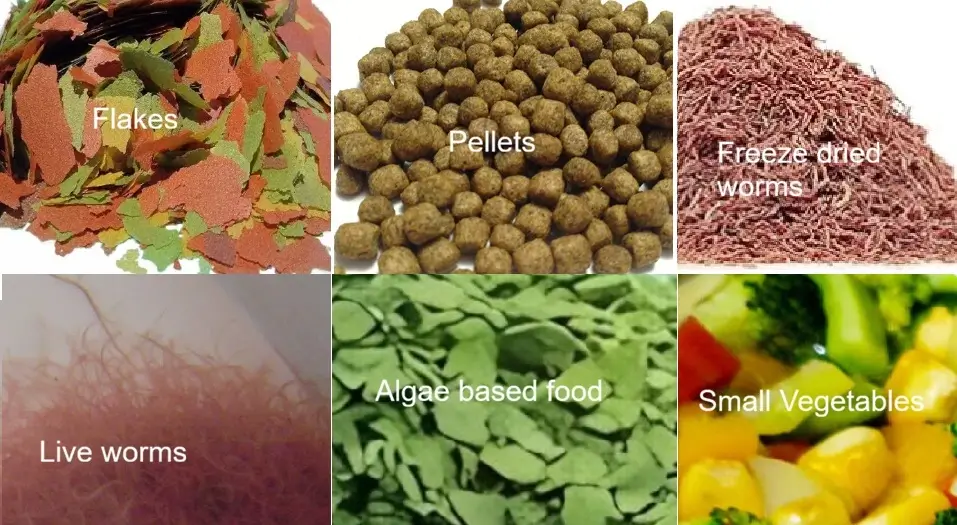
High-quality flake food is the foundation of most guppy diets. Choose a flake with protein listed as the first ingredient. Cheap flakes with fillers produce poor nutrition and cloud water faster. Flakes serve as the daily staple — build variety around them.

Frozen brine shrimp is one of the best supplements available. It is high in protein, easy to digest, and has a well-documented effect on color enhancement. Guppies fed regular brine shrimp display noticeably more vivid reds, blues, and yellows within weeks. Feed two to three times per week.

Guppy Fish food types

Frozen daphnia is high in fiber and acts as a natural digestive aid — particularly useful for preventing and treating constipation and swim bladder problems from overfeeding. Feed once or twice a week alongside brine shrimp.

Bloodworms are a high-protein treat that guppies respond to enthusiastically. Feed sparingly — no more than once or twice a week — as too much bloodworm leads to constipation.

Blanched vegetables — spinach, zucchini, or shelled peas — add plant-based fiber to the diet. Peas are particularly useful for treating mild constipation or swim bladder issues. Remove any uneaten vegetable matter after a few hours.

Spirulina flakes or algae wafers add plant-based nutrition and support immune health.

What Do Guppies Eat in the Wild?

In their natural habitat, guppies feed on small insects, mosquito larvae, algae, plant matter, and zooplankton.worms, dalphnia,mosquito larve, brine shrimp

They are constantly grazing opportunists rather than scheduled feeders. This is why variety in captivity so closely mirrors what they eat naturally — and why a diet of brine shrimp, daphnia, and quality flakes produces noticeably better results than flakes alone.

What Do Guppies Eat Besides Fish Food?

Guppies will eat blanched vegetables, live baby brine shrimp, microworms, vinegar eels, infusoria, and small pieces of boiled egg yolk. For fry specifically, baby brine shrimp and microworms are the best live food options available. Many hobbyists also grow their own infusoria as a fry food starter.

For a full breakdown of the best food options and feeding tips, read our best guppy food guide.


Guppy Feeding Schedule

Feed adult guppies 1–2 times per day. A third small feeding is fine if your schedule allows. The quantity per feeding matters far more than the number of feedings.

The most important rule: only feed what they can finish within 2–3 minutes. Watch your guppies eat. Everything should be consumed before it reaches the substrate. Leftover food that sinks, rots, and releases ammonia is one of the fastest ways to poison a tank — especially in smaller aquariums.

Guppy feeding schedule by life stage:

Adult guppies: 1–2 times daily, small amounts finished in 2–3 minutes
Juvenile guppies (1–3 months): 2–3 times daily, slightly larger portions to support growth
Guppy fry (newborn to 1 month): 3–5 times daily, very small portions of crushed flakes, baby brine shrimp, or microworms
Pregnant females: 2–3 times daily with protein-rich foods to support developing fry

Many experienced fishkeepers fast their guppies one day per week. This gives the digestive system time to clear completely, reduces waste accumulation in the tank, and helps prevent the chronic mild overfeeding that gradually damages water quality. It does not harm healthy adult guppies.

Signs you are overfeeding:

→ Uneaten food visible on the substrate after feeding
→ Water cloudiness appearing between water changes
→ Ammonia readings above zero despite regular maintenance
→ Guppies appearing bloated or swimming awkwardly

If your guppies stop eating suddenly, this is one of the earliest warning signs that something is wrong with the water or the fish. Read our guide on why guppies stop eating.


Guppy Tank Mates

Guppies are peaceful community fish and do well with a wide range of other species. The key is choosing tank mates that share similar water requirements and will not nip guppy fins. Fancy guppies with large ornate tails are particularly vulnerable to even mildly nippy species.

Best guppy tank mates:

Corydoras catfish — peaceful bottom dwellers that clean up leftover food and never bother guppies at any tank level. Keep in groups of 6.
Neon tetras — peaceful schooling fish, one of the most popular community combinations with guppies. Keep in groups of 6+.

neon tetra fish
Harlequin rasboras — calm, non-nippy, share almost identical water requirements to guppies

rasbora fish
Platies — fellow livebearers with nearly identical care requirements, very beginner-friendly

platies
Mollies — compatible in 20 gallon and larger tanks; can become territorial in smaller setups

molly fish
→ Cherry shrimp and Amano shrimp — peaceful invertebrates that help keep the tank clean

Cherry Shrimp
→ Nerite snails and mystery snails — safe, low-maintenance algae eaters that never bother guppies

nerite snail

Fish to avoid with guppies:

→ Tiger barbs — notorious fin nippers that relentlessly target guppy tails, especially fancy males

→ Large cichlids and oscars — predatory, will eat guppies outright
→ Aggressive bettas — male bettas may attack guppies attracted to their colorful fins
→ Goldfish — incompatible water temperatures, will eat fry, completely different care requirements

For a full list of 25 compatible species with tank size requirements and fry safety ratings, read our guppy tank mates guide.


Fancy Guppy Care

Fancy guppies share the same fundamental care requirements as regular guppies but need extra attention in a few specific areas. Their highly modified bodies and large ornate fins — the result of decades of selective breeding — make them noticeably more sensitive than wild-type or standard varieties.

fan tail fancy guppy

Temperature stability matters more for fancy guppies. Their large fins and modified body shapes make them less resilient to temperature swings than hardier varieties. A heater is non-negotiable for any fancy guppy setup — even in warm climates where regular guppies might manage without one.

Water flow must be gentle. Fancy guppies are slow swimmers because of their large decorative tails. Strong currents from powerful filters exhaust them continuously, damage their fins over time, and cause chronic stress. A sponge filter or a baffled HOB outlet is essential. If your fancy guppies are spending most of their time resting rather than actively swimming, the current is almost certainly too strong.

Tank mates need extra screening. Any species with even a mild fin-nipping reputation — zebra danios, serpae tetras, some barb species — should be avoided entirely in fancy guppy tanks. Even a single fin-nipping incident creates entry points for bacterial infection in the elaborate trailing fins.

Feeding needs more attention. Fancy guppies with very large tails sometimes struggle to compete for food against faster, more agile tank mates. Target feeding with a pipette or feeding ring ensures they get adequate nutrition.

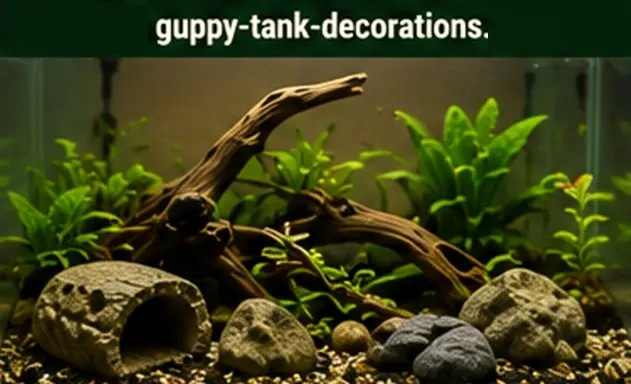
Decoration choices matter. Sharp plastic decorations and rough surfaces tear fancy guppy fins easily. Choose smooth driftwood, rounded rocks, and silk plants rather than stiff plastic as alternatives.

For a full guide to the different fancy guppy strains and their specific needs, read our fancy guppy varieties guide.


Endler Guppy Care

Endler guppies — properly called Endler’s livebearers (Poecilia wingei) — are closely related to common guppies and share very similar care requirements. If you are keeping regular guppies successfully, you will have no difficulty keeping Endlers in the same conditions.

endler guppy

Endler guppy water parameters:

Temperature: 72°F–82°F (same as common guppies)
pH: 7.0–8.0
GH: moderately hard water preferred
Ammonia and nitrite: 0 ppm always

Endlers are generally considered even hardier than fancy guppies. Being closer to their wild ancestors, they handle minor parameter fluctuations with less stress — though stable clean water remains the foundation of good Endler care regardless.

The key difference to be aware of when keeping Endlers alongside common guppies: the two species can and will crossbreed. Hybrid offspring lose the pure characteristics of both strains. If you want to keep pure Endler lines, house them in a separate tank from common guppies.

Endlers are smaller than most guppy varieties — males typically stay under 1 inch — which makes them ideal for nano tanks as small as 5 gallons when kept in same-sex groups. Their compact size and active, peaceful behavior makes them an excellent choice for aquarists who want guppy-like fish in a smaller setup.

For water parameter details specific to Endlers, read our guppy water parameters guide.


Guppy Breeding Basics

Guppies are livebearers and one of the easiest fish to breed in captivity. If you keep males and females together in a healthy, well-maintained tank, breeding happens naturally and continuously without any intervention.
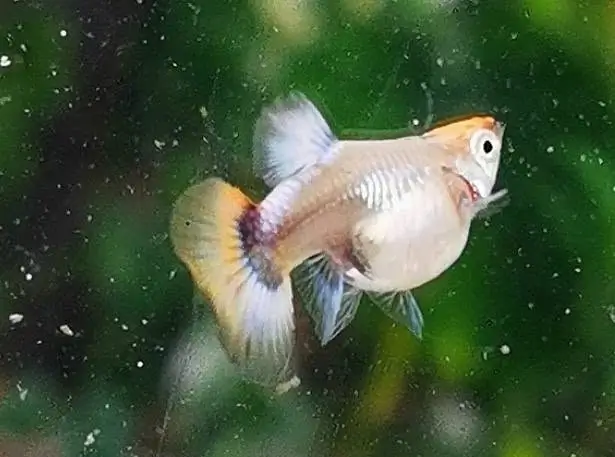
guppy breeding tank

Guppy breeding setup:

A 10-gallon or larger tank works well for breeding. Dense planting with java moss, guppy grass, and floating plants gives fry hiding spots and dramatically improves survival rates in the main tank without requiring a separate setup. For serious breeding projects, a dedicated 20-gallon breeding tank with a sponge filter gives the best results.

Guppy breeding ratio:

Keep 1 male to 2–3 females. This distributes male attention across multiple females, reducing the stress and exhaustion that a single female experiences when continuously pursued. A heavily skewed ratio toward males causes females to become stressed, lose condition, and become susceptible to disease over time.

Guppy breeding temperature:

Slightly warmer water at 78°F–80°F encourages breeding behavior and speeds up fry development. Stable temperature within this range is more important than hitting an exact number.

Guppy breeding box:

A breeding box is a plastic container that sits inside the main tank and allows the female to give birth in isolation while the fry drop safely through a mesh bottom away from the mother. It keeps the female in the same water conditions as the main tank, avoiding the stress of a parameter change. Move the female to the breeding box when she shows late-stage pregnancy signs — boxy belly, very dark gravid spot, hiding behavior — and remove her promptly after birth to prevent her eating the fry. Adding the pregnant female too early can stress them and cause problems.

Guppy breeding cycle:

Healthy females give birth every 3–5 weeks, producing 20–80 fry per batch depending on age and size. Older, larger females consistently produce bigger batches. Guppies can store sperm from a single mating and use it to fertilize multiple successive pregnancies — meaning a female bought from a pet store can give birth several times with no male present in your tank.

For a complete breeding walkthrough including strain selection and line breeding, read our guppy breeding guide.


Is My Guppy Pregnant?

Guppies breed readily and female guppies become pregnant frequently when males are present. Recognizing pregnancy early gives you time to prepare — setting up a breeding box, adding plant cover, or arranging a fry tank before birth happens.

pregnant guppy with dark gravid spot

Signs of a pregnant guppy:

Enlarged belly — the most obvious sign. Starts as a subtle rounding and gradually becomes a distinctive boxy or squared shape in the final days before birth
Dark gravid spot — a dark patch near the anal fin that deepens in color as pregnancy progresses. In light-colored females in late pregnancy, you can often see tiny fry eyes visible through the skin as dark dots near the gravid spot
Behavioral changes — pregnant females slow down, rest more, and avoid chasing males. As birth approaches they seek quiet hiding spots behind plants and decorations
Appetite changes — many pregnant females eat more than usual during mid-pregnancy, then noticeably reduce food intake in the final days before birth
Shivering or twitching — intermittent trembling is a reliable sign that birth is very close

How long are guppies pregnant?

Most guppies remain pregnant for 21–30 days. Warmer water temperatures may slightly shorten the gestation period while cooler conditions may extend it slightly.

Pregnant guppy vs fat guppy:

A pregnant guppy develops her belly gradually over several weeks with a clearly visible gravid spot. A bloated guppy from overfeeding swells more suddenly, has no gravid spot, and may show other signs of illness. Dropsy — a serious condition — causes a swollen belly with raised scales that stick outward in a pinecone pattern. If scales are raised rather than flat, investigate a health issue rather than assuming pregnancy. Read our bloated guppy guide for a full comparison.

When to separate a pregnant guppy:

Move the female to a breeding box or separate tank when her belly becomes distinctly boxy, the gravid spot is very dark, and she is hiding constantly. This is typically 3–5 days before birth. Move her earlier than this and the additional stress can delay or complicate labor.

For a full week-by-week guide to guppy pregnancy stages and birth signs, read our pregnant guppy guide.


Baby Guppy Care

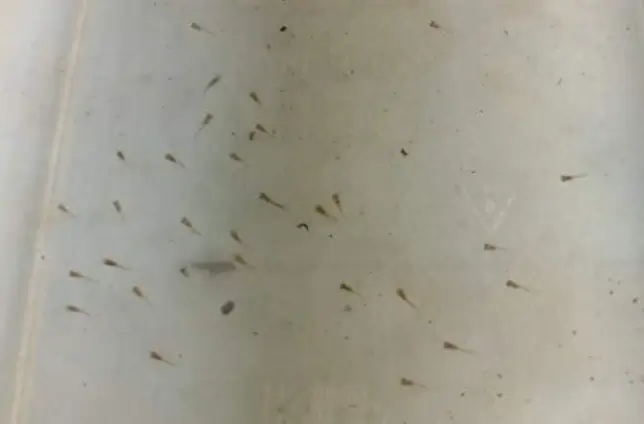
Newborn guppy fry are fully formed and immediately capable of swimming and feeding — but they are tiny and completely vulnerable to being eaten by adult fish, including their own parents. Also note that guppy fry are very sensitive to water parameter changes.

newborn guppy fry

Protecting baby guppies:

The most effective methods in order of reliability are:

Separate fry tank — the safest option. A simple 5–10 gallon tank with a sponge filter gives fry undisturbed space to grow without competition or predation from adults
Breeding box — keeps fry inside the main tank but separated from adults. Convenient but fry can become cramped as they grow
Dense planting — java moss, guppy grass, and floating plants give fry natural hiding spots. In a heavily planted tank a meaningful number of fry survive to adulthood even without separation

What to feed baby guppies:

Fry need small, protein-rich food that they can fit in their tiny mouths. The best options are:

Baby brine shrimp — the gold standard fry food. Highly nutritious, appropriately sized, and stimulates active feeding behavior
Microworms — easy to culture at home, excellent protein source for very young fry
Crushed flake food — grind high-quality adult flakes into powder between your fingers before feeding
Infusoria — microscopic organisms ideal for the first 1–2 days when fry are smallest
Vinegar eels — tiny live food suitable for very young fry

Feed fry 3–5 small meals per day. More frequent small feedings support the rapid growth rate that determines how quickly and well fry develop into healthy juveniles. Only feed what they finish within a few minutes — uneaten food fouls fry tanks quickly and small volumes become dangerously toxic faster than adult tanks.

Guppy fry growth stages:

Guppy fry growth stages

Week 1: Fry are tiny and mostly transparent, survival depends heavily on food availability and hiding cover
Week 2–3: Fry begin developing color and grow visibly
Week 4–6: Sex starts becoming identifiable as males develop color and females grow larger
Week 8–12: Fry are approaching juvenile size and can transition to adult feeding schedules

For a complete fry care and growth guide, read our guppy fry guide and guppy fry growth guide.


Common Guppy Diseases and Warning Signs

Most guppy diseases are not random — they are the end result of stress, and stress almost always traces back to something wrong with the tank environment. A guppy living in clean, stable, well-maintained water is remarkably resistant to disease. The same fish in poor conditions becomes vulnerable to almost everything. Identifying the disease early and treating them in isolation is the best thing to do.

Early warning signs to watch for daily:

→ Hiding constantly or unusual shyness
→ Gasping at the water surface — urgent, check parameters immediately
→ Sitting at the bottom barely moving
→ Clamped fins held tight against the body — one of the earliest universal stress signs
→ Pale or faded coloring that was previously bright and vivid
→ Rapid gill movement or labored breathing
→ Loss of appetite or spitting food out
→ Unusual swimming — spiraling, listing to one side, swimming upside down
→ Scratching against decorations or substrate — flashing behavior

Common guppy diseases:

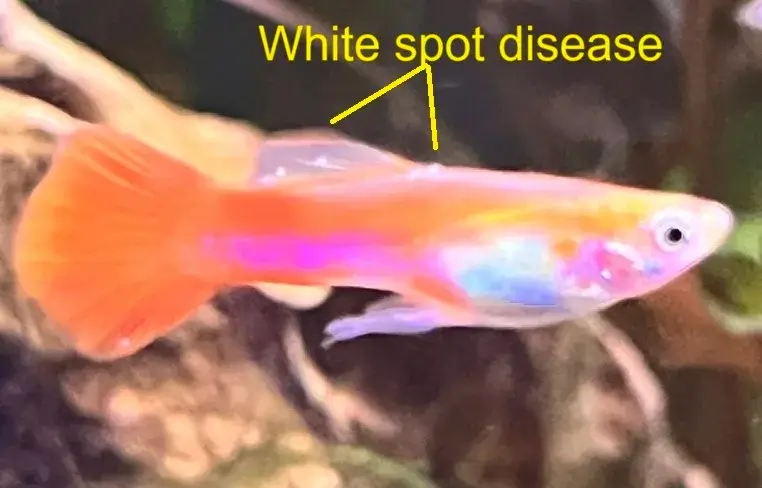
Ich (White Spot Disease) — tiny white spots resembling salt grains on the body and fins. Highly contagious. Caused by stress and temperature drops. Treat with ich medication, raised temperature to 82°F, and a water change. Read our common guppy diseases guide for full treatment steps.

Ich, white spots on guppy fish

Fin Rot — fin edges appear ragged, torn, or melting. Caused by poor water quality and bacterial infection. Early stage often resolves with a large water change alone. Advanced stage requires antibacterial medication.

fin rot in guppy fish

Velvet Disease — fine gold or yellow dust coating on the body, most visible under a flashlight in a darkened room. Very contagious. Treat with copper-based medication and dim tank lights during treatment.

Guppy with Velvet Disease

Swim Bladder Problems — fish swimming upside down, sideways, or struggling to maintain position. Most commonly caused by overfeeding and constipation. Fast the fish for 24–48 hours then offer a blanched deshelled pea.

guppy with swim bladder problem

Dropsy — severely swollen belly with raised scales in a pinecone pattern. Indicates serious internal organ failure. Difficult to treat once fully established. Isolate immediately and treat with antibacterial medication.

dropsy in guppy fish

Columnaris (Mouth Fungus) — white patches around the mouth that spread rapidly. Despite the name it is bacterial, not fungal. Treat with antibacterial medication only — antifungal medication will not work.

mouth fungus in guppy fish

The most important rule: always test your water before reaching for medication. Poor water quality is the underlying cause in the majority of disease cases. Fixing the water first gives medication the best possible chance of working — and in many early-stage cases resolves the problem without any medication at all.

For detailed identification with photos, causes, and full treatment protocols for every common guppy disease, read our common guppy diseases guide.

For specific behavior problems, read our dedicated guides on guppy staying at the bottom, guppy staying at the top of the tank, guppy swimming upside down, and why guppies hide.


Common Guppy Care Mistakes

Most beginner problems with guppies trace back to a handful of common mistakes. Understanding them in advance is the most effective way to avoid them.

Skipping the nitrogen cycle is the single most common cause of early fish deaths. A brand new tank has no beneficial bacteria to process ammonia from fish waste. Adding fish before the tank is cycled leads to toxic ammonia spikes that can kill fish within days even when the water looks perfectly clear. Always cycle the tank before adding fish.

Overfeeding is the most common ongoing mistake. Uneaten food decomposes and releases ammonia directly into the water. The damage accumulates gradually — water quality drops slowly, fish become less colorful and active, and disease resistance weakens over weeks before anything obvious happens. Feed only what they finish in 2–3 minutes and remove anything uneaten.

Overcrowding creates ammonia problems faster than any filter can handle, reduces oxygen levels, increases aggression, and stresses every fish in the tank. Always stock conservatively and remember that guppies breed rapidly.

Large sudden water changes shift temperature, pH, and hardness more than guppies can handle safely. Never change more than 30–40% at once. Always match the temperature of new water to your tank before adding it.

Washing filter media under tap water kills the beneficial bacteria living inside the filter sponge. Always rinse filter media in a bucket of old tank water from the water change — never under the tap.

No acclimation for new fish — dropping guppies directly from the store bag into your tank causes immediate temperature and water chemistry shock. Always float the bag to match temperatures, then gradually mix tank water into the bag before releasing fish.

Adding incompatible tank mates — fin nippers and aggressive species cause chronic stress that weakens the entire tank’s immune health, not just the fish being harassed.

Improper water changes are one of the most dangerous and commonly misunderstood areas. Read our detailed guide on why guppies die after water changes.


Guppy Care Maintenance Schedule

Consistency is the key to a healthy guppy tank. The best maintenance routine is the one you actually follow every week without exception.

Daily

→ Feed guppies 1–2 times — only what they finish in 2–3 minutes
→ Check temperature and observe fish behavior for any early warning signs
→ Remove any uneaten food after 5 minutes before it sinks and decomposes

Weekly

→ Perform a 20–25% water change using a gravel siphon to pull waste from the substrate simultaneously
→ Treat replacement tap water with dechlorinator and match temperature before adding to the tank
→ Wipe algae from the front glass before siphoning so dislodged algae gets removed with the water change
→ Test ammonia, nitrite, and nitrate — weekly testing is the most reliable early warning system you have

Monthly

→ Rinse filter sponge or media in a bucket of old tank water — never under tap water
→ Trim fast-growing plants before they block light to lower plants or cover the surface entirely
→ Check heater and filter are operating correctly
→ Deep clean any decorations with significant algae buildup using tank water only

Every 3–6 months

→ Replace filter cartridges if using disposable media (sponge filters only need rinsing, not replacing)
→ Review stocking levels — guppy populations grow quickly in mixed tanks and overcrowding creeps up gradually

Important: never do a large water change and filter cleaning on the same day. Both remove beneficial bacteria — doing them together can crash your tank’s biological filtration and trigger an ammonia spike. Space them at least a week apart.


Frequently Asked Questions

Are guppies good for beginners?

Yes. Guppies are one of the most beginner-friendly aquarium fish available. They are hardy, adaptable, and forgiving of minor mistakes — as long as water quality and feeding are handled correctly.

How long do guppies live?

Most guppies live 1–3 years. With excellent care — stable water, a varied diet, and low stress — some live closer to 3 years. Poor water quality and overfeeding are the most common causes of shortened lifespan. Read our guppy lifespan guide for more.

Can guppies live without a heater?

In tropical climates where room temperature stays consistently between 74°F–80°F year-round, some hobbyists manage without one. In most homes — anywhere with cold nights, seasons, or air conditioning — a heater is necessary to prevent the temperature swings that stress fish.

Can guppies live without a filter?

Not reliably long-term. Without filtration, ammonia builds up rapidly and becomes toxic within days. The only exception is a wide, lightly stocked tank with heavy live plant coverage and very frequent water changes.

How often should I do water changes?

Weekly partial water changes of 20–25% are the standard recommendation. In a well-filtered, heavily planted, lightly stocked tank every 10–14 days may be sufficient. Always let your test kit readings guide your schedule rather than a fixed calendar.

What is the biggest mistake beginners make with guppies?

Skipping the nitrogen cycle and overfeeding. Both cause water quality problems that stress guppies and invite disease — and both are completely preventable.

Do guppies need live plants?

No, but live plants make a noticeable difference. They absorb nitrates, provide fry hiding spots, reduce stress, and improve water quality naturally. Java moss and guppy grass are the easiest starting options.

Can guppies live in a bowl?

Not recommended. Bowls have too little water volume to maintain stable parameters. Ammonia builds up quickly, oxygen levels drop, and temperature swings are more extreme. A 10-gallon tank is the minimum for a small group.

How many guppies should be kept together?

Guppies are social and do best in groups of at least 4–6. A single guppy kept alone is noticeably less active and confident. A species-only tank or a small peaceful community both work well.

Can guppies live with bettas?

Generally not recommended. Male bettas are territorial and frequently attack guppies — particularly fancy males whose large colorful tails resemble rival bettas. Some fishkeepers have success in heavily planted tanks with specific calm individuals, but the risk is high and the combination is best avoided by beginners.

Can guppies live with goldfish?

No. Goldfish prefer cooler water (60°F–70°F), which is too cold for guppies. Goldfish also grow large and will eat guppy fry. These two species are not compatible.

Do guppies lay eggs?

No. Guppies are livebearers — they give birth to fully formed live fry rather than laying eggs. Read our do guppies lay eggs guide for more on how guppy reproduction works.

How do I tell male from female guppies?

Males are smaller, slimmer, and far more colorful with decorative flowing tails. Females are larger, rounder, and plainer in color with a dark gravid spot near the anal fin. For a detailed comparison with photos, read our male vs female guppy guide.

How often do guppies breed?

Healthy females give birth every 3–5 weeks if males are present. They can also store sperm and give birth multiple times from a single mating. A female bought from a pet store may already be pregnant.

What is the ideal male to female ratio?

1 male to 2–3 females is the standard recommendation. This reduces stress on females from constant male pursuit. A male-only tank avoids breeding management entirely — males display the most vivid colors and the tank is calmer and easier to manage.

Why are my guppies losing color?

Faded coloring is almost always caused by chronic stress or illness. Poor water quality is the most common cause — guppies in chronically elevated nitrates or unstable parameters gradually lose their color. Disease, parasites, poor nutrition, and aggression from tank mates all produce the same response. Read our guppy losing color guide for a full diagnosis.

Why are my guppies dying?

Sudden deaths are almost always linked to water quality — ammonia spikes, nitrite poisoning, temperature shock, or disease. Test your water immediately. Read our common guppy diseases guide for further diagnosis.

Why is my guppy staying at the bottom?

Bottom sitting in a normally active fish indicates significant illness, severe stress, or weakness. Check water parameters immediately. Read our guide on guppy staying at the bottom.

Why is my guppy at the top of the tank?

Guppies hovering near the surface and gasping are usually seeking oxygen. This indicates low dissolved oxygen levels, ammonia poisoning, or gill parasites. Increase surface agitation immediately and test your water. Read our guide on guppy staying at the top of the tank.

Can guppies get ich?

Yes. Ich — white spot disease — is one of the most common guppy diseases, appearing as small white spots on the body and fins. It is usually triggered by temperature drops or stress. Treatable when caught early with raised temperature and ich medication. Read our common guppy diseases guide for treatment steps.

How do I acclimate new guppies?

Float the sealed bag in your tank for 15–20 minutes to match temperatures. Then open the bag and add small amounts of tank water every 5 minutes for 20–30 minutes. Net the fish into the tank and discard the bag water — never pour it in as it may introduce pathogens from the store.

Can guppies live with shrimp?

Yes. Adult Amano shrimp, cherry shrimp, and ghost shrimp coexist well with guppies. Baby shrimp may be eaten — dense plant cover dramatically improves shrimp survival. Read our guppy tank mates guide for full compatibility details.

What is guppy care and breeding for beginners?

Guppy care and breeding for beginners means maintaining stable water between 72°F–82°F, feeding a varied diet 1–2 times daily, keeping a 1:2–3 male to female ratio, providing dense plant cover for fry, and cycling the tank fully before adding fish. Guppies breed naturally without intervention — the main challenge for beginners is managing fry populations and preventing overfeeding. Our guppy breeding guide covers the full process.


Final Thoughts

Guppy care is genuinely one of the most rewarding experiences in the freshwater fishkeeping hobby. These small, colorful, endlessly fascinating fish thrive when given the right foundation — a properly cycled tank, stable water, a varied diet, and enough plant cover to feel secure.

The fishkeepers who have the most success with guppies are not the ones with the most expensive equipment. They are the ones who test their water consistently, observe their fish daily, act on early warning signs before problems escalate, and understand that prevention is always easier than treatment.

Whether you are setting up your first 10-gallon beginner tank or building a serious breeding program, the principles in this guide give you everything you need. Keep the water stable, feed with discipline, choose compatible companions, and your guppies will reward you with vivid colors, active behavior, and successful breeding for years to come.

For more detailed guidance on any specific area, explore our full guppy care library:

→ Complete Guppy Tank Setup Guide
→ Guppy Water Parameters Guide
→ Guppy Tank Mates Guide
→ Common Guppy Diseases Guide
→ Guppy Breeding Guide
→ Pregnant Guppy Guide
→ Guppy Fry Care Guide
→ Best Guppy Food Guide
→ Guppy Lifespan Guide

Guppies

Post navigation

Previous post
Next post

N.P Vittal

Hi, I'm N. P. Vittal, founder of Exotic Fish Hub.

My fishkeeping hobby started in 1993 when I was 11 years old. I still remember when my parents bought me a small aquarium along with a pair of black mollies, white mollies, yellow mollies, guppies, zebra danios, a tiny goldfish, and all the accessories needed to get started. It was the first time in my life that I had seen such colorful fish, and as an 11-year-old kid, I was completely fascinated by them from the moment I saw them. What started as a simple gift soon became a lifelong passion.

With 30+ years of fishkeeping experience, I have kept and bred freshwater fish in aquariums, cement tanks, and outdoor ponds. Over the years, I've kept a wide variety of species including guppies, mollies, goldfish, discus, angelfish, bettas, tetras, cichlids, Thai orandas, ranchus, pearlscales, and many others. I've also spent years experimenting with planted aquariums, fancy guppy strains, aquatic plants, and different aquarium setups. Even today, I continue to be fascinated by the beauty, behavior, and diversity of aquarium fish.

Through Exotic Fish Hub, I share practical fishkeeping knowledge, breeding tips, aquarium setup advice, and solutions to common fish care problems based on real-world experience to help fellow hobbyists build healthier, thriving aquariums.

Related Posts

Guppies

Koi Tuxedo Guppy Care – Tank Setup, Diet, Breeding & Price

The term “Koi Tuxedo Guppy” typically refers to a specific color pattern or variety of…

Read More
Guppies

Guppy Staying at the Top of the Tank: Causes and Fixes

Guppies staying at the top of the tank is not always a bad sign. Guppies…

Read More
Guppies

Why Is My Guppy Hiding? Common Causes Explained

Guppy hiding behavior is usually caused by stress, illness, bullying, poor water quality, or sudden…

Read More

Categories

  • Betta
  • Discus fish
  • glofish
  • Goldfish
  • Guppies
  • Molly Fish
  • Uncategorized
  • Facebook
  • Twitter
  • Instagram
© 2023 www.exoticfishhub.com All Rights Reserved