Do guppies lay eggs? It’s one of the most common questions beginners ask after noticing a pregnant female getting larger and rounder by the day.
The answer is simple: guppies do not lay eggs. They are livebearers that give birth to live fry. This holds true for every healthy female guppy, with no exception in normal reproduction. The confusion comes from the fact that the babies do develop inside egg-like structures within the mother before birth, which is where most of the myths about “guppy eggs” actually come from.
In this guide, you’ll learn why guppies give birth instead of laying eggs, what those internal egg-like structures actually look like, why people keep finding “guppy eggs” in their tank that turn out to be something else entirely, and how the whole pregnancy process works from fertilization to birth.
Quick Navigation
1. Do Guppies Lay Eggs Or Give Birth?
2. Why People Think Guppies Lay Eggs
3. How Guppy Reproduction Works
4. Guppy Pregnancy and Gestation
5. Signs of a Pregnant Guppy
6. How Guppies Give Birth
7. What Do Guppy Eggs Look Like?
8. Why Are There “Guppy Eggs” In My Tank?
9. Can Guppies Lay Unfertilized Eggs?
10. How Long Do Guppy Eggs Take To Hatch?
11. How To Protect Guppy Fry After Birth
12. Frequently Asked Questions
1. Do Guppies Lay Eggs Or Give Birth?
No, guppies do not lay eggs.
Guppies belong to a group of fish called livebearers. Unlike many aquarium fish species that lay eggs on plants, rocks, glass, or spawning mops, female guppies carry their developing young inside their bodies and eventually give birth to live fry.
This means:
➜ You will never see a healthy female guppy laying eggs around the aquarium
➜ Guppy babies develop inside the mother
➜ The fry are born alive and free-swimming
➜ No external egg hatching occurs
Early in my hobby, I found some eggs in the aquarium myself and assumed they were guppy eggs, until I discovered they belonged to a completely different species entirely — something we’ll get to later in this guide.
Quick Answer Table
| Question | Answer |
|---|---|
| Do guppies lay eggs? | No |
| Do guppies give birth? | Yes |
| Are guppies livebearers? | Yes |
| Do guppy eggs hatch outside the mother? | No |
| Pregnancy duration | 21–30 days |
| Average fry per birth | 20–100+ |
2. Why People Think Guppies Lay Eggs
This confusion is extremely common among beginner aquarists, and there are a few different reasons it happens.
Developing Fry Remain Inside the Female
Technically, female guppies do produce eggs inside the body. The fertilized eggs remain inside the female’s ovaries, where the embryos continue developing until they’re born as live fry. Because the eggs are retained internally, most fishkeepers never see actual guppy eggs at all.
People Find Small White Objects in Their Tank
Many aquarists discover tiny white objects attached to the glass, plants, decorations, or substrate and immediately assume they’re guppy eggs. In reality, these are far more likely to be:
➜ snail eggs
➜ fish eggs from another species
➜ fungus
➜ biofilm
➜ debris
Pregnant Females Look Like They’re Carrying Eggs
A heavily pregnant female guppy develops a noticeably enlarged abdomen, and to beginners this can look very similar to a fish that’s full of eggs. In the early days, I was stunned at how many fry the females could carry inside their bodies before I understood what was actually happening.
You can learn more in our detailed Pregnant Guppy Guide.
3. How Guppy Reproduction Works
Guppy reproduction is fascinating because fertilization happens internally, and the entire process occurs inside the female rather than out in the open water.
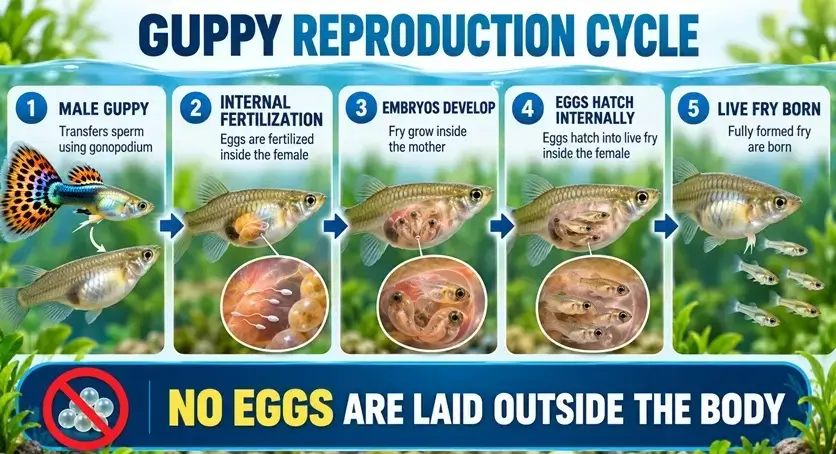
Step 1: Internal Fertilization
Male guppies have a specialized anal fin called a gonopodium, which is used to transfer sperm directly into the female. If you’re unsure how to tell males and females apart, read our Male vs Female Guppy Guide.
Step 2: Embryos Develop Internally
After fertilization, the eggs remain inside the female as the embryos continue developing, gradually forming into fry that are nourished by their yolk sacs the entire time.
Step 3: Internal Hatching, Then Birth
This is where many hobbyists get confused: the eggs actually hatch while still inside the female. By the time the fry emerge, they’re already fully formed baby fish rather than newly hatched ones, which is exactly why guppies are considered livebearers rather than egg layers.
The Real Fact: Female Guppies Can Store Sperm
One of the most fascinating parts of guppy reproduction is sperm storage. This is why many beginners are shocked when a seemingly non-pregnant female suddenly develops a larger belly and gives birth, even with no male in the tank. In many cases, the female mated before being purchased and was storing that sperm the whole time.
A female guppy can:
➜ mate once and store sperm for later use
➜ produce multiple future batches of fry from that single mating
➜ continue giving birth for several months without another male present
4. Guppy Pregnancy and Gestation
The average guppy pregnancy lasts 21–30 days, though this can vary depending on water temperature, nutrition, genetics, stress, and overall health. Warmer water usually speeds development along, while cooler temperatures can stretch the gestation period out slightly.
How Many Babies Can a Guppy Have?
The number of fry varies a fair amount by the size and maturity of the female:
➜ young females typically produce 10–20 fry per brood
➜ mature females commonly produce 20–60 fry per brood
➜ large, healthy females may occasionally produce 80–100+ fry per brood
Under proper conditions, guppies reproduce very quickly. For breeding tips, visit our Guppy Breeding Guide.
5. Signs of a Pregnant Guppy
Enlarged Abdomen
The female gradually becomes larger as the fry develop inside her.
Dark Gravid Spot
The gravid spot is one of the easiest pregnancy indicators to track. As pregnancy progresses, you may notice:
➜ darker coloration
➜ larger spot size
➜ visible fry eyes near birth
Boxy Belly Shape
As delivery approaches, the abdomen often becomes more square than round.
Hiding Behavior
Many pregnant guppies seek out quiet, sheltered spots as labor approaches. This can be even more noticeable if males are constantly chasing her, since a heavily gravid female has a harder time outswimming unwanted attention. If your fish is hiding frequently, our guide on why guppies hide may help.
Reduced Appetite
Some females eat less in the final day or so before labor, which is a normal part of approaching birth rather than a health concern. If appetite loss seems to be going on longer than that, read why is my guppy not eating.
6. How Guppies Give Birth
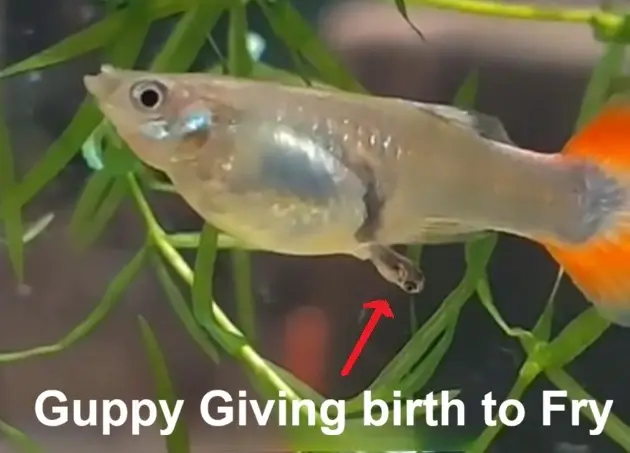
Unlike egg-laying fish, guppies release live fry one at a time. During labor, the female usually isolates herself as contractions begin, and fry emerge individually over a process that can take several hours.
Newborn fry start swimming and searching for hiding places immediately. Unfortunately, adult guppies, including the mother, may eat newborn fry, which is why many breeders rely on:
➜ dense plants
➜ breeder boxes
➜ separate fry tanks
➜ floating plants
to improve survival rates. For more on raising the babies once they arrive, see our Guppy Fry Guide and Guppy Fry Growth Guide.
7. What Do Guppy Eggs Look Like?
This is one of the most searched guppy questions online, and the honest answer is that most hobbyists never see actual guppy eggs, since they remain inside the female until birth.
In certain lightly colored females, advanced hobbyists may occasionally glimpse:
➜ tiny yellowish spheres
➜ embryo structures
➜ developing fry eyes
through the gravid area, but these are still inside the mother and aren’t external eggs. If you see eggs attached to aquarium surfaces, they almost certainly belong to another species or organism entirely.
8. Why Are There “Guppy Eggs” In My Tank?
One of the most common beginner questions is: if guppies don’t lay eggs, why am I seeing eggs in my aquarium? In almost every case, the eggs belong to something else.
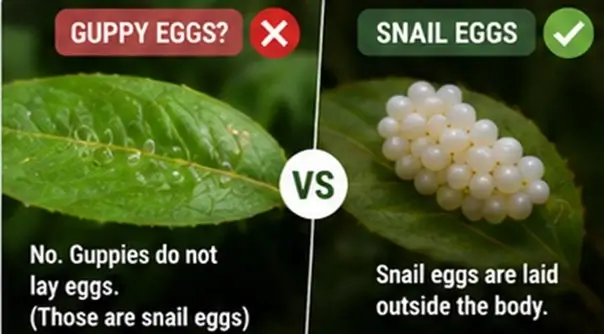
Snail Eggs
This is the most common explanation. Aquarium snails often lay eggs on glass, decorations, plants, or filter equipment, and depending on the species, the eggs may appear as:
➜ jelly-like clusters
➜ small white dots
➜ pink egg masses
➜ clear capsules
Many beginners mistakenly identify these as guppy eggs.
Eggs From Other Fish Species
If your aquarium contains fish other than guppies, the eggs may belong to corydoras, zebra danios, tetras, angelfish, rainbowfish, or plecos, all of which deposit eggs on plants, rocks, glass, or decorations.
Fungus or Biofilm
Sometimes those white spots aren’t eggs at all. They may be fungus, bacterial colonies, biofilm, or organic debris, which is especially common in newly established aquariums.
9. Can Guppies Lay Unfertilized Eggs?
Healthy guppies don’t normally release eggs into the aquarium under any circumstance. Because guppies are livebearers, fertilized eggs stay inside the female until the fry are fully developed and ready to be born live.
There’s one genuine exception worth knowing about: a stressed, ill, or otherwise unhealthy female can sometimes expel unfertilized or non-viable eggs, sometimes called dead eggs, as a way of clearing them from her body. This isn’t a normal part of guppy reproduction, so if you see it happen, treat it as a sign to check your water parameters and the female’s overall condition rather than as a normal birth event. Maintaining stable water quality is one of the simplest ways to reduce the odds of this happening — read our Guppy Water Parameters Guide for the full routine.
If what you’re seeing in the tank doesn’t match that description, it almost certainly belongs to a snail or another fish species, covered in the section above.
10. How Long Do Guppy Eggs Take to Hatch?
Guppy embryos develop inside the female for the same 21–30 days covered earlier, not inside an external egg the way many other fish species work. There’s no incubation period to manage and no egg care required on your part, since the entire process happens inside the mother’s body from fertilization through to birth.
Guppy eggs also can’t hatch successfully outside the mother. If undeveloped material is expelled prematurely, whether from the rare case covered above or from a failed pregnancy, survival is extremely unlikely and development typically stops rather than continuing on its own. This is one of the main reasons breeders focus on keeping pregnant females healthy and low-stress throughout gestation, rather than trying to intervene once eggs are already outside the body.
11. How to Protect Guppy Fry After Birth
One surprising fact about guppies is that adults, including female guppies, male guppies, and other tankmates, may eat newborn fry. To improve fry survival:
Add Dense Plants
Good choices include Java Moss, Guppy Grass, Hornwort, and floating plants, all of which give fry plenty of places to hide.
Use a Breeder Box
Breeder boxes temporarily separate fry from adults, and many breeders set one up whenever a birth is expected.
Set Up a Dedicated Fry Tank
Serious breeders often move fry into a separate grow-out aquarium, which tends to mean higher survival rates, faster growth, easier feeding, and less competition for food.
Provide Proper Tank Space
Overcrowded aquariums increase stress for everyone in the tank. If you’re unsure about stocking levels, read How Many Guppies in a 10 Gallon Tank? and our Guppy Tank Setup Guide.
Frequently Asked Questions
Do guppies lay eggs?
No. Guppies are livebearers that give birth to live fry rather than laying eggs.
What do guppy eggs look like, and can you see them inside a pregnant female?
Most hobbyists never see actual guppy eggs, since they remain inside the female until birth. In light-colored females, the developing embryos may occasionally be faintly visible near the gravid spot, but they’re still inside her, not external eggs.
How long do guppy eggs take to hatch?
Guppies don’t lay eggs externally, so there’s nothing to hatch outside the body. The embryos develop inside the female for roughly 21–30 days before birth.
Where do guppies lay eggs?
Nowhere. Healthy guppies don’t lay eggs anywhere in the aquarium under normal circumstances.
Why are there eggs in my guppy tank?
They almost always belong to snails or another fish species sharing the tank. Guppies themselves don’t lay eggs.
Can guppies eat their own babies?
Yes. Adult guppies, including the mother, commonly eat newborn fry if given the opportunity.
How many babies can a guppy have?
Most mature females produce between 20 and 60 fry per brood, though large, healthy females may occasionally produce over 100.
Can female guppies have babies without a male present?
Yes, if she mated previously. Females store sperm and can produce multiple batches of fry from a single mating, sometimes for several months without another male in the tank.
Conclusion
Guppies do not lay eggs. They’re livebearers that carry developing embryos internally for roughly 21–30 days before giving birth to fully formed fry, and any actual eggs you find in the tank belong to a snail or another species rather than your guppies.
If you’re interested in learning more about breeding and raising healthy guppies, continue with:
➜ Pregnant Guppy