Skip to content
Exotic Fish Hub Exotic Fish Hub

  • Goldfish
    • oranda goldfish
    • Black Oranda Goldfish
    • Ranchu Goldfish: Care Guide, Size, Lifespan & Price
    • Thai Oranda Goldfish: Care Guide, Size, Lifespan & Price
  • Guppies
    • Blue Guppy Fish
    • How Long Do Guppies Live? Guppy Lifespan Explained
    • Snow White Guppy
    • Electric Blue Guppy
    • Red Dragon Guppy
    • 17 Stunning Fancy Guppy Varieties You will Love
  • Betta
  • Molly Fish
    • Dalmatian Molly
  • Discus Fish
  • Contact
Exotic Fish Hub
Exotic Fish Hub

Why Is My Guppy Shaking,Twitching, Shimmying, or Vibrating?

Guppies are normally smooth and active swimmers, so guppy shaking, shimmying, twitching, vibrating, or jerky movements can be alarming. Sometimes the behavior is harmless and passes on its own. Other times it’s an early warning sign of poor water quality, parasites, illness, stress, pregnancy, or an environmental problem in the tank.

Guppy shaking, twitching, and vibrating are symptoms, not diseases on their own. Once you find the cause, most cases can be fixed before they turn serious.

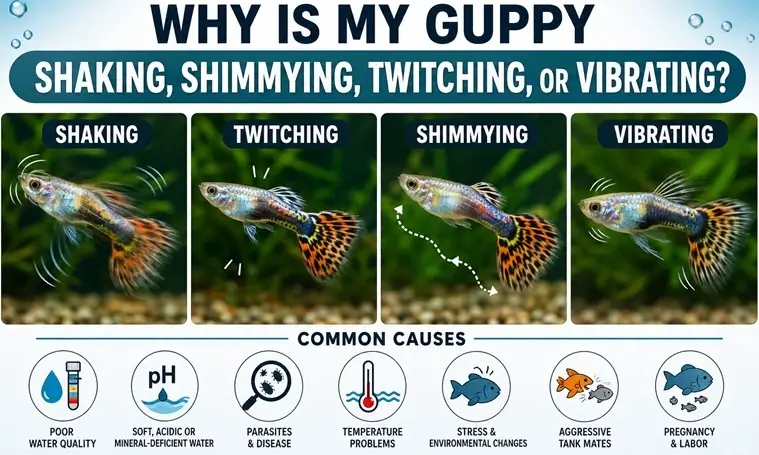
Quick Answer: Guppies shake, shimmy, twitch, or vibrate for a few related reasons:

Poor water quality — ammonia or nitrite stress is the most common trigger of all.

Soft or acidic water — low minerals (GH/KH) and an unstable pH are the classic cause of shimmying.

Parasites or illness — especially when twitching comes with flashing, scratching, or white spots.

Stress, aggression, or temperature swings — new tanks, bullying, and cold water all set it off.

Pregnancy — females may twitch or shiver normally in the final stage before giving birth.

A one-off twitch in a healthy fish is rarely serious. Constant shaking with hiding, appetite loss, clamped fins, heavy breathing, or color loss usually means a real problem worth checking.

Quick Navigation

➜ Why Is My Guppy Shaking, Shimmying, Twitching, or Vibrating?
   ➜ Poor Water Quality
   ➜ Soft, Acidic, or Mineral-Deficient Water
   ➜ Parasites and Disease
   ➜ Temperature Problems and Shimmying
   ➜ Stress and Environmental Changes
   ➜ Aggressive Tank Mates and Overcrowding
   ➜ Pregnancy and Labor
➜ Guppy Shaking at the Bottom of the Tank
➜ Twitching, Shaking, Shimmying, and Vibrating — What Each One Looks Like
➜ Is It Normal for Guppies to Shake or Twitch Occasionally?
➜ Signs the Problem Is Serious
➜ How to Treat a Shaking, Twitching, or Shimmying Guppy
➜ Can Guppies Recover From Twitching and Shaking?
➜ Frequently Asked Questions


Why Is My Guppy Shaking, Shimmying, Twitching, or Vibrating?

Fishkeepers use different words for these behaviors, but shaking, twitching, shimmying, and vibrating are usually closely linked. The difference is mostly in how the movement looks. Some guppies make sudden jerks, some vibrate fast in place, and some rock side to side in what people call shimmying.

Guppy shaking, twitching, shaking, vibrating

What matters is not the exact movement, but the cause behind it. A quick twitch right after the fish is startled is usually fine. Repeated shaking through the day, especially with other symptoms, is the kind that needs a closer look. The causes below run roughly from most to least common.

Poor Water Quality

Poor water quality is the number one reason guppies start twitching or shaking. Ammonia and nitrite are the usual culprits, since they irritate the skin and gills and keep the fish under steady stress. Even levels too low to kill a fish can trigger odd behavior long before other symptoms show up.

Water quality usually slips because of overfeeding, overcrowding, missed maintenance, over-cleaning the filter, or adding fish to a tank that hasn’t finished cycling. A stressed guppy may also lose color, hide more, slow down, or hang near the surface.

Fix: Test the water right away for ammonia, nitrite, nitrate, and pH, and check your readings against our guppy water parameters guide. If anything is high, do a gradual 20–30% water change with dechlorinated, temperature-matched water instead of one big change. If the behavior started right after maintenance, read our guide on why guppies die after water changes.

Soft, Acidic, or Mineral-Deficient Water

This is the cause most beginners miss, and it’s tied closely to shimmying. Guppies are hard-water fish that do best at a pH between 7.0 and 8.0, which is neutral to slightly alkaline. They need a good level of dissolved minerals (general hardness, or GH) and carbonate buffer (KH) to stay healthy, and water that’s too soft or mineral-poor stresses them directly.

Acidic water below a pH of 7 is a real problem for guppies, and soft water is usually what causes it. When KH (the water’s buffer) is low, nothing holds the pH steady, so it drifts down into the acidic range and can swing from day to day. That mix of low minerals and a sliding pH is one of the classic triggers behind the side-to-side shimmy.

Fix: Test GH and KH, not just pH, since a basic test strip often skips them. Guppies do best at roughly 8–12 dGH and 4–8 dKH, with a steady pH in the 7.0–8.0 range. If your water is very soft or reads acidic, raise the hardness and buffer with a remineralizing product, crushed coral, or a GH/KH booster. That usually steadies the pH and clears up shimmy that has no disease behind it. Our guppy water parameters guide covers the ideal mineral and pH levels in detail.

Parasites and Disease

Parasites are one of the biggest causes of twitching. They irritate the skin, fins, and gills, and the fish reacts with sudden jerks or fast shaking. Twitching often shows up before any spots or marks are visible.

The tell-tale sign is flashing — the guppy darts over to rub or scratch its body against gravel, rocks, plants, or decorations. It’s basically trying to scratch the itch and relieve the irritation. That combination points strongly to parasites. Common ones include ich, velvet, gill flukes, skin flukes, and bacterial infections, often with clamped fins, fast breathing, hiding, or appetite loss alongside.

Fix: Match all the symptoms against our common guppy diseases guide to pin down the exact problem, since treatment differs by parasite. Salt and salt baths can help with mild external cases (covered in the treatment steps below), but identifying the actual disease comes first.

Temperature Problems and Shimmying

Shimmying — the side-to-side rocking where a fish trembles but doesn’t move forward normally — is very often a temperature problem. A sudden drop, an unstable or failing heater, or a cold water change can all bring it on, sometimes within hours.

Fix: Check that the tank holds steady in the 76–78°F (24–26°C) range and that nothing recently knocked it off. If the water has gone cold, raise the temperature slowly rather than all at once, and don’t push past about 82°F. A reliable, correctly sized heater prevents the swings that cause this in the first place.

Stress and Environmental Changes

Stress hits guppies harder than many keepers expect. Transport, sudden changes, harsh lighting, loud noise near the tank, new tank mates, and unstable water can all trigger stress-related twitching. A newly bought guppy may spend its first few days hiding, losing a little color, and twitching now and then as it settles in. In that case, stress is usually a better explanation than disease.

Fix: Give the fish a stable, calm setup with hiding spots so it feels secure, then watch for any other symptoms. These guides may help: why is my guppy hiding and why is my guppy losing color.

Aggressive Tank Mates and Overcrowding

Guppies are peaceful fish, and they get stressed when housed with aggressive tank mates or crammed into an overstocked tank. Constant chasing can make a guppy shake, hide, lose color, stop eating, or retreat to the surface or bottom. Aggressive species like angelfish and tiger barbs are common offenders, and even within a guppy group, too many males will harass weaker males and the females.

Fix: Watch the tank at feeding time and check compatibility with our guppy tank mates guide. Keep a ratio of 1 male per 2–3 females to spread out the harassment, and don’t overstock. Knowing the differences between male and female guppies also helps cut down on breeding stress.

Pregnancy and Labor

Pregnant guppies sometimes twitch, shiver, or vibrate shortly before giving birth. As labor gets close, many females show on-and-off twitching, brief shivering, hiding, less appetite, heavier breathing, and a boxy, squared-off belly. These signs are usually normal in the final stages and pass once the fry are born.

Fix: Watch her closely and compare her behavior with the stages in our pregnant guppy guide. If the twitching comes with real illness signs, don’t just assume it’s labor — rule out water quality and disease too. If you’ll be raising the babies, our guppy fry guide explains what to expect.


Guppy Shaking at the Bottom of the Tank

The most likely cause often depends on which guppy is shaking, and where.

Male Guppy Shaking

A male guppy shaking is most often dealing with water quality, stress, or being harassed by other males in a tank with too few females. There’s nothing male-specific about the shaking itself — it traces back to the same causes above. The one extra thing to rule out with males is bullying, since male-on-male chasing often happens out of sight and leaves the weaker fish stressed and shaking in a corner.

Pregnant Guppy Shaking

A pregnant guppy shaking or shivering is often tied to the final stage before giving birth, especially when it comes with hiding, a boxy belly, and heavier breathing. That’s usually normal. But pregnancy doesn’t make a guppy immune to the other causes, so if the shaking comes with flashing, white spots, or clear water quality problems, treat it as a possible illness rather than just labor. See our pregnant guppy guide for the full timeline.

Guppy Shaking at the Bottom of the Tank

A guppy that sits at the bottom while shaking is usually a stronger warning sign than one shaking mid-water. It often points to poor water quality, low temperature, advanced shimmy, or illness, especially when paired with clamped fins or refusing food. Start with a water test and a temperature check, then look for disease signs. Our guide on why guppies stay at the bottom of the tank covers this combination in more detail.


Twitching, Shaking, Shimmying, and Vibrating — What Each One Looks Like

People search for each of these words on its own, but they overlap a lot. Here’s how each one actually looks, and what it tends to point to.

Twitching looks like a sudden, brief jerk or flick of the body or fins — quick and jolting, often in short bursts rather than non-stop. It often comes with the fish darting over to scratch or rub against gravel and decorations to relieve irritation. It’s usually caused by parasites, stress, poor water quality, or skin and gill irritation. A one-off twitch isn’t always serious, but repeated twitching with flashing or scratching needs a closer look.

Guppy twitching

Shaking or vibrating looks like a fast, fine tremor running through the whole body — quicker than a twitch and more continuous, but without the side-to-side rocking. It usually comes from stress, parasites, disease, temperature swings, or poor water. Shaking with refusing food, heavy breathing, or isolating from the group is usually more serious than passing stress. For appetite problems, see our guppy not eating guide. Shaking and vibrating also show up in pregnant guppies, especially in the later stages of pregnancy.

Guppy shaking

Shimmying is the most distinctive of the group and the easiest to spot once you’ve seen it. The fish rocks or wobbles from side to side while staying in roughly the same place, making little or no forward progress — almost like it’s swimming against an invisible current. In worse cases it hovers in one spot, often near the surface, and a badly affected fish may end up sitting on the bottom still rocking. Shimmying is mostly linked to low temperature, soft, acidic, or mineral-deficient water, and stress. Unlike a quick twitch, it keeps going until the underlying problem is fixed.

Guppy shimmying

Vibrating is basically the same fast, fine tremor as shaking — the fish looks like it’s buzzing or shuddering in place. Brief episodes can follow a startle, but constant vibrating usually means something in the tank needs attention.

Guppy vibrating


Is It Normal for Guppies to Shake or Twitch Occasionally?

Sometimes, yes. Not every twitch means disease. Guppies make sudden moves when startled, competing for food, reacting to movement outside the glass, or interacting with other fish. A brief twitch that happens once or twice and never repeats is usually nothing to worry about.

Two normal cases are worth knowing. Pregnant females may shiver or twitch on and off in the final stages of labor, along with other normal pregnancy signs. And male guppies sometimes do rapid body vibrations during courtship displays toward females, which come with active swimming, bright color, and normal feeding. Knowing the difference between male and female guppy behavior helps you tell courtship apart from illness.

It becomes a concern when the behavior is frequent through the day, paired with flashing or scratching, or combined with appetite loss, hiding, clamped fins, fast breathing, color loss, or odd swimming. A simple rule of thumb: an occasional twitch in an otherwise healthy, active fish is usually harmless, while constant twitching with other symptoms usually points to a problem worth investigating.


Signs the Problem Is Serious

The behavior is much more of a concern when it shows up with other symptoms. Warning signs include loss of appetite, constant hiding, clamped fins, fast breathing, flashing against decorations, white spots, bloating, heavy color loss, staying at the bottom, gasping at the surface, and trouble swimming.

When several of these show up together, the cause is usually illness, parasites, or heavy environmental stress rather than a passing issue. Related guides for specific symptoms: hiding, losing color, staying at the bottom, and staying at the top.


How to Treat a Shaking, Twitching, or Shimmying Guppy

Since shaking and twitching are symptoms, not diseases, there’s no single cure — the right move depends on the cause. Work through these steps in order.

Step 1: Test water quality and do a gradual water change. Check ammonia, nitrite, nitrate, pH, and temperature, plus GH and KH if you can, since soft, mineral-poor water is a hidden cause. If anything is off, do a gentle 20–30% water change with dechlorinated, temperature-matched water rather than one big change. Use our water parameters guide for ideal values.

Step 2: Check for recent changes. Ask whether you recently did a water change, added fish, moved decorations, changed filter media, or moved the tank. Recent changes often explain sudden twitching on their own. If symptoms started after maintenance, see why guppies die after water changes.

Step 3: Stabilize temperature. Make sure the heater is holding a steady 76–78°F. If the water is cold, raise it slowly and don’t go past about 82°F, since slow warming lowers stress and can also help with some parasites.

Step 4: Watch the tank mates. Look for chasing, fin nipping, bullying, or food competition. Ongoing aggression creates steady stress that leads to shaking, hiding, appetite loss, and fading. Check compatibility in our guppy tank mates guide.

Step 5: Reduce stress with cover and calm. Add live plants and decorations for hiding spots, keep the lighting from being too harsh, and avoid sudden movement and noise near the tank. A guppy that feels safe bounces back from stress-related shaking faster.

Step 6: Add aquarium salt for mild cases. For mild external irritation or stress, aquarium salt can help by supporting the slime coat and easing stress, and livebearers like guppies handle it well. Start at about 1 tablespoon per 3 gallons, always dissolve it in a cup of tank water first instead of sprinkling it in dry, and don’t jump straight to heavy doses. One key point: aquarium salt doesn’t evaporate or filter out, so it only leaves through water changes. Re-dose only for the water you actually replace, or it slowly builds up. Salt can also harm live plants, so for a planted tank, treat in a separate quarantine tank instead.

Step 7: Use a salt bath for fungus or external parasites. For fungus or stubborn external parasites, a short salt bath in a separate container often works better than dosing the whole tank. Dissolve aquarium salt in tank water at about 1 teaspoon per gallon, place the fish in it for a few minutes while you watch closely, then return it to the main tank. If the fish rolls over or looks distressed, put it back early. Note that a salt bath is its own treatment and shouldn’t be mixed with medication at the same time. A separate, stronger Epsom salt bath (about 1 tablespoon of Epsom salt per gallon for 5–10 minutes) is a different tool — it’s used for bloating and internal swelling like dropsy, not for fungus or external parasites, so don’t swap one for the other.

Step 8: Treat with the right medicine in a quarantine tank. If you’ve identified a specific disease, add the proper medication — antibacterial for bacterial infections, antiparasitic for parasites, antifungal for fungus — in a separate hospital tank, not the main display. For fungus and some external protozoan problems, methylene blue is a common, effective treatment, but it must be used in a hospital tank since it kills the beneficial bacteria in your filter and will stain silicone, decor, and plants. Whatever you use, dose exactly to the label and never overdose to “speed it up,” since too much can harm the fish worse than the disease.

Step 9: Do a large water change if there’s infection in the water. When there’s an active infection in the tank, a small water change isn’t enough. A bigger change of around 50% (up to 50–70% for a stubborn bacterial outbreak) removes a lot of the pathogen load along with toxins, and is a normal part of treating infections like fin rot or columnaris. Always refill with dechlorinated, temperature-matched water and add it gradually so the fish aren’t shocked.

Most mild, stress-related cases improve within a few days once conditions settle. Cases with parasites or disease take longer and need direct treatment rather than environmental fixes alone.


Can Guppies Recover From Twitching and Shaking?

Yes. Many guppies recover fully once the cause is found and corrected. Recovery is quickest when the trigger is stress, transport, a temperature swing, or a minor water quality issue. Cases with parasites, bacterial infections, or advanced disease take longer and need medication rather than environmental fixes alone.

The sooner you find the cause, the better the odds of a full recovery and a normal guppy lifespan.


Frequently Asked Questions

Why is my guppy shaking suddenly?

Sudden shaking is often caused by stress, parasites, poor water quality, or a recent change in the tank. Start by testing water parameters and watching for other symptoms.

Why is my male guppy shaking?

A male guppy shaking usually comes down to water quality, stress, or being chased by other males. Rule out bullying first if you keep several males together, then check the water.

Can parasites make guppies twitch?

Yes. Parasites are one of the most common causes of twitching, flashing, scratching, and shaking, and affected fish often rub against decorations to relieve the itch.

Why is my guppy shaking at the bottom of the tank?

Shaking while sitting on the bottom is usually more serious than mid-water shaking. It often means poor water quality, cold water, advanced shimmy, or illness. Test the water, check the temperature, and look for disease signs.

Why is my guppy shaking after a water change?

Fast changes in temperature, pH, or water chemistry can stress guppies and trigger shaking. Review our water change guide for the common mistakes that cause it.

Is guppy shimmying serious?

Occasional shimmying may just be passing stress, but constant shimmying usually points to soft or mineral-deficient water, low temperature, or illness, and should be checked. Start with GH, KH, and temperature.

Does aquarium salt help a shaking guppy?

It can help mild, stress- or irritation-related cases, since guppies tolerate salt well. Start low at about 1 tablespoon per 3 gallons, dissolve it first, and remember salt only leaves through water changes — so re-dose only for water you replace, and avoid it in planted tanks.

What’s the difference between aquarium salt and Epsom salt?

Aquarium salt (sodium chloride) is for external problems like fungus and parasites. Epsom salt (magnesium sulfate) is a different product, used mainly as a bath for bloating and internal swelling like dropsy. They aren’t interchangeable.

Why is my pregnant guppy shaking?

Pregnant guppies sometimes shake or shiver in the final stages of labor. If she otherwise looks healthy, birth may simply be near. See our pregnant guppy guide.

Why is my guppy twitching and not eating?

Twitching plus appetite loss makes disease, parasites, or water quality problems more likely. See our guppy not eating guide for next steps.

Can twitching lead to upside-down swimming?

Not directly, but both can share causes like disease, stress, or poor water quality. If your fish is struggling with buoyancy, read our guide on why guppies swim upside down.

Final Thoughts

Shaking, shimmying, twitching, and vibrating are all symptoms, not diseases. Poor water quality, soft or mineral-deficient water, parasites, illness, stress, aggressive tank mates, temperature swings, and pregnancy are the usual causes — so the key is to look past the movement and find the trigger.

In many cases, fixing water quality, raising hardness if it’s low, steadying the temperature, and cutting stress is enough to bring back normal behavior. But when twitching comes with appetite loss, hiding, heavy breathing, color loss, bloating, or odd swimming, dig deeper. Acting early makes a big difference and keeps a small problem from turning into a serious one.

Guppies

Post navigation

Previous post

N.P Vittal

Hi, I'm N. P. Vittal, founder of Exotic Fish Hub.

My fishkeeping hobby started in 1993 when I was 11 years old. I still remember when my parents bought me a small aquarium along with a pair of black mollies, white mollies, yellow mollies, guppies, zebra danios, a tiny goldfish, and all the accessories needed to get started. It was the first time in my life that I had seen such colorful fish, and as an 11-year-old kid, I was completely fascinated by them from the moment I saw them. What started as a simple gift soon became a lifelong passion.

With 30+ years of fishkeeping experience, I have kept and bred freshwater fish in aquariums, cement tanks, and outdoor ponds. Over the years, I've kept a wide variety of species including guppies, mollies, goldfish, discus, angelfish, bettas, tetras, cichlids, Thai orandas, ranchus, pearlscales, and many others. I've also spent years experimenting with planted aquariums, fancy guppy strains, aquatic plants, and different aquarium setups. Even today, I continue to be fascinated by the beauty, behavior, and diversity of aquarium fish.

Through Exotic Fish Hub, I share practical fishkeeping knowledge, breeding tips, aquarium setup advice, and solutions to common fish care problems based on real-world experience to help fellow hobbyists build healthier, thriving aquariums.

Related Posts

Guppies

Guppy Diseases With Pictures: Identify, Treat and Prevent

Guppy diseases are one of the most common reasons beginner fishkeepers lose fish unexpectedly —…

Read More
Guppies

Red Gold Tuxedo Guppy Care – Tank Setup, Diet, Breeding & Price

Red Gold Tuxedo Guppy a family of Poecilia reticulata are known for their vibrant red…

Read More
Guppies

Do Guppies Lay Eggs? The Truth About Guppy Eggs and Live Birth

Do guppies lay eggs? It’s one of the most common questions beginners ask after noticing…

Read More

Categories

  • Betta
  • Discus fish
  • glofish
  • Goldfish
  • Guppies
  • Molly Fish
  • Uncategorized
  • Facebook
  • Twitter
  • Instagram
© 2023 www.exoticfishhub.com All Rights Reserved