
Do guppies like hard water? Yes. Guppies generally do best in moderately hard to hard water, where dissolved minerals such as calcium and magnesium are readily available. Although they can adapt to a range of water conditions, consistently very soft, mineral-poor water is generally less suitable for long-term care.
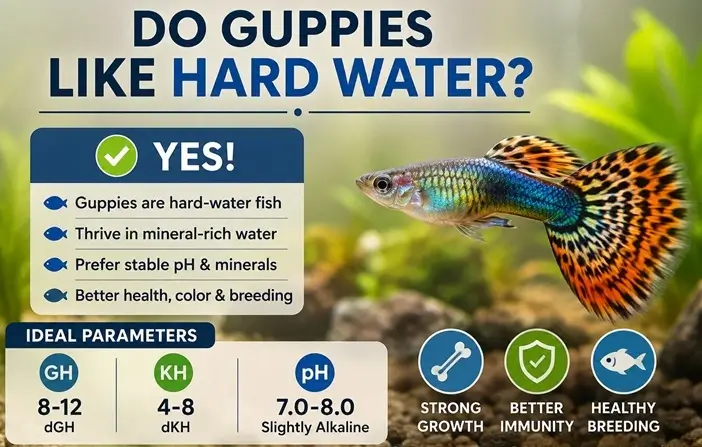
I have kept guppies in both soft and hard water, and in my experience, they have performed better in mineral-rich water, particularly in terms of overall condition and survival. Of course, hardness isn’t the only factor—stable water quality, diet, and genetics also play an important role.
Native to northern South America and parts of the Caribbean, guppies inhabit streams, ponds, ditches, and slow-moving waters with varying mineral levels. Their adaptability is one reason they are so widely kept, but providing suitable hardness remains an important part of keeping them healthy in an aquarium.
Table of Contents
Calcium and Magnesium
Breeding and Fry Development
2) Can Guppies Live in Soft Water?
3) Ideal Water Hardness for Guppies
4) How to Increase Water Hardness for Guppies
What About Commercial Remineralizers?
5) Can Water Be Too Hard for Guppies?
6) Frequently Asked Questions
Why Do Guppies Prefer Hard Water?
Water hardness is more than just a number on a test kit. Moderately hard water provides dissolved minerals, particularly calcium and magnesium, that support important biological functions in guppies.
Calcium and Magnesium
GH (General Hardness) measures primarily the concentration of dissolved calcium and magnesium in water. These minerals contribute to skeletal development, muscle function, and other essential physiological processes.
Guppies obtain minerals through both their diet and their surrounding water. While they can adapt to different conditions, consistently mineral-poor water may be less suitable for their long-term health.
This doesn’t mean harder water is always better. The aim is to provide adequate, stable mineral levels rather than continually increasing hardness.
Breeding and Fry Development
Suitable mineral levels also matter when breeding guppies, particularly for developing fry. Research has shown that water hardness can influence guppy growth and reproduction, although higher hardness does not necessarily produce better results across every measure.
In my own tanks, I’ve noticed better growth and overall condition in broods raised in appropriately mineralized water compared with those raised in very soft tap water. However, diet, genetics, and overall water quality also influence fry development.
For more on breeding and raising healthy guppies, see our guppy breeding guide, pregnant guppy guide, and guppy fry growth guide.
Can Guppies Live in Soft Water?
Yes. Guppies can adapt to softer water, particularly when they have been raised in similar conditions. However, consistently very soft, mineral-poor water may not be ideal for their long-term health, growth, and reproduction.
The important distinction is between GH and KH. GH measures the dissolved calcium and magnesium in water, while KH measures its buffering capacity—the ability to neutralize acids and resist sudden pH drops. These are separate measurements, so water with low GH doesn’t automatically have low KH or an unstable pH.
If your tap water is naturally soft, test both GH and KH before making adjustments. When mineral levels are genuinely too low, a suitable remineralizer can help bring them into a more appropriate range for guppies.
If your guppies show unusual behavior, such as persistent shimmying or reduced activity, check GH and KH alongside the other water parameters rather than assuming mineral deficiency is the cause. Our guppy shaking, twitching, and shimmying guide explains the other possible causes of this behavior.
Ideal Water Hardness for Guppies
Most guppies do well in moderately hard water. For my own tanks, I prefer the following ranges:
| Parameter | Recommended Range |
|---|---|
| GH (General Hardness) | 8–12 dGH |
| KH (Carbonate Hardness) | 4–8 dKH |
These are practical targets rather than strict limits. Guppies can thrive across a broader hardness range, provided their mineral requirements are met and water conditions remain stable.
GH and KH should be tested separately, as a high GH reading doesn’t necessarily mean the water has sufficient buffering capacity.
For the complete water chemistry picture, see our guppy water parameters guide.
How to Increase Water Hardness for Guppies
If your tap water is naturally soft and tests show that GH or KH is too low, there are several ways to increase hardness. The right method depends on whether you need to raise mineral content, buffering capacity, or both.
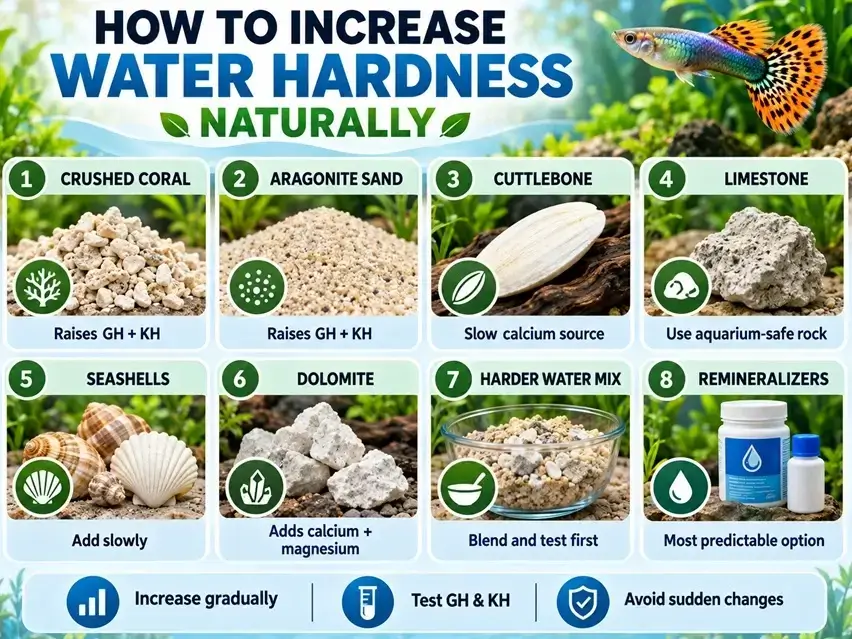
- Crushed coral: A practical option for beginners. It gradually releases calcium carbonate, which can increase both GH and KH. I prefer placing a small amount in a mesh bag inside the filter, where water flows through it. Start with a modest quantity and monitor the results before adding more.
- Aragonite sand: Another calcium carbonate source that can help increase hardness and buffering capacity. It’s commonly used as aquarium substrate, although its effect depends on the existing water chemistry and how readily it dissolves.
- Cuttlebone: Untreated cuttlebone provides calcium carbonate and can be used in small amounts. It dissolves gradually, particularly in more acidic water. Monitor hardness rather than expecting it to stop dissolving at a particular pH.
- Limestone: Aquarium-safe limestone and certain aquascaping rocks can gradually contribute calcium and carbonate to the water. Avoid using unidentified rocks or materials that may contain contaminants.
- Seashells: Clean, untreated calcium carbonate shells can also influence hardness. Their effect depends on the amount used, available surface area, and water chemistry, so add them conservatively and retest.
- Dolomite gravel or rock: Unlike ordinary limestone, dolomite contains both calcium and magnesium carbonates. It can gradually increase GH and KH, making it another option for naturally soft water. Use aquarium-safe material and monitor the results, as its dissolution depends on the existing water chemistry.
- Mixing with naturally harder tap water: If you’re using very soft RO water, blending it with suitable, mineral-rich tap water can help achieve the desired hardness. Test both sources first, treat the tap water with a suitable conditioner, and prepare a consistent mixture before adding it to the aquarium.
What About Commercial Remineralizers?
These are often more predictable when you need to reach a specific hardness level. However, check what each product actually raises:
- Seachem Equilibrium increases GH but does not raise KH or pH.
- Seachem Alkaline Buffer increases KH and pH but does not raise GH.
- Some freshwater remineralizers are formulated to raise both GH and KH.
Always follow the manufacturer’s directions and prepare replacement water to the desired parameters before adding it to an established aquarium.
Whichever method you choose, increase hardness gradually and test the results rather than making large, sudden adjustments.
If your guppies behave unusually after changing their water conditions, see our guide on why guppies die after water changes for common mistakes to avoid.
Can Water Be Too Hard for Guppies?
Yes, although guppies generally tolerate hard water well. Most naturally hard tap water is suitable for them, and there is usually no reason to soften it simply because the GH reading is slightly above the recommended range.
However, extremely high mineral concentrations are not necessarily better. They can affect a fish’s ability to regulate its internal salt and water balance, particularly when guppies are transferred between waters with very different mineral levels.
If your tap water is unusually hard, test GH and KH rather than relying on visible mineral deposits or the pH reading alone. Avoid making sudden adjustments just to reach a particular number.
The goal is suitable, stable hardness—not the highest hardness you can achieve.
Frequently Asked Questions
How Do I Test Water Hardness in My Guppy Tank?
Use a freshwater GH/KH liquid test kit or test strips that measure both parameters. Liquid kits typically involve adding drops to a water sample until it changes color, giving you a reading in dGH or dKH.
Test both your tap water and aquarium water before making adjustments. Remember, a pH reading alone cannot tell you how hard your water is.
Do Fancy Guppies and Endlers Need Hard Water?
Yes. Fancy guppies and Endlers generally do well in moderately hard to hard, mineral-rich water. Fancy varieties such as Blue Tuxedo, Red Tuxedo, Yellow Tuxedo, and Cobra Guppies do not require different hardness levels simply because of their coloration or fin patterns.
Endlers (Poecilia wingei) have similar water-hardness preferences, although they are a distinct, closely related species.
Does Aquarium Salt Increase Water Hardness?
No. Ordinary aquarium salt (sodium chloride) does not meaningfully increase GH because it does not supply the calcium and magnesium measured by a GH test. If your guppy tank needs additional minerals, use an appropriate remineralizer or other suitable hardness-raising material instead.
For more information on keeping guppies healthy beyond water hardness, see our complete guppy care guide.