
Guppy fry growth is something a lot of fishkeepers underestimate. You drop a pregnant female into a tank, she gives birth overnight, and suddenly you have 10 to 100 tiny fish that you have no idea what to do with. Getting them to actually survive and grow into healthy adults is a different skill entirely.
Having said that it is not complicated once you know what drives growth. Feed them right, keep the water clean, give them enough space, and most fry will develop faster than you would expect.
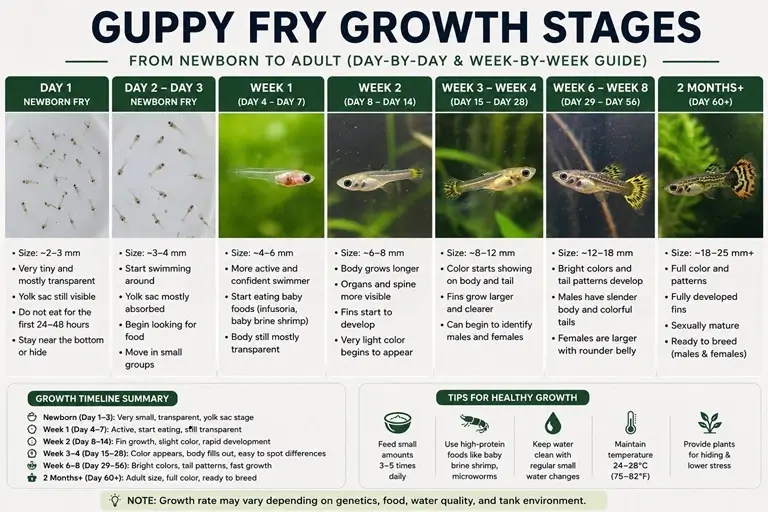
This guide covers every growth stage from day one to adulthood, what to feed them, when colors appear, and how to speed things up if your guppy fry growth seems stuck.
In this guide:
➜ How fast guppy fry grow
➜ Guppy Fry Growth Stages Day by Day
➜ 1 day old guppy fry
➜ 1 week old guppy fry
➜ 2 week old guppy fry
➜ 1 month old guppy fry
➜ 2 month old guppy fry
➜ 3 month old guppy
➜ When guppy fry get color
➜ Male vs female growth differences
➜ How to make guppy fry grow faster
➜ Frequently asked questions
How Fast Do Guppy Fry Grow?
Guppy fry are among the fastest-growing livebearers you can keep in a home aquarium. Under good conditions, most healthy fry become noticeably larger within just two to three weeks of birth. By the end of the first month, you will start seeing early color patches and body differences between males and females. By two to three months, most guppies look and behave like small adults.
That said, growth rates vary considerably from one batch to the next. Genetics play a big role — some guppy strains simply mature faster. But environmental factors matter just as much. Fry raised in clean, well-planted tanks with frequent feedings consistently outperform fry kept in crowded, low-maintenance setups.
Key milestones for healthy guppy fry:
➜ Noticeably larger within 2–3 weeks
➜ First colors appearing between 3–6 weeks
➜ Clear gender differences visible around 4–6 weeks
➜ Near adult size and coloration by 2–3 months
The main factors that control how fast your guppy fry grow are food quality, feeding frequency, water quality, temperature, genetics, and tank space. The more they eat and swim, the faster they grow — but feed in small amounts 3–5 times a day rather than large infrequent meals.
If you are new to raising fry, read our complete guppy fry guide.
Guppy Fry Growth Stages Day by Day
Guppy fry go through several distinct stages before reaching adulthood. Here is a quick overview of what to expect at each point:
1 Day: Transparent newborns, mostly resting and hiding near plants
1 Week: More active swimming, beginning to feed confidently
2 Weeks: Visible fin development, body patterns starting to emerge
1 Month: Early colors appearing, gender differences becoming clearer
2 Months: Bright colors, larger fins, near-adult size
3 Months: Fully adult appearance, capable of breeding
1 Day Old Guppy Fry
Newborn guppy fry are incredibly small — typically around 5–6mm in length — and almost transparent. During their first day of life, they spend most of their time resting near the bottom, on objects or hiding among plants. Many beginners assume this means something is wrong, but it is completely normal behavior.
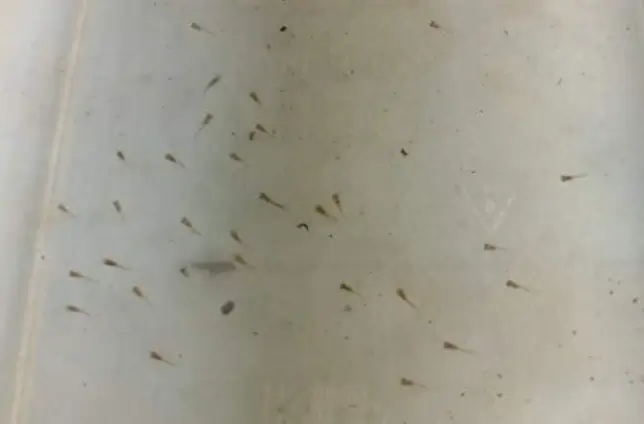
At this stage, the yolk sac from birth is still being absorbed, so fry do not need to actively hunt for food yet. They instinctively seek cover and avoid open water. Strong filter currents stress them easily, and dense planting with java moss or hornwort gives newborns the shelter they need to feel secure.
Keep newborn fry safe on day one:
➜ Use a sponge filter — standard HOB filters can suck in and kill newborn fry
➜ Add plenty of plants and objects like java moss or hornwort for immediate cover — a separate fry tank gives the best survival rates
➜ Keep lights dim for the first few hours
➜ Do not feed for the first 10–12 hours — yolk sac provides nutrition
➜ No water changes on day one — stability is everything right now
1 Week Old Guppy Fry
By one week, the transformation is already visible. Fry that were barely moving at birth are now zipping around the tank, competing for food, and beginning to fill out their bodies. Their transparent appearance starts giving way to a translucent color depending on the parent guppy variety. One-week-old guppy fry are highly active and are about 1/4 inch long.
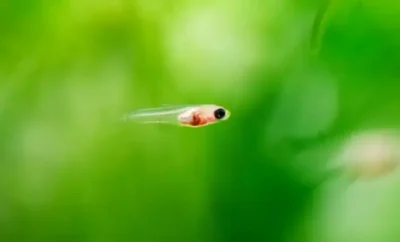
This is when nutrition becomes critically important. Fry are growing rapidly and protein-rich foods make a significant difference in how quickly they develop. At this stage fry are still learning to hunt — start with crushed micro pellets or finely crushed flakes which are easier for them to find and eat. As their coordination improves toward the end of the first week, begin introducing baby brine shrimp and microworms.
Caring for 1 week old fry:
➜ Feed 3–5 small meals daily — spread across the day, not all at once
➜ Start with crushed micro pellets or crushed flakes — introduce live foods like baby brine shrimp as hunting skills develop
➜ A separate grow-out tank gives the best survival rates — if fry must stay in a community tank, provide dense java moss, hornwort, and floating plants
➜ Keep the sponge filter on the lowest airflow setting
➜ 10–15% water change every 10 days — waste load is low at this age
➜ Keep temperature stable at 76°F–80°F
2 Week Old Guppy Fry
At two weeks, you will notice more defined fin edges and the beginnings of body patterning. Some fry will look noticeably larger than others even within the same batch — this is normal and usually comes down to a mix of genetics and feeding competition.
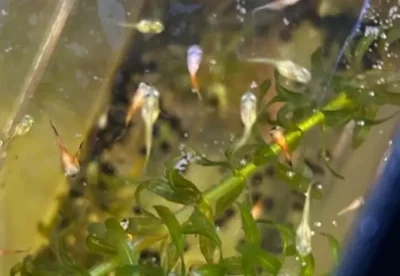
Larger, more aggressive fry tend to claim the best feeding spots, which is why spreading food across multiple areas of the tank helps smaller fry get their share. This is the ideal time to make baby brine shrimp a regular part of their diet if you have not already. The difference in growth rate between fry fed baby brine shrimp and those fed crushed flakes alone is clearly visible by the end of this week.
Caring for 2 week old fry:
➜ Continue 3–5 small meals daily — spread food across multiple spots so smaller fry are not outcompeted
➜ Make baby brine shrimp a regular feeding — this is the stage where live food makes the biggest visible difference in growth
➜ Watch for significant size differences — if some fry are much smaller, target feed them separately using a pipette
➜ Continue 10–15% water changes every 10 days — fry are eating more now so waste is slowly increasing
➜ Keep temperature stable at 76°F–80°F
1 Month Old Guppy Fry
The one-month mark is when things get really exciting. Color patches start appearing — particularly in males — and the body shape differences between sexes become much easier to see.
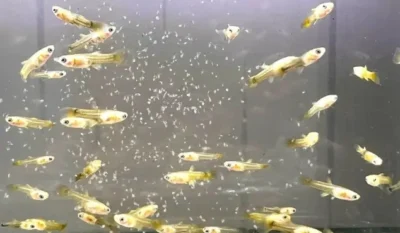
Male fry develop slimmer, more elongated bodies and begin growing distinctive tail coloration. Females stay rounder and larger-bodied, with more subdued coloring. This is the stage where most hobbyists start identifying males and females with some confidence. If you are breeding for a specific color strain, keeping a close eye on males here helps you spot your best specimens early.
One month is also a significant milestone for tank placement. Fry at this age are noticeably faster and more agile — they can swim quickly and escape from adult guppies more effectively than they could in their first two weeks. In a tank with peaceful fish, one-month-old fry can generally be introduced to a community tank or kept alongside adult guppies without significant losses. Avoid any fish large enough to fit the fry in their mouth. A well-planted tank still gives fry important refuges even at this age.
Caring for 1 month old fry:
➜ One-month-old fry can join a community tank with peaceful fish — they are fast enough to escape adult guppies in most cases
➜ Avoid tanks with aggressive or predatory species — they are still small enough to be eaten by larger fish
➜ Start watching for sex differences — males will be showing early color and a developing gonopodium
➜ Begin planning sex separation — aim to separate males and females by 6 weeks to prevent unplanned breeding
➜ A varied diet including live foods now will directly influence how vivid the adult colors become
2 Month Old Guppy Fry
By two months, most guppies have moved firmly into near-adult territory. Colors are bright and defined, fin development is nearly complete, and sexing is easy.
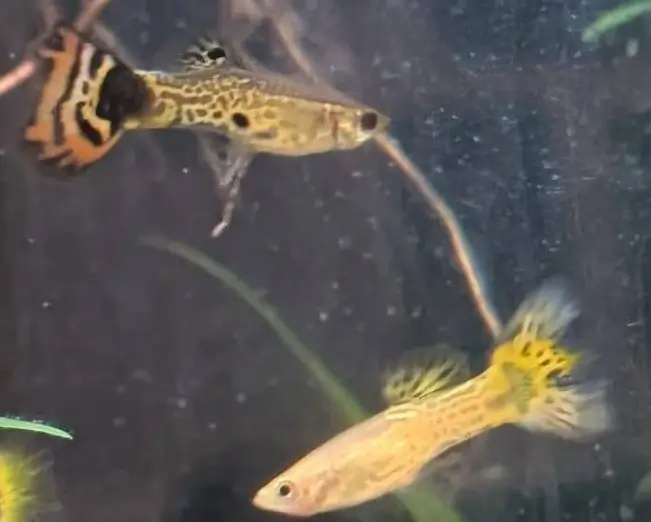
Males will be displaying their best colors to attract females, and some early-maturing individuals may already be attempting to breed. If you have not separated males and females yet, do it now — females at this age can already become pregnant, and a single mating produces a batch of fry every 21–30 days for months afterward. One missed separation at this stage can quickly result in an unmanageable population.
At two months fry are large enough to safely join a community tank without being eaten by most common tankmates. They swim confidently and hold their own in a mixed environment. That said, observe carefully for the first few days after any introduction — some individual fish can be unexpectedly aggressive toward newcomers. Keep in mind that some guppy strains mature significantly faster or slower than others, so treat these timelines as guides rather than strict rules.
Caring for 2 month old fry:
➜ Separate males and females immediately if not done already — breeding can happen at this age and females store sperm for multiple births
➜ Two-month-old guppies are safe to introduce to most community tanks
➜ Observe the tank carefully for the first few days after introduction
➜ Feeding can transition to a standard adult schedule — 2 times daily with occasional live food treats
➜ Move to weekly 20–25% water changes — fish are producing more waste at near-adult size
➜ Select your best males now if developing a specific strain — colors and finnage are fully evaluable at this stage
3 Month Old Guppy
At three months, the fry-raising journey is essentially complete. Most guppies at this age are fully developed adults in every meaningful sense — mature coloration, fully grown fins, active breeding behavior, and strong, confident swimming.
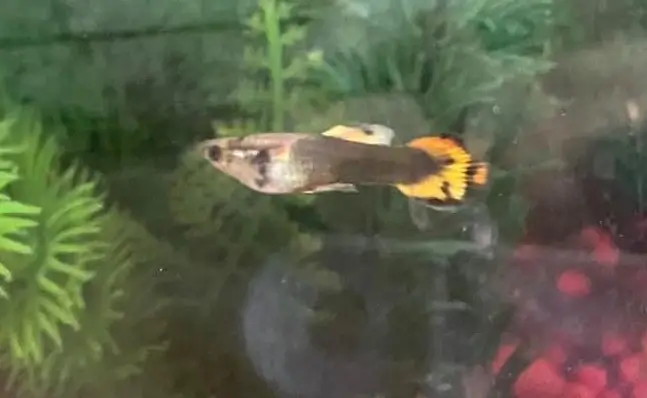
Male guppies in particular are striking at this stage, with vivid tail patterns and the darting movement that makes the species so popular. Females will be noticeably larger and will begin showing a gravid spot if they have been in contact with males.
If you raised them from birth, this is the moment where all that effort pays off. The tiny transparent fry you started with three months ago are now vibrant, healthy adults — and that transformation is one of the most satisfying things this hobby offers.
For anyone breeding for a specific strain, three months is also when you make your final selection decisions. The best males — those with the strongest color, cleanest finnage, and straightest spine — become your next generation breeding stock. The rest can be sold, rehomed, or moved to a display tank. This is how a strain improves over generations rather than drifting toward average.
When Do Guppy Fry Get Color?
Most guppy fry start showing their first hints of color between three and six weeks of age. Males typically color up earlier and more intensely than females, which is one of the earliest reliable ways to distinguish between the sexes.
The vibrancy of that coloration depends heavily on diet. Fry fed a varied diet that includes live foods like baby brine shrimp alongside quality flake or pellet food consistently develop richer, more vivid colors than fry raised on a single food source. Water quality plays a role too — high nitrate levels are known to mute coloration in guppies of all ages, so regular water changes matter more than most people realize.
Lighting also makes a difference that most hobbyists overlook. Fry kept under a consistent 8–10 hour light cycle develop color more reliably than those in dim tanks or tanks with no regular day and night rhythm. Full darkness at night matters just as much as adequate light during the day.
It is also worth understanding that genetics set the ceiling. No amount of perfect feeding or pristine water will make a fry more colorful than its parents. If your breeding stock is dull, the fry will reflect that regardless of how well you raise them. This is why selecting vibrant, healthy breeding pairs matters so much from the start.
Some strains are simply late bloomers. If your fry are still looking washed out at six weeks, do not panic. Keep the water clean, keep feeding well, and give them another few weeks before drawing any conclusions.
Male vs Female Growth Differences
Male and female guppy fry follow noticeably different developmental paths, and these differences become increasingly obvious as they age.
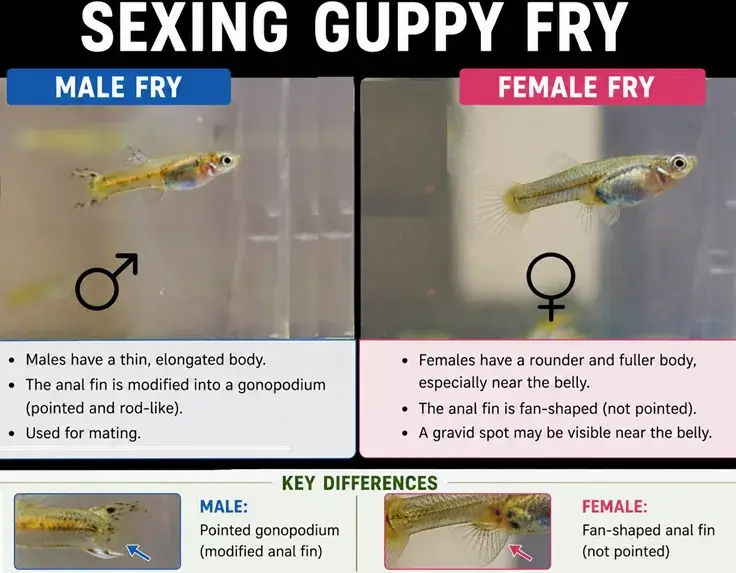
Male fry tend to color up faster, stay slimmer, develop larger and more elaborate tails, and reach visual maturity earlier. Female fry grow larger overall, develop rounder and broader bodies, and remain far less colorful throughout their development.
How to tell male from female guppy fry:
The most reliable marker is the anal fin. In males it gradually transforms into the gonopodium — a long, narrow, pointed fin used for fertilization. In females it stays fan-shaped and rounded. This difference becomes visible from around 3–4 weeks and is clearly obvious by 6 weeks in most strains.
Other signs to look for:
➜ Color — males develop patches of color on the tail and body from 3–6 weeks. Females stay grey or pale.
➜ Body shape — females grow noticeably rounder and larger. Males stay slim and streamlined.
➜ Gravid spot — females develop a dark triangular spot near the lower abdomen as they mature.
➜ Activity — males are more active and begin chasing females as they mature.
Understanding these differences matters practically — most breeders recommend separating males and females around six to eight weeks of age, before males become sexually active and cause unplanned pregnancies. Female guppies can store sperm for multiple births, so even a brief window of mixed housing can result in several batches of fry down the line.
For a detailed comparison with photos, read our male vs female guppy guide. For complete care information, read our guppy care guide.
How to Make Guppy Fry Grow Faster
If your fry seem to be developing slowly, the solution usually comes down to one or more of these core factors. Getting all of them right at the same time is what separates fast, healthy growth from stunted development.
Use a bigger horizontal tank. This is one of the most underrated growth factors. A wide, long tank gives fry more swimming space — and the more they swim, the faster they grow. Guppies are horizontal swimmers and benefit far more from length than depth. A 20-gallon long tank produces noticeably faster growth than a 10-gallon tall tank with the same water volume. More space also means less competition, lower stress, and better water stability.
Feed more frequently. Three to five small meals spread throughout the day makes a meaningful difference, especially during the first month. The more they eat and the more they swim, the faster they grow — but keep portions small enough to finish within 2–3 minutes. Remove anything uneaten promptly.
Prioritize live and frozen foods. Baby brine shrimp, microworms, and daphnia are far more effective growth foods than dry flake alone. If you can only add one live food to your routine, baby brine shrimp is the best choice — nutritionally dense and fry chase them instinctively, which also encourages more active swimming.
Keep up with water changes. Ammonia and nitrates suppress growth in juvenile fish. For young fry in the first two weeks, 10–15% every 10 days is sufficient. As fry grow and eat more from week 3 onward, move to weekly 20% changes. Always match the replacement water temperature exactly before adding it.
Do not overcrowd. A crowded tank means more competition for food, higher stress, and faster water quality deterioration. If you have a large batch, splitting them across two tanks will noticeably improve growth rates in both groups within a week or two.
Maintain stable temperatures. Guppy fry grow best in water kept consistently between 76°F and 78°F (24°C–26°C). Temperature swings slow metabolism and cause stress even when the average looks fine. A reliable heater is not optional in a fry tank.
Use a sponge filter. Gentle biological filtration with no intake risk. The sponge surface colonizes with beneficial bacteria that keep parameters stable. You can switch to HOB or internal filters once fry grow to near-juvenile size at around 6–8 weeks.
For full water parameter guidance, read our guppy water parameters guide.
Frequently Asked Questions
How fast do guppy fry grow?
Healthy guppy fry typically become noticeably larger within two to three weeks of birth. Most reach near-adult size and coloration by two to three months, though this varies depending on genetics, diet, water quality, and how much space they have. Fry raised in clean, well-fed, low-stress environments consistently grow faster than those in crowded or neglected tanks.
When do guppy fry get color?
Most fry begin developing visible color patches between three and six weeks of age. Males tend to color up earlier and more intensely than females. Poor nutrition and high nitrate levels can delay or mute coloration, even in otherwise healthy fish. If your fry look washed out past six weeks, check your water parameters and consider adding live foods to their diet.
Why are some of my guppy fry growing slower than others?
Size differences within a single batch are common and usually come down to genetics, feeding competition, or stress. Larger fry tend to claim the best feeding positions, leaving smaller ones behind. Spreading food across multiple spots in the tank and feeding more frequently helps level things out. In some cases, slower fry are simply genetically predisposed to mature later.
What is the best food for guppy fry growth?
Baby brine shrimp is widely considered the best single food for fry growth, offering ideal protein content and a size that young fry can easily consume. Microworms, daphnia, and finely powdered fry food are excellent additions. Crushed flakes work as a supplement but should not be the primary food source, especially during the first month.
Do guppy fry grow faster in warm water?
Slightly warmer water can speed up metabolism and accelerate growth, but the key word is stable. A consistent temperature in the 76–78°F (24–26°C) range is more important than chasing a specific number. Temperatures that fluctuate frequently cause more stress and stunted growth than water that stays consistently at the lower end.
When should guppy fry be separated?
Most breeders aim to separate males and females around six to eight weeks of age, before males become sexually active. Waiting too long risks unplanned pregnancies — females can store sperm and produce multiple batches of fry from a single encounter, which can quickly lead to an unmanageable number of fish.
Why are some fry still transparent?
Some guppy strains naturally develop colors later than others, so a transparent appearance past two to three weeks is not always a cause for concern. Genetics, water conditions, and diet all influence how quickly coloration develops. If water quality is good and fry are eating well, give them more time before assuming something is wrong.
Can overcrowding slow guppy fry growth?
Yes, significantly. Overcrowding creates competition for food, raises stress levels, and causes water quality to deteriorate much faster — all of which suppress growth. Splitting a large batch across two tanks often produces a noticeable improvement in growth rates within a week or two.
How often should guppy fry be fed?
Most experienced breeders feed fry three to five small meals daily during the first month. Small, frequent feedings are always better than one or two large ones — they reduce waste buildup and ensure that smaller, less competitive fry get enough to eat.
Do larger tanks help guppy fry grow faster?
Yes. Larger horizontal tanks provide better water stability, dilute waste products more effectively, and give fry more room to swim — and the more they swim, the faster they grow. Even moving fry from a 5-gallon to a 10 or 20-gallon long tank can produce a visible improvement in growth rate.
Can guppy fry survive in a community tank?
Some will, but survival rates are generally low without dense planting. Adult fish including adult guppies will eat fry given the chance. Dense java moss, hornwort, and floating plants give fry the best chance in a mixed tank. A dedicated fry tank always gives better results.
Do guppy fry need a filter?
Yes. Unfiltered water deteriorates quickly and is one of the leading causes of fry death. A gentle sponge filter is the best choice for fry tanks — it keeps water clean, grows beneficial bacteria, and does not create the suction risk that standard HOB filters do.
Can guppy fry eat normal fish flakes?
Yes, but standard flakes need to be crushed into a very fine powder first. Crushed flakes work well as a supplement or backup food, but they are less nutritionally dense than live or frozen options. Use flakes alongside baby brine shrimp or microworms rather than as the sole food source.
Why are my guppy fry dying suddenly?
Sudden fry deaths are most commonly caused by ammonia spikes from overfeeding, poor water quality, rapid temperature changes, or insufficient oxygen. Test your water parameters immediately and perform a water change as a first response. Overfeeding is a particularly common culprit — uneaten food breaks down quickly and can crash water quality overnight in a small tank.
Can guppy fry grow without live food?
Yes, guppy fry can grow using powdered fry food and finely crushed flakes alone. However, fry raised with live foods like baby brine shrimp consistently grow faster, develop stronger coloration, and tend to be healthier overall. If live food is not an option, high-quality powdered fry food is a solid alternative — just feed more frequently to compensate.
What temperature is best for guppy fry growth?
Most guppy fry grow best in water kept between 76°F and 78°F (24°C–26°C). Stability matters more than hitting a precise number — consistent temperatures within this range support healthy metabolism and steady growth without the stress caused by fluctuations.
Do guppy fry need light at night?
No. Like most fish, guppy fry need periods of darkness to rest properly. Keeping lights on around the clock disrupts their natural rhythm and can cause chronic stress that slows growth over time. A standard 8–12 hour light cycle is appropriate for a fry tank.
How long should guppy fry stay separated from adults?
Most breeders keep fry separated for six to eight weeks — long enough for them to reach a size where adult fish are less likely to view them as food. If you are unsure, it is always safer to wait a little longer than to reintroduce too early.
How many guppy fry can survive from one birth?
A healthy female guppy can give birth to anywhere from 20 to 100 fry per drop, depending on her age, size, health, and genetics. Younger or smaller females tend to produce fewer fry per birth, while larger, mature females often deliver much bigger batches. Survival rates in a dedicated fry tank with proper care are generally quite high.
Final Thoughts
Raising guppy fry well is one of the most rewarding things you can do in this hobby. When you see a tiny, colorless newborn turn into a vibrant, healthy adult over the course of a few months — knowing your care made that possible — it is hard not to get hooked on breeding.
The fundamentals are not complicated: clean water, frequent feeding, stable temperatures, enough space, and a sponge filter. Nail those five things consistently, and your fry will reward you for it. Some will mature faster than others, and that is perfectly normal. But with the right setup, most healthy guppy fry become noticeably larger and more colorful within their first few months — and that is a deeply satisfying thing to watch.