
Guppy losing color is usually a sign of stress, poor water quality, bullying, illness, or diet problems. Healthy guppies are naturally colorful and active, so sudden fading or pale coloration often means something in the aquarium environment is wrong.
In many cases, the color loss is temporary and improves once the source of stress is removed. However, severe fading combined with lethargy, torn fins, or white patches may indicate disease.
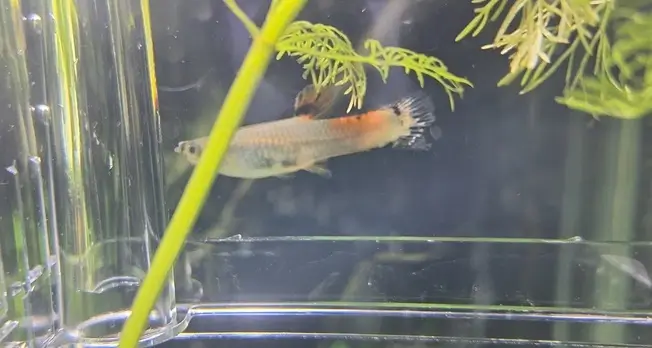
Quick Answer: Most cases of guppy color loss fall into one of these groups:
Temporary and stress-related — caused by water quality, bullying, transport, or sudden changes. Color usually returns within hours to a few days once the trigger is fixed.
Diet-related — caused by a poor or unvaried diet lacking carotenoids, the pigments guppies can’t produce on their own. This rebuilds gradually over weeks, not overnight.
Age-related — older guppies naturally dull as they approach the end of their 1.5–3 year lifespan. Not reversible, but not a cause for alarm either.
Illness-related — accompanied by white spots, fin damage, bloating, or lethargy. Needs identification and treatment, not a wait-and-see approach.
Not actually a problem — a normal color change — males brightening during courtship, a guppy darkening in low light or near a perceived threat, a female’s gravid spot darkening during pregnancy, or a young guppy developing its adult colors for the first time. These are gains, not losses, and need no fix at all.
In this article, you will learn:
➜ Guppy Losing color?
➜ Poor water quality
➜ Bullying and aggression by tank mates
➜ Disease and parasites
➜ Diet and nutrition
➜ Aging
➜ Why is my guppy changing color?
➜ New guppy losing color
➜ Guppy losing color in tail
➜ How to restore guppy color
➜ When should you worry about guppy color loss?
➜ Medication Treatment Protocol: From Experience
➜ Frequently asked questions
Guppy Lose Color?
Guppies usually lose color because of stress. Stress hormones cause pigment cells in the guppy’s skin, called chromatophores, to contract, reducing the intensity of their natural colors. This single mechanism is behind most of the causes covered in this guide — water quality, bullying, sudden changes, and illness all work by triggering this same stress response, just through different routes.
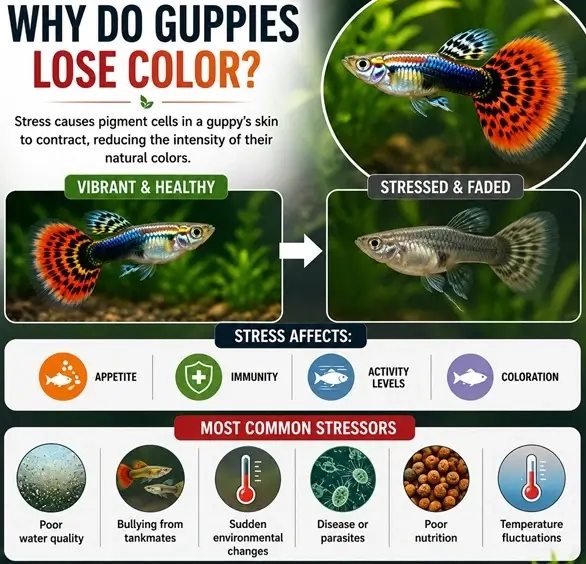
Stress affects guppy fish by impacting:
➜ appetite
➜ immunity
➜ activity levels
➜ coloration
The most common stressors include:
➜ poor water quality
➜ bullying from tankmates
➜ sudden environmental changes
➜ disease or parasites
➜ poor nutrition
➜ temperature fluctuations
Some guppies also lose color temporarily after transportation, water changes, or moving to a new aquarium. They typically regain their color within a few days once they settle in.
If your fish are hiding often, read our guppy hiding guide.
Poor Water Quality
Bad water quality is one of the most dangerous causes of guppy color loss, and it works through the same chromatophore-contraction mechanism above. Ammonia and nitrite are strong, fast-acting stressors, so the fading from poor water quality tends to show up quickly compared to milder stressors.
Ideal Guppy Water Conditions:
Temperature: 76°F–78°F
pH: 7.0–8.0
Ammonia: 0 ppm
Nitrite: 0 ppm
Nitrate: below 20–40 ppm
Bad water quality may also cause:
➜ gasping at the surface
➜ lethargy
➜ clamped fins
➜ shimmying
➜ sudden deaths
New or unstable aquariums may not contain enough beneficial bacteria to process toxins properly. As ammonia and nitrite rise, guppies become stressed, which is what fades or dulls their colors.
For complete water care information, read our guppy water parameters guide.
Bullying and Aggression by Tank Mates
Bullying is another common reason guppies lose color, again through the same stress-chromatophore mechanism. Male guppies chase each other constantly when there are too many males relative to females, and larger or more aggressive tankmates can have the same effect.
Keeping a female-heavy ratio, commonly recommended at 2–3 females per male, spreads out breeding pressure and reduces this significantly. Species like angelfish and tiger barbs are common aggressors in a guppy tank, while platies, mollies, and corydoras tend to coexist peacefully — see our full guppy tank mates guide for the complete breakdown.
Aggressive tankmates may also:
➜ nip fins
➜ chase weaker fish
➜ prevent feeding
➜ increase stress levels
Submissive guppies often become pale and hide frequently. Long-term bullying may eventually lead to disease and fin damage on top of the fading.
Disease and Parasites
Some diseases and infections cause guppies to appear pale, faded, or unhealthy, partly through the same stress response and partly through direct damage to the skin, fins, or scales.
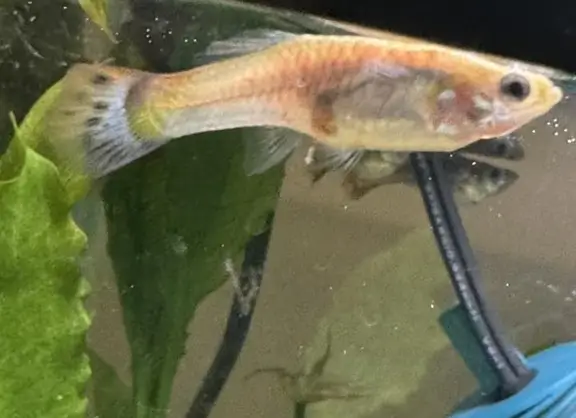
Common illnesses linked to pale or faded guppies include:
➜ ich (white spots)
➜ velvet (a fine gold or rust-colored dusty coating, sometimes mistaken for normal color change)
➜ fungal infections
➜ bacterial infections
➜ internal parasites
See our common guppy diseases guide for full symptom identification and treatment for each of these.
Sick guppies may also show white patches, bloating, rapid breathing, loss of appetite, and lethargy alongside the color loss — the more of these that show up together, the more urgent the situation.
If your guppy is also refusing food, read our guppy not eating guide.
Diet and Nutrition
Diet-related fading works differently from every other cause in this guide. Guppies, like most fish, can’t produce carotenoids, the pigments responsible for the bright red, orange, and yellow coloration, on their own — tank-raised guppies especially, since they have no access to the natural algae and zooplankton that wild guppies get carotenoids from, and depend entirely on what they’re fed. That means diet-based color loss isn’t a stress response that bounces back in a day or two — it’s a genuine pigment shortage that only rebuilds gradually as the fish takes in enough carotenoids over time, typically weeks rather than days.
Worth checking directly: have you recently switched food brands, or has the fish been on the same food for a long time without variety? A change to a lower-quality food, or one that’s been sitting open and losing potency, can dull color noticeably even without any other sign of stress.
Guppies need a varied diet containing:
➜ protein
➜ vitamins
➜ carotenoids
➜ minerals
The best foods for maintaining strong colors include brine shrimp, bloodworms, daphnia, quality pellets, and color-enhancing foods formulated with carotenoid sources like astaxanthin or spirulina. A small amount of cooked, mashed carrot is also a simple, carotenoid-rich addition many hobbyists use alongside their regular feeding. For brand-by-brand recommendations we’ve already verified, see our best guppy food guide.
Aging
Guppies typically live 1.5 to 3 years, and color naturally dulls in older fish as they approach the end of that lifespan. If your guppy has been with you a long time and shows no other signs of illness, poor water quality, or bullying, gradual fading may simply be a normal part of aging rather than something to fix. Unlike the other causes here, this one isn’t reversible. For more on what to expect at different life stages, see our guppy lifespan guide.
Why Is My Guppy Changing Color?
Changing color isn’t the same thing as losing it, and a few specific situations get confused with the fading covered throughout this guide.
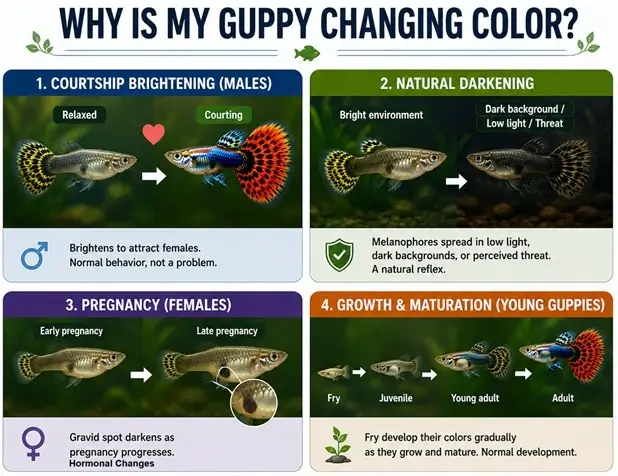
Courtship Brightening — Male guppies often display their brightest colors during courtship, using both color and a specific side-on display movement together to attract a female’s attention. This runs on the same chromatophore system as stress-fading, just in reverse — arousal can make existing pigment look more vivid rather than duller. If a male looks especially colorful while actively courting a female, that’s the system working as intended, not a symptom.
Natural Darkening — This runs through a different pigment cell entirely. Melanophores, which hold the dark melanin in a guppy’s pattern, disperse and darken the body in response to low light, a dark background, or a perceived predator threat — a documented reflex in guppies specifically, separate from the carotenoid fading covered throughout this guide. During active courtship, this darkening and the brightening above often happen together, which is likely why a courting male can look both more vivid and higher-contrast at the same time, rather than just brighter.
Pregnancy Color Change — The gravid spot near the anal fin darkens as pregnancy progresses, the most reliable color-related sign of pregnancy there is. A broader shift in overall body tone is occasionally reported too, but it’s uncommon — the gravid spot and the boxy belly shape it develops alongside are the signs worth actually relying on. See our pregnant guppy guide for the full timeline.
Juvenile Maturation — Fry are born without their adult coloration and develop their full colors gradually as they mature, around the same time males develop a usable gonopodium. A juvenile guppy gaining color over its first couple of months is development, not recovery from anything. See our guppy fry growth guide for that timeline.
This also applies to fancy, selectively bred strains — their causes of color loss are identical to any other guppy’s. The more intense baseline coloration just makes fading more visually obvious when something is actually wrong.
New Guppy Losing Color After Purchase
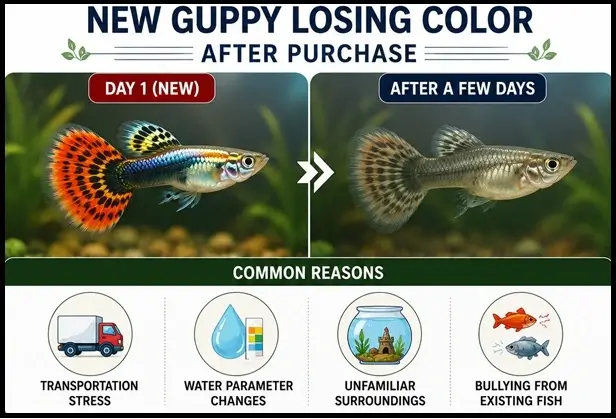
New guppies often lose color temporarily after being moved into a new aquarium. This usually happens because of:
➜ transportation stress
➜ water parameter changes
➜ unfamiliar surroundings
➜ bullying from existing fish
Many guppies regain their colors within a few days once they feel safe and comfortable. Providing plants and hiding spots often helps reduce stress significantly.
One rarer possibility worth knowing about: some sellers in the aquarium trade artificially dye fish to make them look more vibrant, a practice mostly associated with naturally plain species rather than guppies, since guppies already get vivid colors from legitimate selective breeding. If a guppy was unusually cheap, looked unnaturally uniform at purchase, and fades gradually over several months with no other symptoms at all, this is worth considering — the fish isn’t getting sicker, it’s just settling into its real, natural color.
Why Is My Guppy Losing Color in Its Tail?
Tail color fading is fairly common in stressed or unhealthy guppies.
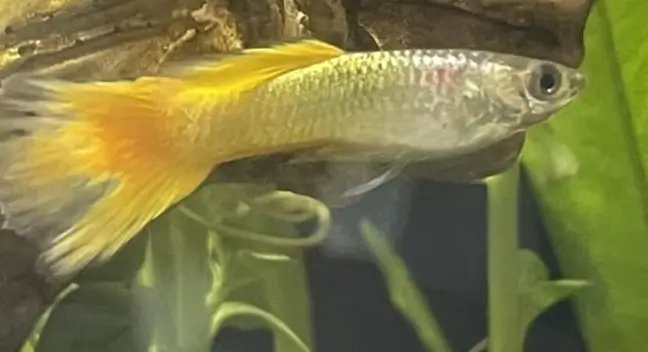
Common causes include stress, poor water quality, bullying, fin damage, and bacterial infections. If the tail also looks torn, ragged, shrinking, or frayed, fin rot or aggression may be involved alongside the color loss. Tail fading often improves once aquarium conditions stabilize and stress levels decrease.
How to Restore Guppy Color
Most guppies recover their colors once stress decreases and water conditions improve. To help restore guppy coloration:
➜ maintain stable water parameters
➜ add live plants, which improve oxygen levels and reduce stress
➜ improve filtration
➜ feed high-quality, varied foods
➜ reduce overcrowding
➜ separate aggressive fish
➜ provide more hiding places, especially in a community tank
One thing worth knowing before changing anything: aquarium lighting color temperature can change how vibrant a guppy looks without the fish’s actual pigment changing at all. Cooler, bluer light tends to bring out shimmery tones, while warmer light emphasizes orange, red, and yellow. If a guppy looks duller right after a lighting change, that’s a perception effect, not real color loss, and it’s worth ruling out before assuming something’s wrong.
Healthy planted aquariums often help guppies feel safer and display brighter colors naturally. If your guppies stay near the surface frequently, read our guppy staying at the top of tank guide.
When Should You Worry About Guppy Color Loss?
Mild, temporary fading is often harmless, especially after stress or transportation. It becomes more concerning when the color loss listed under Disease and Parasites shows up alongside the fading, rather than fading on its own.
In those cases, you should:
➜ test the water immediately
➜ isolate the sick fish if necessary
➜ check for the disease symptoms listed above
➜ improve oxygen and filtration
Early treatment usually improves survival chances significantly.
Medication Treatment Protocol: From Experience, How to Actually Medicate a Sick Guppy
If your guppy needs medication for a parasite or bacterial infection rather than just a water quality fix, how you dose it matters as much as which medication you choose. This is the approach that’s worked reliably in practice, and it isn’t something you’ll find spelled out clearly in most online guides.
Treating in the main tank (lower parasite or bacterial load):
➜ Turn the filter off before adding any medication. This is the most important step, and it’s easy to overlook, if the filter keeps running, it will pull the medication out of the water through the filter media before it ever gets the chance to reach the fish
➜ Keep an air stone running the whole time instead, so the medication still circulates evenly through the tank rather than sitting in one spot, and it also helps enough oxygen dissolve into the water, which matters even more for a sick fish
➜ Leave the filter off for a few hours while the medication works, then turn it back on, running the filter afterward helps the medication reach and treat parasites or bacteria hiding in the filter media itself, not just the fish
Treating in a separate quarantine tank (more serious cases):
➜ Move the fish to a small quarantine tank, even a 2 to 5 gallon container works well for a guppy, with an air stone running
➜ Add the medication and leave it for a few hours, the same as above
➜ Afterward, do a complete water change with properly matched parameters, medicated water becomes toxic over time, and you can’t leave a fish sitting in it indefinitely, especially one that’s already struggling to breathe from illness
➜ Repeat this cycle, dose, wait a few hours, full water change, as many times as needed until the fish actually improves
Even if you’re treating a fish separately in quarantine, don’t neglect the main tank, whatever caused the illness in the first place is usually still present there, so it needs its own water changes or treatment too. And as a general rule any time you add medication to a tank, plan on a 25 to 30 percent water change the following day to clear out the medication’s own toxicity, more than that, even a full change, is fine if you’re willing to put in the extra effort. Finally, any sick guppy needs to be well-oxygenated throughout treatment, an air stone isn’t optional here, illness and medication both put extra strain on a fish’s ability to breathe.
Frequently Asked Questions
Can bad water quality cause guppies to lose color?
Yes — covered in detail under Poor Water Quality above, where ammonia and nitrite are the two parameters to check first.
Can bullying make guppies lose color?
Yes — covered under Bullying and Aggression by Tank Mates above, along with the male-to-female ratio that usually fixes it.
Can sick guppies lose their color?
Yes — covered under Disease and Parasites above, including which specific illnesses are most often behind it.
Can poor diet affect guppy color?
Yes, and differently than the other causes here — see Diet and Nutrition above for why it takes longer to reverse than stress-related fading.
Can old age cause a guppy to lose color?
Yes — covered under Aging above, and unlike the other causes, this one isn’t reversible.
Why are my guppies losing color after a water change?
A water change itself isn’t the cause — it’s how abrupt the shift in temperature or chemistry was. A gentle, well-matched change shouldn’t trigger fading on its own.
Why is my guppy pale but still eating?
A guppy that’s pale but still eating and active is in a much better position than one that’s also off its food, and points more toward mild stress or recent transport than illness.
Are male guppies affected by color loss more than females?
Not more easily, but more noticeably, since males naturally display brighter colors than females to begin with, so any fading shows up more dramatically by comparison — see our male vs female guppy guide for the full color comparison.
Why is my guppy turning white?
A whitish appearance, rather than just duller, leans more toward fungal infection than ordinary stress-fading and is worth checking against the disease symptoms above specifically.
Can overfeeding affect guppy coloration?
Indirectly, yes — leftover food pollutes the water and raises ammonia, which is what actually drives the fading, not the overfeeding itself.
Can cold water make guppies lose color?
Yes, specifically water that drifts below the 76–78°F ideal range covered above, since that’s what triggers the stress response rather than cool water on its own being harmful in small amounts.
Will plants help stressed guppies regain color?
Mainly by giving a bullied or stressed guppy somewhere to retreat to, which lowers the ongoing stress rather than restoring color through any direct effect of the plants themselves.
Final Thoughts
Guppy losing color is usually caused by stress, poor water quality, bullying, illness, or diet problems, and which one it is changes how fast you should expect it to resolve. Stress-related causes bounce back within days once the trigger is fixed. Diet-related fading takes weeks to rebuild. Age-related fading doesn’t reverse at all, and illness needs actual treatment rather than patience. Not every color change is a loss either — courtship brightening, natural darkening, pregnancy’s darkening gravid spot, and a young guppy developing its adult colors are all gains, not problems.
Healthy guppies usually display their brightest colors when provided with:
➜ clean water
➜ stable temperatures
➜ peaceful tankmates
➜ proper nutrition
➜ low-stress environments
Monitoring your guppies closely and fixing problems early is the best way to maintain vibrant, healthy fish.