
Skip to content
Exotic Fish Hub Exotic Fish Hub

  • Goldfish
    • oranda goldfish
    • Black Oranda Goldfish
    • Ranchu Goldfish: Care Guide, Size, Lifespan & Price
    • Thai Oranda Goldfish: Care Guide, Size, Lifespan & Price
  • Guppies
    • Blue Guppy Fish
    • How Long Do Guppies Live? Guppy Lifespan Explained
    • Snow White Guppy
    • Electric Blue Guppy
    • Red Dragon Guppy
    • 17 Stunning Fancy Guppy Varieties You will Love
  • Betta
  • Molly Fish
    • Dalmatian Molly
  • Discus Fish
  • Contact
Exotic Fish Hub
Exotic Fish Hub

Temperature for Guppies: Low, High, Ideal, Heater Guide

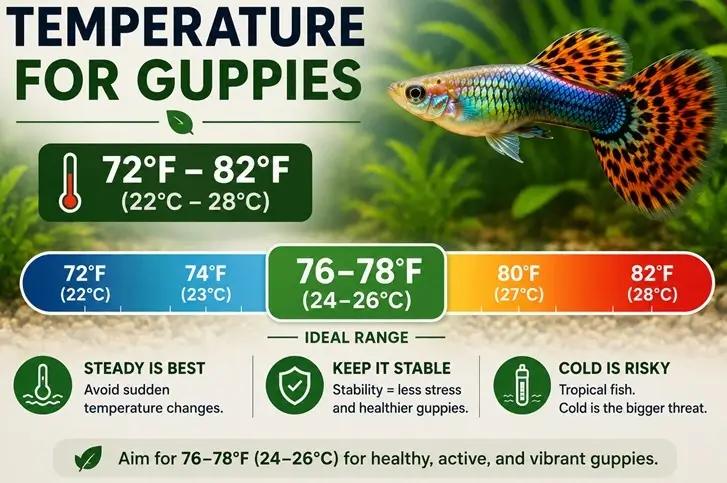
Temperature for guppies should sit between 72°F and 82°F (22°C to 28°C), with 76–78°F (24–26°C) as the steady, ideal range most keepers aim for. Guppies are tropical fish, so cold is the bigger everyday risk, but the real danger in either direction isn’t the number itself, it’s how fast it changes. I’ve kept guppies through both a too-warm summer and an unheated winter tank, and the swings caused far more visible stress than sitting a couple degrees outside the ideal range ever did.

Quick Answer: Guppies do best at 76–78°F (24–26°C), and tolerate 72–82°F (22–28°C) without issue.

Below 70°F, guppies slow down, stop breeding, and become more vulnerable to disease. Below 60°F is a real survival risk.

Above 82°F speeds up growth and breeding but shortens lifespan, and above 90°F can be fatal.

The single biggest danger isn’t the number, it’s the swing. Keep changes under 2°F per day, and use a reliable heater rather than relying on room temperature.

Guppy fry actually do better a little warmer than adults, around 78–80°F, which speeds growth during the stage that matters most.

Quick Navigation

➜ Temperature for Guppies
➜ Water Temperature for Guppies: Ideal Range
➜ Can Guppies Live in Cold Water?
➜ Can Guppies Live in Warm Water?
➜ Why Stability Matters More Than the Number
➜ Temperature for Guppies Breeding
➜ Temperature for Guppy Fry
➜ Can Guppies Live Without a Heater?
➜ Choosing the Right Heater Size
       ➜ Heater Size for a 10 Gallon Tank
       ➜ Heater Size for a 5 Gallon Tank
       ➜ Heater Size for a 20 Gallon Tank
➜ Fancy Guppy Temperature
➜ Endler Guppy Temperature
➜ Temperature for a Mixed Tank
       ➜ Water Temperature for Guppies and Tetras
       ➜ Temperature for Guppies and Mollies
➜ Frequently Asked Questions


Temperature for Guppies

Guppies are tropical fish. They come from warm freshwater streams and rivers in northern South America and Trinidad, where the water runs warm year-round but isn’t perfectly flat, it shifts a few degrees with the wet and dry seasons, generally somewhere in the 75–85°F band depending on the time of year. The shift is real, but it’s slow and gradual, not the kind of sudden swing a tank can go through in a single bad day. That’s the thing worth copying at home: a tank can move toward the warmer end in “summer” and the cooler end in “winter” if you want to mimic that natural rhythm, as long as the change happens over days or weeks, the same pace nature uses, not overnight.
temperature for guppies

The full range a guppy can tolerate runs 72–82°F, but inside that range, three things shift depending on where you sit:

72–74°F: slower metabolism, the longest lifespan, but slower growth and less frequent breeding

76–78°F: the balanced range most keepers settle on for the long term

80–82°F: faster growth and more active breeding, at the cost of a shorter overall lifespan

None of these is the single “right” answer. It depends on what you want. A community tank kept just for enjoyment does fine at 76–78°F long-term. Someone breeding for volume might run a degree or two warmer and accept a shorter lifespan as the tradeoff. The main thing is to pick a target and stick to it, instead of letting the tank drift to whatever the room happens to be.


Water Temperature for Guppies: Ideal Range

ideal temperature range for guppies

The steady target is 76–78°F (24–26°C). In Celsius, the full tolerated range is 22–28°C, with 24–26°C as the same balanced middle ground.

Whether you’re keeping one guppy or a full colony, the target doesn’t change with numbers, the same range applies to a single fish in a five-gallon tank as it does to a breeding colony in a forty-gallon setup. What does change with tank size is how fast the water drifts: a small volume of water heats and cools far faster than a large one, so smaller tanks need closer attention and a more reliable heater to hold the same range a larger tank could coast through more easily.

A digital thermometer with a probe, rather than a stick-on strip on the glass, gives the most accurate read on the water itself. Glass-mounted strips read the glass surface temperature, which can run a degree or two off from what the water is actually doing.


Can Guppies Live in Cold Water?

Not well, and not for long. Guppies are cold-blooded, so a drop in temperature slows their entire system down, not just their swimming speed.

Below about 70°F, guppies get sluggish, eat less, stop breeding, and their immune system gets weaker, which makes them easier targets for fungal infections and fin rot. Below 60°F is when it turns truly dangerous, and staying there too long can cause hypothermia. A guppy might survive a short dip into cold water, but that doesn’t mean it’s a safe place to keep them.

The practical takeaway: if your room temperature regularly dips below the high 60s, especially overnight or seasonally, a heater isn’t optional. Relying on ambient room warmth alone is the single most common way guppy tanks drift cold without anyone noticing until the fish are already stressed.


Can Guppies Live in Warm Water?

Yes, guppies handle warm water better than cold water, but there’s still a limit. As temperature climbs, water holds less oxygen, so guppies have to work harder to breathe, and you’ll often see them spend more time near the surface. Their metabolism also speeds up, which means more waste and faster ammonia buildup between water changes.

82°F is the top of the normal range. It’s not dangerous by itself, but it’s not a good place to leave a tank long-term either. 90°F is the real ceiling, and only for a short time.

One real reason to push toward that upper end on purpose, for a few days, is treating a parasite outbreak like ich. Heat doesn’t kill ich directly. What it does is speed up its life cycle, so it falls off the fish and into the water faster, where it’s actually exposed to treatment. While it’s stuck on the fish, medication and salt can’t reach it.

The usual approach: raise the tank to around 83–86°F, but not all at once, about 1–2°F per hour is the safe pace for this. That’s faster than the normal 2°F-per-day rule, but this is a short, watched treatment, not everyday drift. Add extra aeration too, since warm water holds less oxygen. Then pair the heat with the right dose of aquarium salt or medication to actually kill the parasite once it’s out in the open. Heat alone just speeds things up, it’s not a cure by itself.

If your tank is running hot, fix the room first: turn on the AC if you have it, keep the tank out of direct sunlight, and add more surface movement so the water can actually use the oxygen it has. If you need to cool the water fast, float a sealed bag of ice on top, don’t add ice straight to the tank. Either way, change the temperature slowly using the same 2°F-per-day rule covered next.


Why Stability Matters More Than the Number

This is the part most beginners get backwards. A guppy sitting at a steady 74°F is in better shape than one bouncing between 76°F and 80°F every other day. The fish’s body has time to adjust to a number that’s simply not perfect; it doesn’t have time to adjust to constant change.

The widely used safe limit is no more than about 2°F of change in a 24-hour period. If you need to move the temperature further than that, in either direction, spread it out over several days rather than making the full adjustment at once. A sudden swing, even a moderate one, can trigger real stress and make a guppy far more vulnerable to disease than a temperature that’s simply a few degrees off the textbook ideal.

This is the same instability that causes problems with pH and hardness, and for the same underlying reason. See our guppy water parameters guide for how temperature, pH, and hardness all tend to destabilize together rather than separately.


Temperature for Guppies Breeding

Temperature is one of the easiest levers for nudging breeding behavior. Running the tank toward the warmer end, around 78–80°F, speeds up the reproductive cycle and tends to encourage more frequent breeding, at the cost of a shorter adult lifespan if kept there permanently. Guppies will still breed at the standard 76–78°F range, just somewhat less often.


Temperature for Guppy Fry

Fry are the interesting exception to the usual rule. Rather than preferring the same range as adults, the best temperature for guppy fry runs a little warmer, generally cited around 78–80°F, since the faster metabolism speeds up growth during the stage where development matters most. One long-running breeder experiment split a single brood between a cooler 72–75°F group and a warmer 80–82°F group, and the warmer half grew noticeably faster, though the cooler half wasn’t unhealthy, just slower to mature.

The mid-70s are fine for fry if you’re not in a hurry. The warmer end is for anyone who wants faster growth on purpose. Either way, stability matters even more for fry than for adults, since they handle swings much worse.


Can Guppies Live Without a Heater?

Sometimes, depending on where you live. In warm climates, where room temperature stays in the mid-to-high 70s all year, day and night, guppies can do fine without one. I’ve kept a wide, shallow tank on a balcony with no heater at all, just the local climate, good surface area, and live plants, and it worked well for years.

But that only works if the temperature is actually stable, not just warm on average. Even in a tropical climate, a cooler season, an air-conditioned room, or one cold night can pull the tank out of range, and that’s the same kind of swing covered above. If your indoor temperature truly never drops below the high 70s, day or night, you can probably skip a heater. If there’s any real swing through the day or the year, a heater removes that risk for not much cost. And for a tank under about 15 gallons, there’s so little water that it can swing fast without one.


Choosing the Right Heater Size

Most heater-shopping advice boils down to a flat “watts per gallon” rule, and it’s a reasonable starting point, but it skips the variable that actually matters most: how big a gap the heater has to close between your room and your target temperature. The same size tank in a warm living room and a cold basement doesn’t need the same heater.

Here’s a standard chart based on typical room conditions, which most major heater brands also use as their own sizing guide:

Tank SizeTypical Wattage
5 gallons25–50W
10 gallons50W
15–20 gallons75–100W
30–40 gallons100–150W
55 gallons150–200W
75–90 gallons200–300W
125 gallons300–400W, or two heaters combined

These numbers assume a room that isn’t unusually cold. The bigger the gap between your room temperature and your target water temperature, the more wattage you need, regardless of what the chart says. Roughly, every extra 9°F you need the heater to lift the water above room temperature calls for about 2.5–5 more watts per gallon on top of the baseline. A tank that only needs to climb 5–8°F above room temperature can often sit at the lower end of its range; one that needs to climb 15°F or more should size up, sometimes by a full step.

Heater Size for a 10 Gallon Tank

A 10 gallon tank generally needs a 50 watt heater in a normal room. If the room runs cold, or the tank needs to climb more than about 15°F above room temperature, step up to 75 watts. A 10 gallon tank holds little water, so it’s one of the sizes most likely to swing fast if the heater is undersized or fails, which makes a reliable thermostat especially worth paying for here.

Heater Size for a 5 Gallon Tank

A 5 gallon tank typically needs a 25 to 50 watt heater. Small tanks like this are hard to heat well, because there’s so little water that even a slightly oversized heater can overshoot fast if the thermostat fails. An adjustable, low-wattage heater made for small tanks is worth the extra cost over a generic one here.

Heater Size for a 20 Gallon Tank

A 20 gallon tank generally runs well on a 75 to 100 watt heater. If your room runs cold, go with 100W instead of guessing the lower number will do.

For tanks over about 40–50 gallons, two smaller heaters placed at opposite ends of the tank are generally safer and more even than one large one. If either heater fails, the other keeps the tank from crashing while you notice and react, and splitting the wattage also helps avoid cold spots in a long or wide tank.


Fancy Guppy Temperature

Fancy guppies need the same 72–82°F range as standard guppies, with no special adjustment to the target. Where they differ is sensitivity to swings. Their selectively bred bodies and large, heavy fins handle sudden temperature changes worse than a hardier wild-type guppy or Endler, so the 2°F-per-day rule matters even more here. A reliable heater with an accurate thermostat is close to essential for fancy varieties specifically, since they have less margin for the kind of drift that a tougher fish might shrug off.


Endler Guppy Temperature

Endlers tolerate a slightly wider range than common guppies, roughly 72–80°F, and being closer to their wild ancestors, they tend to handle minor swings with a bit less stress. The same core advice still applies: keep it stable, and don’t assume hardiness is a reason to let temperature drift carelessly.


Temperature for a Mixed Tank

Guppies share enough overlap with most common community fish that finding a shared comfortable range usually isn’t difficult.

Temperature for a mixed fish tank

Water Temperature for Guppies and Tetras

Neon tetras prefer 72–78°F, which overlaps almost completely with the standard guppy range. The shared sweet spot for a mixed guppy-and-tetra tank lands around 76–78°F, right in the middle of what guppies want anyway, so this is one of the easier community pairings to get right.

Temperature for Guppies and Mollies

Mollies want a slightly warmer range than guppies on average, generally 75–82°F, but the overlap with guppies’ own 72–82°F range is wide enough that 76–80°F works comfortably for both in the same tank.

The real risk in a mixed tank isn’t usually finding the overlap, it’s that more species means more total bioload and behavior to monitor, so check the specific range for whatever else is in the tank rather than assuming every tropical fish wants exactly what a guppy wants.


Frequently Asked Questions

What temperature should guppies be kept at in Celsius?

24–26°C is the ideal steady range, with 22–28°C as the wider tolerated range.

How cold is too cold for guppies?

Below 70°F (21°C), guppies slow down and become more vulnerable to disease. Below 60°F (16°C) is a genuine survival risk, not just discomfort.

Is 27°C too hot for guppies?

No, 27°C (about 81°F) is within the normal tolerated range and not dangerous on its own. It’s toward the warmer end, which speeds metabolism and shortens lifespan somewhat if kept there permanently, but it’s not an emergency temperature.

Does raising the temperature cure ich?

Not by itself. Heat speeds up the parasite’s life cycle and pushes it off the fish into the water, where it’s actually vulnerable, but something still needs to kill it once it’s there. An active ich outbreak needs a proper antiparasitic dose, not the gentle maintenance-level salt dose used for mild stress or irritation — see our common guppy diseases guide for the correct treatment.

Can guppies live in cold water permanently?

No. Brief cold tolerance isn’t the same as a livable long-term condition. Guppies kept consistently cold show slowed growth, reduced breeding, weakened immunity, and a shortened lifespan.

Do baby guppies need a heater?

Yes. Fry are less tolerant of temperature swings than adults, and a stable, slightly warmer nursery tank (around 78–80°F) supports faster, healthier growth.

Final Thoughts

Guppy temperature isn’t complicated once you separate the two things that actually matter: staying inside 72–82°F, and never letting it swing fast. Most healthy tanks land at 76–78°F and stay there through a reliable heater rather than hoping room temperature cooperates.

If you’re optimizing for breeding speed or fry growth, nudging toward the warmer end is a legitimate, well-understood tool, not a risk, as long as the change itself happens gradually. For the full picture of everything else guppies need alongside temperature, see our guppy water parameters guide.

Guppies

Post navigation

Previous post

N.P Vittal

Hi, I'm N. P. Vittal, founder of Exotic Fish Hub.

My fishkeeping hobby started in 1993 when I was 11 years old. I still remember when my parents bought me a small aquarium along with a pair of black mollies, white mollies, yellow mollies, guppies, zebra danios, a tiny goldfish, and all the accessories needed to get started. It was the first time in my life that I had seen such colorful fish, and as an 11-year-old kid, I was completely fascinated by them from the moment I saw them. What started as a simple gift soon became a lifelong passion.

With 30+ years of fishkeeping experience, I have kept and bred freshwater fish in aquariums, cement tanks, and outdoor ponds. Over the years, I've kept a wide variety of species including guppies, mollies, goldfish, discus, angelfish, bettas, tetras, cichlids, Thai orandas, ranchus, pearlscales, and many others. I've also spent years experimenting with planted aquariums, fancy guppy strains, aquatic plants, and different aquarium setups. Even today, I continue to be fascinated by the beauty, behavior, and diversity of aquarium fish.

Through Exotic Fish Hub, I share practical fishkeeping knowledge, breeding tips, aquarium setup advice, and solutions to common fish care problems based on real-world experience to help fellow hobbyists build healthier, thriving aquariums.

Related Posts

Guppies

Blonde Tuxedo Guppy Care Guide – Lifespan, Breeding, Price & Tank Setup

The Blonde Tuxedo Guppy offers a softer twist on tuxedo coloration, with pale golden-yellow hues…

Read More
Guppies

Pink Tuxedo Guppy – Care, Breeding & Price

The Pink Tuxedo Guppy is a true beauty in the aquarium world. With its soft…

Read More
Guppies

Why Is My Guppy Shaking,Twitching, Shimmying, or Vibrating?

Guppies are normally smooth and active swimmers, so guppy shaking, shimmying, twitching, vibrating, or jerky…

Read More

Categories

  • Betta
  • Discus fish
  • glofish
  • Goldfish
  • Guppies
  • Molly Fish
  • Uncategorized
  • Facebook
  • Twitter
  • Instagram
© 2023 www.exoticfishhub.com All Rights Reserved