
Most guppy keepers settle on the same answer: guppy pH should sit between 7.0 and 8.0, neutral to slightly alkaline, and held steady rather than chased to an exact figure. I’ve seen guppies do perfectly well at 7.2 and just as well at 7.8 in different tanks of mine. what actually causes problems isn’t sitting a little outside the textbook number, it’s the pH swinging around from week to week.
Quick Navigation
➜ What Is pH and Why It Matters for Guppies
➜ Ideal pH Level for Guppies
➜ pH for Plants and Algae in Guppy Tank?
➜ How to Raise pH for Guppies
➜ How to Lower pH for Guppies
➜ The Safe Rate for Changing pH
➜ Guppy pH for Fancy Guppy and Endlers
➜ Best pH Test Kits for Guppies
➜ Frequently Asked Questions
What Is pH and Why It Matters for Guppies
pH measures how acidic or alkaline water is, on a scale of 0 to 14. A reading of 7.0 is neutral. Anything below 7.0 is acidic; anything above is alkaline.
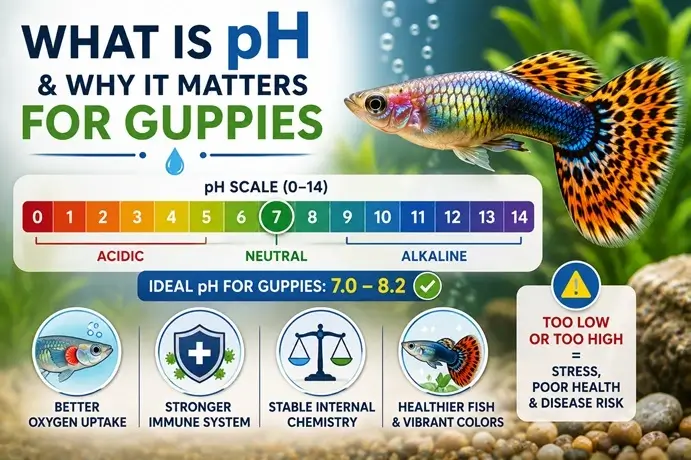
Guppies are native to freshwater streams, ponds, and rivers carrying a fair amount of dissolved minerals, which is why they lean toward the alkaline side of that scale rather than the soft, acidic water other tropical fish are built for.
pH affects a guppy more than just comfort. It influences how well their gills extract oxygen, how their immune system functions, and how stable the rest of their internal chemistry stays. If you get it badly wrong in either direction a guppy can struggle to breathe properly and becomes far more vulnerable to disease.
Ideal pH level for Guppies
Most experienced keepers and breeders converge on the same target:
➜ pH: 7.0–8.0
➜ GH: 8–12 dGH
➜ KH: 4–8 dKH
That’s the range I use across my own tanks, and it’s the same range our guppy water parameters guide is built around, since pH, GH, and KH all move together rather than independently. There’s no narrower sweet spot inside 7.0–8.0 worth chasing. Stability matters far more than the exact number.
Is 8.2 pH Too High for Guppies?
No, not on its own. 8.2 is a bit above the ideal range but well tolerated by guppies as long as it’s stable. Plenty of keepers with naturally hard tap water keep healthy, breeding guppies at that level without issue.
pH for Plants and Algae in Guppy Tank?
If you keep a planted tank with guppies, aim for a pH of 7.0–7.5.
• Plants like 6.5–7.5, guppies like 7.0–8.0 — so 7.0–7.5 is the only spot where both are happy.
• In that range, Anubias, Java fern, Cryptocoryne, and Vallisneria all grow fine.
• Don’t lower pH to fight algae. Algae actually likes the same alkaline water guppies do, so a lower pH won’t stop it.
• If algae is the real problem: keep lights on for only 6–8 hours a day, keep the tank out of direct sun, do regular water changes, add fast-growing plants to crowd it out, and add nerite snails, Amano shrimp, or otocinclus to eat it. See our best algae eaters guide for more.
How to Raise pH for Guppies
If your water tests acidic or low, a few methods raise pH safely and naturally.
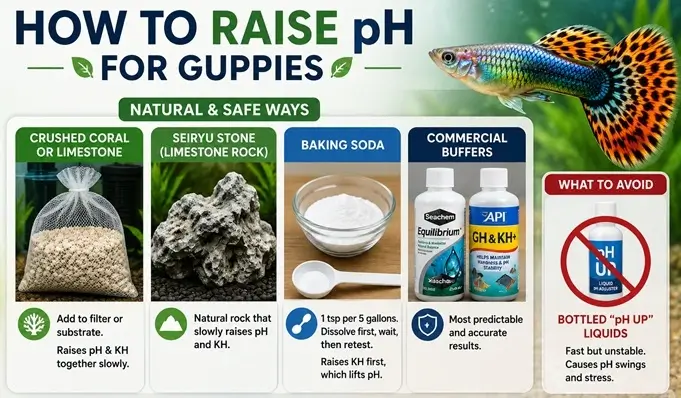
• Crushed coral or limestone — the option to try first. A small mesh bag in the filter, or mixed into the substrate, slowly raises both pH and KH together, and naturally caps out in the high 7s to low 8s without pushing pH dangerously high.
• Seiryu stone or limestone-based aquascaping rock — does the same job more slowly, while doubling as a decoration.
• Baking soda — works faster but needs more care. Start at 1 teaspoon per 5 gallons, dissolved in tank water first, and retest before adding more. It raises KH first, which is what pulls pH up, so it’s shorter-term than crushed coral and needs topping up.
• Commercial buffers like Seachem Equilibrium give the most predictable, repeatable results if you want to hit a specific number reliably.
• Avoid bottled “pH Up” liquid adjusters. They’re fast but unstable — pH tends to bounce back down and overshoot with each dose, which is more dangerous than a low pH held steady. Adjust the water source, not the symptom.
How to Lower pH for Guppies
If your tap water runs high on pH, a few natural methods bring pH down gently. Remember that guppies still need minerals even in lower-pH water, so the goal is a gentle reduction, not a swap to mineral-free soft water.
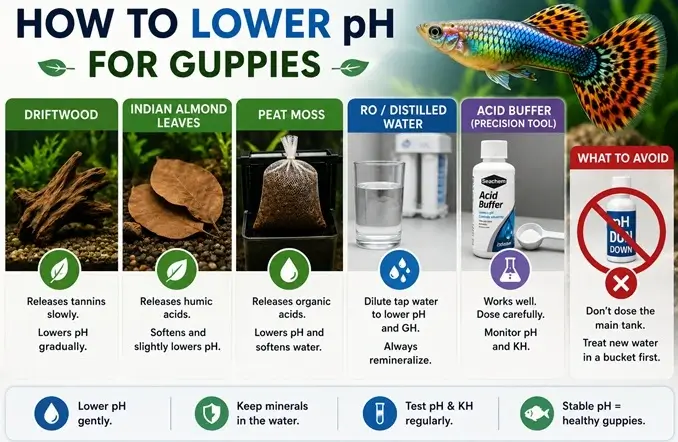
• Driftwood — releases tannins naturally as it sits in the tank, gradually lowering pH over weeks. A passive, low-maintenance option.
• Indian almond leaves (catappa leaves) — similar effect on a smaller scale, with a mild antibacterial benefit as a side effect. Good for smaller or nano tanks.
• Peat moss in a mesh filter bag — lowers pH more assertively than driftwood or leaves, while also softening the water.
• RO or distilled water, mixed with tap water rather than used alone — dilutes mineral content and brings both GH and pH down together. The better long-term route for very hard tap water, but remineralize afterward, since pure RO water has nothing in it for a guppy to use.
• Commercial pH reducers like Seachem Acid Buffer — treat as a precision tool, not a quick fix. High KH resists pH changes, so dose carefully and check KH alongside pH to avoid bounce-back instability.
• Avoid dosing the main tank directly. Treat new water in a separate bucket first, confirm the pH where you want it, then add it to the tank — never adjust around fish that are already in the water.
The Safe Rate for Changing pH
• Whichever direction you’re adjusting, aim for roughly 0.5 of a pH point per day at most — never swing the whole distance in one go.
• A fast jump of even half a point can cause real stress, and a full 1.0 point in one sitting can be dangerous, even though guppies can adapt to a wide pH range given time.
• If you have a significant gap to close, spread it across several days of small water changes rather than one large adjustment.
pH for Fancy Guppies and Endlers
• Fancy guppies need the same 7.0–8.0 range as standard guppies, no special adjustment. Where they differ is sensitivity — their selectively bred bodies and large fins handle sudden swings worse than a hardier wild-type guppy or Endler, the same fin-drag tradeoff covered in our fancy guppy lifespan guide.
• The one real risk for fancy guppies: softening or lowering pH with pure RO water and forgetting to remineralize. The resulting mineral deficiency can contribute to weaker fin and bone development over time. See our hard water guide for more on that connection.
• Endlers share essentially the same 7.0–8.0 pH preference, and tend to be a little more tolerant of minor swings since they’re closer to their wild ancestors.
• Either way, the same advice applies: keep it stable, don’t chase a perfect number, and check KH if pH won’t hold still.
Best pH Test Kits for Guppies
A standard pH test kit covers most guppy tanks fine.
• API Freshwater Master Test Kit — the most common recommendation, since it covers pH alongside ammonia, nitrite, and nitrate in one kit. Good value for regular testing.
• Its color chart gets hard to read above about 7.6, since the colors at the top of the scale bunch close together. That’s a readability limit of the kit, not a sign anything’s wrong — readings up to 8.2 and beyond are still perfectly fine for guppies, just harder to pin down exactly.
• If your tap water tends to run that high, a high-range pH test kit gives a clearer, more precise reading in that zone.
• A digital pH meter is a worthwhile upgrade if you’re testing often or breeding seriously, since it skips the color-matching guesswork entirely.
Frequently Asked Questions
Is 7.8 pH too high for guppies?
No. 7.8 is within the ideal range and considered excellent for guppies as long as it stays stable.
Is low pH bad for guppies?
Yes, if it’s low and unstable, or low enough to turn genuinely acidic (below 7.0 for extended periods). A pH that’s a little low but holding steady is far less risky than one that’s swinging.
What makes aquarium pH drop?
Mainly a buildup of organic acids from fish waste and decomposing matter, combined with low KH that can’t buffer against it. A tank that’s gone too long without a water change is the most common cause.
What’s a good pH for guppies and mollies or platies together?
All three do well in the same 7.0–8.0 range, so a community tank mixing them doesn’t need any special pH compromise.
How often should I test pH?
Weekly for an established tank is enough. Test daily during the first few weeks of a new tank, or any time fish show signs of stress.
Final Thoughts
Guppy pH doesn’t need to be complicated. Aim for 7.0–8.0, and treat stability as the real goal rather than a specific decimal point. Raising or lowering pH is manageable with the right method, as long as it’s done gradually rather than chased in a panic.
For the full picture of everything guppies need beyond pH, see our guppy care guide and guppy water parameters guide.