
Telling a male vs female guppy apart is useful for managing breeding and avoiding unexpected fry. Once you know what to look for, the differences become easier to spot.
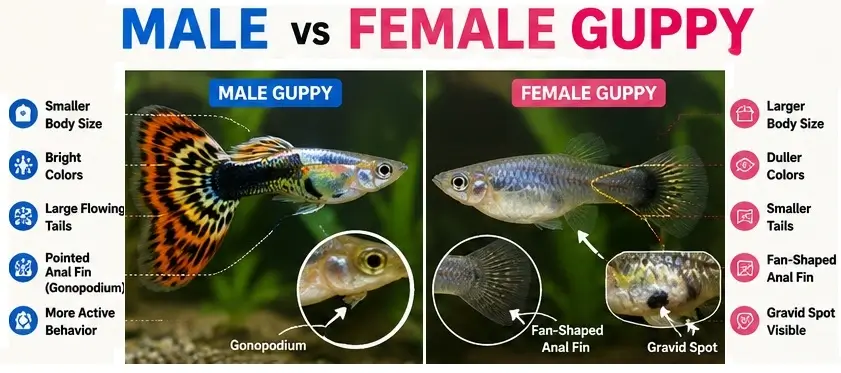
Male guppies are generally smaller, slimmer, and more colorful throughout the body. Females have larger bodies, fuller abdomens, and a distinctive gravid spot near the anal fin. The anal fin is the most reliable way to sex a mature guppy: males develop a narrow, pointed reproductive organ called a gonopodium, whereas females retain a fan-shaped anal fin.
When I first started keeping guppies as a child, identifying males and females wasn’t something I gave much thought to until one fine day, I discovered tiny fry swimming around my aquarium!
Quick Navigation
- Male vs Female Guppy: Quick Guide
- Male vs Female Guppy: 5 Key Differences
- How to Tell Male and Female Guppy Fry Apart
- Frequently Asked Questions
- Final Thoughts
Male vs Female Guppy: Quick Guide
If you are trying to identify your guppy’s sex at a glance, this comparison covers the most noticeable differences. The anal fin is the most reliable indicator; the other features provide supporting clues.
| Feature | Male Guppy | Female Guppy |
|---|---|---|
| Body size | Smaller, usually 1–1.5 inches | Larger, usually 2–2.5 inches |
| Body shape | Slimmer and streamlined | Deeper body with a fuller, rounder abdomen |
| Color | Usually brighter, with more coloration on the body | Often subdued body coloration, although fancy strains can be colorful |
| Anal fin | Narrow, pointed gonopodium | Broad, fan-shaped anal fin |
| Gravid spot | Absent | Usually visible near the anal fin |
| Tail | Often larger and more elaborate | Generally less elaborate, depending on strain |
| Behavior | Frequently displays and pursues females | May avoid persistent male attention |
Male vs Female Guppy: 5 Key Differences
Male and female guppies differ in body size, anal fin shape, coloration, gravid spot, and behavior.
1. Body Size and Shape
Body size and shape are noticeable differences, especially when comparing adult guppies of the same strain and similar age.
Male Guppies:
Adult males generally reach around 1–1.5 inches in length, although some selectively bred strains grow larger. They have smaller, slimmer bodies and relatively flat abdomens, giving them a streamlined appearance.
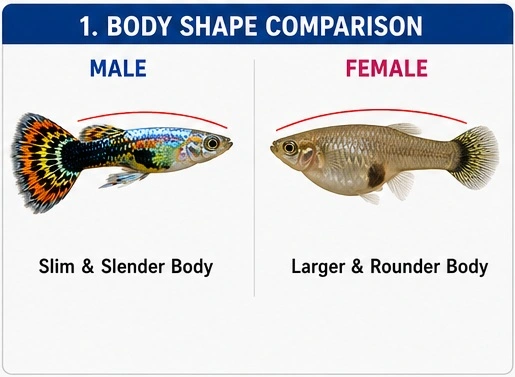
Female Guppies:
Adult females commonly reach around 2–2.5 inches, with some strains growing larger. They have larger, deeper bodies with rounder abdomens. The difference often becomes more obvious when females are pregnant.
2. Anal Fin: The Most Reliable Difference
The anal fin is the most reliable way to distinguish a mature male guppy from a female. It is located underneath the body, just behind the abdomen.
Male Guppy: Gonopodium
As male guppies mature, their anal fin gradually transforms into a narrow, elongated reproductive organ called the gonopodium. It is long, narrow, and pointed rather than fan-shaped. The gonopodium is used to transfer sperm to the female.
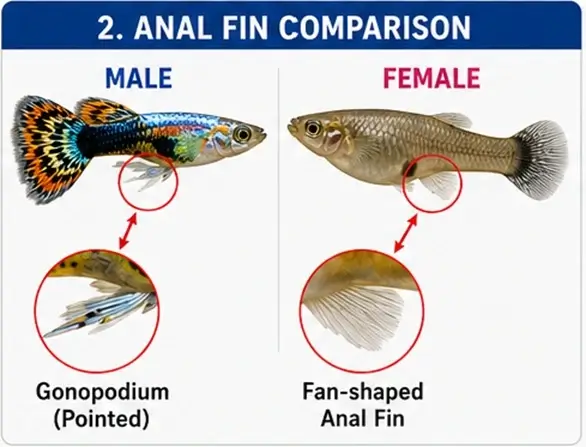
Female Guppy: Fan-Shaped Anal Fin
Female guppies retain a normal anal fin instead of developing a gonopodium. Their anal fin is broad and fan-shaped, with a wider base.
3. Color and Tail Differences
Color is often the first difference people notice when looking at male and female guppies. This difference is less obvious in some modern fancy strains.
Male Guppy Coloration:
Male guppies are generally more colorful, often displaying bright patterns across their bodies and tails. Depending on the strain, they may show red, orange, yellow, blue, green, or black coloration.
They may also have elaborate body patterns, large colorful tails, and more pronounced dorsal fins.
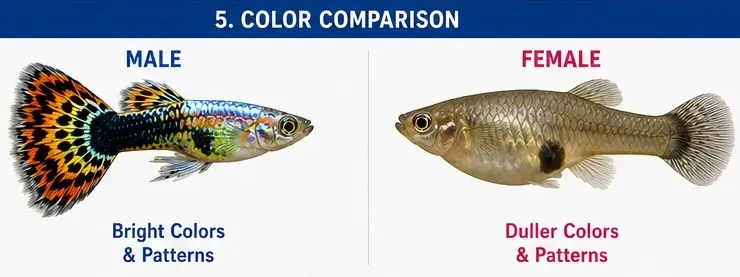
Female Guppy Coloration:
Female guppies often have grey, silver, or subdued body coloration, with some color on the tail. Selectively bred females can also display colorful tails and noticeable body patterns.
Color can help, but the anal fin remains the most reliable indicator. Body shape and the gravid spot provide supporting clues.
4. Gravid Spot in Female Guppies
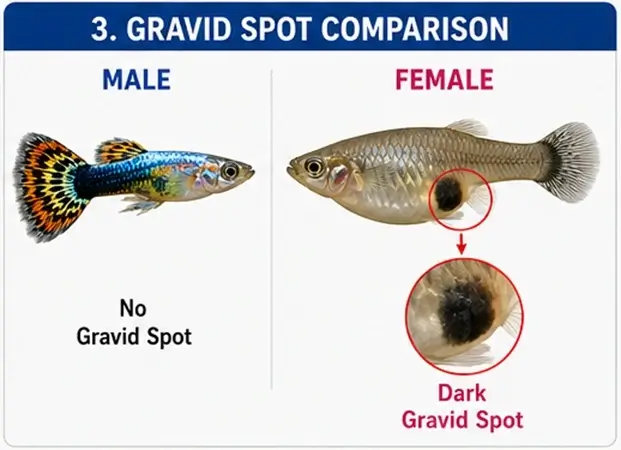
The gravid spot is a useful sign to look for as female guppies mature. It appears as a darker area near the rear of the abdomen, just above and slightly forward of the anal fin.
How to Identify the Gravid Spot:
- It appears near the lower rear abdomen of the female.
- It may look brown, grey, or almost black, depending on the guppy’s color and strain.
- The gravid spot often becomes more noticeable as the female matures.
- It can become more prominent during pregnancy.
The spot’s visibility varies with the fish’s coloration, genetics, and reproductive condition. For example, identifying it on a light-bodied female is generally easier than on a heavily pigmented strain such as a tuxedo guppy.
Does a Gravid Spot Mean a Guppy Is Pregnant?
Not necessarily. The gravid spot is associated with the female’s reproductive anatomy and may be visible even when she is not pregnant. Its appearance alone cannot confirm pregnancy.
Read our Pregnant Guppy Guide for more information on identifying pregnancy and preparing for fry.
5. Behavior Differences
Behavior can help, but it should not be used alone to identify a guppy’s sex.
Male Guppy Behavior
Male guppies frequently display courtship behavior, particularly when females are present.
- Actively pursue females.
- Display their colorful fins during courtship.
- Perform brief courtship movements.
- Compete with other males for mating opportunities.
Persistent chasing is common in mixed-sex aquariums.
Female Guppy Behavior
Female guppies are generally less involved in courtship displays and may spend time avoiding persistent male attention.
- May swim away from pursuing males.
- Seek shelter among aquarium plants.
- Seek quieter areas when heavily pregnant.
Female guppies can also be active swimmers and occasionally show aggression, so behavior alone is not a reliable way to determine sex.
For mixed-sex aquariums, a commonly recommended starting ratio is 1 male for every 2–3 females. This helps distribute male attention rather than having several males continually pursue a single female.
Provide enough swimming space and plant cover so females can avoid persistent males. Keeping both sexes together will almost certainly result in breeding.
How to Tell Male and Female Guppy Fry Apart
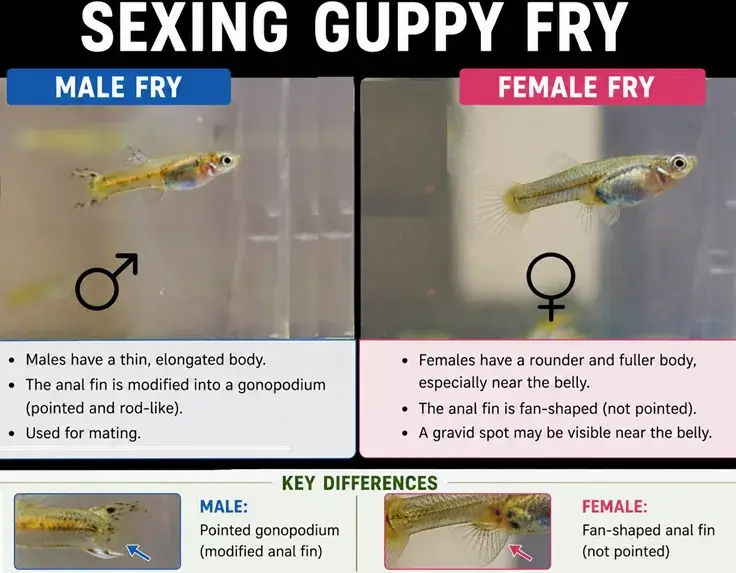
Sexing guppy fry is more difficult than identifying adults because their reproductive characteristics are still developing. Some fry begin showing early differences around 3–4 weeks, although the timing varies by strain and individual growth.
As they mature, look for changes in anal fin shape, body coloration, and the appearance of a gravid spot in females.
Male Guppy Fry:
- Some develop early body and tail coloration, although this varies by strain.
- May develop a slimmer body shape.
- Their anal fin gradually narrows and elongates into a gonopodium.
Female Guppy Fry:
- They often develop a fuller body as they grow.
- A gravid spot may become visible near the rear abdomen.
- They show less pronounced body coloration in many strains and retain a fan-shaped anal fin.
For additional information, read our Guppy Fry Guide and Guppy Fry Growth Stages article.
Frequently Asked Questions
Can female guppies live without males?
Yes. Female guppies can live perfectly healthy lives without males. However, females previously housed with males can store sperm for several months and produce multiple broods without mating again.
Can female guppies be colorful?
Yes. Although males are generally more colorful, selectively bred female guppies can develop bright tails and noticeable body patterns. Color alone is not a reliable way to determine sex.
Do all female guppies have a gravid spot?
The gravid spot is a characteristic feature of female guppies, but its visibility varies depending on the color strain. It may be difficult to identify in young females and heavily pigmented varieties.
Why do male guppies chase females?
Male guppies frequently pursue females as part of their natural mating behavior. However, persistent chasing can stress females, especially in overcrowded aquariums or tanks with too many males.
Can male guppies live together?
Yes. Male guppies can generally coexist, although occasional chasing may occur. Their compatibility depends on temperament, available swimming space, and aquarium conditions.
How can you tell if an Endler guppy is male or female?
Male Endlers are generally smaller, slimmer, and brightly colored, often with metallic markings. Females are usually larger, with subdued grey or silver bodies. As with other guppies, the most reliable way to identify a mature Endler’s sex is by checking the anal fin: males have a gonopodium, while females retain a fan-shaped anal fin. Body shape, color, and the gravid spot provide additional clues.
Final Thoughts
The most reliable way to tell a male vs female guppy apart is to examine the anal fin. Body shape, coloration, and the gravid spot provide supporting clues. Give young guppies time to develop before making a final identification, especially with unfamiliar fancy strains.