
If your goldfish is floating upside down, swimming sideways or erratically, or has a bloated belly, you are likely dealing with what is commonly called goldfish swim bladder disease, though it’s more accurately a disorder or syndrome rather than one specific disease. It is really an umbrella term for a group of buoyancy problems, usually caused by things like overfeeding, poor water quality, or a body shape that leaves little room for the swim bladder to work properly. It’s also one of the most common health problems goldfish keepers run into.
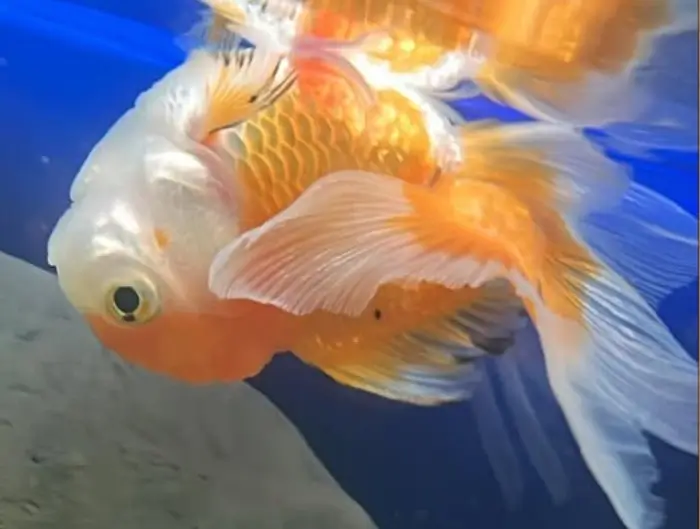
Most cases are treatable at home within a couple of weeks, and even permanent cases don’t have to mean a poor quality of life. This guide covers what is actually going on, which goldfish are most at risk and why, and exactly how to treat and prevent it.
Quick Navigation
1) What Is Goldfish Swim Bladder Disorder?
2) Where Is a Goldfish’s Swim Bladder Located?
3) Goldfish Swim Bladder Disorder – Quick Facts
4) Goldfish Swim Bladder Disorder Symptoms
5) Why Fancy Goldfish Are Especially Prone to Swim Bladder Problems
6) Goldfish Swim Bladder Disorder Causes
7) Goldfish Swim Bladder Disorder Treatment
8) How Vets Diagnose Swim Bladder Disorder
9) Can Goldfish Recover From Swim Bladder Disorder?
10) How to Prevent Swim Bladder Disorder in Goldfish
11) FAQ
12) Final Thoughts
What Is Goldfish Swim Bladder Disorder?
The swim bladder is a gas-filled organ inside the fish. It helps the fish stay level in the water without having to keep swimming.
When the swim bladder does not work properly, the fish can lose control of its balance and buoyancy. This can happen if the bladder is squeezed by nearby organs, damaged, infected, or affected by too much gas in the gut.
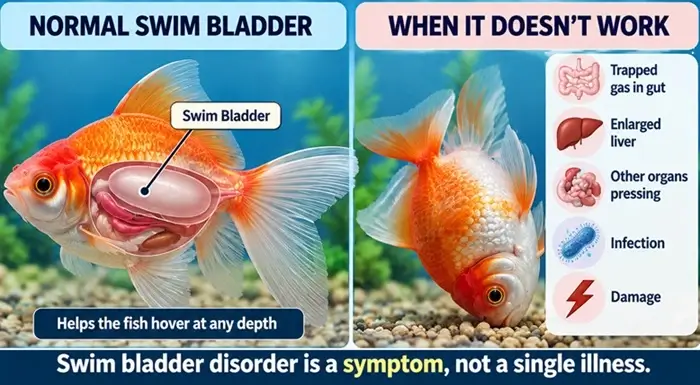
Swim bladder disorder is not a single disease. It is a symptom that can have several different causes, and in a lot of cases, what looks like a swim bladder problem turns out to just be lethargy from poor water quality instead.
Fancy varieties like Oranda are especially prone to it, since their short, rounded bodies leave far less room inside for the swim bladder. Nearby organs, an overloaded gut, or an enlarged liver can press against it and cause buoyancy problems.
Where Is a Goldfish’s Swim Bladder Located?
It is positioned dorsally, up against the underside of the spine, just above the digestive organs and kidneys.
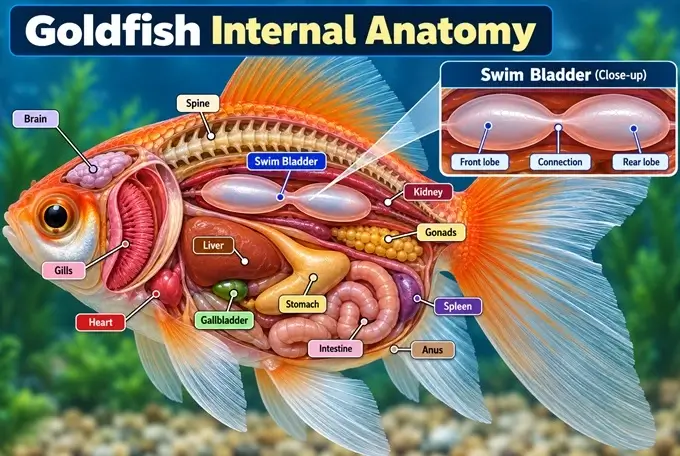
In goldfish specifically, it is a two-chambered organ, with a front and rear lobe connected by a narrow section, protected by a tough outer membrane.
Because it sits so close to the gut and other organs, anything that swells nearby — an overloaded intestine, an enlarged liver, or a fluid-filled cyst — can end up pressing directly on it.
Goldfish Swim Bladder Disorder – Quick Facts
| Attribute | Details |
|---|---|
| Most Common In | Far more common in fancy varieties (Pearlscale most of all, plus Oranda, Ranchu, Lionhead) than in slim-bodied like Comets or Common goldfish |
| Main Symptoms | Floating, sinking, swimming sideways or upside down, bloated belly, curved spine |
| Usual Cause | Overfeeding, floating food, or poor water quality, though a true structural swim bladder problem is less common |
| Contagious? | No |
| First Steps at Home | A short 1–2 day fast when appropriate, followed by small meals and appropriate feeding |
| Recovery Time | Depends on the cause. Some cases improve within days; some become permanent |
| Confirmed Diagnosis | An X-ray may be used by an aquatic veterinarian when needed |
Goldfish Swim Bladder Disorder Symptoms
Symptoms can vary depending on what is causing the problem, but they all point back to the same thing: a goldfish that has lost control of its normal buoyancy. Here’s what to actually look for:
Floating at the surface, often tilted to one side, floating after eating in particular, or unable to submerge.
Sinking to the bottom and struggling to rise.
Swimming upside down, sideways, or head-down with tail up.
Swimming erratically, or with visibly excessive fin movement just to stay level.
A bloated or distended belly.
A visibly curved spine in more severe or long-running cases, where an enlarged belly has pushed other organs out of place.
Appetite changes — some fish keep eating normally, others stop trying to feed altogether if they can’t reach the surface or the food.
Why Fancy Goldfish Are Especially Prone to Swim Bladder Problems
Fancy goldfish are affected far more than other types, and the reason comes down to how their bodies are actually built.
• Goldfish fill their swim bladder the same way they eat, by gulping air at the surface. That is very different from fish like Bettas, which fill their swim bladder a different way and don’t need to swallow air to do it.
• A healthy goldfish swim bladder has two chambers, but decades of selective breeding to achieve compact, rounded bodies seen in Pearlscale, Oranda, Ranchu, Lionhead, and similar fancy varieties have left much less room for the swim bladder inside the body. Even a small issue nearby can end up compressing or distorting the swim bladder and affecting how well it works.
Goldfish Swim Bladder Disorder Causes
Overeating, eating too fast, or gulping air while eating at the surface can trigger swim bladder problems. This is especially common with floating pellets or flakes. An overfilled or gassy gut can press against the swim bladder and affect the fish’s buoyancy. This is often loosely called “constipation,” but true fecal blockage is rare. The main problem is usually trapped gas or an overloaded gut.
Dry food can keep expanding after the fish eats it. This can fill the gut and put extra pressure on the swim bladder.
Low water temperature, which slows digestion and lets food sit and expand in the gut for longer than it should.
Enlarged internal organs — kidney cysts, a fatty liver, or eggs in females can press against the swim bladder nearby.
Bacterial or parasitic infection causing inflammation inside the swim bladder itself.
Rough spawning. Female goldfish can be chased and pushed around hard during spawning, and the physical stress and exhaustion from this can temporarily throw off their buoyancy. Separating her from the males for a few days is often enough to let her recover.
Congenital defects — some fish are simply born with them. This is rare, but usually noticeable from a very young age.
Goldfish Swim Bladder Disorder Treatment
There is no single treatment for goldfish swim bladder disorder because buoyancy problems can have many different causes. The best approach is to detect what could have gone wrong. The first step is to check the water, then correct feeding and other conditions that may be affecting the fish. Medication should only be used when there is a good reason to suspect an infection or another specific disease.
1) Test the Water First
Test the water for ammonia, nitrite, nitrate and pH. Poor water quality can cause stress, weakness and abnormal swimming, and it should be corrected before trying any medications.
Ammonia and nitrite should be 0 ppm. If either is detectable, do a partial water change with properly conditioned water and find the cause of the problem.
Keep nitrate below 20 ppm. If nitrate is high, perform partial water changes to bring it down.
Make sure the new water is close to the tank’s temperature. Sudden temperature changes can make buoyancy problems worse.
2) Check the Water Temperature
Keep the temperature stable and appropriate for goldfish. Avoid sudden temperature changes.
Cold water can slow digestion, while sudden temperature changes can add stress. Fancy goldfish generally do well around 68–75°F (20–24°C ) when kept as indoor aquarium fish. Raise the water temperature to 75°F–80°F (25.5°C–26.5°C) only while treating a goldfish for swim bladder issues. Warmer water increases the goldfish metabolism, which helps it to digest the food and expel gut contents or gas causing the blockage.
Raise the temperature gradually rather than all at once.
3) Stop Feeding Temporarily
If the fish appears bloated or the problem started after overeating, temporarily reducing or stopping food can give the digestive system time to settle.
A short fast of 1–2 days is commonly recommended for an otherwise healthy adult goldfish.
Do not continue fasting for long periods, especially if the fish is already weak, thin, or showing other signs of illness.
4) Look at Whether the Fish Is Floating or Sinking
This is an important step because floating and sinking problems do not always have the same cause.
If the fish is floating:
A fish that repeatedly floats toward the surface may be swallowing air while feeding, particularly when eating floating food. Gas in the digestive tract can also contribute to positive buoyancy.
In this situation, avoid making the fish repeatedly feed at the surface.
If the fish is sinking:
A fish that stays on the bottom may have a different problem. Poor water quality, weakness, disease, or anatomical buoyancy problems can all contribute to negative buoyancy.
So don’t automatically assume that a sinking fish simply needs a different type of food.
5) Resume Feeding Slowly
After the short fasting period, start feeding again with small portions.
Avoid giving a large meal simply because the fish has not eaten for a day or two. Overfeeding can put additional pressure on the digestive system.
Feed only what the fish can comfortably eat.
6) Use Slow-Sinking Pellets
For a goldfish with recurring buoyancy problems, slow-sinking pellets can be a useful middle-ground feeding option.
Floating pellets can encourage some fish to gulp air at the surface, while very fast-sinking food can be difficult for a fish that is already struggling to stay upright.
Slow-sinking pellets gradually absorb water and become heavier, so they sink at different rates. Some may remain near the surface for a while, while others gradually move toward the bottom.
This gives a fish that is floating, sinking, or somewhere in between a better opportunity to reach the food.
Because slow-sinking pellets absorb water before being eaten, they may also be less likely to continue expanding after being swallowed than a very dry food. However, this does not mean they cannot contribute to digestive problems if the fish is overfed.
7) Feed Small Amounts
Regardless of the type of food, portion size matters.
Give small amounts rather than allowing the fish to eat a large quantity at once. This is particularly important when the fish has recently had bloating, constipation-like symptoms, or buoyancy problems.
If several fish are competing for food, spread the pellets around the aquarium so one fish does not consume most of the food.
8) Green Peas Can Be Used as an Optional Food
A small amount of cooked, peeled green pea can be offered after fasting if you suspect a digestive problem.
However, peas should not be described as a guaranteed cure or a special laxative for swim bladder disorder. They are simply a soft, easily eaten food that sinks and can be useful as part of a temporary diet.
The important point is to avoid overfeeding, even with peas.
9) Reduce Strong Water Flow
If the fish is having difficulty maintaining its position, strong currents can make the problem much harder.
Reduce excessive filter flow or strong circulation so the fish does not have to constantly fight the current.
Do not completely stop filtration, however. The aquarium still needs adequate oxygenation and biological filtration.
10) Make the Aquarium Easier for the Fish
If the fish is struggling to swim normally:
- Reduce strong currents.
- Keep food within easy reach.
- Remove sharp decorations that could injure a fish that repeatedly bumps into them.
- A slightly shallower setup can sometimes make it easier for a buoyancy-impaired fancy goldfish to reach the surface or bottom.
These changes do not cure the underlying problem. They simply make it easier for the fish to function while the cause is being addressed.
11) Don’t Automatically Use Antibiotics
Swim bladder disorder is not automatically a bacterial infection.
Antibiotics should not be used simply because a goldfish is floating or sinking. If the fish also has signs such as ulcers, redness, swelling, abnormal waste, loss of appetite, or worsening illness, an infection or another disease may need to be investigated.
Medication should be chosen according to the suspected cause rather than treating every buoyancy problem as an infection.
12) If the Problem Does Not Improve
If the fish continues to float or sink despite good water quality and appropriate feeding, look for another underlying cause.
Possible causes include:
- Anatomical problems
- Internal infection
- Organ enlargement
- Kidney cysts
- Persistent intestinal gas
- Spawning-related problems
- Injury
- Other internal disease
A persistent problem may require examination by an aquatic veterinarian, and imaging such as an X-ray can sometimes help identify problems involving the swim bladder or internal organs.
13) Long-Term Management
Some fancy goldfish have permanent buoyancy problems because of their body shape or internal anatomy. In these cases, the goal may be management rather than a complete cure.
Good water quality, appropriate feeding, slow-sinking food, reduced current, easy access to food, and an aquarium setup that allows the fish to rest comfortably can help the fish live with a chronic buoyancy problem.
How Vets Diagnose Swim Bladder Disorder
Most swim bladder cases are first identified just by watching the fish’s behavior at home.
If the problem continues, a vet may use an X-ray to see what is happening inside the fish. An X-ray can show the swim bladder’s size, shape, and position. It can also reveal whether something else, such as fluid, a growth, or an enlarged organ, is putting pressure on it.
An X-ray can also help the vet look for other causes of buoyancy problems, including trapped gas in the intestines, changes in the swim bladder, or problems with nearby organs.
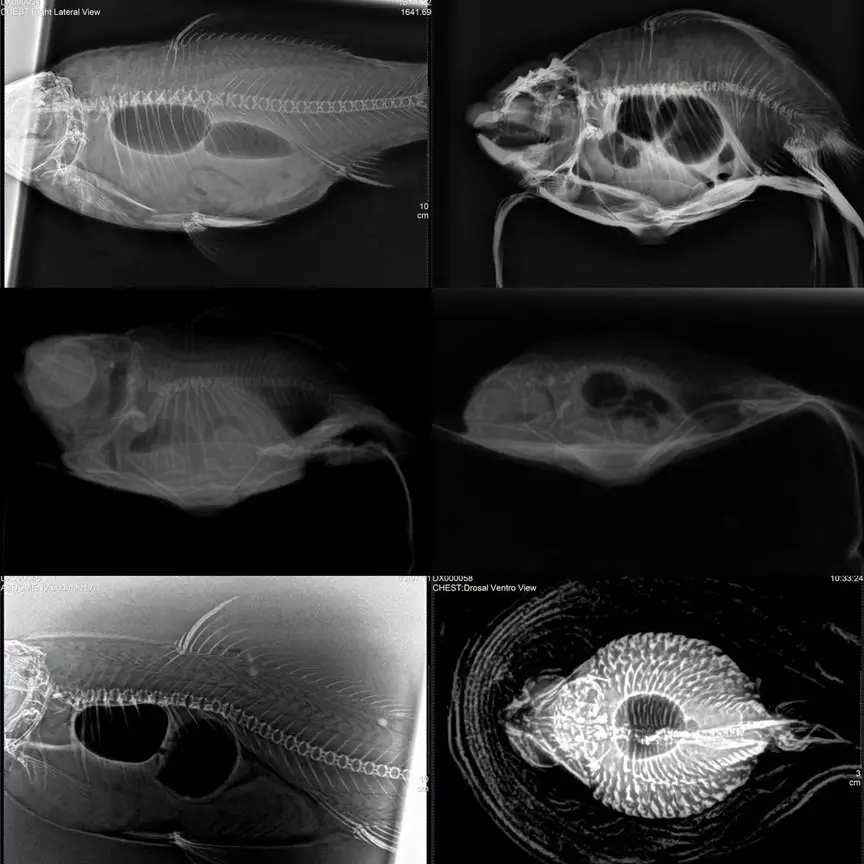
Chamber abnormalities — The size and shape of the front and rear chambers. Fancy breeds like Ranchus naturally have reduced or missing rear chambers compared with slim-bodied goldfish.
Masses and tumors — Internal growths or enlarged organs pressing against the swim bladder.
Fluid or infection — Abnormal fluid buildup inside the bladder or surrounding body cavity.
Spinal issues — Deformities, fractures, or a “W”-shaped spine that can cause permanent swimming problems.
If your goldfish isn’t improving after correcting the water quality and making appropriate feeding changes, an aquatic veterinarian can help determine the underlying cause. An X-ray may be recommended if the problem persists.
Can Goldfish Recover From Swim Bladder Disorder?
Many goldfish can recover from buoyancy problems when the underlying cause is corrected. However, structural problems, especially in fancy goldfish, can be permanent, and some fish may never regain normal buoyancy.
A permanent buoyancy problem does not necessarily mean a poor quality of life. Some goldfish can live normally while spending more time at the bottom or surface, as long as they can eat, breathe, and move comfortably.
If the fish does not improve after correcting water quality and feeding problems, or has difficulty eating or breathing, an aquatic veterinarian should be consulted.
For a fish with a permanent buoyancy problem:
• Keep the water very clean and reduce strong currents.
• Use a bare-bottom tank or large, smooth stones if the fish spends a lot of time on the bottom.
• Hand-feed if other fish are taking its food.
• Provide tall plants or other safe resting areas for a fish that struggles to stay submerged.
The goal is to make the fish comfortable and able to eat and move around as normally as possible.
How to Prevent Swim Bladder Disorder in Goldfish
• Feed small portions and avoid overfeeding.
• Use slow-sinking pellets rather than relying on floating food.
• Keep ammonia and nitrite at 0 ppm and nitrate below 20 ppm.
• Keep the water temperature stable and suitable for goldfish.
• Avoid overcrowding and make sure all fish get enough food without rushing to compete for it.
Fancy goldfish are more prone to buoyancy problems because of their body shape, so good feeding and tank conditions are especially important.
FAQ
Is swim bladder disease painful for goldfish?
Swim bladder problems are not necessarily painful by themselves, but a fish that remains floating or resting on the bottom for long periods can develop skin damage. Pain or discomfort may also come from the underlying problem, such as an infection or pressure from an enlarged organ.
Is goldfish swim bladder disease contagious to other fish?
No. Swim bladder disorder itself is not contagious. However, if several fish develop similar symptoms, check the aquarium water and look for an underlying disease that could affect multiple fish.
Do peas actually cure swim bladder disease?
No. Peas are not a cure for swim bladder disorder. They are a soft, sinking food that can be offered after a short fast when a digestive problem is suspected. They may be useful as part of a temporary diet, but they will not correct a structural swim bladder problem.
How long does goldfish swim bladder treatment take to work?
It depends on the cause. Feeding-related buoyancy problems may improve within a few days after correcting the diet and giving the digestive system time to settle. If the fish does not improve despite good water quality and appropriate feeding, an aquatic veterinarian should be consulted.
Why is my goldfish bloated and floating on its side?
Bloating and floating on the side can have several causes, including an overloaded or gassy gut, poor water quality, internal disease, or an anatomical problem. Check the water first, avoid overfeeding, and consider a short fast if the fish is otherwise healthy. If the bloating or buoyancy problem continues, an aquatic veterinarian can help find the cause.
Should I switch to sinking pellets permanently?
For goldfish with buoyancy problems, slow-sinking pellets are a good everyday food choice. They reduce surface feeding and the chance of swallowing excess air, while giving the fish time to grab food as the pellets gradually sink. They can also be used long-term to help prevent feeding-related buoyancy problems.
Final Thoughts
Swim bladder disease looks alarming. A goldfish floating helplessly on its side or stuck at the bottom is very hard to watch. But most cases resolve with nothing more than a few days of fasting, a bit warmer water, and a diet change. Always rule out water quality first; it’s the most common hidden cause behind what looks like a swim bladder problem. And if your fish turns out to have a permanent buoyancy issue, a few small changes to its tank setup can still give it a long, comfortable life. Read our complete goldfish diseases guide for all goldfish related diseases.