
A goldfish that’s normally active suddenly parked on the substrate, barely moving, is telling you something is wrong, this isn’t a fish choosing to rest the way it might overnight. Why is my goldfish at the bottom of the tank? Goldfish at the bottom of the tank, whether it’s one fish or all goldfish at the bottom of the tank as a group, most often comes down to poor water quality, cold temperature, swim bladder disorder, or illness, and figuring out which one applies changes what you should actually do next.
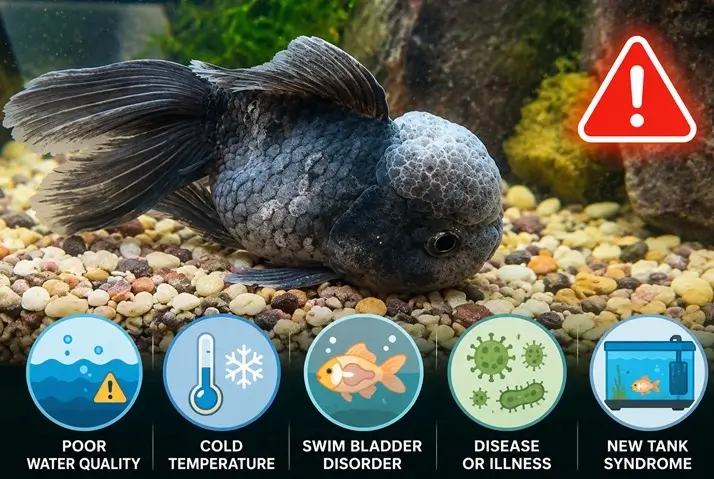
Quick Answer: A goldfish sitting at the bottom of the tank is most commonly caused by poor water quality (ammonia or nitrite), cold water temperature, swim bladder disorder, disease or parasites, or new tank syndrome. Test your water immediately, this rules in or out the single most common cause faster than anything else. A fish that’s still eating and responds when approached is a very different situation from one that’s unresponsive or struggling to move at all.
Quick Navigation
➜ Behavior, Likely Cause, and Urgency at a Glance
➜ Why Is My Goldfish at the Bottom of the Tank?
➜ Goldfish at the Bottom of the Tank Not Moving
➜ Factors That Make a Goldfish Sit at the Bottom
➜ Poor Water Quality and Ammonia
➜ New Tank Syndrome
➜ Cold Water and Temperature
➜ Disease and Parasites
➜ Heavy Fins and Body Shape
➜ Stress and Loneliness
➜ Could It Be Swim Bladder Disorder Instead?
➜ Is This Connected to Not Eating?
➜ Is My Goldfish Just Resting?
➜ Quick Checklist: Goldfish at the Bottom of the Tank
➜ Frequently Asked Questions
Behavior, Likely Cause, and Urgency at a Glance
A fast way to narrow things down before reading the full breakdown below.
| Behavior | Most Likely Cause | Urgency |
|---|---|---|
| Sitting calmly, still eating | Cold water or normal resting | Low |
| Bottom-sitting with rapid or labored breathing | Ammonia or nitrite poisoning | High |
| Bottom-sitting, can’t swim or floats upside down | Swim bladder disorder | Medium to High |
| Bottom-sitting with white spots | Ich (white spot disease) | High |
| Bottom-sitting with red or black fin markings | Ammonia burn | High |
| Bottom-sitting with fraying or ragged fins | Fin rot | Medium |
| Bottom-sitting with fuzzy white growths | Columnaris (cotton wool disease) | High |
| Bottom-sitting, tank set up within the last few weeks | New tank syndrome | High |
| Bottom-sitting only at night, active again by day | Normal resting | None |
| Completely unresponsive, not moving at all | Severe water quality crisis or advanced illness | Urgent |
Why Is My Goldfish at the Bottom of the Tank?
Goldfish are naturally active swimmers, so a fish that’s parked on the substrate for extended periods, rather than briefly resting, is showing a real behavior change worth investigating rather than ignoring.
The most common underlying causes are:
➜ Poor water quality — elevated ammonia, nitrite, or nitrate stresses the fish and burns its gills. This drains its energy and makes it sit at the bottom instead of swimming.
➜ Cold water temperature — slows metabolism enough that swimming takes real effort, which makes the fish rest at the bottom instead of staying active in open water
➜ Swim bladder disorder — the fish loses control of its own buoyancy. It sinks and sits at the bottom instead of swimming or floating normally.
➜ Disease or parasites — drain the fish’s energy directly, which makes it sit at the bottom rather than continuing to move around the tank
➜ New tank syndrome — an uncycled tank spikes ammonia and nitrite unpredictably, which has the same energy-draining effect as poor water quality and makes the fish sit at the bottom the same way
If it’s one fish among several that’s affected, the problem may be specific to that fish. If every fish in the tank is doing it at once, treat it as a tank-wide water quality or temperature issue first.
Goldfish at the Bottom of the Tank Not Moving
A fish that’s completely still, unresponsive, or barely reacting when you approach the tank is a more urgent version of this symptom than one that’s simply spending more time near the substrate than usual. This level of unresponsiveness points more strongly toward advanced illness, severe water quality problems, or a swim bladder disorder that’s progressed to the point the fish truly can’t swim, rather than mild stress or cold.
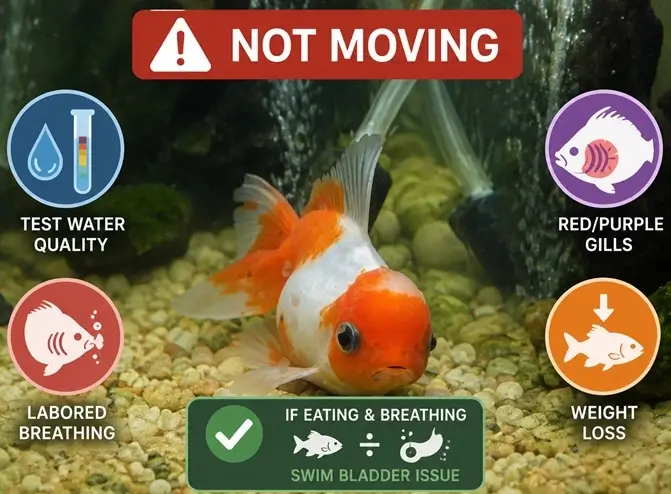
➜ Test water quality immediately — this is still the fastest way to rule in or out the single most common cause
➜ Check for labored or rapid breathing — a strong sign of ammonia poisoning or advanced gill damage
➜ Look for red or purple gills, gasping, or rapid weight loss — these are signs of a serious, possibly late-stage water quality crisis
➜ If the fish is otherwise still breathing normally and eating — it’s more likely swim bladder related than a water quality emergency
What to expect: if caught early and water quality is the cause, improvement often begins within 24 to 48 hours of correcting it. A fish that’s been unresponsive for an extended period, especially with gasping, rapid breathing, or damaged gills, is in a more serious situation, and a vet consult is well worth considering rather than waiting to see if a water change alone is enough.
Factors That Make a Goldfish Sit at the Bottom
These are the causes actually worth checking, in roughly the order most likely to apply.
Poor Water Quality and Ammonia
Toxic spikes in ammonia, nitrite, or nitrate are the most frequent cause of bottom-sitting. Goldfish produce a lot of waste, and it doesn’t take much of an inadequate filter or a skipped water change to foul the water enough to stress the fish, drain its energy, and make it sit at the bottom rather than swim normally.
➜ Test ammonia, nitrite, and nitrate — with a liquid kit, ammonia and nitrite should read 0 ppm, nitrate under 20 to 40 ppm depending on how sensitive the specific fish or breed is
➜ Perform a 25 to 30 percent water change — with a proper dechlorinator if any reading is elevated
➜ Watch for red or black markings on the fins — a visible sign of ammonia burn from prolonged exposure, our Goldfish Turning Black guide covers this specific symptom in depth
➜ Check for rapid breathing alongside the bottom-sitting — a combination that points strongly toward water quality rather than temperature or stress alone
What to expect: mild ammonia or nitrite-related bottom-sitting often improves within 24 to 48 hours of correcting water quality. If burns or gill damage have already occurred, full recovery can take one to two weeks, and it’s worth watching for secondary infection during that window.
New Tank Syndrome
If this is a newly set up tank, or a goldfish that was recently added to one, unstable ammonia and nitrite are almost always the cause. A tank needs to complete the nitrogen cycle before it can safely support fish, and that can take several weeks. During that window, unstable ammonia stresses the fish the same way it would in an older tank, draining its energy and making it sit at the bottom. Skipping the cycling step is one of the most common reasons a new goldfish becomes inactive or dies shortly after being introduced.
➜ Test daily rather than weekly — during the first month, ammonia and nitrite can spike quickly in an uncycled tank
➜ Do smaller, more frequent water changes — rather than one large change, to avoid further destabilizing an uncycled system
➜ Consider a fishless cycle next time — cycling the tank before adding any fish avoids this problem entirely for future setups
What to expect: a tank actively cycling can take several weeks to fully stabilize, and symptoms may fluctuate during that period rather than improving in a straight line. Consistent daily water changes during this window matter more than any single big fix.
Cold Water and Temperature
Goldfish are cold-water fish, but they still have a preferred range, roughly 65 to 75°F, and water that drops meaningfully below that slows their metabolism enough that swimming takes real effort, which makes the fish rest at the bottom rather than stay active. In outdoor ponds specifically, once temperatures fall below about 52°F, this becomes normal seasonal behavior rather than a problem.
➜ Check your water temperature — against the fish’s normal range, not just whether it feels cold to the touch
➜ Bring fancy varieties indoors before winter — fancy goldfish tolerate cold and hibernation far less well than common goldfish or koi
➜ Warm water gradually if correcting a heater issue — no more than 1–2°F per hour to avoid adding a second stressor on top of the first
What to expect: if cold water is the cause and it’s corrected gradually, activity typically picks back up within the same day. Seasonal pond slowdown as winter approaches isn’t something to “fix,” it’s normal and expected for common goldfish specifically.
Disease and Parasites
Illness and parasites drain a fish’s energy directly, and a fish with less energy to spend on swimming settles at the bottom instead, often alongside other visible symptoms that point toward disease or parasites rather than water quality or temperature alone.
➜ White spots like salt or sugar — points toward Ich, a parasitic infection needing medication
➜ Fraying or rotting fins — points toward fin rot, usually linked to prolonged poor water quality
➜ Fluffy white growths on the body — points toward columnaris (cotton wool disease), a fungal-like bacterial infection
➜ External parasites like anchor worms or gill flukes — often visible directly on the body, unlike internal parasites which are harder to confirm without other symptoms
What to expect: most goldfish diseases progress quickly, so starting treatment at the first signs matters. No medication works well if water quality isn’t also corrected at the same time, treating the disease alone while ignoring dirty water rarely resolves the underlying problem.
Heavy Fins and Body Shape
Some fancy goldfish varieties are simply built in a way that makes sustained swimming harder, which tires the fish out and makes it rest at the bottom, not always as a sign of illness, sometimes it’s closer to physical fatigue. A Lionhead with an overgrown wen can become noticeably top-heavy, and Veiltails or other long-finned varieties can tire from the drag of their own fins faster than a streamlined common goldfish would.
➜ Consider the breed specifically — Lionhead, Ranchu, Veiltail, and other heavily modified varieties are more prone to this than Comets or Fantails
➜ Rule out water quality and temperature first — since body shape is a contributing factor, not usually the sole cause on its own
➜ Watch for a pattern of resting after activity — rather than constant, unresponsive bottom-sitting, which points more toward illness
Stress and Loneliness
Goldfish are social animals, and a goldfish kept alone, in a cramped tank, or with incompatible tankmates can become stressed enough to hide and bottom-sit more than usual. This is worth ruling out only after water quality, temperature, and disease have been checked, since stress is a harder cause to confirm directly.
➜ Rule out disease and water quality first — before assuming loneliness or stress is the cause
➜ Consider tank size and mate compatibility — goldfish generally do best with other goldfish, not mixed with incompatible species
➜ A bored fish in a small bowl or bare tank — can also show reduced activity that looks similar to bottom-sitting from illness
Could It Be Swim Bladder Disorder Instead?
A fish that can’t swim normally at all, rather than one that’s simply inactive, points toward swim bladder disorder specifically. This is common in fancy goldfish, and it can range from mild buoyancy trouble to a fish that’s unable to move through the water at all and can only lie on the substrate.
Our Goldfish Swimming Upside Down guide covers swim bladder disorder in full, including the fasting-and-peas approach that resolves most milder cases. Worth knowing directly: some sources are considerably more skeptical of buoyancy harness devices than we’ve previously covered, one veterinary clinic specifically warns that improperly strapped harnesses can cause coelomic perforation, an internal body-cavity injury, on top of the slime-coat damage already noted, which is a real reason to treat that option with real caution and only as an absolute last resort under close supervision.
Is This Connected to Not Eating?
Bottom-sitting and loss of appetite frequently show up together, since the same underlying causes, water quality, illness, and constipation, tend to affect both behaviors at once. If your goldfish has also stopped eating, our Goldfish Not Eating guide covers this overlap directly, including how to tell whether food refusal or lethargy came first.
Is My Goldfish Just Resting?
Goldfish do rest, typically by slowing down and minimizing movement rather than lying flat on the substrate for extended stretches. Some keepers notice their fish hovering near the bottom once the lights go off at night, which is normal, that same fish should be back to active swimming once the lights come on.
➜ A fish that resumes normal swimming once the lights come on — or you approach the tank is very likely just resting
➜ A fish that stays down during active daytime hours — or doesn’t respond when approached is a different, more concerning situation
➜ Lying flat directly on the substrate — is different from simply hovering low in the water column, and is less likely to be normal resting
Quick Checklist: Goldfish at the Bottom of the Tank
➜ Check whether it’s one fish or the whole tank — a tank-wide pattern points strongly toward water quality or temperature
➜ Test ammonia, nitrite, nitrate, and temperature the same day — don’t wait to see if it resolves on its own
➜ Perform a 25 to 30 percent water change — with a proper dechlorinator if anything tests elevated
➜ Look closely for visible symptoms — white spots, fin damage, red or black markings, or fuzzy growths
➜ Check if the fish can swim at all when disturbed — a fish that truly can’t move points toward swim bladder disorder
➜ If everything tests clean and the fish still won’t move — a vet consult is worth pursuing rather than continuing to guess at home
Frequently Asked Questions
Why are all my goldfish at the bottom of the tank?
When every fish in the tank shows the same behavior, it’s almost always a tank-wide issue, water quality or temperature, rather than something specific to one fish’s health. Test the water first.
Why are my new goldfish at the bottom of the tank?
This usually points to new tank syndrome, an uncycled tank with unstable ammonia and nitrite, or the ordinary stress of being moved to a new environment. Test water daily for the first few weeks rather than assuming it will settle on its own.
Is it normal for a goldfish to sit on the bottom of the tank?
Briefly, occasionally, especially at night, yes. Constantly, unresponsively, or alongside other symptoms like rapid breathing or visible marks, no, that points toward a real problem worth addressing.
What’s the difference between a goldfish resting and one that’s sick?
A resting goldfish responds quickly once the lights come on or you approach, and resumes normal swimming. A sick or stressed goldfish stays unresponsive during active hours, may show labored breathing, and often has other visible symptoms alongside the inactivity.
Can cold water alone cause a goldfish to sit at the bottom?
Yes, especially in outdoor ponds as temperatures drop, this is a normal, expected seasonal slowdown for common goldfish. Fancy varieties tolerate cold far less well and should be moved indoors before temperatures fall too far.
Why is my goldfish sitting at the bottom but eating normally?
This is a reassuring sign. Appetite is usually one of the last things to go in most illnesses, so a fish that’s still eating well is more likely dealing with something mild, cold water, normal resting, or minor stress, rather than serious disease. Keep an eye on it, but there’s less urgency here than with a fish that’s both bottom-sitting and refusing food.
Final Thoughts
A goldfish at the bottom of the tank is a genuine behavior change worth investigating, not something to wait out by default. Water quality and temperature explain the majority of cases, disease, body shape, and swim bladder disorder explain most of the rest, and testing the water remains the fastest way to rule in or out the single most common cause. For a fish that’s struggling with buoyancy specifically, see our Goldfish Swimming Upside Down guide, and for one that’s also stopped eating, our Goldfish Not Eating guide covers that overlap in full.