
Goldfish commonly suffer from diseases like Ich, fin rot, swim bladder disorder, Fungus etc. which are usually caused by poor water quality and stress. So it is important that you catch the diseases early to save your pet fish. Goldfish disease symptoms can be subtle at first like hiding more than usual, scratching against decorations and not eating. It is important that we catch the signs early.
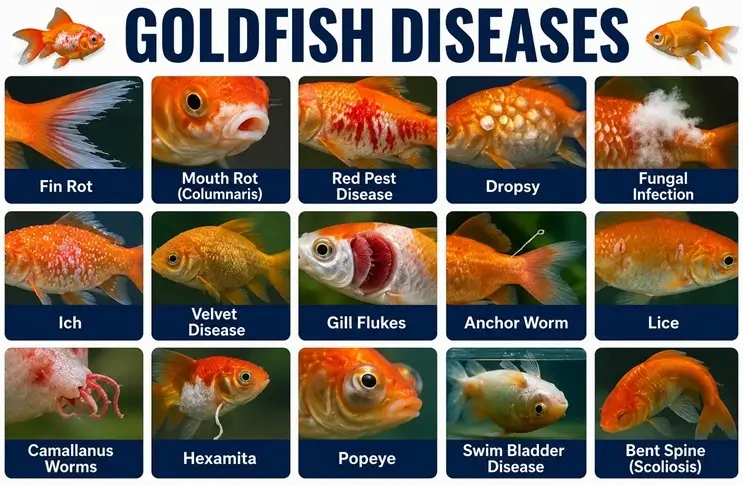
In this article i have presented all goldfish diesases with pictures so that you can match them against your fish symptoms to treat your goldfish illnesses. Catching things early is what makes the difference between a five-minute fix and a two-week treatment.
Quick Navigation
➜ What Causes Goldfish Diseases?
➜ When to Use a Combination of Medicines (Broad-Spectrum Treatment)
➜ Goldfish Disease Chart
➜ Goldfish Fin Rot
➜ Goldfish Mouth Rot (Columnaris)
➜ Goldfish Red Pest Disease (Hemorrhagic Septicemia)
➜ Goldfish Dropsy
External Parasitic Goldfish Diseases
➜ Goldfish Ich (White Spot Disease)
➜ Goldfish Velvet Disease
➜ Goldfish Gill Flukes
➜ Goldfish Anchor Worm
➜ Goldfish Lice
Internal Parasitic Goldfish Diseases
➜ Goldfish Camallanus Worms (Red Worms)
➜ Goldfish Hexamita (Hole-in-the-Head)
Other Goldfish Health Problems
➜ Goldfish Popeye
➜ Goldfish Swim Bladder Disease
➜ Goldfish Bent Spine (Scoliosis)
➜ When Should You Separate a Sick Goldfish?
➜ How to Prevent Goldfish Illnesses
➜ Frequently Asked Questions
➜ Full List of Goldfish Diseases
What Causes Goldfish Diseases?
Most goldfish illnesses aren’t random. They are the end result of stress, and stress almost always traces back to something wrong with your tank or pond environment. A goldfish in a clean and stable water is remarkably resistant to diseases.
• Poor water quality is one the single biggest cause. Ammonia and nitrite are directly toxic to your fish. They burn the gills, damage organs, and suppress the immune system which inturn highers the risk of catching disease.
• Sudden temperature changes don’t directly cause disease, but they suppress immune response letting bacteria and parasites already present in the tank take hold.
• Overcrowding compounds every other problem. They generate more waste, less oxygen, and chronic stress that keeps immune systems suppressed inviting diseases easily.
• Introducing new fish or plants without quarantine or treating with medicines like methyl blue before housing them in tank is how most parasites and infections actually enter a tank in the first place.
• Overfeeding and poor-quality food cause two different problems. During overfeeding, the leftover food dirties the water and can also lead to swim bladder issues for the fish. Poor quality food without much nutrients in it can weakens the fish’s immune system in the long run.
• A dead fish left in the tank starts leaching ammonia almost immediately, and can spread infection directly to tank mates that nibble at it. Remove any dead fish as soon as you spot it.
When to Use a Combination of Medicines (Broad-Spectrum Treatment)
When it’s genuinely unclear which single disease you are dealing with, a combining of medications is a real, recognized approach, not just a home workaround. Several medication brands explicitly confirm their products can be combined for broad-spectrum coverage, and some products, like Tetra Lifeguard, are specifically built for exactly this situation, treating without needing a confirmed single diagnosis first.
Why Some Goldfish Diseases Are Hard to Catch Early:
Many of the organisms behind goldfish disease are microscopic or small enough somewhere you simply cannot see, residing in inside the gut, inside the gills and deep in the muscle tissue. By the time something becomes visible on the outside of the fish the disease has progressed to a critical stage.
• Some parasites and bacteria are invisible to the naked eye entirely. A fish can be genuinely sick before anything shows up that you could actually diagnose by looking.
• One problem often leads to another. Gill flukes, for example, damage the gills first, which means less oxygen and more stress for the fish, and a stressed fish is much easier for a second infection, bacterial or fungal, to take hold in. By the time you spot something’s wrong, you may already be dealing with more than one issue at once.
• Methylene blue is a good starting point, since it works against several parasites, fungus, and some bacteria on its own. Add a second medicine for whatever else you suspect, and together they cover more possibilities.
• Follow up with a water change the next day, 30–40% is reasonable, to clear medication residue before it builds up with repeat dosing.
Goldfish Disease Chart
Use this as a fast comparison once you’ve narrowed things down to a couple of possibilities. Full detail on each one is in its own guide, linked below.
| Disease | Type | Key Sign | Contagious? | Main Treatment |
|---|---|---|---|---|
| Fin Rot | Bacterial | Ragged, melting fin edges | Low risk | Water change + antibacterial |
| Mouth Rot (Columnaris) | Bacterial | Flat white patches around mouth | Yes | Cool water + antibacterial |
| Red Pest Disease | Bacterial | Blood-red streaks or patches | Not directly | Antibiotics in food + water change |
| Dropsy | Multiple causes | Pinecone scales | No | Antibacterial, often poor prognosis |
| Fungal Infection | Fungal | Fluffy cotton-like patches | Low risk | Antifungal medication |
| Ich | Parasitic | White salt-grain spots | Yes | Heat + malachite green/formalin |
| Velvet Disease | Parasitic | Fine gold dust (flashlight test) | Yes | Heat + copper/malachite green |
| Gill Flukes | Parasitic | Gasping, rapid gill movement | Yes | Praziquantel |
| Anchor Worm | Parasitic | Visible thread protruding from skin | Yes | Manual removal + diflubenzuron |
| Lice | Parasitic | Visible flat discs on skin | Yes | Manual removal + diflubenzuron |
| Camallanus Worms | Parasitic | Red worms at anal vent | Yes | Levamisole or fenbendazole |
| Hexamita | Parasitic | White stringy feces, weight loss | Opportunistic | Metronidazole |
| Popeye | Multiple causes | Bulging eye(s) | Depends on cause | Epsom salt + treat underlying cause |
| Swim Bladder Disease | Multiple causes | Floating, sinking, swimming sideways | No | Fasting + peas + sinking food |
| Bent Spine (Scoliosis) | Structural | Visible C or S curve | No | Sometimes reversible with diet; often permanent |
Bacterial Goldfish Diseases
These are caused by bacteria present in almost every tank and pond at low levels, only becoming a problem once a fish’s immune system is weakened.
Goldfish Fin Rot
Fin rot is a bacterial infection, the most common one goldfish develop, that causes fin edges to look torn, ragged, or like they’re slowly melting away. It’s often mistaken for physical injury from fin nipping. It keeps progressing over days rather than staying as a single clean tear.
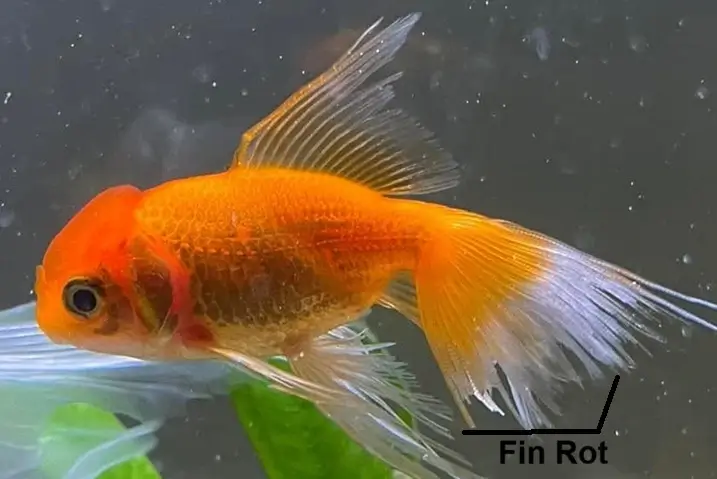
It’s almost always tied to poor water quality or stress weakening the fish’s immune system, which lets bacteria that are already present in the tank take hold. Early cases often clear up with a water change alone. More advanced cases need an antibacterial treatment and daily monitoring to stop it reaching the fish’s body.
You may read our full goldfish fin rot guide to know in detail about the symptoms, causes, and the exact treatment.
Goldfish Mouth Rot (Columnaris)
Despite the name, this isn’t actually a fungus. Rather it’s a quick spreading bacterial infection that shows up as flat, white or grey patches around the mouth. It’s one of the more aggressive infections a goldfish can develop, sometimes visibly worsening within hours in warm water.
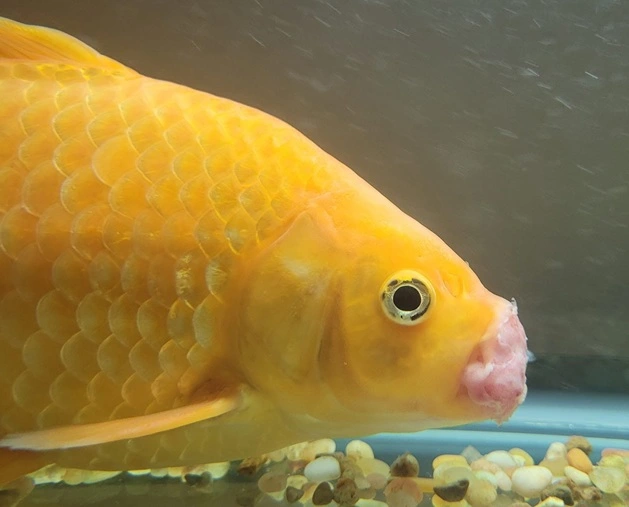
Because it’s mistaken for a true fungal infection so often, treating it with an antifungal medication instead of an antibacterial one is a common mistake, and it does nothing against this specific bacteria. Cooling the water slightly and starting antibacterial treatment quickly gives the best chance of stopping it before it spreads. Read our full goldfish mouth rot guide for how to tell it apart from a true fungal infection and know its syemptons , causes and best treatment.
Goldfish Red Pest Disease (Hemorrhagic Septicemia)
Red Pest shows up as blood-red streaks or patches on the skin and fins, caused by bacteria that are already present in most tanks and they only become a problem once a fish’s immune system is compromised, usually by poor water quality.
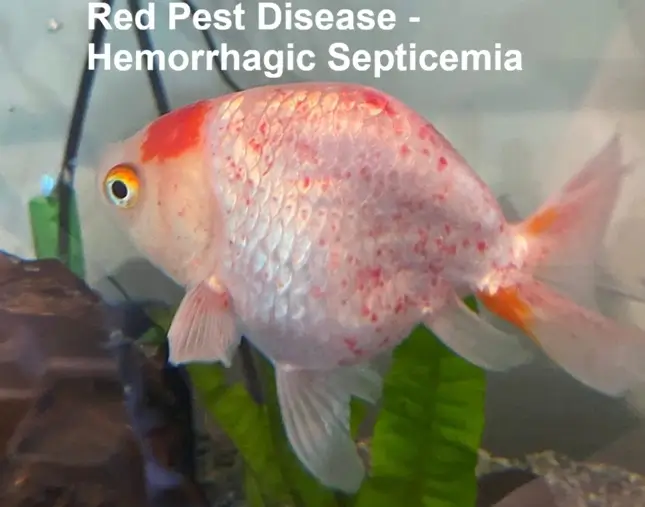
It does not spread directly from fish to fish through contact, but if the water conditions are bad enough to cause it in one fish, the rest of the tank is at the same risk. Treatment usually means antibiotics, ideally delivered through food since the infection is internal, alongside an immediate water change. You may our full goldfish red pest disease guide, to know the sypmtoms and treat them including how to tell it apart from ammonia poisoning.
Goldfish Dropsy
Dropsy isn’t a disease on its own but it’s a sign of serious internal organ failure, most often the kidneys, that causes fluid to build up inside the body. That fluid is what pushes the scales outward into the pinecone pattern that makes advanced dropsy so recognizable.
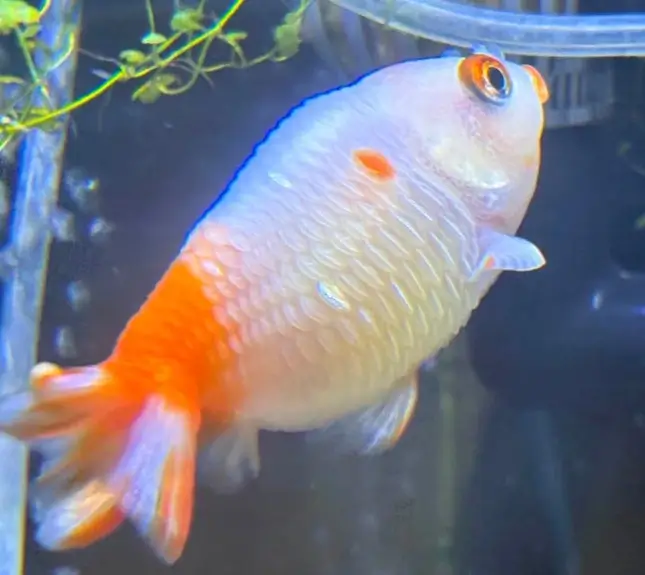
It’s worth being honest upfront that dropsy is difficult to treat once the pinecone stage is reached, since it means the underlying organ damage is already severe. Fish caught earlier, with only mild swelling, have a meaningfully better chance with prompt antibiotic treatment. You may need to feed medicated food to clear the disease that has spred internally if there is any chance to treat it successfully. Look at our goldfish dropsy guide for treatment and an honest look at prognosis.
Fungal Goldfish Diseases
Goldfish fungal infections are almost always secondary, taking hold on tissue that’s already damaged or weakened rather than attacking a healthy fish directly.
Goldfish Fungal Infection
A true fungal infection shows up as white or grey fluffy, cotton-like growths on the body, fins, or mouth. It’s one of the more visually distinctive diseases in the hobby, but also one of the most commonly misidentified, since it looks a lot like Columnaris despite being a completely different kind of infection. White spots limited only to the wen (the head growth on Orandas, Lionheads, and Ranchus) are usually just new tissue growth or shedding slime, not real fungus. It’s likely harmless if the fish is active, eating, and there’s no redness or rotting look. Take it seriously if spots spread past the wen, turn red, or the area looks sunken, that points to a real infection.
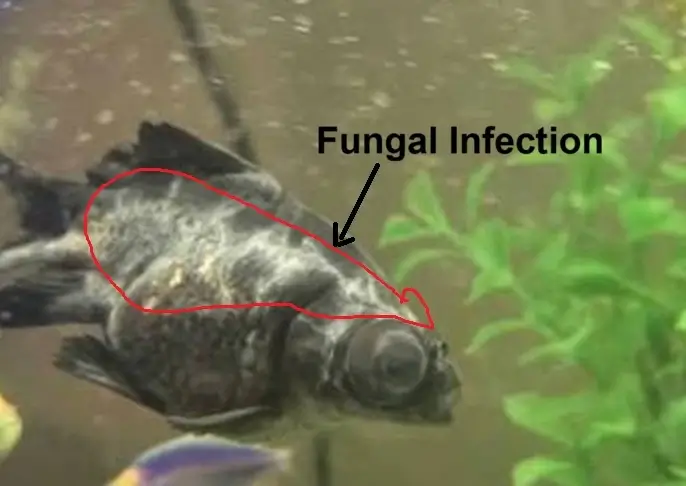
Because it’s almost always secondary, an injury, a healing wound, or skin already damaged by another infection is usually what let the fungal spores take hold in the first place. Treatment is a standard antifungal medication, but fixing whatever weakened the fish to begin with matters just as much.
Read our full goldfish fungal infection guide for how to tell it apart from Columnaris, which looks similar but needs completely different treatment.
External Parasitic Goldfish Diseases
These are parasites that live on the skin, fins, or gills. Some are microscopic; others, like anchor worm and lice, are large enough to see and remove by hand.
Goldfish Ich (White Spot Disease)
Ich shows up as tiny white spots resembling salt grains, and it’s one of the most common and contagious diseases. Each spot is the parasite in its feeding stage, and once it matures, it drops off and then multiplies into hundreds of free-swimming offspring, which is why an outbreak can spread through a tank within days.
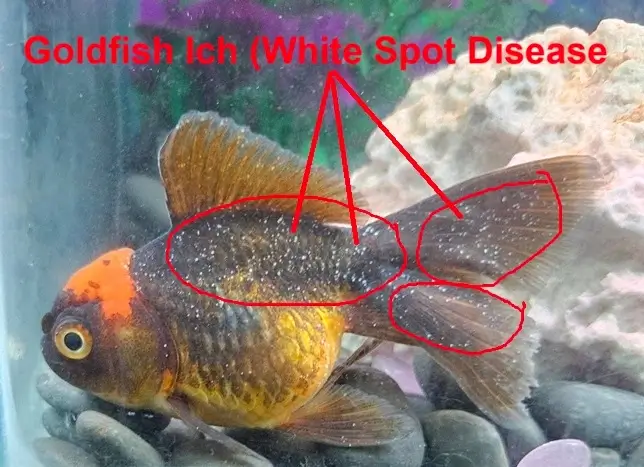
Treatment usually combines gradually raising the temperature, which speeds up the parasite’s life cycle into a vulnerable stage, with a malachite green or formalin-based medication continued for several days after the last spot disappears. Our goldfish ich guide covers for the complete treatment, symptoms and causes.
Goldfish Velvet Disease
Velvet coats the body in a fine gold or rust-colored dust that’s usually too subtle to see under normal tank lighting, which is why the standard way to confirm it is shining a flashlight on the fish in a darkened room. By the time it’s visible without one, the infection is already well established.
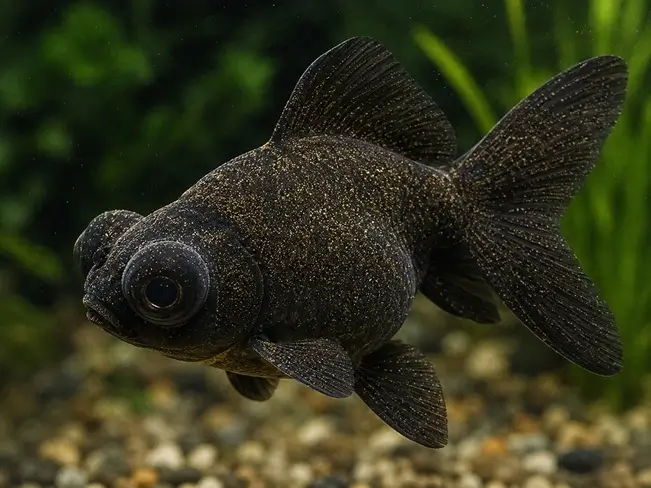
Like Ich, it has a free-swimming stage in the water that medication actually targets, so treatment means a copper or malachite green-based medication combined with dimmed lighting, since the parasite depends on light during part of its life cycle. Read our full goldfish velvet disease guide for the flashlight diagnostic test and treatment steps.
Goldfish Gill Flukes
Gill flukes are microscopic parasites that attach specifically to the gills, and because that’s the organ a fish breathes through, even a moderate infection causes real, fast-developing distress, with the fish gasping at the surface, rapid gill movement, and flared gill covers.
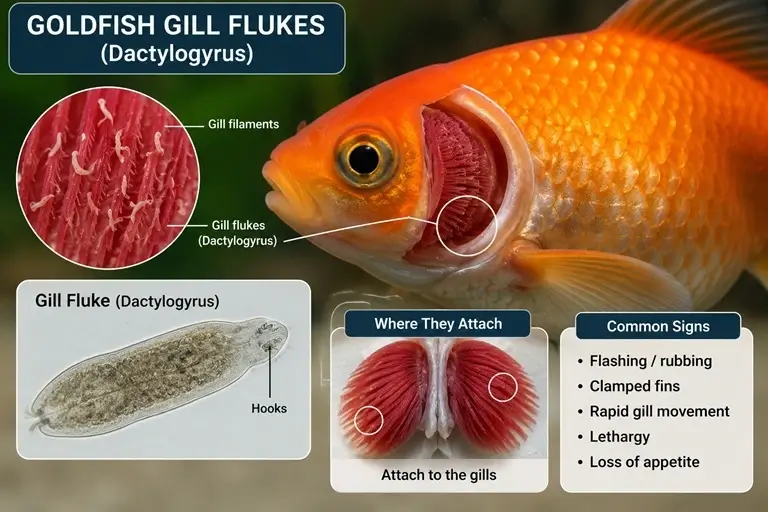
Praziquantel is the standard treatment, and it needs to be repeated on a schedule since a single dose doesn’t reach eggs that haven’t hatched yet, only the active parasites present at the time.
Read our full goldfish gill flukes guide, which also covers skin flukes and how the two differ.
Goldfish Anchor Worm
Despite the name, anchor worm isn’t actually a worm, it’s a crustacean parasite whose visible thread-like tail, trailing out from where it’s burrowed into the skin, is what usually gives it away. It’s one of the few goldfish parasites large enough to see and physically remove it with tweezers.
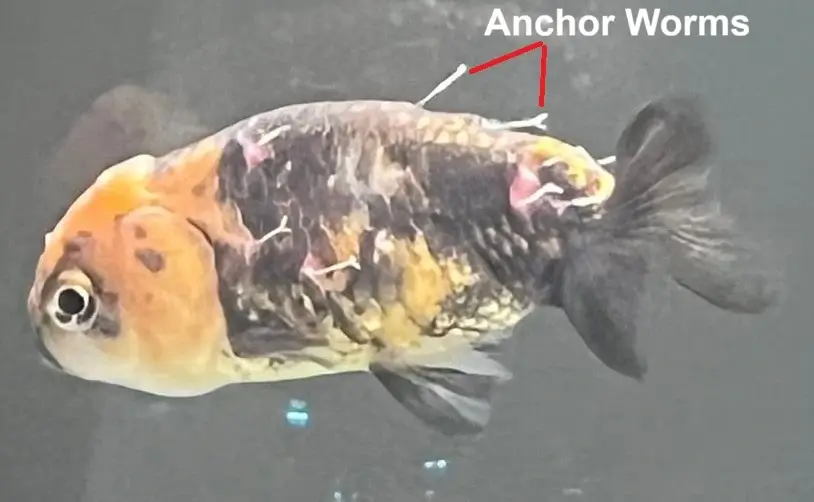
Careful tweezer removal, pulling the whole parasite out in one motion, is the usual first step, followed by a medication like diflubenzuron to clear any remaining juveniles in the water that a single removal pass would miss. You can read our full goldfish anchor worm guide for more information on it.
Goldfish Lice
Goldfish lice show up as flat, greenish or translucent discs stuck to the skin, another parasite large enough to spot and remove by hand rather than needing medication alone to deal with it.
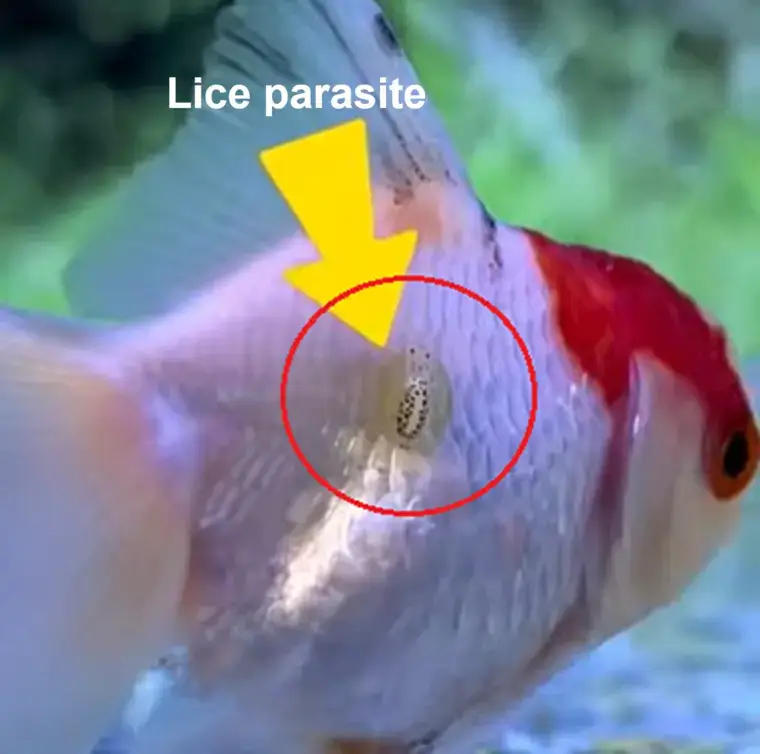
Manual removal followed by a diflubenzuron-based treatment mirrors the approach used for anchor worm, since both are large external crustaceans that need physical removal plus medication to fully clear. Read our full goldfish lice guide for removal and follow-up treatment.
Internal Parasitic Goldfish Diseases
These parasites live inside the digestive tract, often invisible until the infestation is already advanced.
Goldfish Camallanus Worms (Red Worms)
Camallanus worms live inside the intestine, and the only part you’ll ever actually see is a thin, red thread occasionally protruding from the vent, the one internal parasite that’s visible at all, and usually only once the infestation is already well advanced.
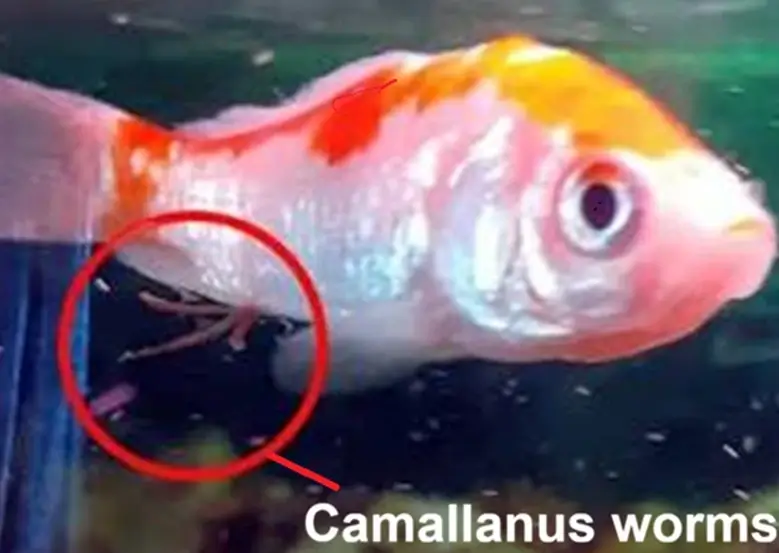
Medication like levamisole or fenbendazole only affects worms that have moved into a treatable position near the vent, not the population still deeper inside the fish, which is exactly why a single treatment often looks fails and repeat dosing is necessary. Read our full article on goldfish camallanus worms for why treatment sometimes seems to “not work” and how to fix that.
Goldfish Hexamita (Hole-in-the-Head)
Hexamita is a protozoan parasite that most fish already carry in small, harmless numbers, and it typically only causes visible problems, white stringy feces and weight loss despite normal appetite, once something else has weakened the fish’s immune system.
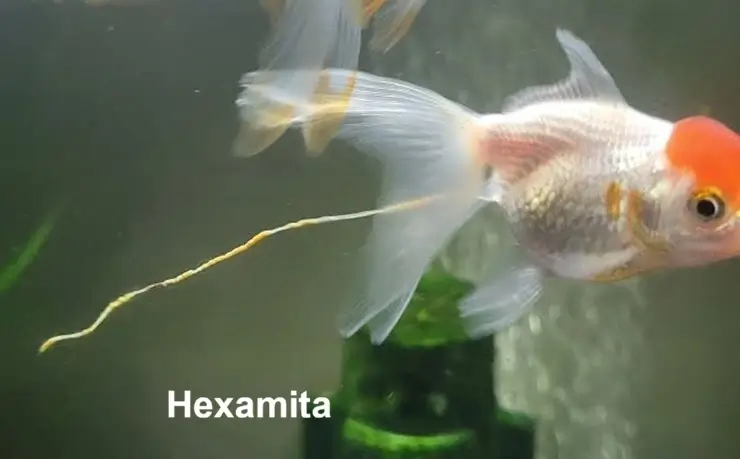
Metronidazole, ideally delivered through food, is the standard treatment, though fixing water quality matters just as much since this parasite is opportunistic rather than something introduced from outside. To know more read our full goldfish hexamita guide to know the symptoms, causes and treatment, including an honest look at its debated connection to Hole-in-the-Head disease.
Other Goldfish Health Problems
These aren’t caused by a single organism — each can stem from infection, injury, genetics, or diet, which is why identifying the actual cause matters more than reaching for one standard treatment.
Goldfish Popeye
Popeye is when one or both eyes swell and bulge outward, and which eye is affected actually tells you a lot: one swollen eye usually points to a physical injury or a bullying tank mate, while both eyes swelling together more often points to a systemic issue like poor water quality or an internal infection.
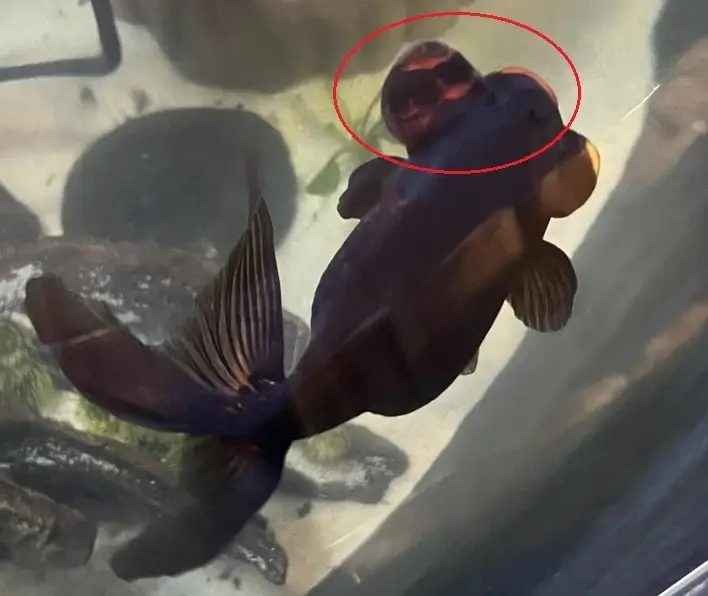
Epsom salt is commonly used to help draw the swelling down, alongside antibiotics if a bacterial cause is suspected, especially in cases affecting both eyes. Read our full goldfish popeye guide for what one-eye versus two-eye swelling usually tells you nad the most effective treatment.
Goldfish Swim Bladder Disease
Swim bladder disease shows up as floating, sinking, or swimming sideways, and it’s one of the most common goldfish health complaints, especially in fancy varieties whose rounded body shape leaves less internal room for the organ to work properly. Overfeeding is the single most common trigger even in straight-bodied goldfish.
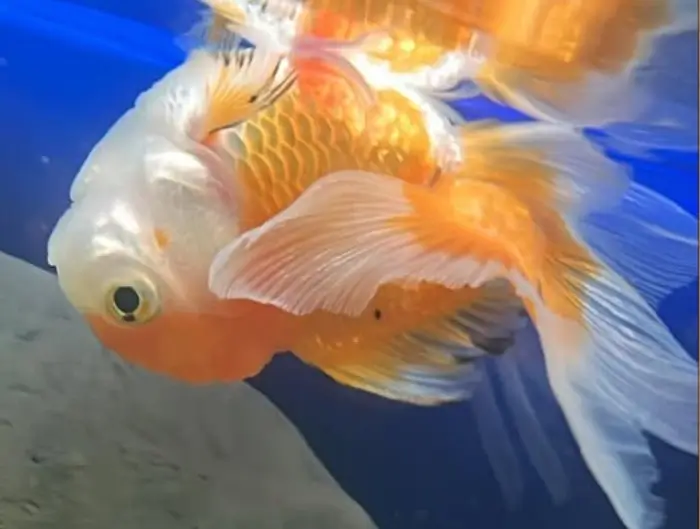
A short fast followed by a blanched, deshelled pea resolves a surprising number of cases within a day or two, though structural causes in fancy varieties don’t always fully resolve. Read and know more on goldfish swim bladder disease guide for the complete home treatment protocol.
Goldfish Bent Spine (Scoliosis)
A bent spine shows up as a visible C or S-shaped curve in the backbone, and the cause matters enormously for whether it’s fixable. Genetics and old injuries are permanent, but a Vitamin C deficiency from old, degraded food is a genuinely treatable cause if it’s caught before lasting damage sets in.
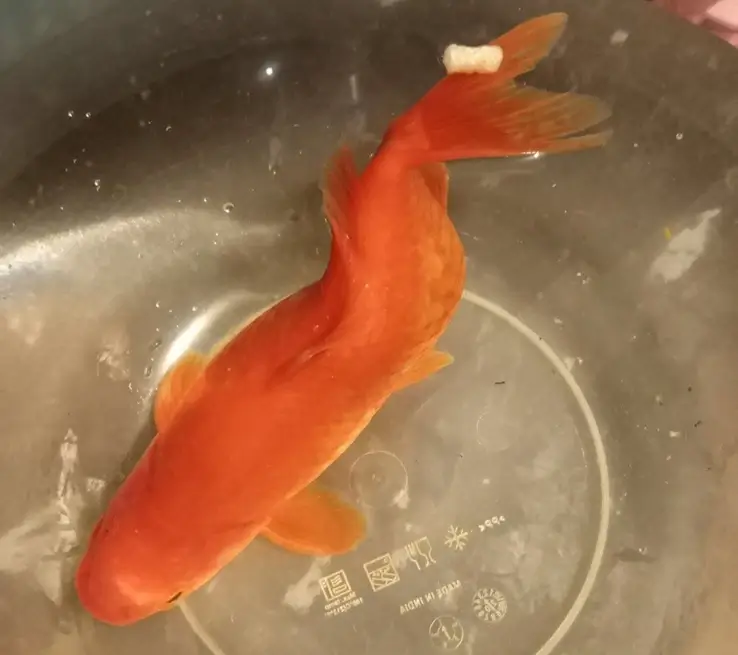
Switching to fresh food and supplementing with vegetables is worth trying for a few weeks before assuming the curve is permanent, since there’s a real chance a nutritional cause can still be corrected.
Read our full goldfish bent spine guide for which causes are genuinely fixable and which are permanent.
When Should You Separate a Sick Goldfish?
The decision comes down to two questions: is the disease contagious, and is the fish suffering from conditions in the main tank that are making recovery harder? If either answer is yes, isolation is almost always the right call.
• Separate immediately for: Ich, Velvet, Mouth Rot, or any visibly contagious parasite — these spread quickly, and every hour of delay increases how many fish are affected.
• Separation may not be necessary for: non-contagious conditions like Bent Spine, Swim Bladder Disease from overfeeding, or a fish that’s still active, eating, and holding its own.
• A quarantine tank doesn’t need to be elaborate — a simple tank with a sponge filter, a heater, and a hiding place is sufficient. Use water from the main tank to avoid adding the stress of adapting to completely different water on top of whatever illness the fish is already fighting.
How to Prevent Goldfish Illnesses
Prevention is always more effective than treatment, and far less stressful for both the fish and the keeper.
• Maintain stable water quality — test weekly, and perform regular partial water changes. This single habit prevents more disease than anything else on this list.
• Quarantine every new fish and plant for several weeks before adding it to your main tank or pond. This is the most commonly skipped step in the hobby, and the single most common reason outbreaks happen in otherwise healthy tanks.
• Avoid overcrowding, incompatible tank mates and remove any dead fish immediately — a decomposing fish degrades water quality fast and can spread infection to tank mates that pick at it.
• Feed a varied, high-quality diet and replace food regularly, since old or degraded food loses vitamin content that supports a fish’s immune system.
• Act early. A goldfish that’s slightly less active, hiding somewhere unusual, or holding its fins differently is showing an early warning sign. Catching that before visible disease develops is the difference between a five-minute fix and a two-week treatment course.
• Clean filter media every few months, rinsing it in clean water that doesnot contain chlorine. Chlorine kills the beneficial bacteria living in the media.
• Keep temperature stable with a reliable heater. A sudden thermal swing suppresses immune response the same way a water quality crash does.
• Add live plants. live plants absorb ammonia, nitrite, and nitrate directly, produce oxygen during the day which lowers the fish stress. When the stress is low, it greatly lowers the risk of disease in fish.
Frequently Asked Questions
What are the most common goldfish diseases?
Ich, fin rot, fungal infections, dropsy, swim bladder disorders, velvet, flukes, anchor worms, fish lice, and various bacterial and parasitic infections are among the common health problems seen in goldfish.
How do I know if my goldfish is sick?
Early signs include hiding more than usual, clamped fins, faster breathing, loss of appetite, and reduced activity — often before any visible spot, sore, or deformity appears. Test your water first whenever you notice any of these.
Can goldfish diseases spread to other fish?
Many can. Ich, Velvet, Mouth Rot, and most external parasites spread readily through shared water. Structural issues like Bent Spine and non-infectious conditions like Swim Bladder Disease from overfeeding cannot spread at all.
Are goldfish diseases dangerous to humans?
Almost none pose a real risk. The one notable exception is fish tuberculosis, which can rarely infect humans through open cuts — always wash your hands after handling tank water or a sick fish.
Why is my goldfish not eating?
Loss of appetite can occur with many different problems, including poor water quality, stress, parasites, infection, digestive problems, or other illness. It should be considered alongside the fish’s other symptoms.
Why is my goldfish sitting at the bottom of the tank?
Bottom sitting is a symptom rather than a specific disease. Poor water quality, stress, weakness, buoyancy problems, parasites, and infections can all contribute to abnormal resting at the bottom.
Why is my goldfish staying at the top of the tank?
A goldfish spending excessive time at the surface, particularly while gasping, can indicate low oxygen, water-quality problems, or gill disease. Check the water and oxygenation immediately.
Should I use medication whenever my goldfish looks sick?
Not automatically. Different diseases require different treatments, and some symptoms have several possible causes. Testing the water and identifying the most likely cause before medicating can help avoid unnecessary or inappropriate treatment.
Full List of Goldfish Diseases
Click any disease below for symptoms, causes, and full treatment steps:
• Goldfish Ich (White Spot Disease)
• Goldfish Velvet Disease
• Goldfish Fin Rot
• Goldfish Fungal Infection
• Goldfish Mouth Rot (Columnaris)
• Goldfish Dropsy
• Goldfish Popeye
• Goldfish Swim Bladder Disease
• Goldfish Gill Flukes
• Goldfish Anchor Worm
• Goldfish Camallanus Worms (Red Worms)
• Goldfish Hexamita (Hole-in-the-Head)
• Goldfish Red Pest Disease (Hemorrhagic Septicemia)
• Goldfish Bent Spine (Scoliosis)
• Goldfish Lice
Related Goldfish Symptom Guides
Sometimes a symptom points to a specific disease above, and sometimes it’s better covered as its own topic. These guides go deeper on individual behaviors that can show up across several of the diseases on this page:
• Goldfish Staying at the Top of the Tank
• Goldfish Staying at the Bottom
• Goldfish Swimming Erratically
• Goldfish Swimming Upside Down
• Goldfish Not Eating
• Goldfish Turning Black
• Goldfish Turning White
Final Thoughts
Goldfish diseases are rarely as mysterious as they first appear. In almost every case there’s an identifiable cause, a logical treatment, and a preventable set of conditions that allowed it to take hold in the first place. The keepers who lose the fewest fish aren’t the ones with the most expensive equipment — they’re the ones who test their water consistently, quarantine every new addition without exception, and act quickly when something doesn’t look right.
If your goldfish is sick right now, start with the water. Test ammonia, nitrite, nitrate, and temperature before anything else, fix whatever you find, then identify the disease using the guides above and begin treatment promptly. If your goldfish is currently healthy, keep it that way through consistency — stable water, appropriate stocking, varied nutrition, and quarantine for anything new are the four pillars of long-term goldfish health.
