
Goldfish egg development stages can be surprisingly easy to follow once you know what to look for. A freshly laid egg starts as a tiny, translucent sphere, and typically develops over 4 to 7 days at standard aquarium temperatures, sometimes faster in warmer water. At first the eyes and body become visible and then the body of the fry takes shape, reaching to a point where it hatches from the egg.
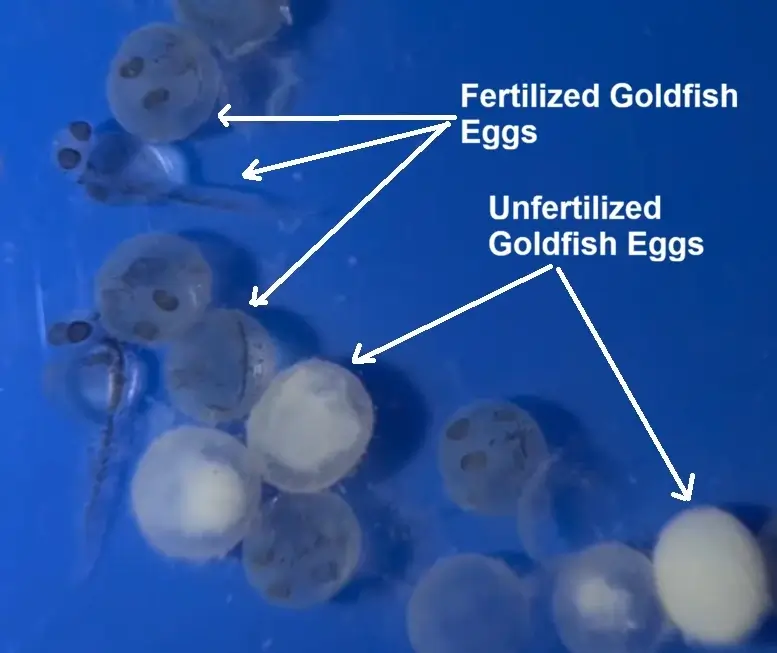
The exact hatching timing can vary slightly with water temperature and other conditions, so not all eggs develop at the same pace. It would just be a few hours difference for the healthy eggs to hatch. Watching the changes from day to day gives a much better idea of whether an egg is developing normally and how close it may be to hatching.
Quick Navigation:
➜ Goldfish Egg Development at a Glance
➜ Day 1: Freshly Laid Goldfish Eggs
➜ Day 2: Early Development
➜ Day 3: The Embryo Becomes Visible
➜ Day 4: Eyes and Body Become Noticeable
➜ Day 4–7: The Fry Takes Shape
➜ When Do Goldfish Eggs Hatch?
➜ What Happens After the Egg Hatches
➜ Why some Goldfish Eggs Don’t Develop
➜ Goldfish Egg Care During Development
➜ FAQ
Goldfish Egg Development at a Glance
You can understand goldfish egg development by watching the gradual change from a clear, freshly laid egg to a recognizable fish.
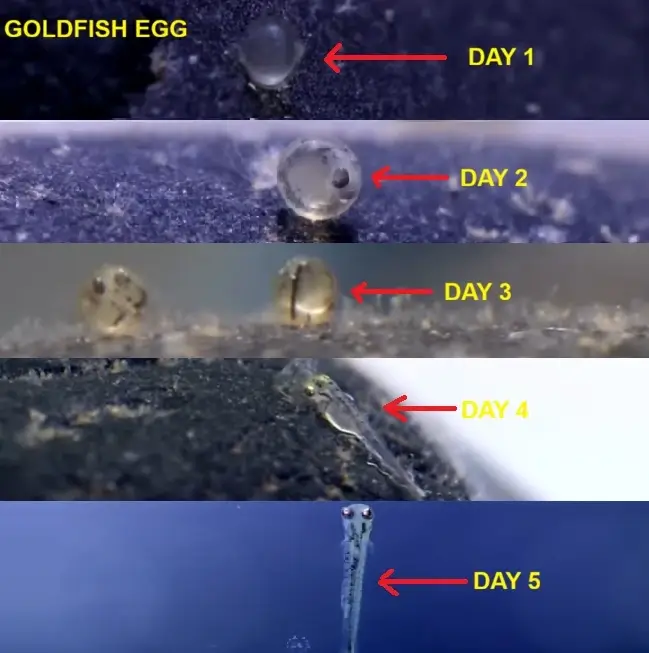
The timeline below gives you a quick visual guide to the main stages.
• Day 1: The eggs are freshly laid and look translucent with nothing visible inside yet.
• Day 2: Early embryo development begins, with a dark spot showing up which is the fry’s eye. Unfertilized eggs turn white or cloudy instead.
• Day 3: The embryo is easier to see, and the egg starts looking a bit more golden, with visible eye and spine development.
• Day 4: Eyes, spine, and the developing body become more noticeable, and the fry may start taking on its fish shape.
• Day 4–7 (sometimes sooner): The fry moves around more until it breaks out of the shell, tail first and then head. Once hatched, it sticks to a surface for a day or two living off its yolk sac, then becomes free-swimming and needs its first food. Warmer water hatches faster, sometimes in as little as 2 to 3 days, while cooler water can push hatching toward the higher end of the range.
These stages are a general guide rather than a strict schedule. Temperature can significantly affect how quickly goldfish eggs develop, so your eggs may be slightly ahead of or behind this timeline.
Day 1: Freshly Laid Goldfish Eggs
The freshly laid goldfish eggs are tiny, round, and sticky. They’re usually clear or pale yellow and attach to whatever surface they land on during spawning, including plants, spawning mops, decorations, and other aquarium surfaces. For a closer look at what they look like in a tank or on plants, see our guide on what goldfish eggs look like.
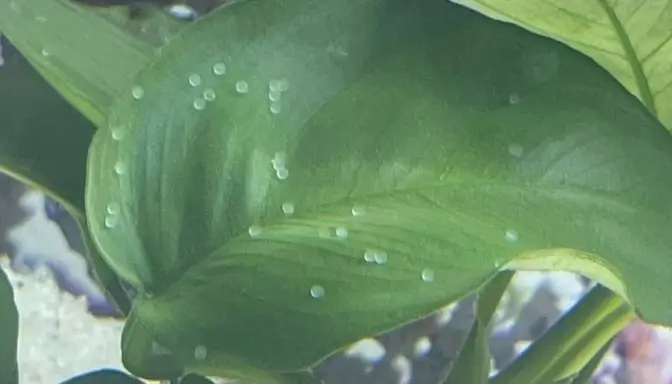
At this point, there may be very little visible inside the egg. A newly laid egg can look almost like a tiny clear bubble, which is why new goldfish keepers often mistake a group of eggs for debris when they first notice them.
If the eggs have been fertilized, development will begin inside them. If they haven’t been fertilized, they’ll eventually become cloudy or white rather than developing into fry.
Day 2: Early Goldfish Egg Development
During the second day, development inside a fertilized goldfish egg is still subtle. The egg remains small and translucent, but the developing embryo is beginning to form inside.
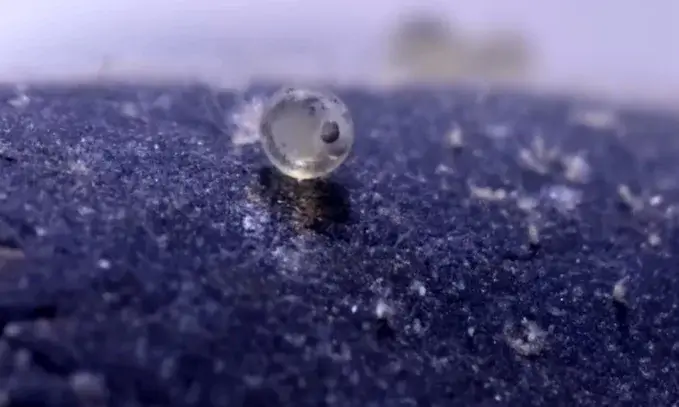
There may not be an obvious fish shape yet, but a black dot appears upon magnification, which is the fry’s eye. As development continues, the embryo becomes easier to distinguish and the changes become much more obvious.
Day 3: The Embryo Becomes Visible
By the third day, the changes inside a fertilized goldfish egg are usually easier to notice. The developing embryo becomes more defined, and with a clear close up image you may be able to see darker areas beginning to form inside the egg which is the fry’s eye and spine.
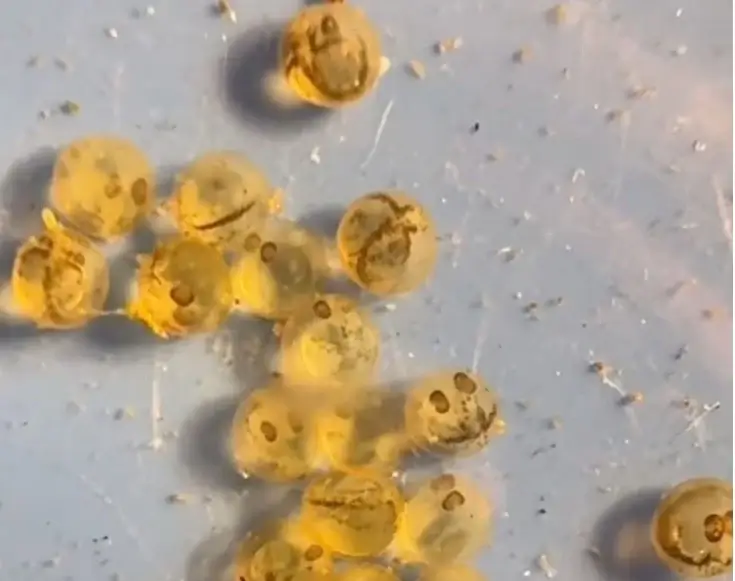
This is also around the stage where it becomes easier to separate a developing egg from one that has stopped developing. A healthy developing egg remains relatively clear or golden, while an unfertilized or failed egg may become increasingly white or cloudy.
Don’t worry if the embryo isn’t obvious in every egg. Visibility depends on the egg itself, the lighting, and how closely you’re able to examine it.
Day 4: Eyes and Body Become Noticeable
As development continues, the young fish becomes much easier to recognize inside the egg. Dark eye spots may become visible, while the developing body begins to curve around the inside of the egg.
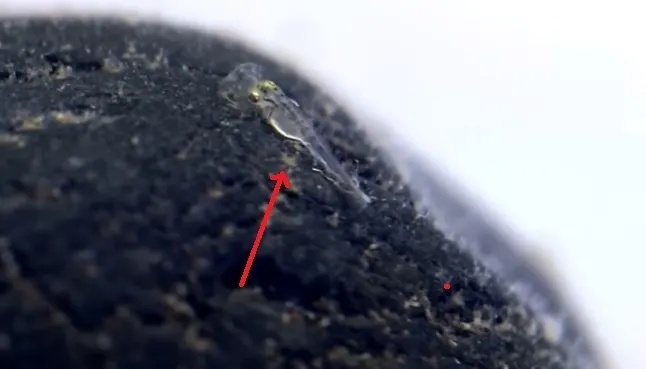
This is one of the most interesting stages to watch because the egg no longer looks like an empty, transparent sphere. Instead, you can begin to see that there’s a developing fish inside.
Day 4–7: The Fry Takes Shape
By this stage, the developing goldfish is increasingly recognizable. The body becomes more defined as the fry gets closer to hatching, and by day 7, most eggs in a healthy batch have hatched.
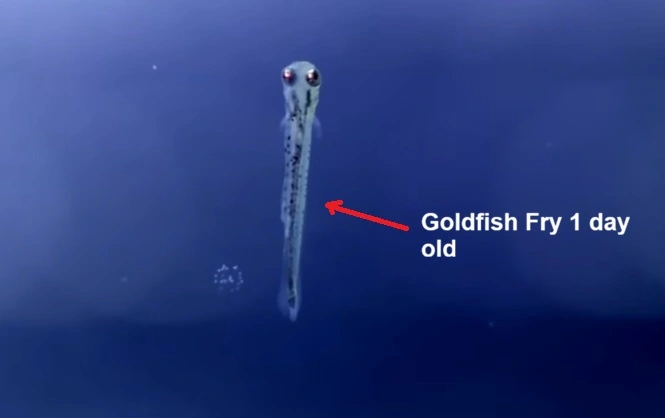
If you compare this stage with a freshly laid egg, the difference is dramatic. Instead of a clear sphere, you can now see a developed fry with a recognizable body shape.
Once hatched, the fry sticks to a nearby surface and lives off its yolk sac for the first day or two, no feeding needed yet. Once that yolk sac is used up, it becomes free-swimming and starts looking for its first food.
Don’t expect every egg in a spawning batch to look identical on the same day or hatch at exactly the same pace.
When Do Goldfish Eggs Hatch?
Most goldfish eggs hatch within 4 to 7 days at typical aquarium temperatures (68–75°F), although the exact timing depends mainly on water temperature and the conditions in which the eggs are developing. In warmer water, hatching can happen noticeably faster, sometimes in as little as 2 to 3 days, while cooler water can push hatching toward the higher end of that range or slightly beyond.
Rather than looking for one exact hatching day, watch for the signs of a fully developed fry inside the egg. As the embryo develops, its eyes and body become easier to see until the young fish is ready to break free from the egg.
• Early stage: The egg looks mostly clear with little visible development.
• Middle stage: The embryo, developing eyes and spine become easier to see.
• Late stage: The fry fills more of the egg and its body becomes clearly recognizable.
• Hatching: The developed fry emerges from the egg and begins the next stage of its life.
Because of variation in pace of development, a visual stage of the embryo can be more useful than counting the exact number of days.
What Happens After the Egg Hatches?
The newly hatched fry looks nothing like an adult goldfish, and almost nothing like the fully developed embryo you were watching inside the egg just hours earlier.
• It’s tiny and mostly transparent, often just a few millimeters long, with a simple body shape that hasn’t filled out yet.
• It sticks to a surface rather than swimming. Most newly hatched fry attach themselves to plants, glass, or decorations using a small adhesive gland, and stay there for the first day or two.
• It doesn’t need feeding yet. The fry is still absorbing its yolk sac, which supplies all the nutrition it needs during this stage.
• Once the yolk sac is gone, it becomes free-swimming and starts actively searching for its first food, usually within 24 to 48 hours of hatching.
Why Some Goldfish Eggs Don’t Develop
Not every egg from a spawning survives to hatch, and the reasons come down to a few specific things.
• Never fertilized: during spawning, the male releases milt over the eggs as the female lays them, and not every egg gets reached in time. This is the single biggest reason an egg fails, simple bad timing in a chaotic process, not anything wrong with the fish.
• Poor oxygenation: developing embryos breathe through the egg membrane, so eggs buried under others or sitting in a low-flow spot can suffocate and stop developing partway through, even if they were fertilized.
• Genetic or developmental defects: some fertilized eggs simply stop developing on their own, unrelated to water conditions, the same way not every fertilized egg in most animals goes on to develop successfully.
• Why a whole batch can be lost: eggs are laid in dense, sticky clusters, touching each other directly. Once an unfertilized or dead egg starts growing fungus, it spreads through direct contact to the healthy eggs around it, and a batch that started with a strong fertilization rate can end up with few or no survivors if that spread isn’t stopped early.
• Removing failed eggs promptly is what actually protects the rest of the batch, since it’s the physical contact and shared water that lets fungus spread, not something in the water alone.
➜ Read the full guide: How Do Goldfish Eggs Get Fertilized?
Goldfish Egg Care During Development
Goldfish eggs are vulnerable during development, so stable aquarium conditions are more important than repeatedly disturbing or moving them. If you’re trying to raise the fry, the goal is to give developing eggs clean, well-oxygenated water without any infections in the tank.
• Keep the water clean: Good water quality helps reduce the conditions that can cause developing eggs to fail.
• Provide gentle water movement: Adequate circulation and oxygenation are important, but strong currents can be unsuitable for delicate eggs and newly hatched fry.
• Avoid unnecessary disturbance: Once eggs are attached to plants or a spawning mop, avoid repeatedly moving or handling them.
• Watch for fungus: White or cloudy eggs that develop fuzzy growth should be monitored closely so problems don’t spread to nearby healthy eggs.
• Keep conditions stable: Sudden changes in temperature or water chemistry can interfere with successful development.
FAQ
Can you see a baby goldfish inside an egg?
Yes. As a fertilized egg develops, the embryo gradually becomes visible. The eyes may appear as small dark spots, followed by a more recognizable body shape as the fry gets closer to hatching.
Why are some goldfish eggs white?
Goldfish eggs that become white, opaque, or cloudy are often unfertilized or have stopped developing. These eggs can also become susceptible to fungal growth, so they may eventually develop a fuzzy appearance.
Do goldfish eggs change color as they develop?
They can appear different as development progresses. Healthy developing eggs generally remain relatively clear or golden while the embryo becomes increasingly visible inside.
Can goldfish eggs hatch on different days?
Yes. Eggs from the same spawning can develop at slightly different rates. Water temperature is one of the main factors affecting how quickly the embryos develop.
How can you tell if a goldfish egg is developing?
A developing egg gradually shows more of the embryo inside. As development progresses, darker areas such as the eyes and the curved body of the fry become easier to see.