
If you suddenly spot a cluster of tiny black specks darting around your goldfish tank or pond, there’s a good chance you are looking at baby goldfish, which are often mistaken for tadpoles, mosquito larvae, or any other unwanted insects. So what do baby goldfish look like exactly? Not much like the gold, orange, or calico adults that most people picture. They start out grey, brown, or almost translucent based on genetics. You can see through them, and they are barely bigger than a grain of rice. This is exactly why so many goldfish pond and tank owners are caught off guard the first time they notice them.
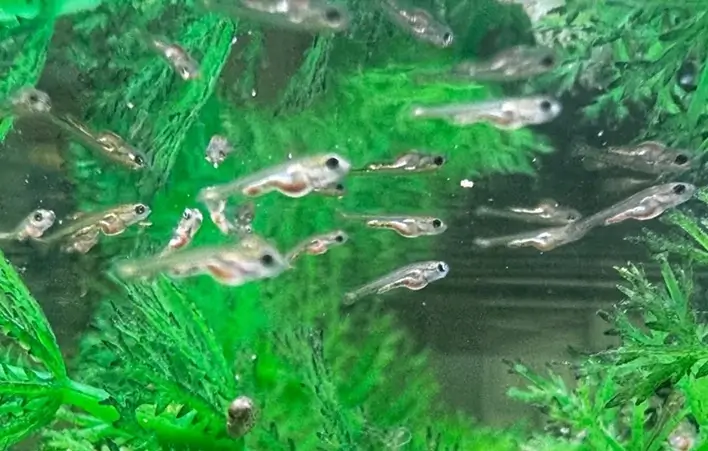
They can’t swim on their own at first either. For the first few days, they stay stuck to plants or whatever tank surface the egg was laid on. When you look closer in the light after a day or two, you can often make out their eyes, head, tiny organs, and stomach through the skin. You might even notice a slightly plump belly from the yolk sac, which they are still living off.
Quick Navigation
1) What Baby Goldfish Look Like When They Hatch
2) How Baby Goldfish Change Color As They Grow
3) What Baby Goldfish Look Like in a Pond
4) Frequently Asked Questions
What Baby Goldfish Look Like When They Hatch
Goldfish eggs typically hatch within 4 to 7 days of being laid (see our guide on goldfish egg development stages for the full timeline). When they first hatch, baby goldfish hardly look like a fish. They remain attached to plants, spawning mops, or tank surfaces, living off a yolk sac rather than swimming freely.
After 3 to 4 days, they look:
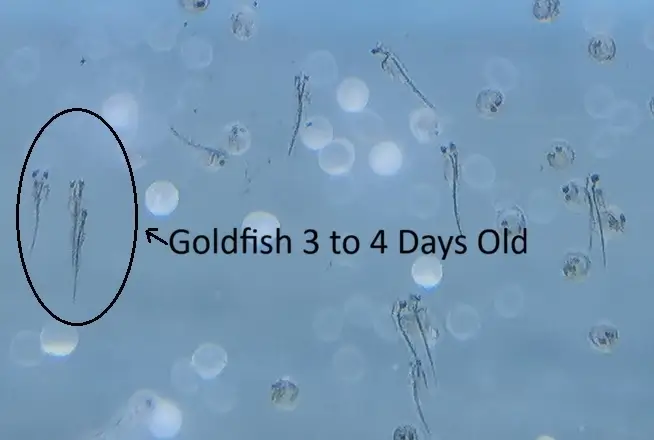
• A few millimeters long (4 mm to 6 mm), roughly the size of a grain of rice.
• Nearly transparent, with a visible yolk sac attached to their underside
• Slightly dark or grey in color, not gold
• Motionless for long stretches, only shaking or twitching occasionally
Once the yolk sac is absorbed, usually after 3 to 4 more days, the fry become free-swimming and start looking for food on their own.
How Baby Goldfish Change Color As They Grow
The grey or bronze coloring on the fry is not a sign of poor health. It is a camouflage mechanism against predators, similar to what most animals rely on. As the fry grows, the dark pigment called melanin slowly breaks down, letting the orange, red, or white colors take over depending on the genetics. For the full week-by-week color changes, including when patches of gold, white, or black appear, read our guide on when goldfish fry get their color and also learn why some goldfish never turn orange at all.
What Baby Goldfish Look Like in a Pond
Pond goldfish fry are where most of the confusion happens. The visibility in ponds is far lower compared to a glass tank. Most outdoor ponds develop algae due to direct sunlight falling on them, which adds to the visibility problem. Goldfish fry appear dark, grey, or brown and stay that way for weeks. For first-timers, a sudden discovery of a large batch of small black fish in a pond is very often mistaken for tadpoles or some other species fry.
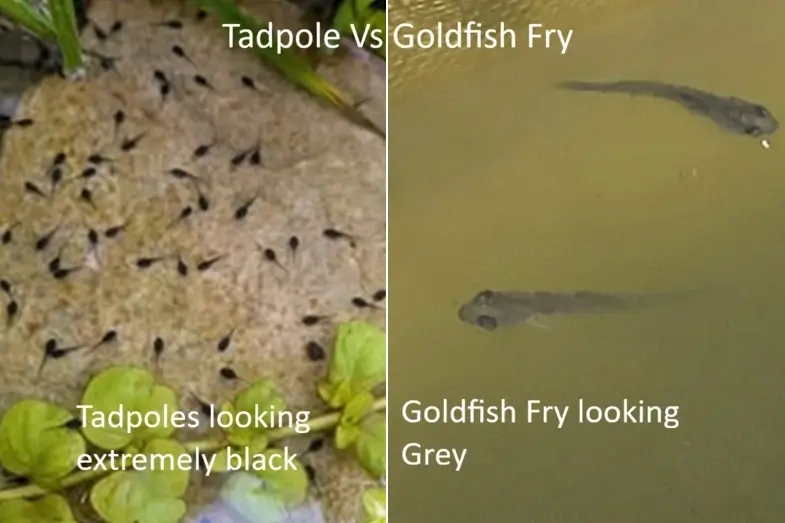
A few things can make pond goldfish fry easy to misidentify:
• Goldfish babies often show up in large numbers in a single spawning event, especially if there are no predator fish that would eat the fry immediately.
• Ponds, being outdoors most of the time, can also contain other small life such as frogs, insects, and snails. So goldfish fry are often misread as fry of other species.
• Some hobbyists keep other fish like koi and goldfish in the same pond. They look similar to goldfish fry. The one reliable way to tell the fry apart is that koi fry develop small barbels (whisker-like feelers) near the corners of their mouths if you watch them closely enough.
Frequently Asked Questions
Do all baby goldfish turn orange eventually?
No. Most fry gain gold, orange, or white coloring over their first year, but some keep their dark, wild-type coloring for life depending on their genetics.
How can you tell how old a baby goldfish is just by looking at it?
Size and color together can give a rough estimate. A dark fry under an inch is usually only a few weeks old, while fry starting to show gold patches could typically be 2 to 3 months old. Genetics and feeding can speed this up or slow it down significantly. So it is just an estimate, not an exact age.
Why are my baby goldfish black instead of gold?
Baby goldfish are often black, grey, brown, or bronze when they are young, so this is usually completely normal. Their early dark coloration helps them blend into their surroundings and provides camouflage while they are small and vulnerable. As they grow, the darker pigment may gradually fade and their adult colors, such as gold, orange, red, white, or combinations of these, begin to appear.
When do baby goldfish start swimming?
Newly hatched fry spend the first few days attached to plants, spawning material, or other surfaces where the eggs land. After they absorb most of their yolk sac, they become free-swimming and begin actively moving around in search of food.
Can you tell if a baby goldfish is a fancy goldfish or a common goldfish?
It can be difficult to tell when they are very young. Most fry initially have a similar slender body shape, and the distinctive body shapes, head growth, tail forms, and other traits of fancy goldfish become easier to recognize, particularly after the first couple of months.
Why can’t I see my baby goldfish in the tank?
Baby goldfish are extremely small and nearly transparent during their first few weeks. Looking closely around plants and other surfaces is often the easiest way to find them. However, if they suddenly disappear, they may have been eaten by adult goldfish or other tankmates, as larger fish can easily prey on very small fry.