
Goldfish lice are not actually lice at all. They are crustacean parasites related to crabs and shrimp, and they are large enough to see with a naked eye. If your goldfish is repeatedly scraping itself against surfaces and you notice small, flat, greenish or translucent discs attached to its skin or fins, fish lice are a likely cause.
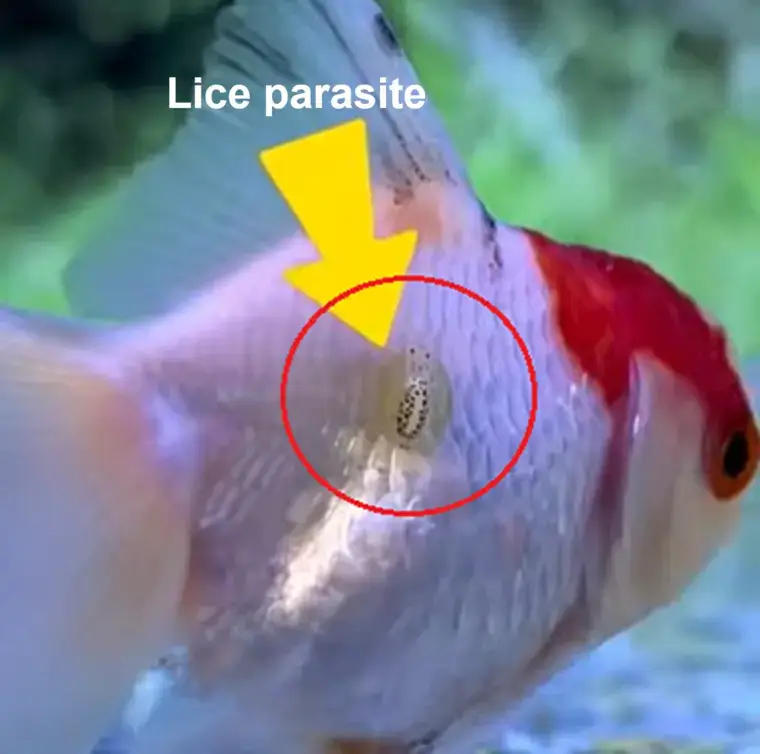
Visible lice can be carefully removed with tweezers and a steady hand. I have personally removed them this way from many of my goldfish. However, removing the visible lice from the fish does not eliminate eggs and other life stages that may still be present in the aquarium or pond.
Quick Navigation
1) What Are Goldfish Lice?
2) Lice Quick Facts
3) Lice Symptoms
4) Goldfish Lice Life Cycle
5) What Causes Lice in Goldfish?
6) Goldfish Lice Treatment
7) How to Prevent Goldfish Lice
8) FAQ
9) Final Thoughts
What Are Goldfish Lice?
Goldfish lice (Argulus) are parasitic crustaceans which are relatives of crabs, lobsters, and shrimp and they are not actual lice. The name stuck simply because of how they look and behave on a fish.
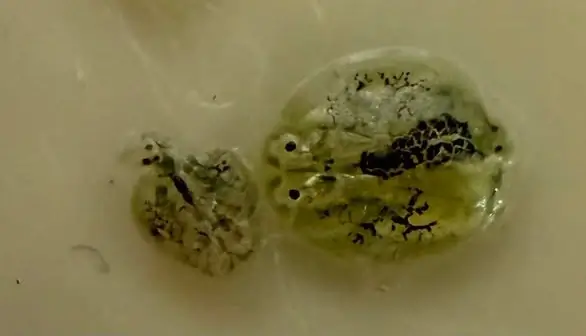
• Fully grown lice are roughly 3–7 mm long and 2–4 mm wide, flat, oval, and often translucent, which can make them surprisingly easy to miss, especially on lighter-colored fish.
• Unlike anchor worms, they do not stay permanently attached. Adults can detach from the fish and swim freely in the water before attaching to a host again.
• Adults use sucker like structures to attach to the fish, while younger stages use hooks. They pierce the fish skin and feed on the fish’s body fluids.
• Heavy infestations can be dangerous. Fish lice damage the skin, cause irritation and small hemorrhages, and can contribute to anemia and secondary infections. Severe infestations can eventually kill the fish.
Lice Quick Facts
| Attribute | Details |
| Type | Parasitic crustacean (Argulus), not a true lice. |
| Size | 3–7 mm long and 2–4 mm wide — visible to the naked eye. |
| Common Attachment Sites | Skin, fins, gills, and mouth. |
| Contagious? | Yes — adults can detach, swim freely, and move between fish. |
| Life Cycle | About 30–60 days, depending on species and water temperature. |
| Main Treatment | Manual removal plus treatment of the aquarium or pond to break the life cycle. |
Lice Symptoms
Visible lice: Small, round, translucent or greenish-brown discs may be seen attached to the body or fins, sometimes moving. This is the clearest sign of fish lice, although they can be harder to spot on lighter-colored fish or in poor lighting.
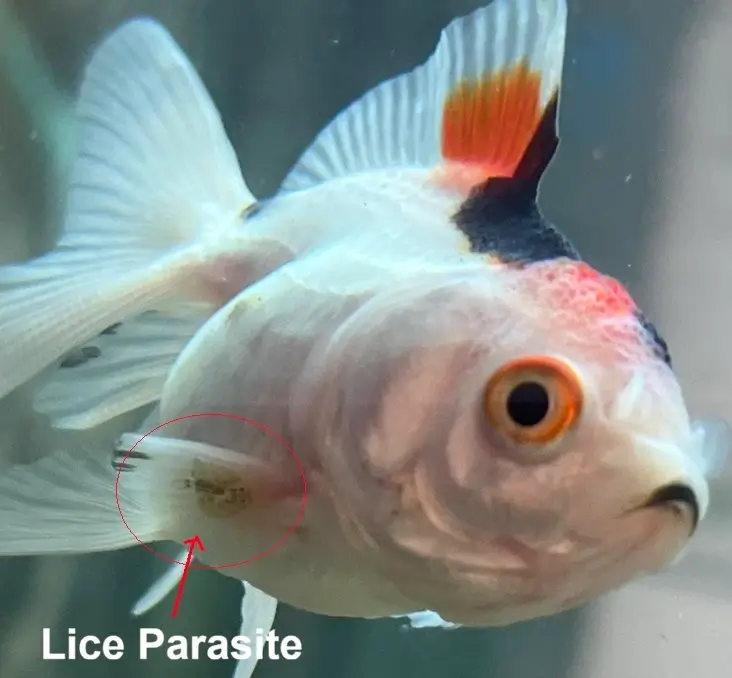
Changes in behavior: Flashing against rocks, gravel, or tank walls is common as the fish tries to dislodge the lice. Some fish may also swim erratically.
Skin damage: Small red hemorrhages or open sores can develop where the lice attach and feed. These damaged areas can also become vulnerable to secondary infection.
Lethargy: Heavily infested fish may become lethargic and swim less. With a light infestation, however, there may be few obvious symptoms apart from the visible lice themselves.
Goldfish Lice Life Cycle
Understanding the life cycle explains why removing the visible lice or treating the water just once may not clear an infection completely.
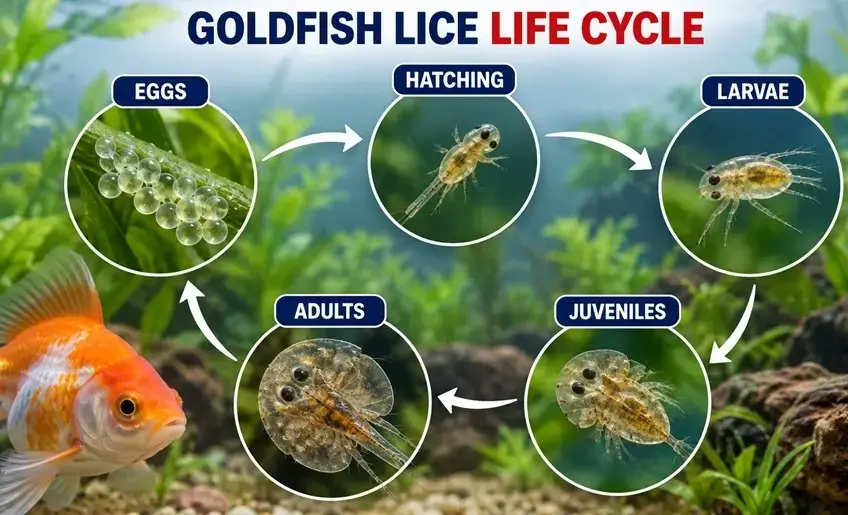
• Adult females leave the fish to lay eggs on hard surfaces, plants, and other objects in the aquarium or pond.
• Hatching time depends heavily on water temperature. Eggs generally hatch faster in warmer water and much more slowly in cooler conditions.
• Newly hatched larvae must find a fish fairly quickly. Newly hatched lice need to find a fish within about 2–3 days or they may die.
• Once they find a host, they go through several juvenile stages and repeatedly molt as they grow. They can reach maturity in roughly 30–40 days, depending on species and temperature.
• Adult females eventually leave the fish again to lay eggs, continuing the cycle. Adults can also survive away from a fish for some time.
• Eggs can survive cold conditions and overwinter, which is particularly important in outdoor ponds. They can begin developing and hatching again as conditions become favorable.
What Causes Lice in Goldfish?
• Introducing an infested fish is one of the main ways fish lice enter an aquarium or pond, especially when new fish are added without quarantine.
• Plants and other wet materials from an infested pond can also carry lice or their eggs into another system.
• Outdoor ponds are more commonly affected because fish, plants, water, and equipment may provide more opportunities for the parasite to be introduced.
• Once lice are established, the infestation can continue through eggs laid on surfaces and plants. This is why removing the visible lice from the fish alone may not solve the problem.
Goldfish Lice Treatment
Removing the lice you can see is only the first step. You also need to deal with lice and eggs remaining in the aquarium or pond, which is why treatment usually takes several weeks.
1. Test the Water First
Before treatment, test ammonia, nitrite, nitrate, pH, and temperature. Ammonia and nitrite should ideally be 0 ppm. Good water quality is especially important because fish lice leave damaged areas on the skin that need to heal.
2. Remove Visible Lice
Carefully remove visible lice with fine tweezers. Hold the goldfish gently and pull each parasite away carefully with tweezers.
I have personally removed many fish lice this way from my goldfish. Physically removing the visible lice gives the fish immediate relief and allows the damaged areas to begin healing.
However, manual removal will not remove eggs or lice still present elsewhere in the aquarium or pond, which may attach to the fish again.
3. Treat with Fish Lice Medication
Use a medication specifically made for fish lice and other crustacean parasites.
Cyromazine is one option. Fish lice treatments containing cyromazine interfere with the parasite’s development and molting.
Diflubenzuron is also effective against fish lice, but in the United States it is a restricted-use pesticide, so it is not the first DIY treatment I would recommend for the average goldfish keeper.
Always use the dose printed on the particular product you buy rather than using a generic dose.
4. Remove Carbon and Keep Good Aeration
Check the medication label before treatment. If it instructs you to remove activated carbon or other chemical filtration, remove it because these media can interfere with some medications.
Do not automatically switch off your biological filter. Follow the instructions for the particular medication you are using.
Keep good aeration throughout treatment using an air stone.
5. Repeat Treatment to Break the Life Cycle
One treatment may not be enough because eggs remaining on surfaces can hatch later.
Fish lice have a life cycle of roughly 30–60 days, depending on the species and water temperature. Treatment therefore needs to account for lice that hatch or develop after the first treatment.
The exact treatment schedule depends on the medication you use. Some products require repeated treatment at weekly intervals, while others use a different schedule. Always follow the product label.
6. Treat the Entire Aquarium or Pond
For pond fish, removing lice from individual goldfish is not enough. Eggs may already be attached to pond walls, plants, rocks, and other surfaces.
Treat the whole affected pond or Aquairum with a fish lice medication specifically labeled for ornamental ponds. Calculate the pond volume carefully before dosing.
Be especially careful if the pond contains shrimp, crayfish, or other crustaceans, as medications designed to kill fish lice may harm them too.
7. Can Aquarium Salt Help?
Aquarium salt can be useful as supportive care for freshwater fish with damaged skin, but it should not be relied upon to kill fish lice.
Research specifically on Argulus(Fish lice) indicates that increased salt concentration is not an effective way to control the parasite in freshwater.
So if salt is used to support a recovering goldfish, it should be considered supportive care, not the main fish lice treatment.
8. Watch the Wounds for Infection
The small red marks and sores left by fish lice are injuries and do not automatically require antibiotics.
Keep the water clean and watch the affected areas while they heal. If a wound becomes increasingly red, swollen, ulcerated, or develops other clear signs of bacterial infection, then a separate antibacterial treatment may be needed.
Do not use antibiotics routinely just because fish lice were present.
9. Check the Fish After Treatment
Continue inspecting the fish after the final treatment. Look for new lice, flashing, red marks, or sores.
If lice continue appearing after the full treatment course, do not simply keep adding medication. Recheck the aquarium or pond volume, treatment instructions, and whether lice could be continually reintroduced.
How to Prevent Goldfish Lice
• Quarantine every new fish for several weeks before adding it to your main tank or pond, and inspect it closely for any visible parasites during that period.
• Quarantine new live plants too, especially anything wild-collected or sourced from an outdoor pond — eggs can be present without any visible sign on the plant itself.
• Ask about parasite treatment history when buying fish from a breeder or seller, particularly for pond-raised goldfish or koi.
• Check your fish regularly, especially in outdoor ponds where an infestation can develop and spread before it’s noticed.
Goldfish Lice FAQ
Are Goldfish Lice Harmful to Humans?
No. Fish lice are parasites of fish and are not known to infect humans.
Can Fish Lice Spread From a Pond to an Aquarium?
Yes. Fish, plants, wet equipment, or other materials moved from an infested pond can potentially introduce fish lice or their eggs into another system. Avoid sharing nets and wet equipment between systems without cleaning them first.
Can Goldfish Lice Live on Other Fish?
Yes. Fish lice are not limited to goldfish. They can infest koi and many other freshwater fish, so other fish sharing the aquarium or pond should also be inspected.
Can Goldfish Lice Come From Live Plants?
Yes. Lice eggs can be laid on aquatic plants and other submerged surfaces. Plants taken from an outdoor pond or another system with fish lice eggs can therefore introduce the parasite even when no lice are immediately visible.
Do Goldfish Lice Die During Winter?
Not necessarily. Cold temperatures slow their development, but eggs can survive through winter and hatch when conditions become favorable again. This is particularly relevant to outdoor ponds.
Are Goldfish Lice the Same as Anchor Worms?
No. Both are crustacean parasites, but fish lice (Argulus) are flat, disc-shaped parasites that can detach and swim, while anchor worms (Lernaea) become embedded in the fish and look more like thin threads protruding from the body.
Final Thoughts
Goldfish lice can look alarming, but they are one of the easier parasites to spot because they are visible to the naked eye. Removing visible lice promptly, treating the aquarium or pond to break the life cycle, and keeping an eye on the wounds afterward are the key steps to getting the infestation under control.
For more on keeping your goldfish healthy, see our complete guide to goldfish diseases and our guides on goldfish anchor worm and goldfish gill flukes.