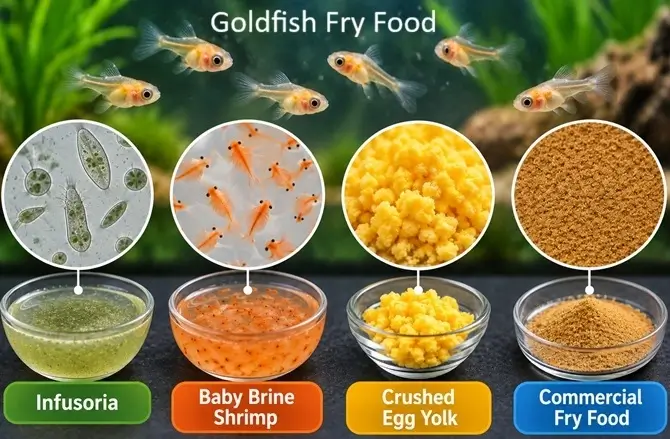
Goldfish fry or baby goldfish can’t eat the same food as adults, and feeding them too early or with pieces that are too large is one of the most common reasons a batch of fry doesn’t survive its first week. So what do goldfish fry eat once they are free-swimming? Tiny, protein-rich foods like infusoria, freshly hatched baby brine shrimp, crushed hard-boiled egg yolk, or a commercial powdered fry food, since anything bigger simply won’t fit in their mouths yet.
What they eat keeps changing fast as they grow, so timing matters as much as the food itself.
Quick Navigation:
1) The First 2 Days: No Food at All
2) First Foods Once They’re Free-Swimming
3) What to Feed Goldfish Fry, Week by Week
4) How Often to Feed Baby Goldfish
5) What Do Goldfish Fry Eat in a Pond
6) Frequently Asked Questions
The First 2 Days: No Food at All
For roughly the first 2 days after being laid, goldfish fry don’t eat anything. Most of them are not even hatched yet, and the ones that are stay still and don’t move. They are still absorbing their yolk sac and don’t yet have a functional mouth. Trying to feed them during this window just pollutes the water, since nothing gets eaten.
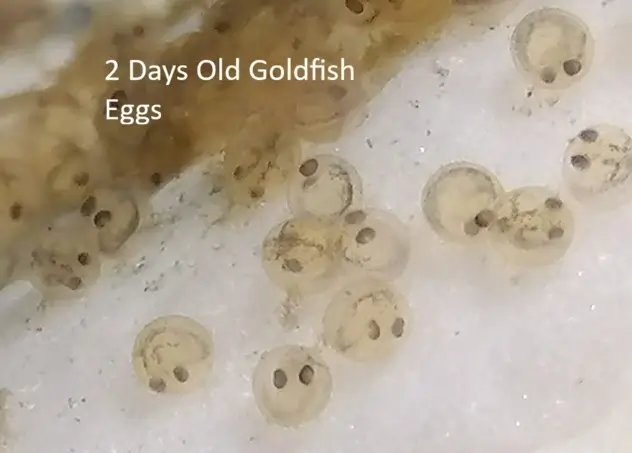
Once the yolk sac is used up and the fry become free-swimming, usually around day 3 or 4, they’ll start actively searching for food and need their first meal.
What to Feed Goldfish Fry, Week by Week
The main challenge at this stage is size. Baby goldfish mouths are tiny, so the first food needs to be just as small, and what works keeps changing as they grow. Below are some of the options that you can feed your newborn baby goldfish.
Week 1: Days 3-7 Getting Started
• Infusoria: Infusoria are microscopic organisms which can be cultured at home in a jar of water with lettuce or banana peel. Feeds baby goldfish for up to two weeks on its own
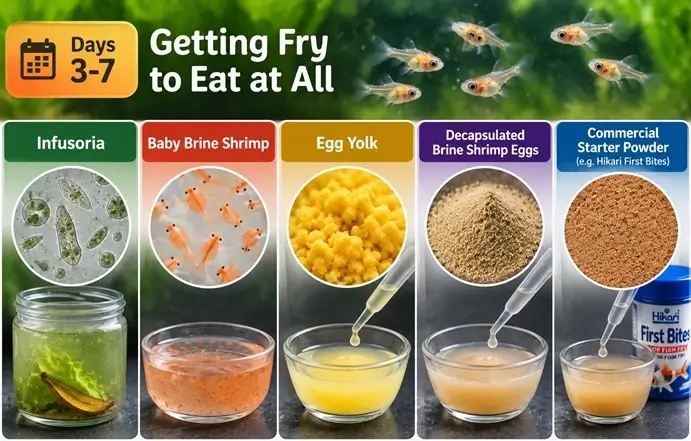
• Newly hatched baby brine shrimp: can be fed live once fry become free-swimming (usually around day 3-4), and are more eagerly accepted than infusoria
• Egg yolk: hard-boiled egg yolk, crushed, mixed with a little water at a higher concentration, and fed a few drops at a time with a dropper
• Decapsulated brine shrimp eggs: sold as capsules containing shell-free brine shrimp eggs, opened and mixed into water, then fed with the included dropper, no hatchery needed. Nutritionally similar to live baby brine shrimp, and safer than whole, unprocessed shells, which can cause gut blockage in tiny fry
• Commercial starter powder (e.g. Hikari First Bites): mixed with water, dropper-fed the same way as egg yolk. Particles may be slightly large for the very smallest fry
Try to feed 3 to 5 small meals a day. Clear out anything uneaten, as water quality is very important for the fry.
Week 2: More Variety
Keep feeding what worked in week one, and you can start introducing a couple of additions alongside it if you wish to.
• Vinegar eels, easy to culture at home and fine enough to fit fry’s tiny mouths
• Daphnia, though it’s worth knowing it can carry hydra into a fry tank, and hydra will kill fry. If you go this route, source daphnia from a clean, trusted culture rather than scooping it straight from a random pond
Try feeding 3 to 4 times a day and clear out anything uneaten to maintain water quality.
Week 3: Can Go for Bigger Bites
These are foods fry can start handling at this stage, not a full daily menu you need to feed all together.
• Commercial fry food: a high quality commercial powdered fry food can be started.
• Daphnia: you can offer small live or frozen daphnia in small amounts, as they can handle slightly bigger bites now.
Maintain frequent small feedings and monitor water parameters closely.
Week 4: Transition to Juvenile Food
These are the options available as fry move toward an adult diet, not a checklist to feed all together.
• Fine crushed flakes or small sinking pellets: crush flakes to a smaller size or use small slow-sinking pellets.
• Gel foods: gel foods like Repashy Super Gold, or specialized options like Northfin Fry Food, add protein and support better coloration than flakes alone
• Frozen bloodworms: frozen bloodworms can be added as a supplement, never Tubifex worms, which carry a real risk of introducing disease
• Complete transition: by 6 to 8 weeks, most fry can handle standard crushed food and can also eat the same food as adult goldfish.
A diet with roughly 35-40% protein, the rest made up of vegetable matter, along with vitamins like A, D, and E and minerals such as calcium and phosphorus, supports strong growth and helps bring out full coloration. Make sure you monitor and maintain good water parameters at all times.
How Often to Feed Baby Goldfish
Baby Goldfish need to eat more frequently than adult goldfish because of their small stomach size and rapid growth. During the first month, feed 3 to 5 times a day, offering only what they can finish in about 2 minutes each time. Overfeeding is the bigger risk than underfeeding at this stage, since leftover food fouls the water quickly in a small fry tank.
What Do Goldfish Fry Eat in a Pond?
In an established pond, fry don’t rely on you for every meal the way tank-raised fry do. A mature pond carries some food hobbyists carefully culture indoors, just occurring naturally.
Below are the following things the fry would eat to survive:
• Algae and biofilm: they graze on algae and biofilm coating rocks, plant leaves, and the pond walls
• Zooplankton: daphnia, copepods, and ostracods build up naturally in a pond that has been running a while, giving the fry a steady live food source
• Microscopic organisms: similar to cultured infusoria, these occur naturally in pond water once it has matured
• Mosquito and insect larvae: small larvae that land and hatch on the water’s surface add another natural food source
• Decaying plant matter: organic material settled on the pond floor also gets picked at by foraging fry
A well-established, lightly stocked pond can often raise a batch of fry to a decent size on natural food alone. But if you want to speed up growth, improve survival numbers, bring out the best out of your goldfish fry or if you are working with a newer pond that hasn’t built up much natural food yet, the same approach used for indoor tanks applies just as well outdoors. See our week by week feeding section above for what to add.
Frequently Asked Questions
Can I feed goldfish fry regular flake food from day one?
No, you should not feed goldfish fry regular flake food from day one because their mouths are too small and they need higher protein levels for proper development. Try feeding them foods like hard-boiled egg yolk, infusoria, or baby brine shrimp instead.
What happens if goldfish fry don’t get enough food early on?
Growth slows down significantly, and the fry become more vulnerable to disease and to being outcompeted by faster-growing siblings. There can be high inconsistencies in the overall growth of the fry.
How long can goldfish fry go without being fed?
Not long. Unlike adult goldfish, which can handle 10 to 14 days without food thanks to a slower metabolism and fat reserves, fry have almost no energy reserves and are growing fast. The safe limit is between 24 and 48 hours. If you need to be away, arrange for someone to feed them rather than assuming they will be fine like an adult fish would.
How do I know if I’m overfeeding my baby goldfish ?
The clearest sign is food still visible in the tank a couple of minutes after feeding, since that’s food they should have already eaten. In case of heavy overfeeding, cloudy water, a sudden ammonia smell, or a film forming on the water’s surface can also show up.
Is baby brine shrimp alone enough to raise healthy goldfish fry?
It can sustain them, but variety produces better results. Baby brine shrimp is nutritious, but fry raised on a mix of foods alongside it tend to show more consistent growth with fewer deficiencies than fry fed a single food.