
Why is my guppy hiding? Guppies are naturally active, curious, and social fish, so when one suddenly starts hiding behind plants, decorations, filters, rocks, or in the corners of the aquarium, it usually means something has changed in its environment. In most cases, hiding is caused by stress, poor water quality, bullying, illness, pregnancy, or recent changes within the tank.
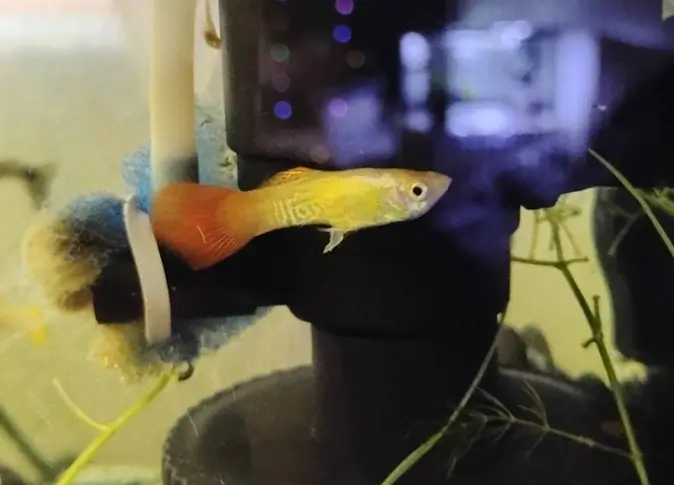
While occasional hiding can be completely normal, a guppy that spends most of its time out of sight is often trying to avoid a problem rather than simply resting. Understanding why your guppy is hiding is the first step toward correcting the issue and preventing more serious health problems from developing.
Quick Answer:
Guppies usually hide because they feel stressed, unsafe, sick, or uncomfortable. Poor water quality, aggressive tank mates, pregnancy, illness, bright lighting, and recent environmental changes are the most common causes. New guppies may also hide temporarily while adjusting to a new aquarium.
If your guppy is hiding alongside symptoms such as loss of appetite, heavy breathing, clamped fins, unusual swimming, or color loss, the problem should be investigated immediately.
Quick Navigation
➜ Why Is My Guppy Hiding?
➜ Poor Water Quality
➜ New Guppy Hiding After Purchase
➜ Bullying and Aggressive Tank Mates
➜ Illness or Disease
➜ Pregnancy and Giving Birth
➜ Bright Lights and Lack of Cover
➜ Common Guppy Hiding Situations
➜ Why Is My Guppy Hiding Behind the Filter?
➜ Why Is My Guppy Hiding in the Corner?
➜ Why Is My Guppy Hiding Under a Rock?
➜ Why Is My Guppy Hiding in Plants?
➜ Why Is My Female Guppy Hiding?
➜ Why Is My Male Guppy Hiding?
➜ Why Are My Guppy Fry Hiding?
➜ Common Guppy Fry Hiding Situations
➜ Why Are All My Guppies Hiding?
➜ Is It Normal for Guppies to Hide?
➜ Signs Your Guppy Is Stressed or Sick
➜ How to Help a Hiding Guppy
➜ When Should You Be Concerned?
➜ Can Guppies Recover?
➜ Frequently Asked Questions
Why Is My Guppy Hiding?
A guppy that suddenly starts hiding is usually responding to stress. Water quality problems, aggressive tank mates, illness, pregnancy, and environmental changes can all make a guppy seek shelter behind decorations, plants, filters, or rocks.
The key is to look at the rest of the fish’s behavior. A guppy that hides occasionally but comes out to eat and interact with other fish is very different from a guppy that remains hidden all day and refuses food.
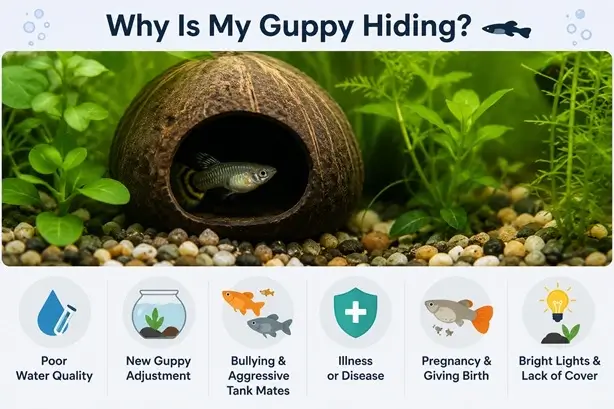
Common triggers include:
Poor Water Quality
Poor water quality is one of the most common reasons guppies hide. High ammonia or nitrite levels are highly stressful to fish and can quickly make them feel unsafe. Even slightly unstable water conditions can cause guppies to become withdrawn and spend more time hiding.
Water quality issues often develop after overfeeding, overcrowding, missed maintenance, or improper water changes. Many guppies begin hiding before other symptoms become obvious.
Fix: Test the water immediately and compare the results with the ideal values in our guppy water parameters guide. If the behavior started after maintenance, read our guide on why guppies die after water changes.
New Guppy Hiding After Purchase
New guppies commonly hide during their first few days in a new aquarium. Transportation stress, unfamiliar surroundings, and different water chemistry can make them feel vulnerable.
Many fish spend their first day behind plants or decorations before gradually becoming more active.
Fix: Give the fish time to adjust and avoid making unnecessary changes to the aquarium. Following a proper guppy care routine helps reduce stress during acclimation.
Bullying and Aggressive Tank Mates
Bullying is another major cause of hiding. Guppies are peaceful fish and can become stressed when housed with aggressive species or dominant individuals.
Constant chasing, fin nipping, and competition during feeding often force guppy fish into hiding.
Male guppies may also harass females continuously, particularly when there are too few females in the tank.
Fix: Review your stocking choices using our guppy tank mates guide. Understanding the differences between male and female guppies can also help identify breeding-related stress.
Illness or Disease
Many sick guppies isolate themselves from the group. Hiding is a natural defense mechanism that allows weakened fish to avoid attention and save their energy.
Disease-related hiding is often accompanied by clamped fins, loss of appetite, unusual swimming, rapid breathing, scratching, or fading colors.
Fix: Compare symptoms with our common guppy diseases guide. If your fish is also refusing food, see our guppy not eating guide. If the colors appear dull, our guppy losing color guide may help identify the cause.
Pregnancy and Giving Birth
Pregnant guppies commonly become more secretive during the final days before giving birth. Many females begin spending more time among plants, behind decorations, or in quiet corners of the tank.
Another reason pregnant females hide is constant attention from males. In heavily male-biased tanks, females may hide simply to avoid harassment.
Fix: Usually no treatment is necessary. Provide plenty of cover and monitor the fish closely. Learn more in our pregnant guppy guide. If you plan to raise the fry afterward, our guppy fry guide and guppy fry growth guide explain what to expect.
Bright Lights and Lack of Cover
A brightly lit aquarium with few plants or decorations can make guppies feel exposed. In nature, guppies spend much of their time among vegetation, roots, and submerged cover.
Fix: Add live plants, floating plants, caves, or decorations to create shaded areas where guppies can retreat when they feel stressed.
Common Guppy Hiding Situations
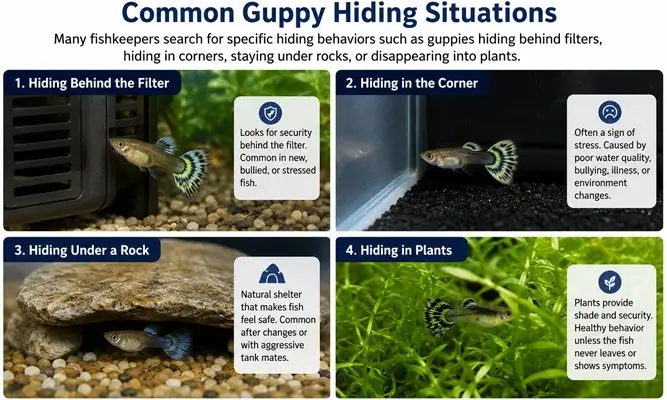
Many fishkeepers search for specific hiding behaviors such as guppies hiding behind filters, hiding in corners, staying under rocks, or disappearing into plants. While all of these behaviors involve hiding, the underlying causes can be quite different.
Why Is My Guppy Hiding Behind the Filter?
A guppy hiding behind the filter is usually looking for security. New fish, bullied fish, and stressed fish often choose this location because it provides shelter and reduces exposure to other tank mates.
The shaded area behind a filter can feel safer than the open parts of the aquarium. Newly introduced guppies commonly spend their first day or two behind the filter before gradually becoming more confident.
If the fish continues eating and slowly becomes more active, this behavior is often temporary. However, if it remains behind the filter continuously, refuses food, or shows other symptoms, investigate water quality and possible illness.
Why Is My Guppy Hiding in the Corner?
A guppy hiding in the corner often indicates stress. Corners provide a sense of security because the fish only has to watch activity from one or two directions rather than the entire aquarium.
Poor water quality, illness, bullying, pregnancy, sudden environmental changes, excessive lighting, and recent tank maintenance can all trigger corner-hiding behavior.
If the fish remains in the same corner for several days and refuses food, further investigation is needed.
Why Is My Guppy Hiding Under a Rock?
Guppies sometimes hide under rocks, caves, driftwood, and decorations because these locations mimic natural shelter. This behavior is especially common after introducing new fish, rearranging decorations, or adding aggressive tank mates.
Occasional hiding under decorations is usually harmless. Constant hiding combined with appetite loss, heavy breathing, or inactivity is more concerning and often points toward stress or illness.
Why Is My Guppy Hiding in Plants?
Plants provide natural shelter and security. A guppy hiding among plants is not automatically a problem, especially in heavily planted aquariums where fish naturally move in and out of cover throughout the day.
Live plants reduce stress, provide shade, and help fish feel more secure. However, if the fish never leaves the plants, avoids feeding, or shows signs of illness, stress or disease may be involved.
Learn more in our guppy tank setup guide.
Why Is My Female Guppy Hiding?
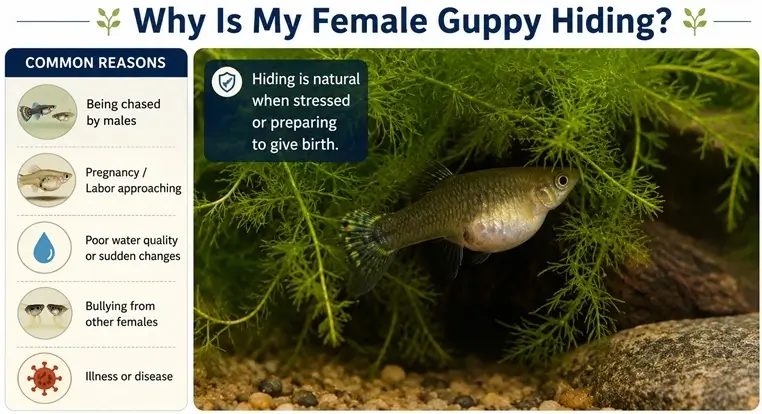
Female guppies often hide more than males, particularly when they are being chased constantly by males. In breeding groups, male guppies may spend much of the day attempting to court females, which can become stressful when there are too many males in the aquarium.
Pregnancy is another common reason. As labor approaches, many females become noticeably more secretive and spend increasing amounts of time in dense plant cover or quiet corners of the aquarium away from chasing males.
Less commonly, a female guppy may hide because of poor water quality, bullying from other females, illness, or sudden environmental changes.
If hiding is accompanied by appetite loss, heavy breathing, clamped fins, unusual swimming, or color loss, investigate further rather than assuming pregnancy is the cause.
See our pregnant guppy guide and male vs female guppy guide for more information.
Why Is My Male Guppy Hiding?
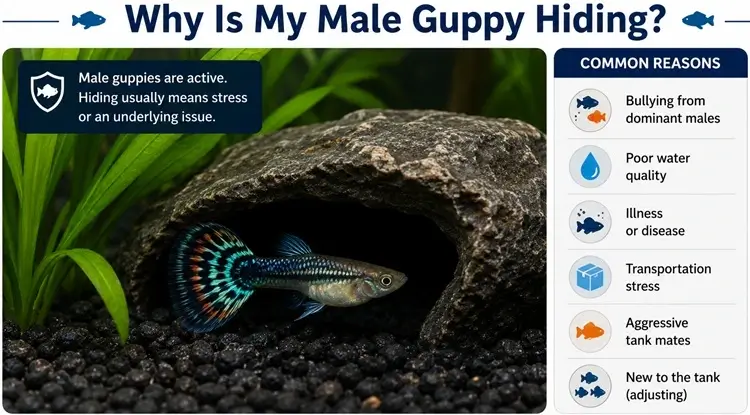
Male guppies are normally among the most active fish in the aquarium, so sudden hiding is often more noticeable in males than females.
Common causes include bullying from dominant males, poor water quality, illness, transportation stress, and aggressive tank mates. Male guppies frequently establish a loose hierarchy, and weaker males may spend time hiding if they are being constantly chased or outcompeted during feeding.
A newly introduced male may also hide temporarily while adjusting to the social structure of the aquarium.
If the male is also refusing food, losing color, breathing heavily, or isolating himself completely, illness or water quality problems become more likely explanations than social stress alone.
Related guides:
Guppy Losing Color,
Guppy Not Eating,
Common Guppy Diseases.
Why Are My Guppy Fry Hiding?
Guppy fry hiding is completely normal and is one of the most important survival behaviors young guppies possess. Newly born fry instinctively seek shelter because adult fish, including their own parents, which may eat them.
As a result, baby guppies spend much of their time hiding among plants, moss, roots, decorations, and other sheltered areas of the aquarium during their first few weeks of life.
Unlike adult guppies, hiding usually does not indicate stress or illness in fry. In fact, a fry that spends all of its time swimming openly in a community tank is often at greater risk than one that stays hidden.
Common Guppy Fry Hiding Situations
Guppy fry spend much of their first few weeks hiding among plants, moss, floating roots, and other sheltered areas of the aquarium. Searches such as guppy fry hiding in plants, guppy fry hiding in java moss, and guppy fry hiding in floating plant roots are extremely common because these are the places where newborn fry naturally feel safest and are most likely to survive.
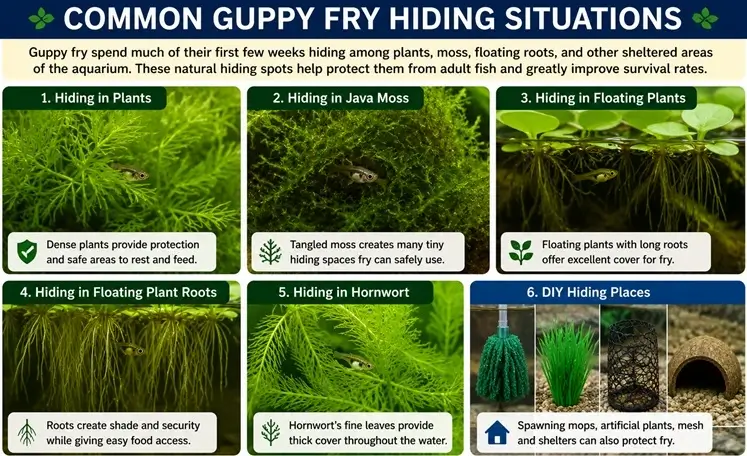
Guppy fry hiding in plants
Guppy fry hiding in plants is one of the most common sights in breeding aquariums. Dense plants provide protection from adult fish while giving fry safe areas to rest and feed.
Guppy Fry Hiding in Java Moss
Java moss is widely considered one of the best guppy fry hiding places available. The tangled structure creates hundreds of tiny hiding spaces that adult fish cannot easily reach. Many breeders intentionally use large mats of java moss because guppy fry hiding in java moss aquarium setups tend to survive at much higher rates than fry raised without cover.
Java moss also supports microscopic organisms that young fry naturally graze on throughout the day.
Guppy Fry Hiding in Floating Plants
Floating plants create another excellent refuge for newborn fry. Guppy fry hiding in floating plants aquarium setups are often found among the hanging roots of Amazon frogbit, water lettuce, red root floaters, and water sprite.
The long root systems create a natural curtain of protection that allows fry to move freely while remaining hidden from larger fish.
Guppy Fry Hiding in Floating Plant Roots
Guppy fry hiding in floating plant roots aquarium environments often spend most of their first few weeks among these root systems.
The roots provide shade, security, and protection from larger fish while allowing fry easy access to microscopic food sources that naturally develop there.
Guppy Fry Hiding in Hornwort
Hornwort is another favorite among guppy breeders. Its fine needle-like leaves create dense cover throughout the water column.
Guppy fry hiding in hornwort are often difficult to spot because the plant forms thick masses that provide security from every direction.
Unlike many rooted plants, hornwort grows quickly and requires very little maintenance, making it one of the easiest ways to create fry-safe cover.
DIY Guppy Fry Hiding Places
If live plants are unavailable, DIY guppy fry hiding places can still work very well. Breeders commonly use spawning mops, artificial plants, breeding grass, mesh structures, and specially designed fry shelters.
While live plants usually provide the most natural environment, artificial hiding places can significantly improve fry survival rates in breeding tanks and community aquariums.
For more information, see our guppy fry guide, guppy fry growth guide, and guppy tank setup guide.
Why Are All My Guppies Hiding?
When every guppy in the aquarium starts hiding at the same time, the cause is usually environmental rather than individual. Poor water quality, temperature swings, chemical contamination, excessive lighting, recent maintenance, or a new aggressive tank mate are among the most common explanations.
If all fish suddenly become reclusive, test the water immediately. Group-wide hiding behavior is often one of the earliest warning signs that something in the aquarium environment has changed.
Is It Normal for Guppies to Hide?
Sometimes, yes. Newly introduced guppies, pregnant females, and fish recovering from stress may hide temporarily.
Healthy guppies should eventually return to normal activity levels. Constant hiding that lasts several days is usually a sign that something needs attention.
Signs Your Guppy Is Stressed or Sick
A hiding guppy becomes more concerning when the behavior is accompanied by other symptoms.
Warning signs include:
➜ Refusing food
➜ Heavy breathing
➜ Clamped fins
➜ Faded colors
➜ Unusual swimming
➜ Staying near the bottom
➜ Remaining at the surface for extended periods
If your guppy is spending time near the substrate, read our guide on why guppies stay at the bottom.
If it is gathering near the surface, see our article on guppies staying at the top of the tank.
If it is hiding while swimming abnormally, see our guppy swimming upside down guide.
How to Help a Hiding Guppy
Start by identifying the source of stress.
➜ Test water quality
➜ Maintain stable temperatures
➜ Add more plants and hiding spots
➜ Observe tank mates carefully
➜ Avoid sudden environmental changes
➜ Prevent overcrowding
Most guppies become active again once the underlying problem is corrected.
When Should You Be Concerned?
Take action if your guppy:
➜ Hides constantly for several days
➜ Stops eating
➜ Breathes heavily
➜ Shows signs of disease
➜ Loses significant color
➜ Becomes weak or inactive
Early intervention greatly improves recovery chances.
Can Guppies Recover?
Yes. Many guppies recover completely once the cause of stress is identified and corrected.
Recovery may take anywhere from a few days to several weeks depending on the underlying issue. Maintaining proper care and water quality greatly improves the chances of a full recovery and a normal guppy lifespan.
Frequently Asked Questions
Why is my guppy hiding and not eating?
This combination often indicates stress, illness, or poor water quality and should be investigated promptly.
Why is my guppy hiding after a water change?
Sudden changes in temperature or water chemistry can temporarily stress guppies. Review our water change guide to avoid common mistakes.
Can aggressive fish make guppies hide?
Yes. Bullying and fin nipping are among the most common reasons otherwise healthy guppies become reclusive.
Why is my female guppy hiding from the male?
Constant chasing by males is one of the most common reasons female guppies hide. This becomes even more noticeable when the female is pregnant.
Why are all my guppies hiding suddenly?
When all fish hide at once, poor water quality, sudden temperature changes, chemical contamination, or a new aggressive fish are often responsible.
Why is my guppy fry hiding in plants?
This is normal behavior. Plants provide protection from adult fish and significantly improve fry survival rates.
Is it normal for guppy fry to stay hidden?
Yes. Fry commonly spend much of their first few weeks hidden among plants, moss, roots, and decorations.
Should I isolate a hiding guppy?
If illness or bullying is suspected, temporary isolation can be helpful. However, isolation is not usually necessary for mild stress-related hiding.
Final Thoughts
Guppies hide for many reasons, but stress is almost always the common thread. Poor water quality, bullying, illness, pregnancy, and environmental changes can all make a guppy seek shelter behind plants, filters, rocks, and decorations.
The good news is that most cases improve once the underlying cause is identified and corrected. Pay attention to accompanying symptoms, maintain stable water conditions, and act quickly when something seems wrong.
