
Guppy ammonia poisoning happens when ammonia builds up faster than the aquarium can process it. Fish release ammonia directly through their gills, while uneaten food and decaying matter add to the load. Toxic exposure can damage the gills, interfere with breathing, and become life-threatening.
Testing the water is the first step. Gasping, lethargy, or inflamed gills can suggest a water-quality problem, but symptoms alone cannot confirm ammonia poisoning.
Quick Navigation
2) What Is Guppy Ammonia Poisoning?
3) Guppy Ammonia Burn: What It Looks Like
4) Symptoms of Ammonia Poisoning
5) Ammonia vs Nitrite: Telling Them Apart
6) What Causes an Ammonia Spike?
7) New Tank Syndrome and Cycling
8) Preventing Ammonia Spikes
9) Frequently Asked Questions
10) Final Thoughts
Emergency Steps If You Find Ammonia
Check ammonia, nitrite, pH, and temperature. Keep the filter running and increase aeration while preparing replacement water.
1. Dilute the ammonia with a partial water change. In an otherwise stable aquarium, a 25–50% change is a practical starting point. Use water treated for chlorine and chloramine and closely matched in temperature. Check the replacement water too, particularly if ammonia keeps returning after changes.
A 50% change approximately halves the concentration only if the replacement water contains no ammonia and no additional ammonia is produced during the change. Retest once the water has mixed; further changes may be necessary. Do not automatically wait until the following day if fish remain distressed or readings remain elevated.
Important for a long-neglected tank: If its pH is much lower than the replacement water’s, a large change can raise pH and increase the toxic fraction of the ammonia left behind. Use controlled, smaller changes with repeated testing and seek experienced aquatic veterinary help if fish are distressed. Do not try to solve ammonia poisoning by abruptly lowering pH or temperature.
Large water changes do not normally remove the biological filter: most nitrifying bacteria live on filter media and other surfaces. The concern is an abrupt change in water chemistry or exposure to untreated replacement water.
2. Remove excess waste and briefly pause feeding. Remove uneaten food, dead leaves, and any dead fish. Check the filter for blockages. Temporarily withholding food reduces new waste; resume small meals when readings are controlled and the fish can eat normally.
3. Maintain oxygen and protect the filter. Use an air stone or increase surface movement. Both fish and filter bacteria need oxygen. Keep biological media wet and the filter running; do not replace all media or disinfect it during the emergency.
4. Use conditioners according to their labels. Always dechlorinate replacement tap water. If using a product marketed for temporary ammonia detoxification, follow its instructions for dosing and repeat use. Seachem states that Prime provides temporary binding for up to 48 hours; this is not a guarantee that a distressed aquarium can be left unchecked for that period.
These products do not replace water changes or a functioning biological filter. Total-ammonia tests may still show a reading after treatment; check the conditioner’s and test kit’s compatibility instructions before interpreting results or adding more product.
5. Support biological filtration. Established filter media from a healthy, disease-free aquarium can help restore an immature or disrupted filter. A bottled nitrifying-bacteria product may also help when used as directed, but do not assume the aquarium is instantly cycled. Continue testing.
6. Keep checking until the system is stable. Retest after corrective water changes and at least daily during recovery, more often if readings rise or fish remain distressed. Monitor nitrite as well: it can increase as the filter begins processing ammonia.
7. Avoid unnecessary additions. Do not add new fish during a spike. Salt does not remove ammonia, and antibiotics do not treat ammonia poisoning itself. Medication is appropriate only if a separate condition has been identified. Keep disturbance and harsh lighting to a minimum while the fish recover.
If breathing or balance remains abnormal despite corrected water conditions, seek an aquatic veterinarian’s help. Gill damage or another problem may still be affecting the fish.
What Is Guppy Ammonia Poisoning?
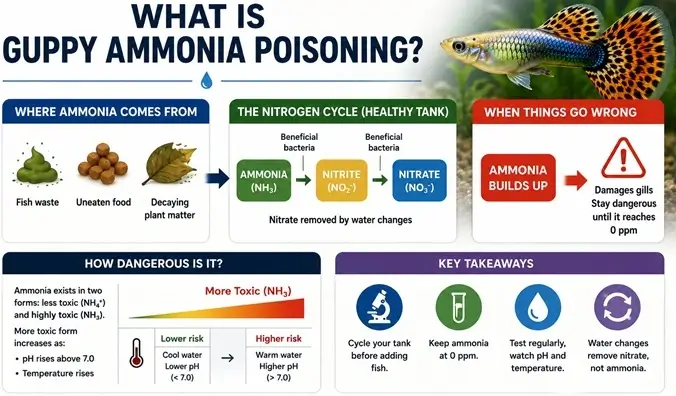
Ammonia is a waste product of a fish’s metabolism. Much of it passes directly through the gills into the water. Decaying food, fish waste, dead plants, and dead animals also contribute.
- The nitrogen cycle. In an established aquarium, beneficial bacteria convert ammonia into nitrite, then nitrate. Nitrate is less acutely toxic, but still needs to be controlled through maintenance and water changes.
- When processing falls behind. An immature, damaged, or overloaded biological filter cannot process ammonia fast enough. Ammonia then accumulates, potentially damaging the gills and other tissues.
- Why pH and temperature matter. Total ammonia includes more toxic un-ionized ammonia (NH3) and less toxic ammonium (NH4+). As pH and temperature rise, a greater proportion is present as NH3. This is a gradual shift, not a switch that starts at pH 7.
Many aquarium kits measure both forms together. A total-ammonia reading cannot be interpreted properly without knowing pH and temperature, so a single universal emergency cutoff is misleading. Keep the target at 0 ppm and investigate any detectable result.
Our guppy pH guide and temperature for guppies guide explain suitable conditions. For problems linked to replacement water, see why guppies die after water changes.
Guppy Ammonia Burn: What It Looks Like
“Ammonia burn” is a common term for tissue damage associated with ammonia exposure. Affected guppies may have irritated or inflamed gills, excess mucus, damaged fins, or changes in body color. However, dark or red patches alone do not confirm an ammonia burn.
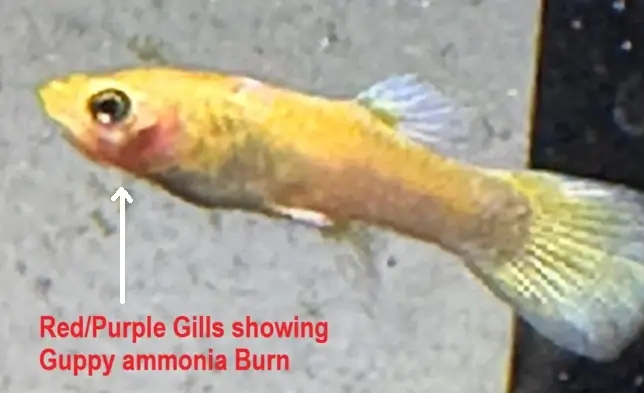
Ammonia can damage the gills and interfere with breathing even when there is no obvious mark on the body. A fish may breathe rapidly, gasp, become inactive, or stop eating. The appearance of a patch cannot establish how severe the exposure was or how long it lasted.
This is a water-quality problem rather than an infectious disease. Confirm exposure through water tests and recent tank history. Injuries and infections can produce similar marks; our common guppy diseases guide covers other possible causes.
Symptoms of Ammonia Poisoning
Possible signs include the following. They do not occur in a fixed order, and several can also result from low oxygen, nitrite exposure, or disease.
- Rapid gill movement or gasping at the surface
- Red or irritated gills
- Lethargy, including remaining at the bottom
- Clamped fins or damaged fin edges
- Loss of appetite
- Excess mucus or an unusually dull or dark appearance
- Erratic swimming, disorientation, or loss of balance in severe cases
Test immediately if several fish become unwell together. Ammonia is invisible, so clear water does not establish that the aquarium is safe. Routine testing can reveal a problem before visible damage develops.
Ammonia vs Nitrite: Telling Them Apart
Ammonia and nitrite harm fish in different ways, but their outward symptoms overlap. Both may cause gasping, inactivity, and appetite loss.
- Ammonia damages gill tissue and can affect other body systems. Inflamed gills or altered body color may occur, but they are not diagnostic.
- Nitrite interferes with the blood’s ability to carry oxygen. It can cause “brown blood disease,” although the brown discoloration is not always easy to see in a small fish.
Test both ammonia and nitrite rather than diagnosing by gill color. They can be elevated together, particularly while an aquarium is cycling. Increasing aeration supports the fish but does not remove either substance.
What Causes an Ammonia Spike?
An ammonia spike means production has exceeded the aquarium’s ability to process or remove it. Check these common causes:
An uncycled tank. A new aquarium may not yet have enough nitrifying bacteria to process the waste its fish produce. This is commonly called new tank syndrome.
Overfeeding. Leftover food decomposes, and fish produce more ammonia as they process more food. Offer small portions and remove uneaten food.
Overcrowding or a sudden stocking increase. Adding too many fish at once can overwhelm a filter that previously handled the aquarium’s waste.
A neglected aquarium. Accumulated debris, clogged filtration, and declining buffering capacity can disrupt the cycle. Missing a water change does not automatically cause ammonia to rise in every established tank. The filter’s condition and the water chemistry matter too. Our water-change problems guide explains the risks of sudden corrections in a neglected aquarium.
Damage to the biological filter. Replacing all filter media, allowing it to dry out, exposing it to chlorine or disinfectants, or using certain medications can reduce the bacteria that process ammonia. A prolonged filter outage can also disrupt filtration.
Decaying material. Dead fish, dying leaves, and hidden food can add a substantial waste load. Check behind decorations and around the filter intake.
Replacement water. Source water may contain ammonia or chloramine. Treat tap water appropriately and test it if readings remain elevated despite repeated changes.
New Tank Syndrome and Cycling
Cycling establishes bacteria that process ammonia and nitrite. It commonly takes several weeks and may take six to eight weeks or longer, depending on conditions. Use test results, rather than a fixed number of days, to judge whether the filter can handle the intended waste load.
- Before adding fish: Use a fishless cycling method with a measured aquarium-safe ammonia source. Never add cycling ammonia to a tank containing fish. Follow the method’s testing instructions to confirm that both ammonia and nitrite are being processed before stocking.
- If fish are already present: Monitor ammonia and nitrite closely, control them with appropriate water changes, feed sparingly, and avoid adding more fish. Do not buy “hardy” fish simply to expose them to the cycling process.
- To help establish the filter: Transfer suitable mature filter media from a healthy aquarium, keeping it wet during transfer. Avoid material from a tank with disease or unexplained deaths.
Once cycling is complete, increase stocking gradually and continue testing after each addition.
Preventing Ammonia Spikes
Routine maintenance protects the filter and keeps the waste load manageable:
- Feed small portions and remove leftovers.
- Avoid overcrowding and sudden large additions of fish.
- Perform regular partial water changes using properly conditioned water.
- Rinse dirty filter media gently in removed tank water or dechlorinated water; do not replace all biological media at once.
- Remove dead fish and decaying leaves promptly.
- Test ammonia and nitrite weekly in an established aquarium, and more often after stocking changes, filter problems, or treatments that may affect the filter.
During water changes, use a gravel siphon where appropriate to remove trapped waste. Work gently around plant roots and avoid deep disturbance of established substrate. Check the filter’s flow regularly so a blockage does not go unnoticed.
Frequently Asked Questions
What’s a safe guppy ammonia level?
Aim for 0 ppm on your aquarium ammonia test. Any detectable reading warrants investigation, but the risk is not determined by the number alone. Check pH, temperature, and whether the kit measures total or free ammonia. Fish showing breathing difficulties or loss of balance need urgent attention.
How fast can ammonia kill a guppy?
Severe exposure can be fatal within hours. Lower toxic exposure may cause damage over a longer period. The outcome depends on concentration, pH, temperature, exposure duration, and the fish’s condition; do not wait for a particular threshold or visible burn before acting.
Can a guppy recover from ammonia poisoning, and how long does it take?
Yes, guppies can recover if ammonia exposure is stopped promptly and water conditions remain stable. There is no fixed recovery time: breathing and activity may improve before damaged gill tissue has fully healed, while severe or prolonged exposure can cause lasting damage or death. Monitor appetite, breathing, and swimming, and seek aquatic veterinary help if symptoms persist or worsen despite corrected water conditions.
Why do I have ammonia even though I do water changes?
A change dilutes ammonia but may not fix an immature or damaged filter, excessive feeding, overcrowding, or hidden decaying material. Replacement water can also contribute. Test both tank and source water, check the filter, and retest after each corrective change.
Final Thoughts
Ammonia poisoning needs prompt correction of the water conditions. Test rather than relying on visible marks, keep filtration and aeration working, and confirm that ammonia and nitrite remain controlled after the initial water change.
For routine care, see our guppy water parameters guide. If symptoms persist after the water is corrected, our common guppy diseases guide explains other conditions to investigate.