
Fancy guppy is a brightly colored, big-finned version of the common guppy you see in nearly every pet store and aquarium photo online. They’re the same fish as the hardy wild-type guppy underneath, the difference comes from generations of selective breeding for color and fin shape, paired with color-enhancing food that helps those genetics actually show through. That combination is also why fancy guppies aren’t cheap: a pair typically runs $10 to $20, well above the $2 to $5 you’d pay for a plain wild-type guppy, and rarer strains climb a lot higher than that.
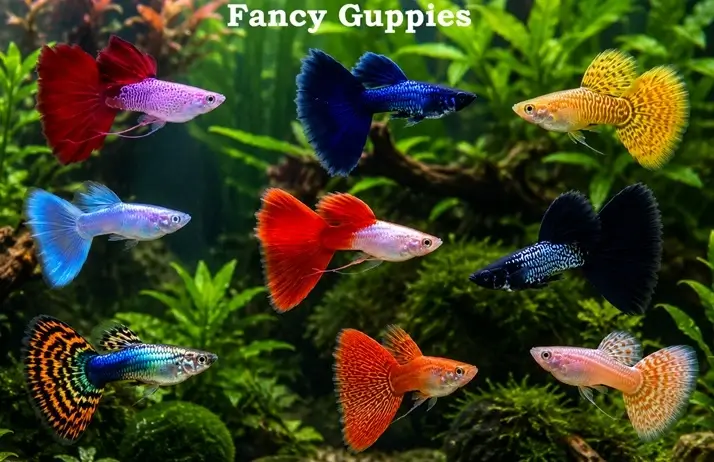
This guide covers what a fancy guppy actually is, how males and females differ, the real story behind where all that color and finnage came from, and where to go for the deeper details on care, food, breeding, and health that this overview doesn’t have room for.
Quick Navigation
➜ What Is a Fancy Guppy?
➜ Fancy Guppy vs Regular Guppy
➜ Male Fancy Guppy
➜ Female Fancy Guppy
➜ Types of Fancy Guppies
➜ Rare Fancy Guppies
➜ Fancy Guppy Care
➜ Fancy Guppy Tank Mates
➜ Fancy Guppy Food
➜ Fancy Guppy Lifespan
➜ Fancy Guppy Breeding
➜ Fancy Guppy Fry
➜ Common Health Issues in Fancy Guppies
➜ Frequently Asked Questions
What Is a Fancy Guppy?
A fancy guppy is still Poecilia reticulata, the exact same species as the plain, hardy guppy sold as a cheap community fish. The difference isn’t genetic origin, it’s generations of selective breeding, where keepers chose the most colorful, biggest-finned fish in each batch and bred them together, repeating that over and over until the trait became reliable and consistent.
There’s a popular myth worth clearing up here, since it comes up constantly in hobbyist forums: fancy guppies were not created by crossing guppies with mollies or platies. Platies are a different genus entirely (Xiphophorus, not Poecilia), and the two can’t produce offspring at all. Guppies and mollies are close enough to occasionally hybridize by accident, but those hybrids are weak and usually sterile, more of a hobby curiosity than a real breeding pathway, and not how any named fancy strain came to exist.
The one real exception is the Endler guppy, Poecilia wingei, a close relative of the guppy that can produce fully fertile offspring when crossed with one. Some modern fancy lines do incorporate Endler genetics deliberately, which is a genuine part of the story, just not the dominant one. Most of the color and fin diversity you see in fancy guppies today came from guppies bred to guppies, not from mixing in another species.
Fancy Guppy vs Regular Guppy
Both are the same species, but generations of selective breeding have pulled fancy strains in a different direction than the hardy wild-type.
| Trait | Fancy Guppy | Regular / Wild-Type Guppy |
|---|---|---|
| Appearance | Vivid colors, elaborate patterns, large flowing fins | Smaller fins, more muted or speckled coloring |
| Hardiness | More sensitive to instability, due to generations of selective breeding | More resilient, closer to wild genetics |
| Lifespan | Typically 2–3 years | Similar range, sometimes hardier on the upper end |
| Swimming | Slower, large fins create more drag | Fast, streamlined, agile |
| Breeding | Needs managed line-breeding or colors revert to “mutt” patterns | Breeds freely with little intervention |
The lifespan numbers deserve a closer look than the table can give them, since they’re easy to get wrong, see the Fancy Guppy Lifespan section below for the full picture.
The tail-weight difference is worth understanding too, not just noting. Large, flowing fins like delta or halfmoon tails create real drag in the water, which is why male fancy guppies are often slower, more cautious swimmers than their wild-type counterparts, and why they get stressed more easily by fast-moving tank mates.
Breeding is the other major split. Regular guppies will reproduce prolifically with almost no management. Fancy guppies need deliberate line-breeding to keep a color pattern consistent, left unmanaged across generations, offspring tend to drift back toward duller, mixed “mutt” coloring. Our guppy breeding guide covers this in full.
Male Fancy Guppy
Male fancy guppies are the more colorful, more elaborately finned half of the species, and the easier sex to identify at a glance.
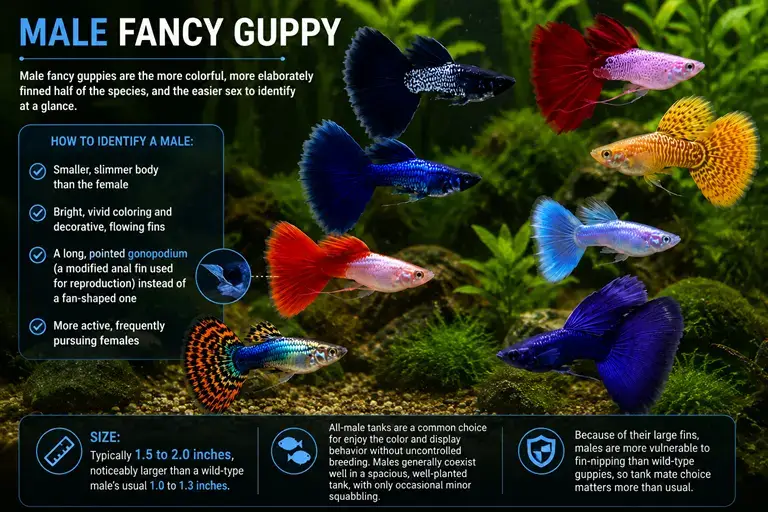
How to identify a male:
➜ Smaller, slimmer body than the female
➜ Bright, vivid coloring and decorative, flowing fins
➜ A long, pointed gonopodium (a modified anal fin used for reproduction) instead of a fan-shaped one
➜ More active, frequently pursuing females
Size: typically 1.5 to 2.0 inches, noticeably larger than a wild-type male’s usual 1.0 to 1.3 inches, since fancy strains have been bred for bigger bodies alongside bigger fins.
A couple of practical things worth knowing if you’re keeping males specifically. An all-male tank is a deliberate, common tactic for keepers who want the color and display behavior without uncontrolled breeding, males generally coexist fine in a spacious, well-planted tank, with only occasional minor squabbling. And because of those large fins, males are more vulnerable to fin-nipping than a wild-type guppy would be, so tank mate choice matters more than usual, covered in the tank mates section below.
Female Fancy Guppy
Female fancy guppies are larger, rounder, and generally less colorful than males, though there are real exceptions worth knowing.
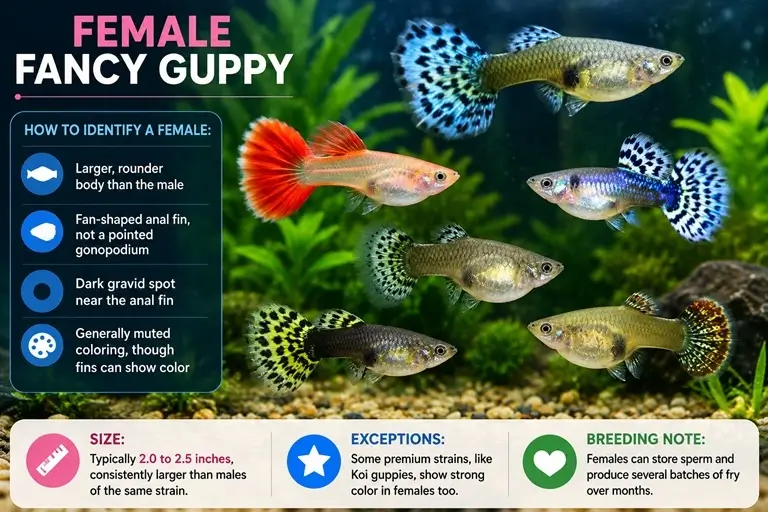
How to identify a female:
➜ Larger, rounder body than the male
➜ A fan-shaped anal fin, rather than the male’s pointed gonopodium
➜ A dark gravid spot near the anal fin, which darkens and enlarges with pregnancy
➜ Generally more muted coloring, though fins can still show some color
Size: typically 2.0 to 2.5 inches, consistently larger than males of the same strain, the same pattern seen in wild-type guppies too, this isn’t a fancy-specific trait, just a guppy trait that fancy breeding hasn’t changed.
The “females are always drab” rule has a genuine exception worth naming: some premium strains, Koi guppies being the clearest example, show real color in their females too, not just the males. Breeders have made real progress pushing color into females generally, even if matching male-level vibrancy remains difficult for most strains.
Females are also the ones that matter most for breeding planning, since a single mating lets a female store sperm and produce several batches of fry over months without a male present. Our pregnant guppy guide covers the full pregnancy timeline if you’re trying to plan around this.
Types of Fancy Guppies
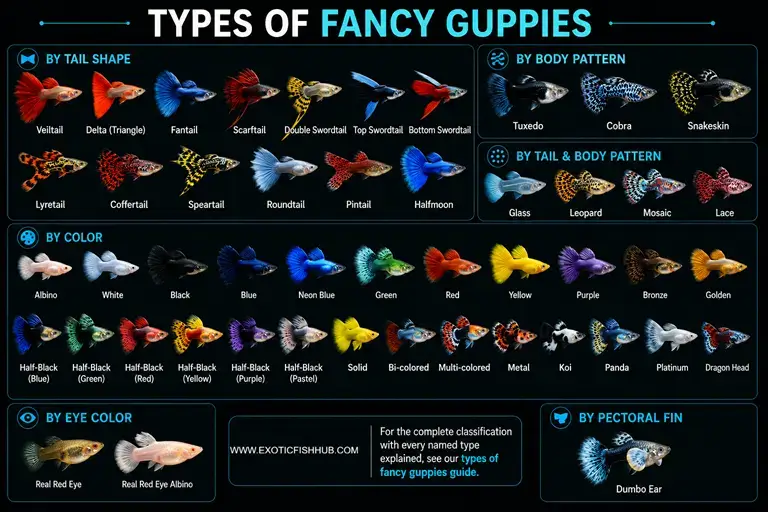
The variety in fancy guppies comes from breeders selecting for several independent traits at once, not just color. Here’s how they break down:
➜ By tail shape: veiltail, delta (triangle), fantail, scarftail, double swordtail, top swordtail, bottom swordtail, lyretail, coffertail, speartail, roundtail, pintail, halfmoon
➜ By body pattern: tuxedo, cobra, snakeskin
➜ By tail and body pattern: glass, leopard, mosaic, lace
➜ By color: albino, white, black, blue, neon blue, green, red, yellow, purple, bronze, golden, half-black (blue, green, red, yellow, purple, pastel), solid, bi-colored, multi-colored, metal, koi, panda, moscow, platinum, dragon head
➜ By eye color: real red eye, real red eye albino
➜ By pectoral fin: dumbo ear
Many of these already have their own dedicated guide on this site, including Tuxedo, Cobra, Electric Blue, and a full range of tuxedo color variants. For the complete classification with every named type explained, see our types of fancy guppies guide.
Rare Fancy Guppies
Some fancy guppy strains command real prices and real attention because they’re genuinely hard to produce and maintain. Rarity in this hobby almost always comes down to genetic purity, intensive line-breeding labor, and the constant risk of losing the trait to inbreeding depression if a line isn’t managed carefully.
There’s also a simpler, more temporary kind of rarity worth knowing about: a brand new strain is automatically rare the moment it appears, just because no one else has it yet. Guppies breed so readily that supply usually catches up with demand fast, so a strain that sells for a premium today can be common, even sold as cheap feeder stock, within a year or two once enough breeders have it. The genuinely lasting rarity, the kind that doesn’t fade, comes from strains that stay hard to breed true generation after generation, not just from being new.
Well-established rare and premium strains:
➜ Moscow guppies — solid, deep metallic color in purple, blue, or green
➜ Albino strains — red eyes, pale bodies, genuinely scarce as females
➜ Dumbo Ear varieties — the large pectoral fins are difficult to breed reliably
➜ Koi guppies — the red-white-orange pattern, with real demand for color-matched females too
For the deeper dive into what makes a strain genuinely rare versus just uncommon, and a longer list of premium strains, see our rare fancy guppies guide.
Fancy Guppy Care
Fancy guppies don’t need different water parameters than a regular guppy, they need more consistency in the ones that already apply. Aim for 7.0–8.0 pH, 8–12 dGH, 4–8 dKH, and a steady 76–78°F, the same targets covered in full in our guppy water parameters guide.
One genuinely fancy-specific point worth knowing: large-finned strains tend to do better in moderately hard water specifically because soft water can leave those big, heavy fins more prone to tearing. It’s not a strict requirement, but it’s a real reason some experienced keepers lean toward the harder end of the guppy-friendly range when keeping large-finned fancy strains.
Beyond water, the basics that matter most are a stable heater (fancy strains handle temperature swings worse than wild-types), a tank with gentle flow rather than a strong current, and enough plant cover to give a stressed or bullied fish somewhere to retreat.
Fancy Guppy Tank Mates
The same general guppy tank mate list applies to fancy strains, peaceful fish that won’t outcompete them for food or harass them. What’s different is the risk profile. Large, flowing fins make fancy guppies an easier target for fin-nipping fish than a streamlined wild-type would be, and their slower swimming means they can lose out on food to faster, more aggressive tank mates.
Good options that consistently work well:
➜ Corydoras catfish — peaceful bottom-dwellers that clean up leftovers without ever touching fins
➜ Otocinclus catfish and nerite snails — gentle algae cleanup, with almost no interaction with guppies
➜ Harlequin rasboras and ember tetras — small, peaceful schooling fish that add movement without competing for food
➜ Amano shrimp — large enough to avoid harassment, and useful cleanup crew
➜ Platies — share the same water parameters and an equally easygoing temperament
Avoid known fin-nippers and boisterous fish entirely with fancy strains, and watch feeding time specifically to make sure your fancy guppies are actually getting fed, not just out-competed. For the complete list of compatible and incompatible species, see our guppy tank mates guide.
Fancy Guppy Food
Fancy guppies benefit from a higher-quality diet than the bare minimum a wild-type guppy could get by on, mainly because color and large fins both take real nutritional investment to maintain. A reasonable target for a “high protein” food is around 50 percent protein content, well above the 30–35 percent in standard staple flakes.
The real color-driving ingredient to look for is astaxanthin, a carotenoid pigment guppies can’t produce themselves and have to get from food. It’s directly responsible for vibrant red, orange, yellow, and blue tones. Krill meal is the usual source in commercial pellets, and spirulina covers the same ground from a plant-based angle.
Vitamin D3 matters more than most keepers realize too. In the wild, fish get it from sunlight, but standard aquarium lighting doesn’t come close to replicating that, so it has to come from food instead. A color-enhancing food fortified with D3 supports bone, fin, and overall development in a way that shows up indirectly as a more vibrant, well-conditioned fish, one of the more overlooked reasons a dedicated color food outperforms a basic flake.
A few brands worth knowing by name:
➜ Hikari Fancy Guppy — a micro-pellet formulated specifically for this fish. It softens to a sponge-like texture in water instead of dissolving, sinks slowly enough that every fish in the tank gets a fair shot at it, and includes ingredients aimed specifically at breeding condition and fry quality.
➜ Omega One Color Mini Sinking Pellets — built around natural color-enhancing ingredients rather than synthetic additives.
➜ NorthFin Color & Growth Formula — a higher-protein option that pairs color support with growth.
➜ New Life Spectrum — a widely trusted staple with strong color-support credentials.
For the full breakdown of staple foods, color-enhancing ingredients, and feeding frequency, see our best guppy food guide.
Fancy Guppy Lifespan
A healthy fancy guppy typically lives 2 to 3 years. Temperature has a direct, well-documented effect on that number: keeping the tank steady at 72°F can push lifespan out to 3.5 years or more, at the cost of slower growth and less frequent breeding, while running warm at 82°F speeds up growth and breeding but shortens lifespan to around 18 months.
You’ll sometimes see “5 years” quoted as a fancy guppy’s lifespan. That’s better understood as the species’ biological ceiling than a realistic target for a modern, intensively line-bred fancy strain, most fancy lines, bred hard for color and fin size rather than longevity, fall short of it in practice.
For the full breakdown of what actually extends a fancy guppy’s life, see our fancy guppy lifespan guide.
Fancy Guppy Breeding
The mechanics of breeding a fancy guppy are the same as breeding any guppy, livebearing, no special triggers required, a healthy male and a few females in good water will breed on their own. What’s different is the level of management needed to keep a specific look consistent.
A single brood can run anywhere from 10 to 100 fry, with age, size, and genetics deciding where in that range a given female lands. Since fancy females tend to run larger-bodied than wild-type females, a mature, well-fed fancy female is often toward the higher end, sometimes close to that 100 mark. First-time mothers and younger females deliver smaller batches, completely normal, and batch size typically grows with subsequent pregnancies.
Breeding frequency is steady once a female is mature: expect a new batch roughly every 21 to 30 days, and since females store sperm after a single mating, that cycle continues for months without a male needing to be present at all.
If you’re working toward a specific show-quality trait, most experienced breeders wait until fish are 3 to 5 months old before pairing them, since that’s when color, fin shape, and body structure are developed enough to judge accurately. Maintaining a strain also means culling, removing offspring that don’t show the traits you’re breeding for from the pool, which sounds harsh but is standard practice for keeping a line consistent rather than letting it drift toward mixed “mutt” coloring.
For the complete walkthrough, including tank setup, ratios, and line-breeding technique, see our guppy breeding guide.
Fancy Guppy Fry
Fancy guppy fry aren’t born colorless. Each one has a real base body color at birth, commonly grey, blond, black, bronze, white, or pink depending on genetics, even though the adult strain’s full color pattern hasn’t developed yet. Darker colors like black tend to show up before reds and yellows do, with the full pattern and vibrancy developing gradually over the following weeks.
Fry need small, frequent feedings, far more often than adults, and dense plant cover or a separate fry tank, since adult guppies, including their own mother, will eat newborn fry on sight. Our guppy fry guide and guppy fry growth guide cover feeding, growth stages, and survival in full.
Common Health Issues in Fancy Guppies
Fancy guppies are more prone to certain health problems than wild-type guppies, mostly as a direct consequence of generations of selective breeding for color and fin size rather than resilience. Inbreeding depression, the gradual weakening that comes from breeding closely related fish repeatedly, shows up in fancy lines as smaller batch sizes, weaker fry, and a higher rate of bent spine (scoliosis) than you’d see in a hardier wild-type line.
Beyond genetics, the large fins themselves create practical vulnerabilities, slower swimming makes a fancy guppy an easier target for aggressive tank mates, and heavy fins are more prone to physical damage that can open the door to fin rot or fungal infection.
For full symptom identification, treatment, and prevention across every common guppy disease, see our common guppy diseases guide.
Frequently Asked Questions
Are fancy guppies hard to keep?
Not hard, but less forgiving than a wild-type guppy. Fancy strains need more stable water and a closer eye on tank mates, but the day-to-day care is the same.
Do fancy guppies live shorter lives than regular guppies?
Not dramatically. Both typically live 2–3 years. Some intensively line-bred fancy strains lean toward the shorter end of that range due to inbreeding, but it’s not a fixed rule.
Can male and female fancy guppies be kept together?
Yes, but they’ll breed continuously. If you don’t want fry, either keep an all-male or all-female tank, or be prepared to manage the resulting population.
What makes a fancy guppy strain expensive?
Genetic purity and breeding labor. A strain that’s been carefully line-bred over many generations to lock in a specific color or fin shape takes real time and skill to produce and maintain.
Do fancy guppies need a heater?
In most homes, yes. Fancy strains handle temperature swings worse than wild-types, so a stable heater matters more for them specifically, even in a warm climate.
Final Thoughts
A fancy guppy is, underneath all the color and finnage, the exact same species as the toughest community-tank guppy you’ve ever owned. The difference is generations of deliberate selection, and that selection is also exactly why fancy strains ask for a bit more consistency and care than their wild-type relatives.
Get the water stable, feed a quality diet, choose tank mates carefully, and a fancy guppy is every bit as easy to keep long-term as its plainer cousin, just considerably more dramatic to look at while you do it. For the full picture of guppy care beyond what’s fancy-specific, see our guppy care guide.