
Guppies are normally smooth, active swimmers, so seeing your guppy shaking, shimmying, twitching, or vibrating can be worrying. Sometimes these movements are harmless and pass quickly. Other times, they may indicate poor water quality, parasites, illness, stress, or unsuitable tank conditions.
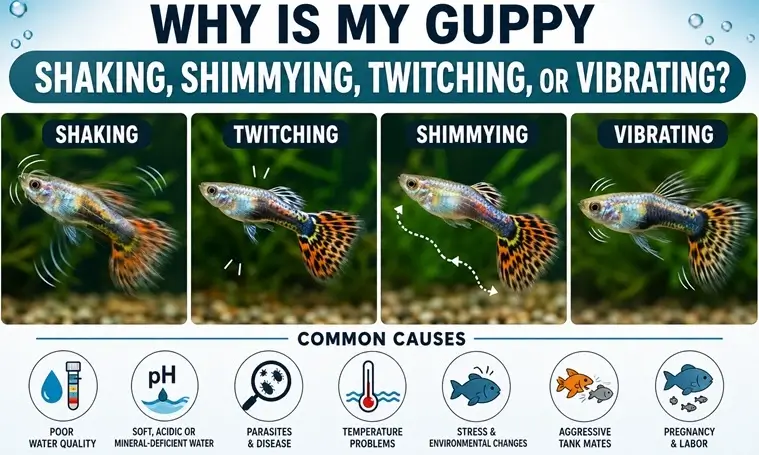
Guppy shaking, twitching, and shimmying are symptoms, not diseases themselves. The important thing is to identify what’s causing the unusual movement before deciding whether treatment is needed. Persistent shaking accompanied by clamped fins, loss of appetite, hiding, or heavy breathing needs closer attention.
Why Is My Guppy Shaking, Shimmying, Twitching, or Vibrating?
Fishkeepers use different words to describe these movements. Twitching usually refers to sudden, brief jerks, while shimmying describes a side-to-side trembling or rocking movement, often with little forward progress.
An occasional twitch may be harmless, especially after a sudden disturbance. However, repeated shaking or shimmying, particularly with other symptoms, needs closer attention.
1. Poor Water Quality
Ammonia, nitrite, and sudden changes in water conditions can irritate or stress guppies, sometimes causing unusual swimming movements.
Common causes:
- Overfeeding — Uneaten food and excess fish waste decompose, increasing the risk of ammonia buildup.
- Overcrowding — Too many fish produce more waste than the aquarium’s filtration system may be able to handle.
- Inadequate filtration — An undersized or poorly functioning biological filter may struggle to convert toxic ammonia and nitrite into nitrate.
- Missed water changes — Nitrate and dissolved waste can accumulate over time, gradually reducing water quality.
- Over-cleaning or replacing filter media — Removing too much beneficial bacteria can disrupt the nitrogen cycle, causing ammonia or nitrite spikes.
What to look for:
Affected guppies may hide, lose color, breathe rapidly, or remain near the surface.
What to do:
Test ammonia, nitrite, nitrate, and pH. Ammonia and nitrite should be zero. If either is detectable, perform an appropriate partial water change using dechlorinated, temperature-matched water and increase aeration.
Check that the filter is working properly, avoid overfeeding (offer only what the fish can eat within a few minutes), and make sure the tank is not overcrowded. Repeat water tests and water changes as needed while correcting the underlying cause.
If the behavior started after maintenance, see our guide on why guppies die after water changes.
2. Soft, Acidic, or Mineral-Deficient Water
Guppies generally do best in moderately hard to hard water. Very soft, mineral-poor water can contribute to stress and shimmying.
Why it happens:
GH measures dissolved calcium and magnesium, which are important for normal fish physiology. KH measures the water’s buffering capacity, or how well it resists changes in pH.
Very low GH may indicate insufficient mineral content, while low KH makes the water less resistant to pH fluctuations. Soft water does not automatically mean acidic or unstable water, but unsuitable water chemistry can stress guppies.
What to do:
Test GH, KH, and pH. As a general guide, aim for a pH of 7.0–8.0 and GH of approximately 9–20 dGH, with enough KH to maintain a stable pH.
If your water is unusually soft, use a suitable aquarium remineralizer to restore the missing minerals. Make changes gradually rather than adjusting the water chemistry overnight.
Our guppy water parameters guide explains these measurements in more detail.
3. Chlorine and Chemical Contamination
Chemical contamination can cause sudden distress and abnormal swimming movements, particularly when it damages a guppy’s skin or gills.
Common causes:
- Untreated tap water — Chlorine or chloramine in untreated tap water can enter the aquarium during water changes if the replacement water is not properly conditioned.
- Household chemicals — Cleaning sprays, insecticides, or air fresheners used near an aquarium can enter the water. Soap or detergent residue on hands, buckets, or tank equipment can also harm guppies.
- Improper medication use — Overdosing or combining incompatible aquarium treatments can harm fish.
What to look for:
Sudden twitching, darting, rapid breathing, or gasping at the surface. If several fish develop these symptoms shortly after a water change or chemical exposure, contamination should be investigated immediately.
What to do:
If chlorine or chloramine exposure is suspected, add a suitable aquarium water conditioner according to its instructions and increase aeration.
For other chemical contamination, remove the source and perform an appropriate water change using safe, dechlorinated, temperature-matched water. Severe cases may require urgent assistance from an aquatic veterinarian.
Never use soap or household cleaning products on aquarium equipment.
4. Temperature Problems
Guppies are tropical fish, and temperatures outside their suitable range can affect their activity and swimming behavior.
Common causes:
- Low temperature — A malfunctioning heater or a cold room can cause the aquarium temperature to drop.
- Sudden temperature changes — Adding replacement water that is considerably warmer or colder than the tank water can stress the fish.
- Unstable temperature — A faulty heater or frequent temperature fluctuations can place guppies under additional stress.
What to look for:
Reduced activity, clamped fins, or unusual movements that begin after a temperature change.
What to do:
Check the thermometer and confirm the heater is working properly. A stable temperature around 76–78°F (24–26°C) is suitable for most guppies.
If the water is too cold, raise the temperature gradually. Avoid increasing it above the normal range simply to stop the shaking, since heat is not a universal treatment for shimmying.
5. Parasites and Disease
External parasites can irritate a guppy’s skin and gills, causing sudden jerks, twitching, or rubbing against objects. However, these movements alone cannot confirm a parasitic infection.
What to look for:
Repeated flashing or scratching against decorations, white spots, excess mucus or a cloudy skin coating, clamped fins, rapid breathing, or loss of appetite.
Possible causes:
Ich, velvet, skin flukes, and gill flukes are among the conditions worth investigating. Bacterial infections can also cause abnormal behavior, although twitching is not specific to them.
What to do:
Test water quality first, since ammonia and nitrite irritation can also cause flashing. Look for other symptoms to help narrow down the cause before starting treatment.
If a parasite or bacterial infection is identified, use medication appropriate for that condition and follow the manufacturer’s dosage and treatment duration. A separate, well-aerated hospital tank can be useful for treating an affected guppy without unnecessarily medicating healthy fish.
Keep biological filtration running unless the medication instructions say otherwise, and remove activated carbon when required by the product label. Avoid combining medications or using salt baths without a specific reason.
If the fish is severely ill or continues to deteriorate despite appropriate care, consult an aquatic veterinarian.
Read our common guppy diseases guide for more information.
6. Stress, Aggression, and Environmental Changes
Stress can affect a guppy’s normal swimming behavior, sometimes causing brief twitching or erratic movements.
Common causes:
- New surroundings — Recently purchased guppies may become stressed while adjusting to a new aquarium.
- Aggressive tank mates — Repeated chasing or fin nipping can keep weaker fish under constant stress.
- Male harassment — Male guppies frequently pursue females, sometimes giving them little opportunity to rest.
- Sudden environmental changes — Abrupt changes in lighting, water conditions, or tank setup can disturb fish.
What to look for:
Hiding, faded coloration, reduced appetite, clamped fins, or a fish repeatedly retreating to a corner, the surface, or the bottom.
What to do:
Observe the fish for signs of chasing or aggression. Provide plants and hiding places, maintain stable tank conditions, and separate persistent aggressors when necessary.
If keeping males and females together, a ratio of around one male to two or three females may help distribute male attention, provided the tank has enough space.
Our guppy tank mates and male vs. female guppy guides explain compatibility and breeding behavior.
7. Normal Male Courtship and Reproductive Behavior
Not every shaking or vibrating movement indicates illness. Some are part of normal reproductive behavior.
Male guppy courtship behavior
Male guppies may rapidly quiver or vibrate their bodies while displaying their colorful fins to females. During these displays, they may briefly curve their bodies into an S-shaped posture.
Unlike persistent shimmying, courtship movements are usually brief and directed toward a female, often while the male is chasing her. The male otherwise swims and feeds normally.
Pregnant female guppy behavior
Pregnant females may occasionally make brief jerky movements or become less active as birth approaches. However, shaking alone is not a reliable sign of labor. Read our pregnant guppy guide for more information.
What to do:
Brief courtship displays in otherwise healthy guppies require no treatment. However, persistent shaking accompanied by clamped fins, rapid breathing, or loss of appetite should not be dismissed as normal reproductive behavior.
Frequently Asked Questions
Why Is My Guppy Shaking at the Bottom of the Tank?
A guppy shaking while resting at the bottom may be experiencing poor water quality, unsuitable temperature, or illness, particularly if it also has clamped fins or refuses food. Test ammonia, nitrite, and temperature first, then look for other signs of disease.
For more information, see our guide on why guppies stay at the bottom of the tank.
Can Guppies Recover From Twitching, Shaking, or Shimmying?
Yes. Many guppies recover once the underlying cause is corrected, particularly when shaking is related to stress, unsuitable water conditions, or temperature changes. Recovery from infections or serious illness depends on the severity of the condition and how quickly appropriate treatment is started.
Is Guppy Shimmying or Shaking Contagious?
Shaking and shimmying are symptoms, not contagious diseases. However, if an infection or parasite is responsible, other guppies may also become affected. Check the remaining fish for similar symptoms and monitor water quality.
Why Is Only One Guppy Shaking While the Others Are Normal?
One guppy may be more stressed, injured, or affected by parasites or illness than the others. However, normal behavior in the remaining fish does not rule out a water-quality problem. Test the water and examine the affected guppy for other symptoms.
Final Thoughts
Guppy shaking, twitching, or shimmying is not always a sign of illness, but persistent or unusual movements should not be ignored. The important thing is to identify the underlying cause rather than treating the shaking itself.
Start by checking water parameters and the guppy’s overall behavior. Many cases improve once the underlying problem is corrected, while infections or more serious conditions may require specific treatment.