
Telling a male vs female guppy apart is one of the first things every new guppy keeper needs to learn — it matters for breeding control, preventing stress, and keeping a healthy aquarium. Fortunately, once you know what to look for, the difference is easy to spot. Body shape, color, the anal fin, and the gravid spot give you everything you need. In my childhood I didn’t even think about sexing guppies until one fine day they gave birth to fry.
Quick summary:
➜ Males — smaller, slimmer, more colorful, more active
➜ Females — larger, rounder, grey or silver-toned with color usually concentrated on the tail, calmer, presence of a Gravid Spot
In this guide:
➜ Quick visual guide
➜ Size and shape
➜ Color
➜ Anal fin comparison
➜ Gravid spot in female guppies
➜ Behavior differences
➜ Male vs female guppy fry
➜ Which is better for your tank
➜ Frequently asked questions
Quick Visual Guide
The easiest way on how to tell male and female guppy apart at a glance is by comparing body shape, color, tail size, Gravid spot and the anal fin side by side.
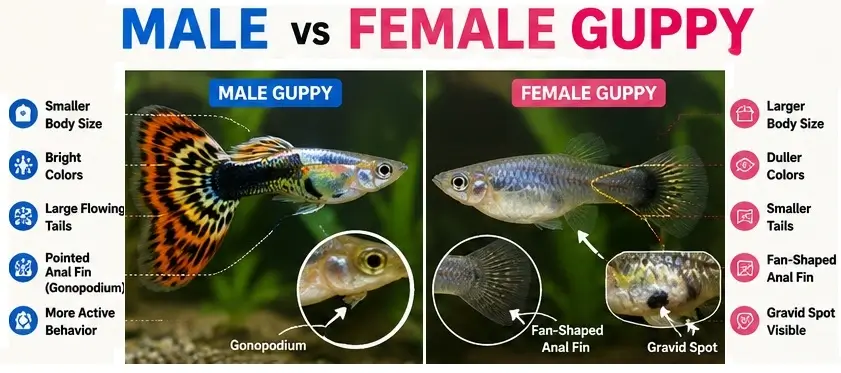
Male guppy:
➜ have smaller bodies
➜ display bright color throughout the body
➜ have larger flowing tail
➜ pointed anal fin (gonopodium)
➜ display more active behavior
Female guppy:
➜ have larger bodies
➜ display grey or silver-toned depending on the variety, with color mostly on the tail
➜ have a rounded tail shape
➜ have fan-shaped anal fin
➜ visible gravid spot once they mature
Male vs Female Guppy Size and Shape
Body size and shape is one of the easiest differences to spot, even from across the tank — unlike the anal fin, which usually needs a much closer look to confirm.
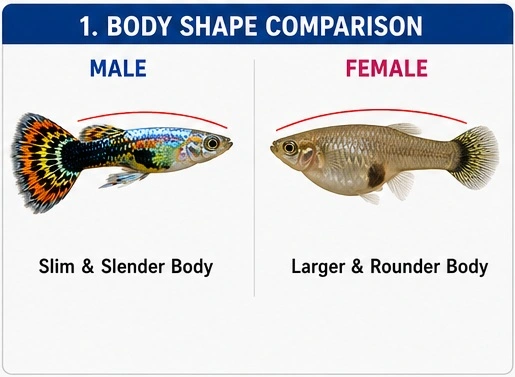
Female guppies usually:
➜ have larger bodies
➜ display a deeper-bodied shape
➜ have a fuller abdomen
Adult females commonly reach 2–2.5 inches, with some well-fed fancy strains reaching more than 2.5 inches.
Male guppies usually:
➜ have smaller bodies
➜ display a slimmer build
➜ have a more streamlined shape
Adult males commonly stay at 1–1.5 inches, with some fancy strains reaching more under good nutrition and genetics.
Male vs Female Guppy Color
Color is the most immediately noticeable difference, though it is worth being precise about exactly where that color shows up on each sex.
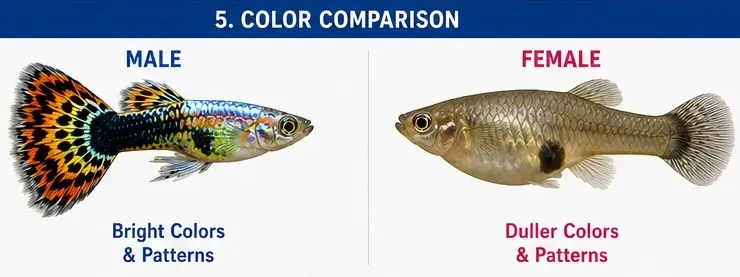
Male guppies commonly display:
➜ color patterns across the entire body, not just the tail
➜ bright coloration, especially in the tail section
➜ widely varying patterns by strain
Female guppies are usually:
➜ grey or silvery-bodied depending on the variety
➜ lightly colored on the tail only
➜ occasionally colorful-tailed in certain fancy strains
As guppies mature, this color gap becomes more obvious. By full adulthood, a male’s full-body coloration next to a female’s grey body and lightly-patterned tail is usually unmistakable.
Anal Fin Comparison
The anal fin is the single most reliable way to sex a guppy, since it does not vary much by strain the way color and size can. Once you know what to look for, a close look at this one fin is often enough to confirm gender with confidence, even on fish from an unfamiliar strain.
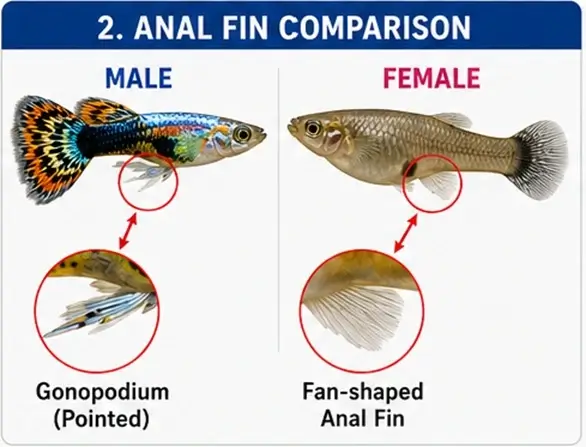
Male guppies develop a gonopodium. This is the anal fin modified into a reproductive organ, and it begins forming gradually from around 3–4 weeks of age.
This fin appears:
➜ longer in males, shorter and more compact in females
➜ thinner in males, noticeably wider at the base in females
➜ pointed in males, rounded off in females
➜ rigid and rod-like in males, soft and flexible in females
The gonopodium is used to transfer sperm during breeding, and its shape stays consistent across virtually every guppy strain, fancy or wild-type.
Female guppies instead have a fan-shaped anal fin that never transforms the way a male’s does, regardless of age or strain.
This fin appears:
➜ wider— spans a noticeably broader base than the male’s fin
➜ triangular— fans out in a clear triangle shape rather than tapering
➜ less pointed — ends in a rounded or blunt edge instead of a tip
Because the anal fin difference holds true across strains it remains one of the markers most worth trusting.
Gravid Spot in Female Guppies
Nearly all mature female guppies develop a gravid spot, and male guppies never develop one at all — making it another highly reliable sexing marker. The spot itself typically starts becoming noticeable around 4 weeks of age, well before a female is anywhere close to breeding, and grows more defined as she matures into adulthood. It is worth knowing that the gravid spot is present on virtually every female regardless of whether she is currently pregnant, though it can be harder to spot on darker-colored strains like tuxedo varieties where the body color itself masks it
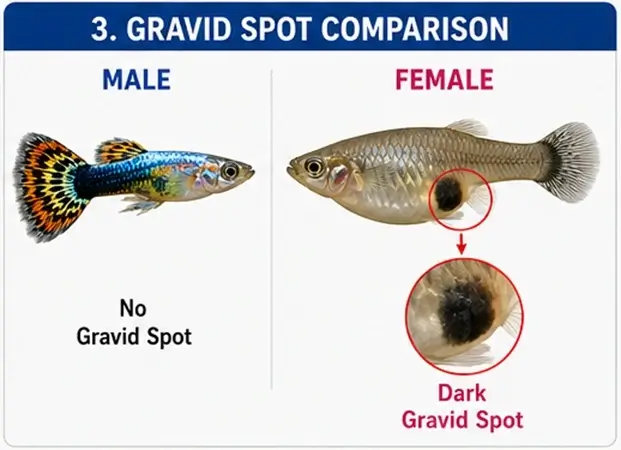
The gravid spot appears:
➜ near the lower abdomen
➜ close to the anal fin
➜ darker and larger on mature females
➜ most noticeable during pregnancy
A dark gravid spot is often one of the clearest signs when sexing a male vs female guppy. You can also read our pregnant guppy guide for more information.
Behavior Differences
Behavior differences are subtler than the visual markers above, but they add useful confirmation once you know what to look for.
Male guppies are usually:
➜ more active
➜ constantly chasing females
➜ displaying fins
➜ competing with other males
Female guppies are usually:
➜ calmer
➜ less aggressive
➜ slower swimmers
➜ less territorial
Too many males inside one aquarium can stress females through constant chasing. A common recommendation is 1 male for every 2–3 females, which gives each female enough room to avoid unwanted attention while still allowing natural breeding behavior.
Male vs Female Guppy Fry
Many aquarists try sexing fry very early, but early fry sexing is difficult and often inaccurate — it is usually better to wait until the markers below become reliable.
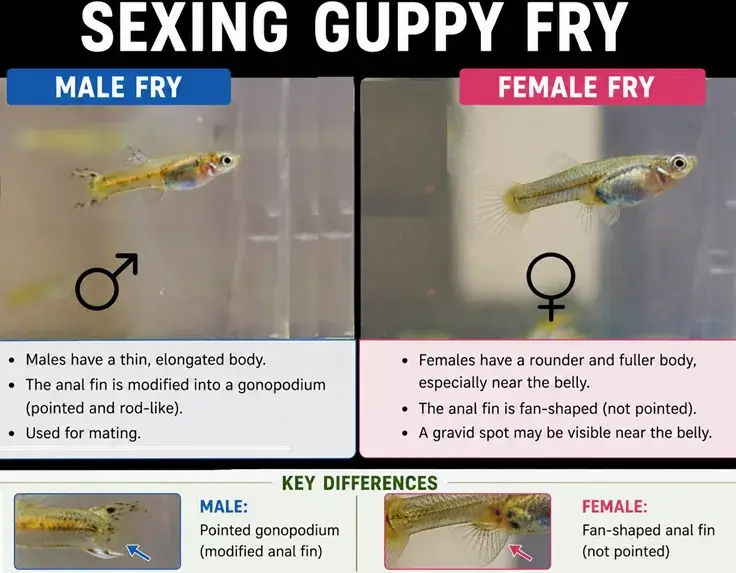
During the first 2–3 weeks, both sexes look very similar, though females tend to grow slightly larger and faster even at this early stage. By weeks 2–3, a closer look often shows male fry developing color across more of the body, while females show only mild color on the tail.
As the fry matures, male fry, around weeks 4–6:
➜ body looks slimmer and flatter
➜ colors develop earlier on body and tail
➜ gonopodium begins forming, visible from around 3–4 weeks and clearly obvious by 6 weeks in most strains
Female fry at the same age:
➜ body looks larger and rounder compared to males
➜ little color on the body, only mild color on the tail
➜ a darker gravid area develops earlier
Another easy way to identify fry gender is by examining the developing anal fin, the same marker used on adults. Gender differences are usually reliably identifiable by 4–6 weeks of age across most strains. For more on raising fry to this stage, read our guppy fry guide and our guppy fry growth guide.
Which Is Better for Your Tank?
Both male and female guppies have their own advantages — it depends on what you want from your aquarium.
Choose male guppies if you want:
➜ bright colors
➜ fancy tails
➜ active behavior
Choose female guppies if you want:
➜ calmer tanks
➜ breeding projects
➜ less fin aggression
Keeping both sexes together leads to frequent, fast breeding — guppies reproduce readily under normal aquarium conditions (see our do guppies lay eggs guide for how that reproduction actually works), so be ready for fry if you mix genders. If breeding is the goal, read our guppy breeding guide for setup and ratio guidance.
Frequently Asked Questions
How do you know if guppies are male or female?
The easiest method is checking the anal fin, gravid spot, and coloration. Male guppies develop a pointed gonopodium and full-body color with no gravid spot, while females have a fan-shaped anal fin, a visible gravid spot once mature, and color usually limited to the tail.
Can female guppies be colorful?
Yes. Some strains produce females with colorful tails, but males are usually much more colorful and brighter throughout the body.
Can male guppies get pregnant?
No. Only female guppies become pregnant and give birth to fry.
Do all female guppies have a gravid spot?
Nearly all mature female guppies develop a visible gravid spot, though the darkness can vary between strains. The gravid spot looks more pronounced especially during pregnancy.
Why are male guppies chasing females?
This is normal breeding guppy behavior. Males constantly attempt to breed with females.
How many female guppies per male?
Most aquarists recommend 2–3 females per male. This helps reduce stress on females.
Can two male guppies live together?
Yes, two male guppies can usually live together without major problems. Minor displaying and chasing may occur occasionally, but serious aggression is uncommon. Issues are more likely when multiple males compete for territory or access to females in crowded aquariums. Providing adequate swimming space and hiding places helps maintain a peaceful tank.
At what age can you tell if a guppy is male or female?
Most guppies can be reliably identified as male or female between 4 and 6 weeks of age. During this period, males begin developing brighter colors and a pointed gonopodium, while females become larger, rounder, and gradually develop a visible gravid spot.
Can female guppies live without males?
Yes, female guppies can live without males and remain healthy. However, many breeders and hobbyists keep males and females together because breeding is a natural part of guppy behavior. If you keep both genders together, expect frequent reproduction. If you prefer to avoid breeding, female-only groups can also be maintained successfully.
Conclusion
Understanding male vs female guppy differences becomes much easier once you learn the major visual features. The most reliable identification methods include body size and shape, coloration, anal fin shape, and gravid spot visibility.
Male guppies are usually smaller, brighter, and more active, while females are larger, calmer, and capable of pregnancy. Using these visual differences, even beginners can confidently identify guppy gender.