
Getting your guppy water parameters right is the single most important factor in keeping guppies healthy. Get the water right, and your guppies will be active, colorful, and long-lived. Get it wrong, and even the hardiest fish will begin to show signs of stress within days.
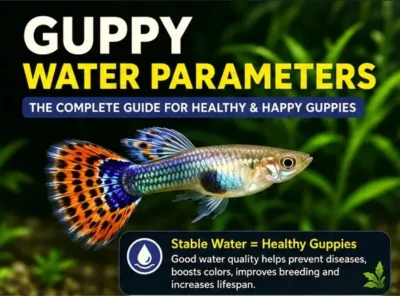
Guppies have a reputation for being tough, beginner-friendly fish, and that reputation is largely deserved. But “hardy” does not mean “indestructible.” Poor water quality is the most common cause of fin rot, shimmying, unexplained deaths, and chronic illness in guppy tanks.
Whether you keep fancy guppies, endlers, or a simple community tank, understanding your water parameters is not optional. It is the foundation upon which everything else is built. This guide covers everything you need to know — from temperature and pH to GH, KH, ammonia, and nitrates — so you can give your guppies the stable, healthy environment they need to thrive.
In this guide, you will learn:
➜ Ideal Guppy Water Parameters Chart
➜ Best Guppy Water Temperature
➜ Guppy Water pH
➜ Guppy Water Hardness (GH & KH)
➜ Endler Guppy Water Parameters
➜ Ammonia, Nitrite & Nitrate for Guppies
➜ Why Water Changes Matter
➜ How Often to Change Water in a Guppy Tank
➜ Guppy Water Flow
➜ Signs Your Water Parameters Are Bad
➜ Best Water Conditioner for Guppies
➜ Can Guppies Live Without a Heater?
➜ Can Guppies Live Without an Air Pump or Filter?
➜ Common Beginner Mistakes
➜ Best Test Kits for Guppy Water
➜ Frequently Asked Questions
Ideal Guppy Water Parameters Chart
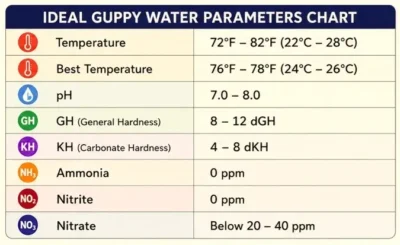
The table below covers the key water parameters every guppy keeper should know. While guppies can tolerate a range of conditions, staying within these values gives them the best chance of a long, healthy life.
| Parameter | Acceptable Range | Ideal Range |
|---|---|---|
| Temperature | 72°F–82°F (22°C–28°C) | 76°F–78°F (24°C–26°C) |
| pH | 7.0–8.0 | 7.0–8.0 |
| GH | 8–12 dGH | 8–12 dGH |
| KH | 4–8 dKH | 4–8 dKH |
| Ammonia | 0 ppm | 0 ppm |
| Nitrite | 0 ppm | 0 ppm |
| Nitrate | Below 40 ppm | Below 20 ppm |
Each of these parameters is covered in detail in the sections below.
Best Guppy Water Temperature
The ideal guppy water temperature is between 76°F and 78°F (24°C–26°C). Within this range, guppies tend to be active, display their best coloration, breed reliably, and maintain stronger immune systems. It is the sweet spot where everything works as it should.
Guppies can tolerate a broader range of 72°F to 82°F (22°C–28°C) depending on your goals, but there are real trade-offs at both ends worth understanding. Just like humans, fish also have their summer and winter seasons in the wild.
Cooler water around 72°F–74°F slows the metabolism and can extend a guppy’s lifespan. Cold water also holds more dissolved oxygen, which is beneficial for breathing. However, lower temperatures slow down a guppy’s immune response, making them less equipped to fight off infections. If water quality slips even slightly in a cooler tank, harmful bacteria, parasites, and fungi grow faster in cooler temperatures and can take hold more easily because the guppy’s natural defenses are not working at full strength.
Warmer water around 80°F–82°F speeds up breeding and growth, but comes with its own downsides. Warm water holds slightly less dissolved oxygen, which means guppies have to work a bit harder to breathe and may be seen spending more time near the surface. The higher metabolic rate also places more strain on the body over time, gradually shortening their overall lifespan. Waste also breaks down faster in warmer water, causing ammonia and toxin levels to rise more quickly between water changes.
For most fishkeepers, the 76°F–78°F middle ground is the best long-term choice — warm enough to keep guppies healthy and active, cool enough to avoid the downsides of extremes. What matters just as much as the temperature itself is consistency. Sudden temperature swings, even small ones, can stress guppies significantly, weaken their immune response, and open the door to disease. A reliable heater with a built-in thermostat is the simplest way to keep temperatures stable day and night.
76°F–78°F: ideal balanced range
80°F–82°F: faster breeding and growth but shorter lifespan
If you are setting up a new tank for the first time, our guppy tank setup guide walks you through everything you need.
Guppy Water pH
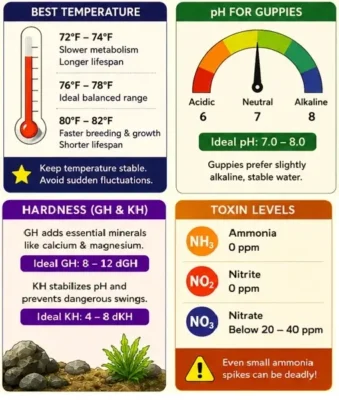
The ideal pH for guppies is between 7.0 and 8.0, slightly alkaline. This reflects their natural habitat — wild guppies live in mineral-rich freshwater, so they’re naturally suited to alkaline conditions rather than soft, acidic water.
There’s no narrower sweet spot worth chasing inside that range. Stability matters more than the exact number — a guppy living in a steady 7.8 is healthier than one swinging between 7.0 and 7.8 day to day. If your pH won’t sit still, low KH is almost always the reason, covered in the next section.
For the full breakdown, including how to raise or lower pH safely, what counts as too high, and what pH to aim for in a planted tank, see our guppy pH guide.
Guppy Water Hardness (GH & KH)
Water hardness is one of the most overlooked aspects of guppy care, particularly among beginners. Most fishkeepers learn to test for ammonia and pH fairly quickly, but GH and KH often get ignored — and that oversight can quietly cause a range of problems that are difficult to trace back to their source.
GH (General Hardness) measures dissolved calcium and magnesium, the minerals guppies need for growth, fin condition, color, and breeding. Aim for 8–12 dGH. KH (Carbonate Hardness) is what actually keeps your pH steady — it buffers against the acids that build up in a tank over time, and when KH runs too low, pH can drift or crash without warning. Aim for 4–8 dKH.
For the full picture, including how to raise hardness naturally, whether your water can be too hard, and the signs your water is too soft, see our hard water guide.
Endler Guppy Water Parameters
Endler guppies — often called Endlers or Endler’s livebearers — are closely related to common guppies and share very similar water parameter requirements. If you are already keeping regular guppies successfully, you will have no trouble keeping Endlers in the same conditions.
pH: 7.0–8.0
Water Type: moderately hard water preferred
Endlers do best in water temperatures between 72°F and 80°F (22°C–27°C), which overlaps comfortably with the standard guppy range. They prefer a pH of 7.0 to 8.0 and moderately hard water, just like their common guppy cousins. The same attention to stable KH and GH levels applies here too. See our guppy pH guide and hard water guide for the full Endler-specific notes on both.
Where Endlers differ slightly is in their overall toughness. They are generally considered even hardier than fancy guppies, which have been selectively bred over many generations for appearance rather than resilience. Fancy guppies, with their large ornate fins and highly modified body shapes, are more sensitive to water quality fluctuations. Endlers, being closer to their wild ancestors, tend to handle minor parameter shifts with less stress. That said, stable clean water is still the foundation of good Endler care — hardiness is not an excuse to let water quality slide.
Ammonia, Nitrite & Nitrate for Guppies
Of all the water quality issues that affect guppies, toxic nitrogen compounds are the most dangerous and the most common cause of unexpected illness and death in fish tanks. Understanding how ammonia, nitrite, and nitrate work — and how they relate to each other — is one of the most valuable things a fish keeper can learn.
Nitrite: 0 ppm
Nitrate: below 20–40 ppm
Ammonia is the most immediately deadly of the three. It is produced constantly in your tank through fish waste, uneaten food, and decaying matter, and even a small amount damages a guppy’s gills and weakens its immune system. The target is always zero, anything above that should be treated as urgent. For symptoms, emergency steps, and the full picture, see our guppy ammonia guide.
Nitrite is produced when beneficial bacteria in your tank break down ammonia. It is less immediately lethal than ammonia but still highly toxic. Nitrite interferes with a guppy’s ability to carry oxygen in their blood, causing them to suffocate even in well-oxygenated water. Like ammonia, the only acceptable level is zero.
Nitrate is the end product of the nitrogen cycle and is far less toxic than ammonia or nitrite. However, allowing it to build up over time creates chronic low-level stress that weakens guppies gradually. Keeping nitrates below 20 ppm is ideal, though levels up to 40 ppm are generally tolerable for healthy adult guppies. Fry and pregnant females are more sensitive and do better at the lower end of that range. Regular water changes are the most effective way to keep nitrates under control.
If your guppies are gasping at the surface or behaving unusually, an ammonia or nitrite spike is often the cause. Our guide on why guppies stay at the top of the tank covers this in more detail.
Why Water Changes Matter
No matter how good your filtration is, it cannot do everything. Filters remove solid waste and process ammonia through beneficial bacteria, but they cannot reduce nitrates or replenish the minerals that guppies gradually deplete from the water. That is where regular water changes come in — and they are arguably the single most impactful maintenance task in any guppy tank.
For most guppy setups, a weekly water change of 25% to 30% is the standard recommendation. This removes accumulated nitrates, dilutes any toxins that have been building up between changes, and refreshes the mineral content that guppies rely on for healthy immune function, fin development, and breeding. Many fishkeepers notice an immediate improvement in their guppies’ activity and coloration in the hours following a good water change — and that is not a coincidence. Fresh, clean water genuinely makes guppies feel better.
Beyond routine partial water changes, a more thorough deep clean should be done approximately once a month. This involves a larger water change of around 50%, vacuuming the substrate to remove accumulated waste, and rinsing filter media in old tank water — never tap water, as chlorine will kill your beneficial bacteria. This monthly reset helps prevent the gradual buildup of organic waste that partial changes alone cannot fully address over time.
In the event of a disease outbreak or even a strong suspicion that something is wrong in your tank, a complete intervention is necessary. This means performing a full or near-complete water change, thoroughly cleaning the tank walls and decorations, rinsing all filter media, and treating the water appropriately for the specific illness. Waiting to see if the situation improves on its own during a disease outbreak almost always makes things worse. Acting quickly and decisively with a full clean gives your guppies the best chance of recovery.
Always treat new tap water with a quality water conditioner before adding it to the tank to neutralize chlorine and chloramine. Make sure the temperature of the new water closely matches the tank temperature before adding it — even a few degrees difference can stress guppies. Adding the new water slowly rather than all at once gives the tank time to adjust and keeps the experience as stress-free as possible for your fish.
How Often to Change Water in a Guppy Tank
There is no single water change schedule that works for every guppy tank. The right frequency depends on several factors working together, and understanding them helps you find the rhythm that suits your specific setup rather than blindly following a generic rule.
Tank size plays a significant role. Larger tanks dilute waste and toxins across a greater volume of water, so parameters stay stable for longer. A small 5 to 10 gallon tank can see ammonia and nitrate levels rise fast, especially with several fish inside. A 30 gallon tank with the same number of fish gives you considerably more breathing room between changes.
Stocking level is equally important. The more fish you have, the more waste is produced, and the faster toxins accumulate. An overcrowded tank will need more frequent water changes regardless of how good your filtration is, while a lightly stocked tank gives the beneficial bacteria and plants more time to process waste naturally.
Filtration quality makes a meaningful difference too. A high quality filter running efficiently will keep the water cleaner for longer compared to a basic or undersized filter struggling to keep up with the tank’s bio-load. That said, even the best filter cannot replace water changes entirely — it simply extends the window between them.
Live plants are one of the most underrated tools for water quality management. A well planted tank actively absorbs nitrates, ammonia, and other harmful compounds around the clock, significantly reducing how quickly parameters deteriorate between water changes.
Taking all of these factors together, here is a practical general guide:
Small tanks (under 10 gallons) — two partial water changes per week of around 20% to 25% each. Small tanks are unforgiving and parameters can shift quickly.
Medium tanks (10 to 30 gallons) — one water change per week of 25% to 30% is sufficient for most setups at moderate stocking levels.
Large tanks (30 gallons and above) — with good filtration, light stocking, and live plants, water changes every 10 to 15 days of around 30% are generally adequate, provided weekly water testing confirms parameters remain stable.
When in doubt, test your water rather than guessing. The numbers will always tell you more accurately than a schedule whether a water change is overdue.
Guppy Water Flow
Guppies are not strong current fish. In the wild they inhabit slow moving streams, ponds, and drainage channels where the water is calm and gentle — and their tank should reflect that as closely as possible.
Too much current can make it difficult for guppies to swim comfortably and may:
➜ stress fancy guppies
➜ damage large fins
➜ tire fry and weak fish
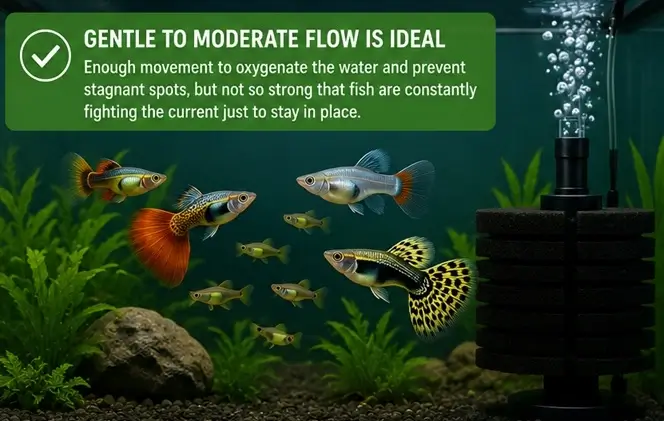
A gentle to moderate water flow is ideal. Enough movement to oxygenate the water and prevent stagnant spots, but not so strong that fish are constantly fighting the current just to stay in place. When flow is too powerful, the effects are more serious than most fishkeepers realize. Fancy guppies with their large tails are particularly vulnerable — strong currents push and bend their fins constantly, which over time can cause physical damage and chronic stress. Fry and weaker fish struggle even more, exhausting themselves trying to swim against a current their small bodies simply are not built for.
The good news is that the solution is straightforward. Sponge filters are widely considered the best filtration option for guppy tanks, and for good reason. They provide gentle, biological filtration without creating strong currents. They’re safe for newborn fry, who could otherwise get sucked into a more powerful filter intake. The sponge surface itself also gets colonized by beneficial bacteria over time, making it highly effective at processing ammonia and nitrite. For breeding tanks and fry tanks especially, a sponge filter is close to essential.
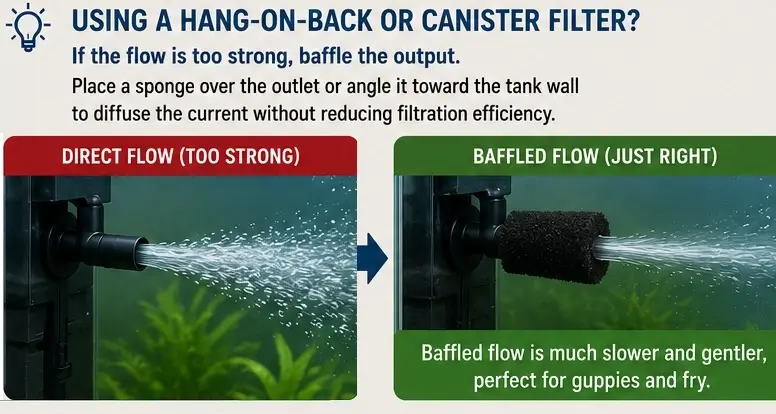
If you are using a hang-on-back or canister filter and finding the flow too strong, a simple fix is to baffle the output. Place a sponge over the outlet, or angle it toward the tank wall, to diffuse the current significantly without reducing filtration efficiency.
Signs Your Guppy Water Parameters Are Bad
Guppies cannot tell you when something is wrong with their water, but they show it clearly through their behavior and appearance.
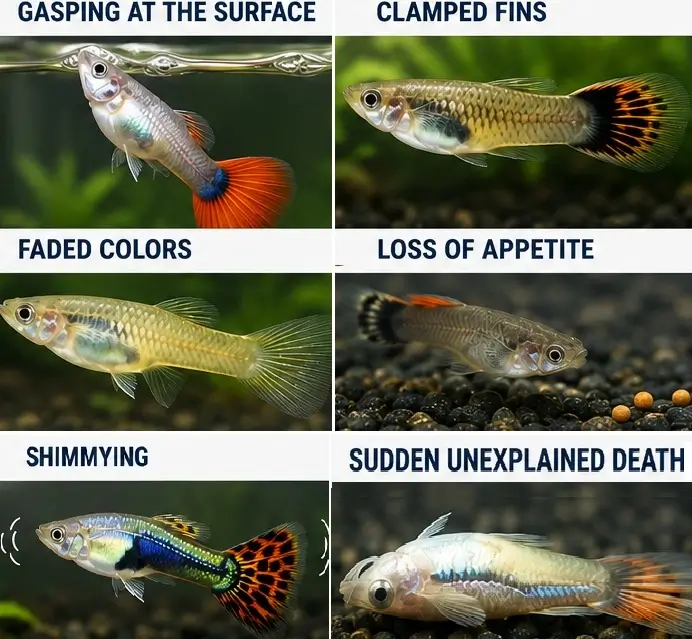
Gasping at the surface is one of the most urgent signs. When guppies are repeatedly seen gulping air at the waterline, it almost always indicates a serious problem — either very low oxygen levels, an ammonia or nitrite spike, or both. This is not normal behavior and should never be dismissed as the fish simply being hungry. Test your water immediately, and see our guppy ammonia guide for the full symptoms and emergency steps if ammonia is the cause.
Clamped fins are another reliable early warning. Healthy guppies hold their fins open and flowing. When fins are pressed tightly against the body, it signals stress or the early stages of illness. Poor water quality is one of the most common triggers, often showing up as clamped fins before any other visible symptom appears.
Shimmying is a side to side rocking or trembling motion where the fish barely moves forward. It’s most often triggered by water temperature that’s too low, a sudden temperature drop, or unstable water parameters, including low GH and KH. It can also be an early sign of velvet disease, a parasitic infection that thrives in poor water conditions. Either way, a shimmying guppy warrants an immediate water test and temperature check. See our guppy shaking, twitching, and shimmying guide for the full diagnosis.
Faded colors develop more gradually but are equally telling. Guppies in poor water conditions lose their vibrancy over time as chronic stress suppresses their natural pigmentation. If your fish look duller than they used to, a full water test is worth doing before assuming it is a feeding or lighting issue.
Loss of appetite paired with any of the above signs is a serious red flag. A guppy that refuses food in clean, well maintained water is unusual. Combine that with clamped fins or gasping and water quality should be your first suspect.
Sudden unexplained deaths — particularly when no visible disease is present — are often the result of an ammonia spike, a pH crash, or oxygen depletion that went undetected. If fish are dying without obvious cause, test your water before anything else.
Whenever you notice any combination of these signs, resist the urge to treat immediately with medication. Test your water parameters first. In the majority of cases, a water change and addressing the underlying parameter problem will do more good than any medicine, and medicating already stressed fish in poor water can make things significantly worse.
Best Water Conditioner for Guppies
Tap water straight from the faucet contains chlorine and chloramine — chemicals added by water treatment facilities to make water safe for humans, but toxic to fish. Chlorine damages a guppy’s gills and slime coat, and it kills the beneficial bacteria in your filter that are responsible for processing ammonia. Always treat new tap water with a quality water conditioner before adding it to your tank.
A good water conditioner neutralizes chlorine, chloramine, and heavy metals instantly, making tap water safe for guppies within seconds of adding it. In the US, Seachem Prime is widely considered the gold standard — it is highly concentrated, works instantly, and also temporarily detoxifies ammonia and nitrite in emergency situations, which makes it particularly valuable for new or stressed tanks.
Can Guppies Live Without a Heater?
This is one of the most common questions from beginner fishkeepers, and the honest answer is — it depends on where you live and how stable your indoor temperatures are.
In tropical climates where room temperatures consistently stay between 76°F and 80°F (24°C–27°C) year round, guppies can technically survive without a heater. Many fishkeepers in countries like India, the Philippines, and parts of Southeast Asia keep guppies successfully without one. If your ambient temperature stays warm and stable throughout the day and night, a heater may not be strictly necessary.
However, for most fishkeepers a heater is strongly recommended — and here is the key reason why. It is not just about average temperature, it is about consistency. Even in warm climates, room temperatures can drop several degrees overnight, during monsoon seasons, or when air conditioning is running. These swings, even small ones, are enough to stress guppies, suppress their immune systems, and trigger disease outbreaks that would not otherwise happen in stable conditions.
Fancy guppies are particularly sensitive in this regard. Their highly modified bodies and large ornate fins make them more vulnerable to temperature fluctuations than hardier wild type guppies or Endlers. For anyone keeping fancy varieties, a reliable heater with a built-in thermostat is close to essential.
A good aquarium heater is one of the least expensive investments you can make for your tank, and the stability it provides is well worth it. When choosing one, look for an adjustable model with an accurate thermostat — cheap fixed temperature heaters are often unreliable and can cause the very fluctuations you are trying to avoid.
Can Guppies Live Without an Air Pump or Filter?
Air pump: Guppies do not strictly need an air pump, but they do need adequate oxygen in the water. What many fishkeepers do not realize is that tank shape matters just as much as volume. A wide, shallow tank has significantly more surface area exposed to air than a tall, narrow aquarium of the same capacity — and it is at the water surface where oxygen exchange actually happens. More surface area means more oxygen naturally dissolving into the water, which is why wide shallow setups can support healthy guppies without any additional aeration equipment.
As an experienced fishkeeper myself, I raised guppies successfully in wide 2 x 1.5 feet tanks kept on a balcony with a water depth of just one foot and no air pump. The combination of good surface area, natural outdoor airflow, and live plants kept oxygen levels consistently healthy for ten guppies without any issues. If your setup has good surface exposure and you are not heavily stocked, a separate air pump may simply not be necessary.
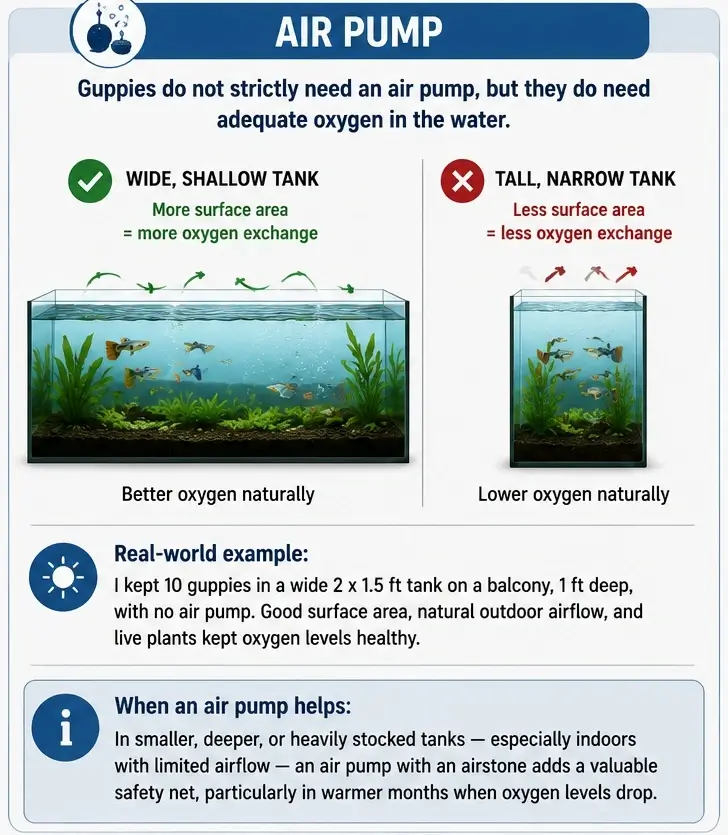
That said, smaller, deeper, or more heavily stocked tanks are different, particularly indoor setups with limited airflow. An air pump with an airstone provides a valuable safety net there, especially during warmer months when dissolved oxygen levels naturally drop.
Filter: A filter is a different matter entirely and is not something most fishkeepers should go without. Without filtration, ammonia from fish waste builds up rapidly with nothing to process it, and even a lightly stocked tank can reach dangerous ammonia levels within days. The only realistic exception is a setup like the one described above — a wide, lightly stocked tank with healthy live plants and regular water changes. Plants absorb nitrates and ammonia around the clock, effectively acting as a natural biological filter when conditions are right.
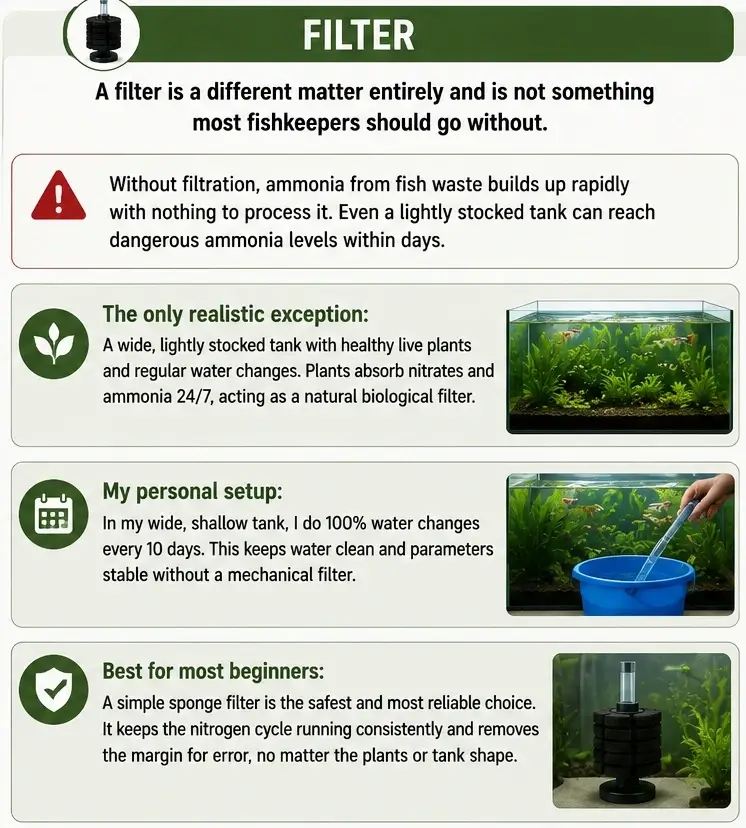
In my own wide shallow tank setup, complete water changes every ten days kept the water consistently clean and parameters stable without a mechanical filter. This works well when stocking is light, plants are healthy, and the water change schedule is followed without exception. For most beginners however, a simple sponge filter remains the safest and most reliable approach — it removes the margin for error and keeps the nitrogen cycle running consistently regardless of plant coverage or tank shape.
Common Beginner Mistakes
Even well-intentioned fishkeepers make mistakes that quietly compromise their water quality. These are the most common ones — and understanding why they are problematic is just as important as knowing to avoid them.
Overfeeding is probably the single most widespread mistake in the hobby. It is easy to do — guppies always look hungry and will eat eagerly regardless of whether they actually need food. The problem is that uneaten food sinks to the substrate and breaks down rapidly, releasing ammonia directly into the water. Even partially eaten food contributes to this. A good rule of thumb is to feed only what your guppies can consume within two minutes, twice a day, and remove any uneaten food promptly.
Overcrowding is the second most common issue. Too many fish in too small a space means too much waste, and beneficial bacteria simply cannot process ammonia fast enough to keep up. The result is a tank where ammonia and nitrite levels are chronically elevated, even with regular water changes and good filtration. Guppies kept in overcrowded conditions are almost always stressed, more prone to disease, and shorter lived than those given adequate space.
Large sudden water changes can do more harm than good, which surprises many beginners who assume more is always better. Replacing more than 50% of your tank water at once can cause rapid shifts in temperature, pH, and mineral content that shock your fish — a condition sometimes called osmotic shock. It can also crash your biological filtration by removing too much of the beneficial bacteria that live in the water column. Stick to gradual partial changes rather than dramatic overhauls unless you are dealing with a disease outbreak that specifically requires it.
Starting with an uncycled tank is one of the most common causes of early fish loss. A brand new aquarium has no established colony of beneficial bacteria, which means ammonia from fish waste has nothing to convert it into less harmful compounds. This leads to what is known as “new tank syndrome” — a dangerous spike in ammonia and nitrite levels in the first few weeks. Cycling your tank before adding fish, either fishlessly using ammonia drops or with a hardy starter fish, gives the bacterial colony time to establish and makes the tank genuinely safe for guppies.
Ignoring water testing is perhaps the most preventable mistake of all. Water can look perfectly clear and clean while harboring dangerous ammonia or nitrite levels that are invisible to the naked eye. Testing your water weekly — and immediately whenever fish show signs of stress — gives you early warning of problems before they become emergencies. A basic liquid test kit covering ammonia, nitrite, nitrate, and pH is an essential piece of equipment for any guppy keeper.
Best Test Kits for Guppy Water
Testing your water regularly is one of the most important habits you can build as a guppy keeper. It is the only reliable way to know what is actually happening in your tank before problems become visible to the naked eye. Clear water tells you nothing about ammonia or pH levels — only a test kit does.
As an experienced fishkeeper myself, I’ve reached a point where I can often read my tank through my fish’s behavior alone, but it took years of observation and plenty of mistakes to get there. For anyone still learning the hobby, a good test kit removes the guesswork entirely. It gives you the confidence to act before small problems become serious ones, and it honestly speeds up how quickly you develop that instinct in the first place.
Your test kits would be:
➜ liquid test kits
➜ digital thermometers
➜ TDS meters
➜ GH/KH test kits
Liquid test kits are the most reliable option for everyday water testing, and the one most experienced fishkeepers recommend. Unlike test strips, which give rough approximate readings, liquid kits use chemical reagents that produce accurate, consistent results. In the US, the API Freshwater Master Test Kit is the most widely used and trusted option. It covers ammonia, nitrite, nitrate, and pH in a single kit, and provides hundreds of tests, making it excellent value for regular weekly testing.
A digital thermometer is equally essential. Stick-on thermometers that attach to the outside of the glass are cheap but notoriously inaccurate. A simple digital probe thermometer gives you a precise reading of the actual water temperature rather than the glass surface, which can differ by several degrees. Consistent temperature monitoring is one of the easiest ways to catch a failing heater before it causes a problem.
A GH and KH test kit is something many beginners overlook entirely, but as we covered earlier in this guide, hardness parameters have a direct impact on guppy health and pH stability. If you are experiencing unexplained pH crashes or poor breeding results, testing your GH and KH is often where the answer lies. The API GH & KH Test Kit is affordable and straightforward to use.
A TDS meter — which measures total dissolved solids in the water — is a useful additional tool, particularly if you are using RO water that needs remineralizing or want a quick overall snapshot of your water’s mineral content. It does not replace a full liquid test kit but works well as a fast daily check between full tests.
Testing your water at least once a week is the minimum for a stable guppy tank. During the first few weeks of a new tank cycle, or any time fish are showing signs of stress, test every day until parameters are confirmed stable.
Frequently Asked Questions
Can guppies live in cold water?
Guppies can survive temporarily in cooler water, but cold temperatures below 68°F (20°C) weaken their immune system, slow their metabolism, and make them significantly more vulnerable to bacterial infections, parasites, and fungal diseases. Long term exposure to cold water almost always leads to illness and a shortened lifespan.
Is 82°F too hot for guppies?
82°F sits at the upper edge of the acceptable range and is not immediately dangerous, but it is not ideal for long term keeping. Warmer water holds less dissolved oxygen, places more strain on the body, and accelerates waste breakdown in the tank. If your tank regularly runs at 82°F or above, consider improving surface agitation to increase oxygen levels and monitoring your fish closely for signs of stress.
How often should I test guppy water?
For an established, stable tank, testing once a week is sufficient. During the first few weeks of a new tank cycle, or any time your fish are showing unusual behavior, test every day until parameters confirm stable. Weekly testing gives you early warning of problems before they become visible in your fish.
Can I use bottled water for guppies?
Technically yes, but it is not recommended as a long term solution. The mineral content of bottled water varies widely between brands, making it difficult to maintain consistent parameters. Properly dechlorinated tap water treated with a quality water conditioner is more reliable, more consistent, and far more cost effective for regular water changes.
Do fancy guppies need different water parameters?
Fancy guppies thrive in the same parameter ranges as regular guppies, but they are considerably more sensitive to fluctuations. Their highly modified bodies and large ornate fins make them less resilient than wild type guppies or Endlers. Stability matters even more with fancy varieties — sudden shifts in temperature, pH, or water hardness that a hardier fish might handle without issue can trigger illness in fancy guppies relatively quickly.
Can water parameters affect guppy colors?
Yes, significantly. Guppies kept in clean, stable, mineral rich water display their most vivid coloration. Poor water quality, unstable pH, or chronic low level ammonia stress all suppress natural pigmentation over time, causing fish to look dull and washed out. If your guppies have lost their color and there is no obvious disease present, a full water test is always the first step.
Do guppies need oxygen in the tank?
Yes. Like all fish, guppies breathe dissolved oxygen from the water through their gills. Adequate surface movement is essential for gas exchange — it allows oxygen to enter the water and carbon dioxide to escape. A filter outlet, air stone, or gentle surface agitation is sufficient for most tanks. Signs of low oxygen include guppies gasping at the surface, reduced activity, and rapid gill movement.
What happens if guppy water is too acidic?
Water that drops below pH 7.0 starts to work against guppies, and water below 6.5 creates serious problems. Acidic conditions irritate the gills, suppress the immune system, interfere with the nitrogen cycle by slowing beneficial bacteria activity, and can cause reproductive failure. Prolonged exposure to acidic water leads to chronic stress and increased susceptibility to disease. If your pH is dropping regularly, test your KH — low carbonate hardness is almost always the underlying cause.
Can unstable water parameters kill guppies?
Yes, and it happens more often than most fishkeepers realize. Sudden swings in temperature, pH crashes, or unexpected ammonia spikes can kill guppies within hours in severe cases. Even less dramatic fluctuations that happen repeatedly over time create chronic stress that gradually weakens fish and shortens their lives. Stability is not just preferable — it is essential.
Do baby guppies need different water parameters?
Fry thrive in the same parameter ranges as adult guppies, but they are far less tolerant of deviations. Even mild ammonia or nitrite levels that an adult fish might handle with minimal visible effect can be fatal to newborn fry. Clean, stable water with nitrates kept as low as possible — ideally below 10 ppm — gives fry the best chance of growing out healthy. More frequent small water changes in fry tanks are strongly recommended.
How long does it take for a guppy tank to cycle?
A new aquarium typically takes between 4 and 6 weeks to fully cycle — meaning enough beneficial bacteria have established to reliably convert ammonia through nitrite and into nitrate. The process can be accelerated by adding a small amount of substrate or filter media from an already established tank, which introduces an existing bacterial colony to the new environment. Never add guppies to an uncycled tank.
Should I test guppy water after adding new fish?
Yes, always. New fish introduce additional waste load to the tank, and in smaller or heavily stocked setups this can cause a temporary ammonia spike as the biological filtration adjusts. Testing on the day of introduction and for several days afterward gives you early warning if parameters are shifting and allows you to act before fish are affected.
What is the safest way to add new water to a guppy tank?
Always dechlorinate tap water with a quality water conditioner before it touches the tank. Match the temperature of the new water as closely as possible to the existing tank water — within one or two degrees is ideal. Add the new water slowly rather than pouring it in all at once, particularly after larger water changes, to minimize the disruption to water chemistry and temperature stability.
Can low oxygen levels stress guppies?
Yes. Low dissolved oxygen is one of the most stressful conditions a guppy can experience and one of the hardest to detect without testing. The most visible sign is guppies repeatedly surfacing to gulp air. Causes include high water temperature, poor surface agitation, overcrowding, and excessive organic waste in the tank. Improving surface movement and addressing the underlying cause usually resolves the issue quickly.
Do guppies prefer still water or flowing water?
Guppies naturally inhabit slow moving or still bodies of water and strongly prefer gentle flow in the aquarium. Strong currents stress fancy guppies, damage their large fins over time, and exhaust fry and weaker fish. A sponge filter or a baffled hang-on-back filter that diffuses the outlet flow is ideal for most guppy setups.
Final Thoughts
Maintaining stable guppy water parameters is not complicated, but it does require consistency and attention. Temperature, pH, hardness, and toxin levels all work together — when one falls out of range, the others are usually not far behind.
The fishkeepers who have the most success with guppies are not necessarily the ones with the most expensive equipment or the largest tanks. They are the ones who test their water regularly, respond to problems early, and understand that prevention is always easier than treatment. A stable, well maintained tank does not just keep guppies alive — it lets them thrive, display their best colors, breed successfully, and live out their full lifespan.
Whether you are setting up your first guppy tank or troubleshooting an existing one, come back to the parameters in this guide as your reference point. The water is always where the answer lies.
