
How many guppies in a 10 gallon tank can you safely keep? For most setups, 5–7 adult guppies is a comfortable range, though the exact number depends on your filtration, tank setup, and whether you are keeping males only or a mixed group.
In this guide, we’ll look at how many guppies a 10-gallon tank can accommodate, how breeding affects the fish count, and what you can do to prevent overcrowding, stress, and poor water quality. We’ll also cover the factors that help keep your guppies healthy and support a longer guppy lifespan.
Quick Navigation
1) How Many Guppies in a 10-Gallon Tank
2) What Happens When You Add Female Guppies in a 10-Gallon Tank?
3) What Should a 10-Gallon Guppy Tank Have?
4) Signs Your 10-Gallon Guppy Tank Is Overcrowded
5) Common Mistakes to Avoid When Keeping Guppies in a 10-Gallon Tank
6) Frequently Asked Questions
How Many Guppies in a 10-Gallon Tank
A 10-gallon tank can comfortably accommodate 5–7 adult guppies in a properly maintained aquarium. This gives them reasonable swimming space while keeping the fish population manageable.
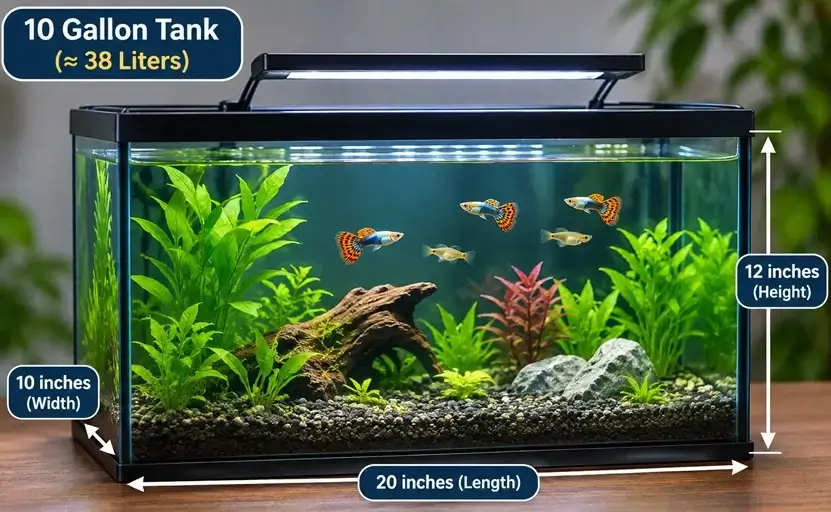
If you keep both males and females, remember that the population can increase quickly when they start breeding.
Male vs Female Guppy Count in a 10-Gallon Tank
All-male group:
If you don’t want to deal with breeding, keeping 5–7 male guppies is a practical choice for a 10-gallon aquarium.
Male guppies are generally smaller and more colourful, making an all-male guppy group popular among fishkeepers.
Mixed-sex group:
If you want to keep both males and females, a ratio of one male to two or three females helps reduce constant attention from males.
For a 10-gallon tank, starting with one male and three females is a better option than filling the tank to its maximum capacity because they may breed.
Female guppies can store sperm and give birth to multiple batches of fry even after being separated from males. So, if you introduce females that have previously been kept with males, they may already be pregnant.
This is something to consider before choosing a mixed-sex group, as the number of guppies can increase much faster than you expect.
If you want to fill it to the maximum capacity, stock the 10-gallon tank with 7 guppies: 2 males and 5 females.
To tell male and female guppies apart, read our male vs female guppy guide.
How Many Guppies Per Gallon?
A commonly used stocking guideline is 1 adult guppy per 2 gallons of water. This provides a more conservative starting point for maintaining a balanced aquarium.
Remember, these are general guidelines. Tank dimensions, fish size, filtration and maintenance also affect how many guppies an aquarium can support.
What If You Keep Other Fish in the Tank?
The recommendation of 5–7 guppies assumes a guppy-only aquarium. If you add other fish, such as 1 or 2 corydoras or a single betta, you will need to account for their space requirements, the additional waste they produce and their compatibility with guppies.
For compatible tankmate options, see our guppy tank mates guide.
What Happens When You Add Female Guppies in a 10-Gallon Tank?
Guppies are livebearers, meaning that they give birth to free-swimming fry. Once pregnant, a female guppy usually gives birth within approximately 21–30 days, although the timing can vary depending on water temperature.
The number of fry also varies depending on the female’s age, size and genetics:
First-time mothers: May give birth to around 10–20 fry.
Adult females: Can produce approximately 20–60 fry in a single brood.
Larger females: May occasionally produce 80 or more fry.
Imagine starting with two male and five female guppies in a 10-gallon tank. If several females give birth around the same time, you could suddenly have dozens of additional fish in the aquarium.
Guppy fry are small, but they still contribute to the tank’s overall waste load as they grow. As their numbers increase, competition for food and swimming space could also become a concern.
If you plan to breed guppies, arrange a separate grow-out tank or make plans to rehome the extra fry. Dense plants can provide hiding places for young guppies, but they won’t prevent overpopulation.
For more information, see our guides on guppy breeding and guppy fry care.
What Should a 10-Gallon Guppy Tank Have?
A good tank setup helps maintain clean water, reduce stress and provide enough space for guppies to thrive. For general care and maintenance tips, see our complete guppy care guide.
Filter: Use a properly sized filter to remove waste and support beneficial bacteria that break down ammonia and nitrite. Choose one with a gentle water flow.
Live plants: Guppy Grass, Java moss, Hornwort and Ambulia provide hiding places, improve oxygenation and help guppies feel secure. They also offer cover for the fry.
Heater and thermometer: Maintain a stable temperature of around 72–82°F (22–28°C).
Cycled aquarium: Make sure the nitrogen cycle is established before adding guppies. Ammonia and nitrite should be zero.
Regular maintenance: Perform partial water changes, remove uneaten food and monitor water quality regularly.
Remember, plants and filtration help maintain water quality, but neither replaces regular water changes or adequate swimming space.
Signs Your 10-Gallon Guppy Tank Is Overcrowded
As the guppy population increases, watch for these signs that your 10-gallon tank may be becoming overcrowded:
Poor water quality: Ammonia and nitrite become detectable, or nitrate levels rise quickly between water changes.
Gasping at the surface: Guppies that repeatedly gather near the surface and breathe rapidly may be showing signs of low oxygen or water-quality problems.
Constant chasing: Male guppies may compete with one another, while males in mixed-sex groups may constantly pursue females. If chasing becomes excessive, it can cause stress, especially when the tank has limited swimming space and hiding places.
Frequent health problems: Stress and poor water conditions can make guppies more vulnerable to disease.
Limited swimming space: Fish may struggle to move freely when the aquarium contains too many adults and growing fry.
If you notice these signs, test the water and review your stocking level and maintenance routine. If necessary, move some guppies to another properly established aquarium.
Common Mistakes to Avoid When Keeping Guppies in a 10-Gallon Tank
Even with a suitable tank setup, a few common mistakes can lead to overcrowding and poor water quality.
Adding too many guppies at once: Introduce fish gradually rather than filling the tank immediately.
Ignoring breeding: A small group can quickly grow when females start producing fry. Plan how to manage the extra fish.
Overfeeding: Uneaten food increases waste and can affect water quality. Feed only what your guppies can consume within a few minutes.
Skipping water changes: Regular partial water changes help control nitrate and remove accumulated waste.
Adding fish without cycling the tank: An uncycled aquarium can expose guppies to toxic ammonia and nitrite.
Relying only on the filter: A filter does not eliminate the need for water changes, regular testing or suitable stocking levels.
Frequently Asked Questions
Can I keep 10 guppies in a 10-gallon tank?
Yes, you can keep 10 guppies in a 10-gallon tank if it is properly set up and well-maintained. However, this is near the upper end of stocking for this tank size and requires good filtration, regular water changes and close monitoring of water quality. Beginners may find it easier to manage a smaller group of 5–7 guppies.
Is a 10-gallon tank enough for guppies?
Yes, for a small group of 5–7 guppies. It is one of the most common starter sizes for the hobby.
How many male guppies can I keep in a 10-gallon tank?
You can comfortably keep 5–7 male guppies in a 10-gallon tank. Some experienced fishkeepers keep up to 8 males with stronger filtration, live plants and more frequent maintenance.
How many female guppies can I keep in a 10-gallon tank?
You can comfortably keep around 4–6 adult female guppies in a 10-gallon tank with proper filtration and regular maintenance. Females are generally larger than males and need adequate swimming space.
An all-female tank avoids continuous mating harassment from males, but females purchased from mixed-sex tanks may already be pregnant. They can also store sperm and produce several batches of fry even after being separated from males.
Can I keep guppies without a filter?
Yes, but it is risky. Without a filter, waste builds up quickly, water quality drops fast, and fish become stressed and can die. If you want to try it anyway, keep the guppy count very low and do frequent water changes.
Can I mix guppies with other fish in a 10-gallon tank?
Yes, you can keep guppies with some compatible tankmates, provided the tank is properly filtered and maintained. However, swimming space and the additional waste produced by other fish must be considered. You may need to reduce the number of guppies to accommodate tankmates.
For more options, see our guppy tank mates guide.
What is the best tank size for guppies?
For beginners, a 20-gallon tank is the best choice, since it offers more stable water conditions, easier maintenance, and comfortably more fish than a 10-gallon allows.
How Many Guppies Can I Keep in a 5-Gallon Tank?
A 5-gallon tank is generally too small for a group of guppies. A larger aquarium provides better swimming space and more stable water conditions. A 5-gallon tank can hold 2–3 guppies at most.
How Many Guppies Can I Keep in a 15-Gallon Tank?
A 15-gallon tank can house 8 to 11 adult guppies or up to 10–12 small guppies if the tank is planted and has a good filtration system.
How Many Guppies Can I Keep in a 20-Gallon Tank?
A 20-gallon tank can accommodate a larger group of 10 to 15 guppies and provides more room for swimming and breeding. Remember to account for growing fry when planning your stocking level.
Final Thoughts
A 10-gallon tank can comfortably hold 5–7 adult guppies with proper filtration and regular maintenance. Plan for extra fry if you keep females, and avoid overcrowding to maintain good water quality.