
Goldfish ich, also called white spot disease, shows up as small white spots that look like grains of salt scattered across your goldfish’s fins, gills, or body. It’s one of the most common diseases in the aquarium hobby, and goldfish can be affected just like many other freshwater fish. Ich is not a goldfish-specific infection. Ich often affects the fins and gills early in an infection. The fins may show the first visible white spots, while gill infections can go unnoticed because you cannot see the gills from the outside.
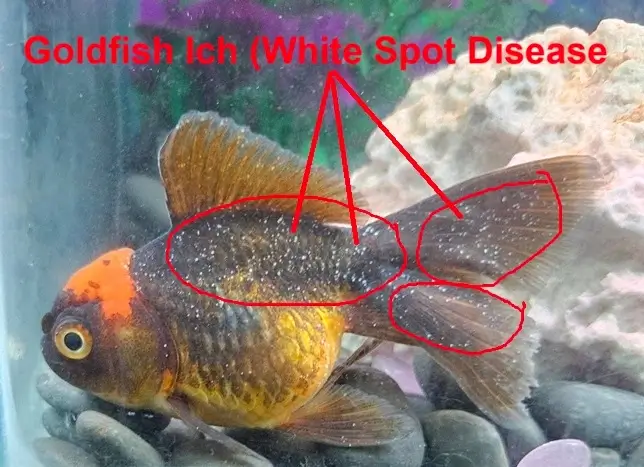
Although ich can spread quickly, it is also treatable when caught early and properly treated according to its life cycle.
Table of Contents
1) What Is Ich (White Spot Disease)?
2) Ich Quick Facts
3) Ich (White Spot Disease) Symptoms
4) Ich Causes
5) Ich (White Spot Disease) Treatment
6) How to Prevent Ich
7) What Else Can Look Like Ich in Goldfish
8) FAQ
9) Final Thoughts
What Is Ich (White Spot Disease)?
Ich, also called white spot disease, is caused by a microscopic parasite called Ichthyophthirius multifiliis. The parasite attaches to the fish skin, fins, and gills, where it feeds and irritates the surrounding tissue. This produces the small white spots that give ich its name.
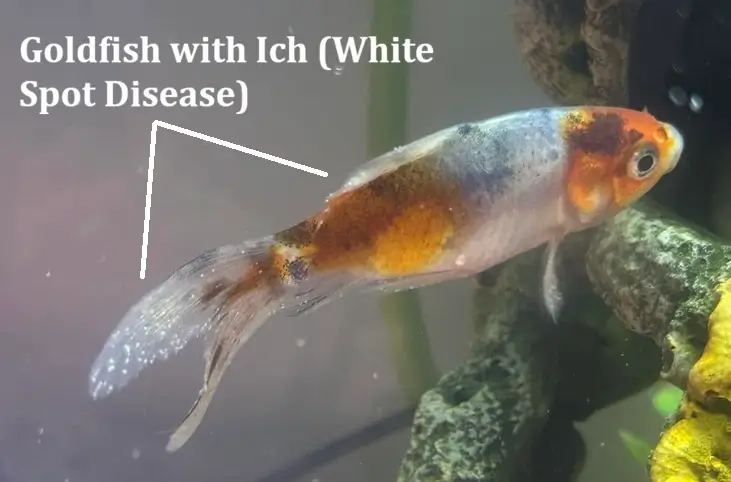
The parasite burrows into the outer layer of the skin, fins, or gills and feeds there. This irritates the surrounding tissue and causes the skin to thicken around the parasite, creating the small raised white spots that are characteristic of ich. The spots are easier to see on darker goldfish, but they can also be seen on lighter-colored fish.
The Ich Life Cycle
Understanding the life cycle is the whole reason ich treatment works the way it does. The parasite moves through three stages:
• First stage (Trophont) — This is the feeding stage. The parasite attaches to and becomes embedded in the fish’s skin, fins, or gills. This is the stage seen as the white spot, and the parasite is protected from most medications while it remains on the fish.
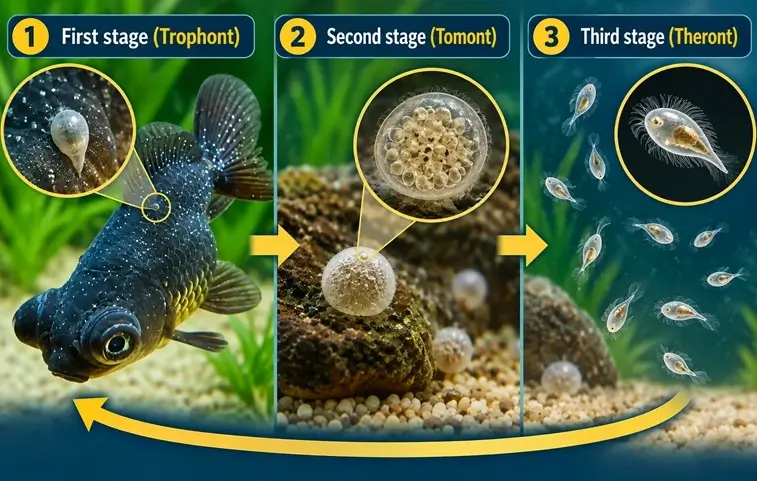
• Second stage (Tomont) — After feeding, the parasite leaves the fish and forms a cyst on the substrate, glass, or décor. Inside the cyst, it divides and produces new parasites.
• Third stage (Theront) — The cyst eventually ruptures and releases free-swimming parasites that search for a new host. This is the main stage targeted by ich medications.
The entire life cycle is temperature-dependent. In water around 75–79°F (24–26°C), ich can complete its life cycle in about 3–6 days, while colder water can slow the cycle considerably. This is why ich treatment usually requires repeated treatments at intervals based on water temperature rather than a single dose.
Ich Quick Facts
| Attribute | Details |
|---|---|
| Scientific Name | Ichthyophthirius multifiliis |
| Type | External protozoan parasite |
| Contagious? | Yes, highly — spreads to the whole tank within days |
| Main Symptoms | Salt-like white spots, flashing, clamped fins, lethargy, loss of appetite |
| Standard Treatment | Anti-parasitic medication, with salt and temperature management |
| Treatment Length | Usually 3–7 days, depending on water temperature and treatment used |
| Prevention | Quarantine new fish and avoid transferring contaminated plants, water, or equipment between tanks |
Ich (White Spot Disease) Symptoms
Ich affects the fins and gills early in an infection. The fins may show the first visible white spots, while gill infections can go unnoticed because the gills cannot be seen from the outside. As the infection progresses, the parasite can also affect the skin and other areas of the fish.
• Small white spots on the skin and fins, usually resembling grains of salt or sugar. They may also occur on the gills, although gill infections are not visible from the outside.
• Flashing — rubbing or scraping against gravel, decorations, or the tank glass.
• Rapid or labored breathing, especially when the gills are heavily affected. The fish may also gather near the surface or other areas with good water movement.
• Clamped fins — holding the fins tightly against the body instead of keeping them relaxed and spread.
• Loss of appetite and general lethargy.
• Hiding behavior, including spending more time near the bottom of the tank than usual.
• In severe, advanced cases, sudden death can occur, and an outbreak may cause multiple fish to die within a short period.
One important warning: Ich does not always produce visible white spots. If the parasite is concentrated in the gills, a goldfish may have serious breathing problems while the skin and fins remain clear. Rapid breathing, gasping, or other signs of respiratory distress without visible spots should not be dismissed as harmless.
Ich Causes
• An unquarantined new fish — one of the main ways ich enters an aquarium; a newly introduced fish can carry the parasite without showing obvious symptoms.
• Shared equipment — nets, siphons, or filter media moved between tanks without being properly disinfected first.
• New plants or decor — these can carry the parasite if they were previously kept with infected fish and weren’t properly quarantined or disinfected.
• A sudden temperature drop — rapid temperature changes can stress fish and may make ich outbreaks more likely.
• Poor water quality — poor environmental conditions can weaken fish and increase their susceptibility to disease.
• Overcrowding — crowded conditions increase stress and can allow ich to spread rapidly between fish.
Goldfish that survive an ich outbreak may continue to carry low numbers of the parasite without showing obvious signs. They can still act as a source of infection for fish that have not been exposed before.
Ich (White Spot Disease) Treatment
If one goldfish has ich, treat the aquarium rather than only the fish with visible white spots. The parasite has free-swimming stages that can spread to other fish, while the stages attached to the fish or enclosed in cysts are protected from many treatments.
1) Check the Water and Improve Oxygenation
Before starting treatment, make sure the water quality is good and the fish have plenty of oxygen.
• Check ammonia, nitrite, nitrate, and pH.
• Remove excess waste and uneaten food.
• Increase aeration, especially if you are raising the temperature or using a medication that can reduce dissolved oxygen.
• Avoid sudden temperature changes.
2. Raise the Temperature Gradually — If Appropriate
Warmer water speeds up the ich life cycle, allowing the
vulnerable free-swimming stage to appear sooner. However, raising the temperature is not suitable for every aquarium, especially when other tank mates cannot tolerate warmer water.
If you choose to raise the temperature, gradually bring the water to around 75–79°F (24–26°C) and provide strong aeration. Do not simply push the tank to the highest temperature possible. Warmer water holds less oxygen, which can be particularly important when the fish already has gill damage.
3) Use an Ich Medication
A proven anti-parasitic medication is usually the most straightforward treatment option.
Common treatments for freshwater ich include formalin, copper-based medications, and products containing malachite green. Follow the product label carefully because dosing and treatment intervals differ between products.
Remove activated carbon from the filter during treatment if the medication label instructs you to do so, because carbon can remove some medications from the water.
Don’t guess the dose. Calculate the actual water volume of the aquarium and follow the medication’s instructions. Overdosing can harm fish, while underdosing may fail to eliminate the parasite.
Perform water changes as directed by the medication — some ich medications require a partial water change before each dose, while others do not. Always follow the instructions on the specific product you are using.
4. Aquarium Salt Can Be Used as an Alternative or Supportive Treatment
Aquarium salt can help reduce the osmoregulatory stress caused by damage to the fish’s skin and can also affect the free-swimming stage of ich. A prolonged treatment around 0.6–0.75 ounces of salt per gallon for 7–10 days can be effective at suitable temperatures when the fish and aquarium inhabitants can tolerate the salinity.
However, Aquarium salt isn’t suitable for every aquarium. Some plants and salt-sensitive tank mates may not tolerate it.
5) Don’t Stop Treatment When the Spots Disappear
This is one of the most important parts of ich treatment.
The white spots are the trophont stage, which is protected while attached to the fish. Medication is mainly effective against the free-swimming stage. The aquarium therefore has to be treated repeatedly as new organisms emerge from their cysts.
At around 75–79°F (24–26°C), the life cycle can take about 3–6 days, so treatment should usually be repeated daily for at least 3–5 treatments at these temperatures. At cooler temperatures, treatment intervals need to be longer.
Follow the treatment schedule for the specific medication you are using rather than stopping when the visible spots disappear.
6) Clean the Aquarium During Treatment
Ich cysts can settle on the substrate and other surfaces after leaving the fish. Removing waste and debris can help reduce the number of organisms remaining in the aquarium. Siphon the waste while doing water changes.
During treatment:
• Vacuum the substrate regularly where practical.
• Remove dead fish promptly.
• Keep the filter running unless the medication specifically requires otherwise.
• Maintain good aeration.
The important thing is to remove debris without interrupting the medication schedule.
7) Reconsider the Diagnosis if Treatment Isn’t Working
If the fish continues to develop new spots or symptoms despite following the treatment correctly, don’t keep adding more medication blindly.
Other conditions can look similar to ich, and a microscopic examination of skin, fin, or gill tissue can help confirm the parasite.
If there’s no improvement after about 5 days of proper treatment, reconsider the diagnosis and treatment approach rather than continuing to medicate blindly. Persistent symptoms can mean that the condition isn’t ich or that the treatment isn’t working as expected.
How to Prevent Ich
• Quarantine every new fish for 4–6 weeks before adding it to the main tank.
• Quarantine new plants for at least 2 weeks without fish present, allowing any ich to die out without a host. A short plant-safe treatment or dip can also be used before adding plants to the main tank.
• Disinfect or use separate nets, siphons, and other equipment for each tank.
• Keep ammonia and nitrite at 0 and avoid overcrowding.
• Keep the water temperature stable and avoid sudden temperature changes.
• Wash your hands and forearms between tanks to avoid transferring ich between aquariums.
What Else Can Look Like Ich in Goldfish
A few other things get mistaken for ich, and treating the wrong condition wastes time and can stress the fish unnecessarily:
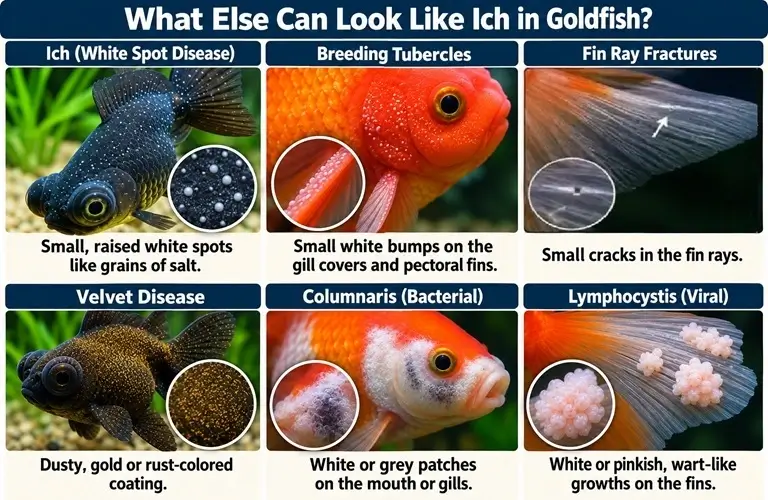
• Breeding tubercles — small white bumps that develop on the gill covers and pectoral fins of mature male goldfish during breeding condition. These are completely normal and are often mistaken for ich.
• Fin ray fractures — small cracks in the fin’s cartilage-like rays can look spot-like but aren’t a health threat on their own
• Velvet disease — causes a dustier, gold or rust-toned coating rather than distinct raised white spots
• Columnaris — a bacterial infection producing white or grey patches, often around the mouth and gills, that look more like smudges than individual spots
• Lymphocystis — a viral condition that produces similar-looking white bumps on the fins, usually distinguishable with a closer look or a vet’s opinion
FAQ
Can a goldfish survive ich?
Yes. Goldfish can recover from ich, especially when treatment is started promptly. The risk becomes greater when the infection is severe, the gills are heavily affected, or the fish is already weakened by another problem.
Is ich contagious to humans?
No. Ich cannot infect humans because the parasite requires a fish host. However, it can be transferred between aquariums on wet equipment, hands, or water, so avoid sharing equipment between tanks.
Does ich spread to every fish in the tank, or just the one with visible spots?
Treat the entire aquarium, even if only one fish has visible spots. Free-swimming ich can spread through the water and infect other fish.
What if I see white spots that aren’t ich?
Not every white spot on a goldfish is ich. Breeding tubercles, velvet, Columnaris, and lymphocystis can produce spots, coatings, patches, or growths that may be confused with ich. If you’re unsure, a microscopic examination can help confirm the parasite.
Will ich go away on its own without treatment?
It is not safe to rely on ich going away on its own. Without treatment, the parasite can continue its life cycle and spread to other fish, and heavy infections can cause serious gill damage.
Should I remove the fish with ich from the main tank?
Usually, no. Because ich can spread through the water, treating only the fish with visible spots can leave parasites in the aquarium. In most cases, the treatment should cover the entire aquarium rather than only the visibly affected fish. If the fish is severely infected, you may opt for a hospital tank.
Can I use aquarium salt and ich medication together?
Sometimes, but don’t automatically combine them. Check the medication label first because compatibility varies between products. If the label does not recommend combining treatments, use the medication on its own rather than adding salt at the same time.
Final Thoughts
Ich can look alarming when you first notice the small white spots on your goldfish, but understanding its life cycle makes treatment much more straightforward. Check the water, maintain good oxygenation, choose an appropriate treatment, and continue treatment according to the medication’s schedule rather than stopping when the spots disappear.
Prevention is just as important. Quarantine new fish, be careful with new plants and shared equipment, and maintain good water quality to reduce the chance of ich entering or spreading through your aquarium. showing up in fancy varieties already stressed by an active infection.