
Goldfish popeye is a condition where one or both eyes bulge outward from the head. Also called exophthalmia, popeye is not a disease itself but a symptom of an underlying problem. It can result from an injury, such as bumping against tank decor, poor water quality, bacterial infection, or an internal health problem.
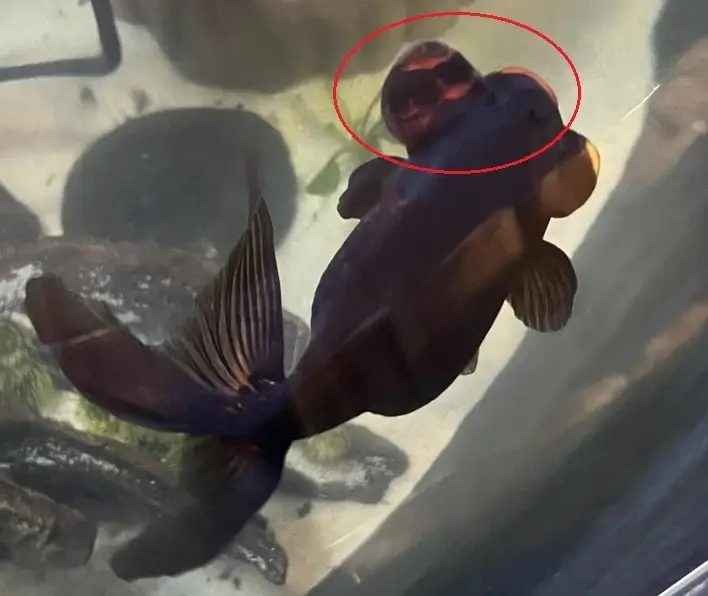
Goldfish with large, protruding eyes, such as Black Moors and Telescope Eye goldfish, are more prone to eye injuries that can lead to popeye. The cause matters because treatment depends on what is causing the eye to swell.
Quick Navigation
1) What Is Goldfish Popeye?
2) Goldfish Popeye Quick Facts
3) Goldfish Popeye Symptoms
4) How to Find Out If Your Goldfish Has Popeye
5) One Eye or Both? Why It Matters
6) Goldfish Popeye Causes
7) Goldfish Popeye Treatment
8) How to Prevent Goldfish Popeye
9) Popeye vs. Naturally Protruding Eyes (Black Moors & Telescopes)
10) Final Thoughts
What Is Goldfish Popeye?
Popeye happens when fluid leaks into the space behind a goldfish’s eyeball and builds up faster than the body can drain it, gradually pushing the eye outward from its socket. It can affect just one eye or both, and in more advanced cases the surface of the eye can turn cloudy, bloody, or discolored as pressure damages the cornea.
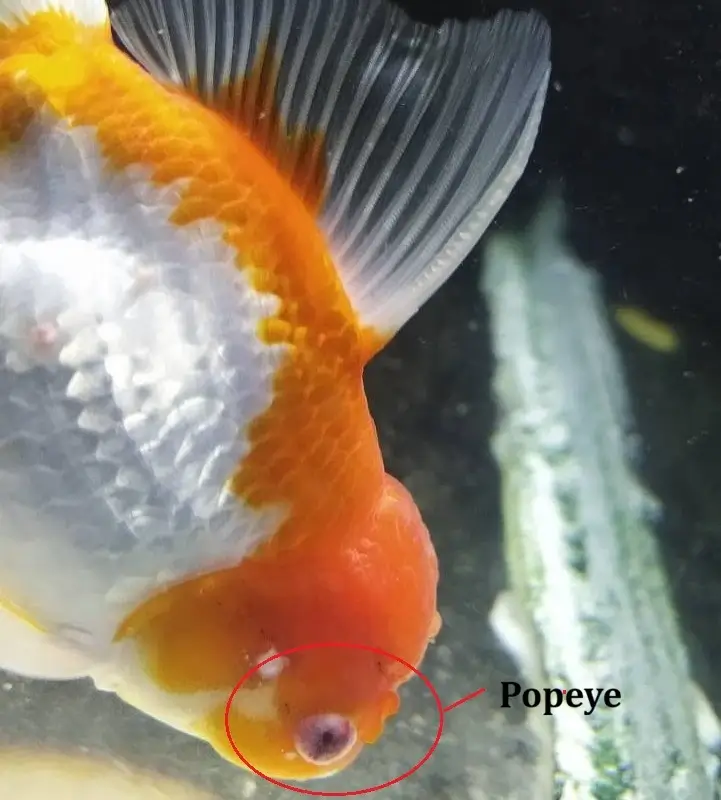
Because popeye is a symptom rather than a disease itself, treatment means figuring out what is causing the fluid to build up in the first place — such as an injury, infection, or internal problem — and treating that cause.
Goldfish Popeye Quick Facts
| Attribute | Details |
|---|---|
| Type | Not a disease itself — swelling behind the eye from injury, infection, or poor water quality |
| Contagious? | No, though bilateral cases often signal a water-quality problem affecting every fish in the tank |
| Main Symptoms | One or both eyes bulging, cloudy or bloody eye surface, clamped fins, lethargy |
| Usual Cause | Trauma (usually one eye) or poor water quality/infection (usually both eyes) |
| Standard Treatment | Water change, aquarium or Epsom salt, and antibiotics if infection is likely |
| Prognosis | Good for injury-related cases — more guarded if infection or kidney issues are involved |
Goldfish Popeye Symptoms
• One or both eyes bulging from the socket, sometimes subtle at first and becoming more pronounced over time
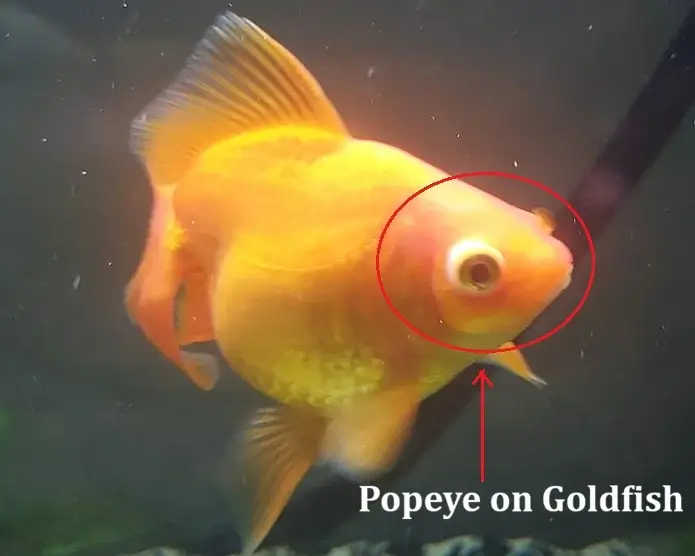
• Cloudiness, discoloration, or blood on the surface of the eye, a sign the cornea is under stress
• Stretching of the eye socket itself in more advanced cases
• Clamped fins and raised or rough-looking scales from an internal systemic or organ problem
• Loss of appetite and general inactivity, including spending more time near the bottom of the tank
• A swollen body alongside the eye swelling, which can point toward a more serious internal cause
In rare, severe cases the eye can rupture completely. A fish can still recover from this, but it will be blind in that eye. Goldfish generally cope well with the loss of one eye, relying on their other senses to compensate.
How to Find Out If Your Goldfish Has Popeye
Popeye is usually easy to spot by looking at the eyes, but changes in behavior can also help you notice a problem early. A goldfish with a swollen or damaged eye may behave differently from normal, especially if its vision is affected.
Look for changes such as:
• Hiding more than usual — The fish may stay near the bottom, in corners, or behind decorations and avoid bright light
• Less active — It may swim less and spend more time resting
• Eating less — A swollen or damaged eye can make it harder to see and cause it to miss out on food
• Bumping into objects — This is more likely when vision is affected, especially if both eyes are swollen
• Rubbing against objects — Some fish may rub the affected area against decorations or other surfaces to relieve irritation
One Eye or Both? Why It Matters
Whether popeye shows up in one eye or both is the single most useful clue for figuring out what’s actually going on.
One eye (unilateral) almost always points to physical trauma. A collision with tank decor, a scrape against something sharp, or a fight with a tank mate could be the cause. It is especially likely to be trauma if only one fish in a shared tank is affected while the others look completely normal.
Both eyes (bilateral) is far more often a sign of poor water quality or a systemic infection affecting the whole fish, not just one eye. If more than one fish in the tank is showing symptoms at once, that points even more strongly toward a shared cause like water chemistry rather than an isolated injury.
Goldfish Popeye Causes
• Physical trauma — Bumping into tank decor, sharp objects, or another fish can injure the eye, usually affecting one eye
• Poor water quality — High ammonia, nitrite, or nitrate can stress the fish and contribute to popeye
• Bacterial, fungal, or parasitic infection — Infections can cause swelling and are more likely when both eyes are affected
• Kidney problems or internal fluid buildup — Fluid retention can cause popeye and may occur along with dropsy
• Gas supersaturation — Excess gas in the water can form tiny bubbles in the fish’s tissues and sometimes push the eye outward
• Vitamin deficiency or fat deposits — These are less common causes of popeye
In many cases, the exact cause is never known. That is why treatment usually starts with checking the water, since water problems are a common cause.
Goldfish Popeye Treatment
There is no single treatment for goldfish popeye because the condition can have different causes. Treatment depends on what is behind the swelling — an injury, poor water quality, infection, internal fluid buildup, or another problem. The first step is to check the water and remove anything that could be damaging the eye. Once the underlying cause is corrected, the swelling can gradually go down as the eye heals.
1) Check the water first
Test ammonia, nitrite, nitrate and pH. Ammonia and nitrite should be 0 ppm, and nitrate should be kept low.
If the water is poor, correct it with a 25% to 50% water change and siphon accumulated waste from the substrate. If the filter is clogged, clean the mechanical media gently using removed aquarium water rather than tap water.
Why this matters: Poor water quality can contribute to popeye and can also prevent an injured eye from healing properly. Veterinary guidance for aquarium fish puts environmental correction first before any drug treatment.
2) Protect the injured eye
If only one eye is affected and there are no other signs of illness, look closely for a physical injury.
Remove sharp rocks, rough decorations, pointed plastic plants and anything else the fish could collide with. Large-eyed varieties such as Black Moors and Telescope Eye goldfish deserve particular attention because their protruding eyes are more exposed to injury.
If the fish is being bullied or repeatedly crashing into objects, correcting the environment is part of the treatment.
For a straightforward injury, clean water, good food, removal of the source of injury and time may be all that is needed.
Feed a good-quality, nutritionally complete diet while the eye heals. Good nutrition supports the fish’s overall health and recovery, but it does not replace treatment for an infection or other underlying problem.
3) Consider a quarantine tank
A separate hospital tank can be useful when the fish needs treatment, is being bullied, or needs a quieter environment while the eye heals.
Keep the tank simple:
• Clean, well-conditioned water
• Gentle filtration and good oxygenation
• No sharp decorations
• Easy access to food
• Minimal stress
If the problem appears to be a simple injury and the fish is otherwise healthy, moving it is not automatically necessary. The goal is to protect the eye without creating additional stress.
Veterinary guidance also recognizes hospital tanks as useful systems for treating ornamental fish.
4) Epsom salt can be used as supportive treatment
Epsom salt (magnesium sulfate) is commonly used by fish keepers to help reduce swelling associated with popeye. For a short bath (30-60 minutes), a stronger dose of 1-3 teaspoons per 5 gallons is commonly used. For ongoing treatment directly in a quarantine tank, a much lower dose, around 1/4 to 1/2 teaspoon per 5 gallons, is more commonly recommended, since the fish stays in that water continuously rather than briefly. Remove the excess salt gradually by making water changes.
Epsom salt may help reduce swelling by removing excess fluid build-up, but it does not treat the underlying cause of popeye. If the problem is caused by an injury, infection or internal disease, that underlying problem still needs to be addressed.
5) When Should You Consider Antibiotics?
Don’t use antibiotics simply because the eye is bulging. Antibiotics become more reasonable when there are signs suggesting an infection, such as:
• Both eyes becoming swollen
• Cloudy or damaged eyes
• Redness, ulcers or bleeding
• Loss of appetite
• Severe lethargy
• Swollen body or other signs of systemic illness
• Popeye continuing to worsen despite corrected water quality
Common fish antibiotics include erythromycin, minocycline, oxytetracycline, kanamycin, and sulfa-based antibiotics. Follow the product label for the correct dose and treatment duration. If you are unsure which medication to use, an aquatic veterinarian is the safest option.
For suspected internal infections, medicated food may work better than adding medication to the water. Mix the medication with food according to the product instructions and feed it to the fish.
When treating the water with antibiotics, remove activated carbon because it can absorb the medication. Keep filtration running and use a mildly running air stone for good oxygenation and water circulation.
6) What If Both Eyes Are Affected?
Both eyes becoming swollen is more likely to point to a problem affecting the whole fish or the aquarium, such as poor water quality, infection, or internal fluid buildup.
If both eyes are affected, check the water quality, appetite, body swelling, fins, and overall behavior. If other fish are also showing symptoms, investigate the aquarium rather than treating only the affected fish.
7) Don’t Overlook Gas Supersaturation
If popeye appears suddenly after a water change, especially when you notice tiny bubbles on the aquarium glass, fins, gills, or around the fish, gas supersaturation is another possibility. Excess dissolved gas can form tiny bubbles in the fish’s tissues and around the eyes, causing swelling.
If you suspect gas supersaturation, don’t keep doing large water changes blindly. Look for the source of the excess gas, remove excess gas by improving aeration and water circulation.
How Long Does Goldfish Popeye Take to Heal?
Don’t expect the eye to return to normal in a few days. The swelling may take weeks to gradually decrease, even after the underlying problem has been corrected. Damage to the cornea of the eye can take even longer to heal.
An injured eye may eventually return close to normal, but severe damage can leave permanent changes or even result in loss of the eye. A goldfish can generally continue living normally with vision in only one eye, provided it can eat and move around safely.
How to Prevent Goldfish Popeye
Keep up with regular water changes and avoid overcrowding or overfeeding.
Remove sharp, rough, or pointed decor, especially in tanks with fancy varieties whose protruding eyes are more prone to injury.
Use a soft net, or guide the fish into a container rather than netting it directly. Goldfish have no eyelids, so their eyes are easy to scratch during handling.
Avoid aggressive or overly active tank mates that may repeatedly startle or chase your goldfish, causing it to crash into decorations.
Avoid sudden lighting changes that startle the fish. Turn on the room light a few minutes before the aquarium light.
Feed a species-appropriate, nutritionally complete diet to support overall health.
Popeye vs. Naturally Protruding Eyes (Black Moors & Telescopes)
Some fancy goldfish varieties, especially Black Moors and Telescope Eyes, are bred to have large, protruding eyes. This is a normal feature of these varieties and is not popeye by itself.
A few things can help you tell the difference:
• Their eyes have always looked this way. Popeye usually develops or becomes noticeably worse over time.
• Naturally protruding eyes are usually similar in size on both sides. Popeye can affect one eye or both.
• Healthy eyes should remain clear. Cloudiness, redness, bleeding, or a sudden change in size can indicate a problem.
Black Moors and Telescope Eyes are also more vulnerable to eye injuries because their eyes protrude farther from the head. Keep their tanks free of sharp decorations and avoid tank mates that may chase or repeatedly startle them.
Final Thoughts
Popeye is really a message from your fish that something else needs attention — an injury to address, water quality to fix, or an infection to treat. Figure out which eye is affected and whether other symptoms are present, and that narrows down the likely cause fast.
Most cases, especially the simple one-eyed injury kind, resolve well with clean water and time. Keep a closer eye on anything paired with body swelling or other signs of illness, since that combination points toward something more serious happening internally.