
Ragged, damaged, or fraying fins on your goldfish are often a sign of goldfish fin rot, a common bacterial infection in aquarium fish. Fin rot is not limited to goldfish; the same type of infection can also affect bettas, angelfish, and many other aquarium fish.
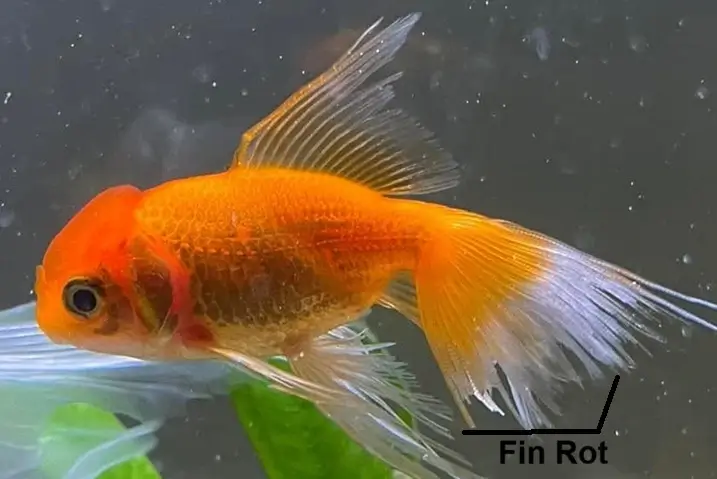
What follows here is specifically about goldfish fin rot, since their fin shape, waste production, and typical tank conditions can affect how the problem develops and how it should be treated.
Table of Contents
1) What Is Goldfish Fin Rot?
2) Goldfish Fin Rot Quick Facts
3) Fin Rot Symptoms and Stages
4) Fin Rot Causes
5) Goldfish Fin Rot Treatment
6) How to Prevent Goldfish Fin Rot
7) Fin Rot vs Fin Nipping
8) FAQ
9) Final Thoughts
What Is Goldfish Fin Rot?
Fin rot is a bacterial infection that attacks the fins and tail, causing the tissue to gradually discolor, fray, and break down. Some call it tail rot in the hobby, since it often affects the tail specifically.
Fin Rot Facts:
• The bacteria responsible for fin rot are naturally present in essentially every established aquarium and don’t need to be introduced from outside.
• Most of the time they cause no trouble at all. Fin rot develops when a fish’s immune defenses are compromised, usually by stress, poor water quality, or an injury that gives the bacteria an opening.
• If fin rot is left untreated, the damage spreads from the fin tips toward the body. Once it reaches the fin’s base (called the caudal peduncle on the tail specifically), the fish is much less likely to recover fully, and the fin may never grow back to its original length even if it survives.
• Goldfish aren’t natural fin-nippers. It is not their typical behavior, and when it happens, something in their care usually needs fixing.
• Fin rot can sometimes come with a secondary fungal infection. Fungus grows on dead tissue left by the bacterial infection. It looks like fuzzy, cotton-like white or grey growth on the damaged fin and needs separate antifungal treatment.
• Long-finned fancy goldfish varieties, like Oranda, tend to show damage more visibly and are more prone to serious cases than short-finned types, simply because they have more fin surface for the infection to spread across.
Goldfish Fin Rot Quick Facts
| Attribute | Details |
|---|---|
| Type | Bacterial infection, occasionally with a secondary fungal component |
| Also Affects | Not goldfish-specific — common in bettas, angelfish, and most aquarium fish |
| Contagious? | Not highly — opportunistic, spreads more easily to already-stressed or injured fish |
| Main Symptoms | Discolored, fraying fin edges; red, inflamed skin at the fin base; tissue loss in advanced cases |
| Usual Cause | Poor water quality, stress, overcrowding, or a physical injury |
| Standard Treatment | Fix water quality first, then an antibacterial medication along with aquarium salt bath |
| Prevention | Regular water changes, avoid overcrowding and overfeeding, remove aggressive tank mates |
Fin Rot Symptoms and Stages
Symptoms to Watch For:
• Fin and tail tips look ragged, torn, or tattered instead of smooth
• Red, inflamed skin at the base of the affected fins, where the infection is most active
• Loss of appetite and general lethargy, including spending more time near the bottom of the tank, as the fish’s body works to fight the infection
• Clamped fins, held tightly against the body instead of relaxed and spread out, often shows up alongside fin rot, though it is a general sign of stress or illness rather than something unique to this disease specifically
Fin Rot Stages:
Fin rot tends to move through fairly distinct stages, which makes it easier to judge how urgent treatment is. Fin rot usually starts at the edges of the fins and slowly moves inward if the problem is not treated. It does not usually become severe all at once. It goes through a few stages, and recognizing the early signs gives your goldfish a much better chance of recovering.
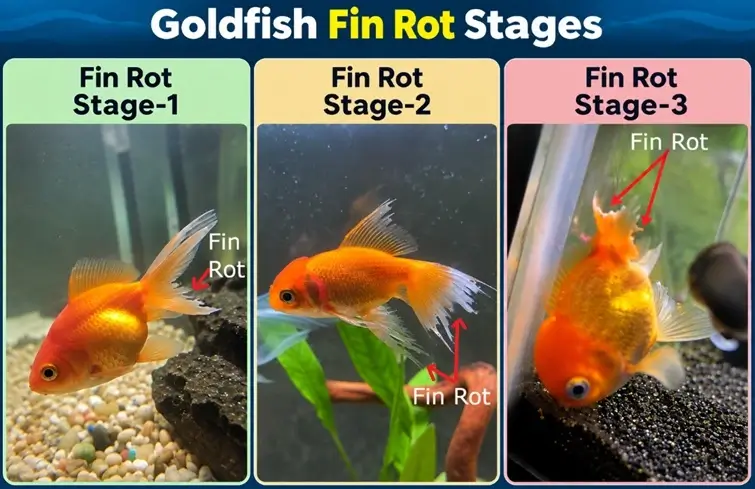
Stage 1: Early Fraying
• Fin edges look faded, whitish, or slightly discolored, with a ragged or uneven tip instead of a clean edge
• The fish is usually still active and eating normally
• In this stage there is a chance of a full recovery, often reversible with clean water alone
Stage 2: Active Spread
• Fins visibly shorten as tissue dies off, edges look chewed or split, sometimes with redness along the damage
• The fish may become sluggish, eat less, or spend more time resting at the bottom
• Water changes alone are no longer enough at this point. Medication is needed to stop the spread which is covered in the Treatment Section below
Stage 3: Advanced Rot
• Large parts of the fins are gone, sometimes leaving only short stubs. The base of the fin may also be red or have sores.
• The fish may stop eating, sit at the bottom, or struggle to swim normally
• At this stage, the fish needs immediate treatment and quarantine. Don’t wait and see if it gets better on its own.
Fin Rot Causes
Fin rot is most often caused by opportunistic bacteria like Aeromonas, Pseudomonas, and Vibrio, all naturally present in aquarium water and usually harmless until a fish’s defenses are down.
• Poor water quality — elevated levels of ammonia, nitrite, or nitrate, or an out-of-range pH, all stress a goldfish enough to let the bacteria take hold.
• Overcrowding, which raises both stress and waste levels at the same time.
• Overfeeding — excess uneaten food decays and drags water quality down, creating the conditions that let fin rot develop.
• A low-quality or unbalanced diet, which weakens a fish’s general resistance to infection over time.
• Aggressive tank mates or fin-nipping, which creates the physical injuries that bacteria can exploit.
• Prolonged cold water — extended exposure to temperatures well below a goldfish’s comfortable range can be enough on its own to weaken its immune response.
• Existing injuries from sharp decor, rough handling, or a prior illness that has not fully healed.
Goldfish Fin Rot Treatment
Treating fin rot means fixing the root cause alongside the visible infection. Medication alone, without fixing the underlying stressor, is why fin rot often comes back.
1. Test and Fix the Water First
• Test your water immediately: ammonia and nitrite at 0 ppm, nitrate under 20-50 ppm, pH around 7.0-7.5. A problem here is very likely the underlying cause, and even a sudden pH swing alone can be enough to weaken a fish’s immune defenses.
• Fix whatever the test turned up first. The same stress that caused one fish’s fin rot, dirty water, overcrowding, unstable temperature, has likely affected every fish sharing that tank.
• Do daily partial water changes in the main tank, up to 50%, matching the new water’s temperature closely.
2. Decide Where to Treat the Fish
• If the infection was severe from the start, consider moving the fish to a separate hospital tank. This makes treatment easier and lets you monitor the fish more closely without exposing tank mates to medication they don’t need.
• For milder cases, treating the whole main tank is usually the better move anyway, since other fish sharing the water have likely been exposed to the same stress already.
3. Prepare the Tank for Medication
• Remove any activated carbon from your filter before dosing, carbon will pull the medication out of the water before it can work.
• Run an air stone during treatment. It keeps oxygen up (medication lowers it) and helps disperse the medication evenly through the tank.
4. Treat the Infection
• Treat the whole tank with a broad-spectrum antibacterial: erythromycin (sold as Mardel Maracyn) or tetracycline (sold as API T.C.) for established infections, or API Fin & Body Cure / API Melafix for milder cases.
• If white, cotton-like fungal growth has also appeared alongside the bacterial infection, add methylene blue (sold as API or Kordon Methylene Blue).
• For a severe, stubborn, localized patch, dab methylene blue directly onto the spot on the fins with a cotton swab for a more concentrated, targeted dose than a diluted whole-tank treatment gives.
5. If You Don’t Have Medication
• An aquarium salt bath can work for mild cases, though it’s slower than medication. Roughly 1 tsp/gallon for early damage, 1.5 tsp/gallon for moderate cases, and up to 3 tsp/gallon for severe infection.
• Once the fish is recovering, remove the salt gradually with 30% water changes rather than all at once. Skip this option entirely if the tank has sensitive plants or invertebrates like snails, salt is harmful to both.
6. For Severely Damaged Fins
• If damaged fins are hindering swimming, a vet or experienced fishkeeper can trim the dead tissue with sterile scissors, ideally with the fish sedated, followed by povidone-iodine (Betadine) on the fresh edge.
• Don’t trim once the infection has reached the body, it won’t help at that point and full antibiotic treatment is needed instead.
• Fins usually grow back if the underlying rays are intact, small trims heal within a few weeks, while larger trims can take up to a year to fully regrow.
7. Complete the Treatment
• Most antibacterial treatments run 5 to 10 days, dosed daily, with a 25% water change before each new dose to clear ammonia, dead bacterial matter, and the medication’s own toxic buildup.
• Complete the full course even if the fish looks better partway through, stopping early is a common reason the infection returns.
Signs the Treatment Is Working
• The rot has stopped spreading
• No new symptoms appear
• Appetite and energy return to normal
• New fin growth begins, sometimes a slightly different color than the original
How to Prevent Goldfish Fin Rot
• Keep a regular water change schedule rather than waiting until something looks wrong.
• Avoid overcrowding, and avoid overfeeding, as both drive up waste and stress at the same time.
• Feed a high-quality, species-appropriate diet to support general immune resilience.
• Remove or rehome aggressive, fin-nipping tank mates rather than hoping that the behavior stops.
• Keep the temperature stable and avoid prolonged cold spells well outside a goldfish’s comfortable range.
• Add live plants to the tank. They help absorb some of the waste and keep the stress low in the tank.
• Check your fish closely at feeding time each day, since early-stage fin rot is easy to miss if no one is looking closely.
Fin Rot vs Fin Nipping
Not every damaged fin is caused by fin rot. Knowing the difference can help you choose the right treatment.
• Fin nipping usually happens when another fish bites the fins. It can leave clean or jagged tears in a few areas. The damage often appears suddenly, and there is usually no redness or discoloration. The fish otherwise looks healthy.
• True fin rot usually gets worse slowly over several days. The fin edges may become ragged, discolored, or red, and the redness may spread toward the base of the fin.
• The fin edges can also give you a clue about the cause. Ragged or jagged edges are more commonly seen with bacterial fin rot. Smoother fin loss along with white, cotton-like growth may suggest a fungal infection.
FAQ
Can a goldfish’s fins fully grow back after fin rot?
Often, yes, especially if only the trailing edges were affected. If the infection reached deep into the fin or the caudal peduncle before treatment started, the fin may grow back shorter or not fully recover its original shape.
Do I need medication, or will water changes alone fix fin rot?
For a truly early, mild case, improving water quality alone sometimes stops it in its tracks. Once fraying and tissue loss are visible, medication meaningfully speeds recovery and lowers the risk of the infection reaching the body.
Is Goldfish Fin Rot Contagious?
Not exactly in the usual sense. The bacteria are already present in most tanks at low levels, so it’s less about catching it from another fish and more that whatever stress or water problem caused it in one fish is likely affecting every fish sharing that water. If one fish has fin rot, treating the tank and improving water quality helps protect the others.
Why does my goldfish keep getting fin rot even after treatment?
This almost always means the root cause was never fully resolved. Water quality slipping back down, ongoing overcrowding, or an aggressive tank mate still causing injuries. Treating the visible infection without fixing what caused it is the most common reason it returns.
How long does goldfish fin rot treatment take?
Mild cases can start improving within days of a water quality fix. A full medication course typically runs about a week, and visible fin regrowth usually follows within a couple of weeks after that, though severe cases take much longer.
Does water temperature affect fin rot?
Yes, warmer water speeds up bacterial growth, which can make fin rot progress faster. Since goldfish are a coldwater species, staying toward the cooler end of their comfortable range (65-75°F) during an outbreak can help slow things down, an option tropical fish keepers may not have.
Can fin rot come back in the same spot after healing?
Yes, if the original cause wasn’t fully fixed. Scarred or previously-damaged tissue which has healed isn’t necessarily more vulnerable on its own, it’s usually the same underlying water or stress problem striking again.
Does diet matter while treating fin rot?
Yes. A varied, high-quality diet supports the immune system while it fights the infection and helps fuel new fin growth once treatment starts working.
Final Thoughts
Fin rot looks worse than it usually is. Most healthy goldfish make a full recovery once the underlying stressor is addressed alongside the visible infection. The mistake to avoid is treating only the symptom: fixing water quality, removing a source of stress or injury, and following through on a complete medication course together are what actually stop it from coming back. See our complete goldfish diseases guide for all goldfish disease symptoms, pictures, and treatment for all of them.