
The guppy gestation period is surprisingly short compared to most animals, usually lasting between 21 and 30 days. During this time, the fertilized embryos develop safely inside the female guppy until they are fully formed and ready to be born as free-swimming fry. Although 21 to 30 days is considered normal, not every pregnancy follows exactly the same schedule. Water temperature, genetics, nutrition, stress, and the mother’s age can all influence how quickly the embryos develop. Some females may give birth a few days earlier, while others remain pregnant slightly longer without there being any cause for concern.
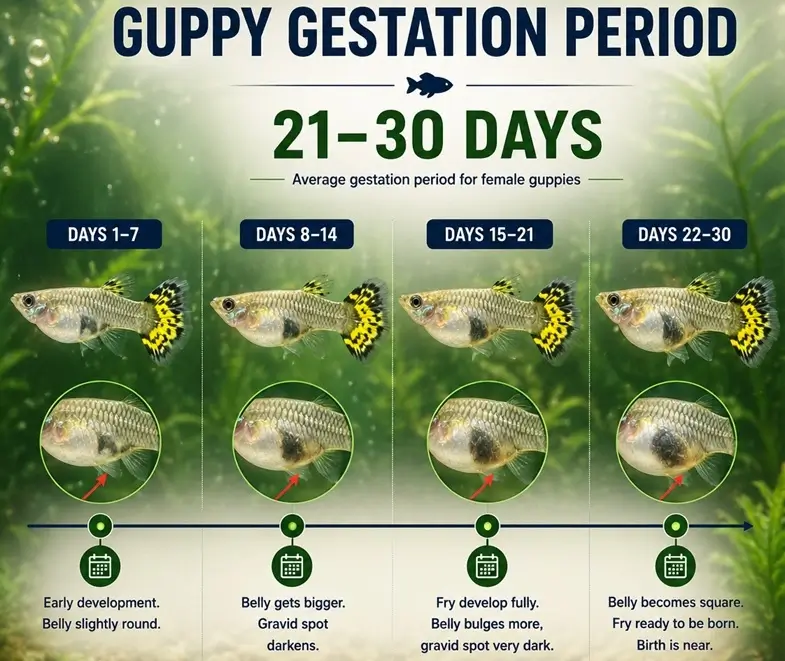
Quick Answer: The average guppy gestation period lasts 21 to 30 days. During this time, the embryos develop inside the female’s body before hatching internally and being born as fully formed, free-swimming fry.
Quick Navigation:
➜ What Is the Guppy Gestation Period?
➜ Guppy Gestation Chart
➜ Guppy Gestation Stages
➜ Factors That Affect Gestation
➜ The Science Behind Guppy Gestation
➜ Signs the Gestation Period Is Ending
➜ Frequently Asked Questions
What Is the Guppy Gestation Period?
The gestation period is the length of time between fertilization and the birth of live fry. In guppies, this period averages 21 to 30 days, although slight variations are completely normal. During gestation, each embryo develops inside its own egg membrane while remaining protected within the female’s body until it is fully formed.
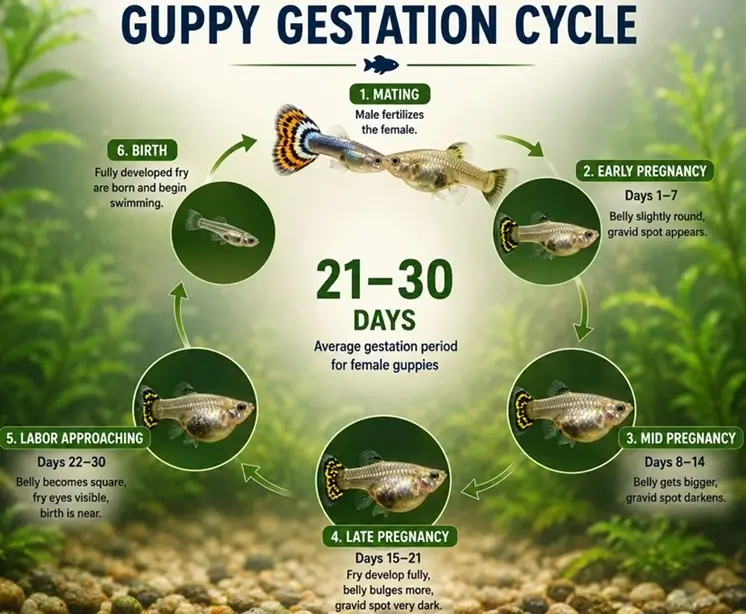
Unlike mammals, guppies do not nourish their embryos through a placenta. Instead, each developing fry relies primarily on its own yolk sac for nutrition. The eggs hatch internally shortly before birth, which is why healthy guppies release live fry rather than laying eggs into the aquarium.
Guppy Gestation Chart
| Feature | Details |
|---|---|
| Days 1–7 | Fertilization occurs, embryos begin developing. Little visible change yet. |
| Days 8–14 | Belly becomes noticeably fuller and the gravid spot darkens. |
| Days 15–21 | Fry develop rapidly; eyes become visible through the skin in lighter females. |
| Days 22–30 | Belly turns square-shaped, labor signs appear, birth usually occurs. |
| Average Gestation Period | 21–30 days |
| Reproductive Type | Livebearer (Ovoviviparous) |
| Typical Brood Size | 4–100 fry |
| First Pregnancy | Often slightly longer |
| Best Water Temperature | 76–78°F (24–26°C) |
| Signs Birth Is Near | Square belly, dark gravid spot, hiding, contractions |
Guppy Gestation Stages
Although the average guppy gestation period lasts between 21 and 30 days, pregnancy is a gradual process. Each week brings noticeable changes as the embryos develop inside the female. Understanding this timeline helps you recognize normal pregnancy and estimate when birth is likely to occur.
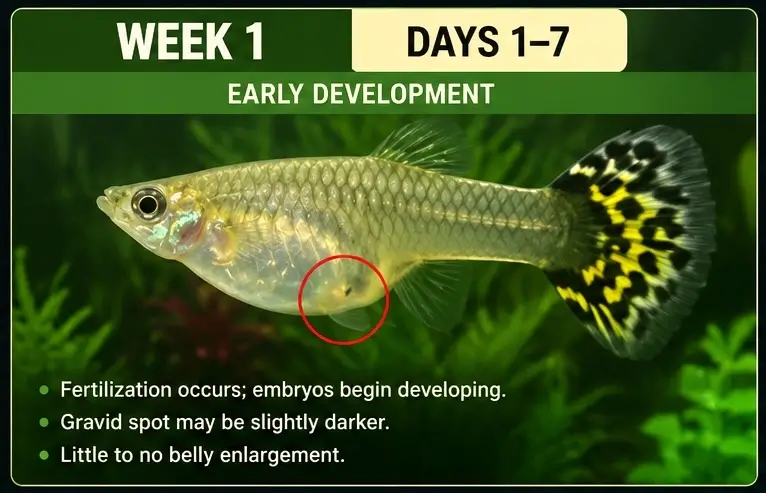
Guppy Gestation Period Days (1–7):
Fertilization and Early Embryo Development:
Shortly after mating, fertilization occurs inside the female’s reproductive tract. Tiny embryos begin developing within individual egg membranes inside the ovaries. At this stage, there are usually very few visible changes on the outside of the female.
Most guppies continue swimming, feeding, and behaving normally during the first week. The gravid spot may become slightly darker, but the abdomen usually shows little noticeable enlargement.
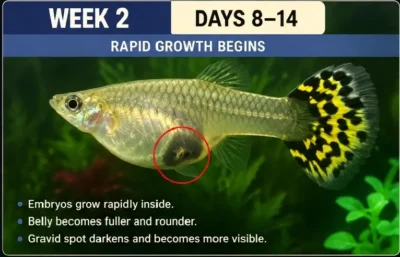
Guppy Gestation Period Days (8–14):
Rapid Growth Begins:
During the second week, the embryos begin growing rapidly. The female’s abdomen becomes noticeably fuller as each developing fry increases in size. The gravid spot usually darkens further, making pregnancy much easier to recognize.
The mother remains active and generally continues eating well. Providing a varied diet rich in protein during this stage supports healthy embryo development and prepares the female for the demanding final weeks of pregnancy.
Guppy Gestation Period Days (15–21)
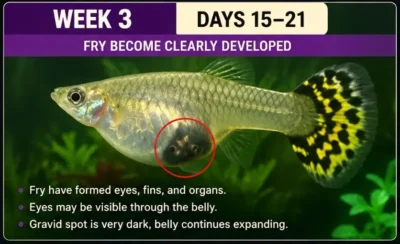
Fry Become Clearly Developed:
By the third week, the developing fry have formed recognizable bodies, eyes, fins, and internal organs. In light-colored females such as albino or blonde strains, experienced hobbyists can sometimes see the tiny eyes of the fry through the abdominal wall.
The abdomen continues expanding, and the gravid spot becomes almost black in darker strains. Although many females still behave normally, some begin spending more time among plants or quieter areas of the aquarium.
Guppy Gestation Period Days (22–30):
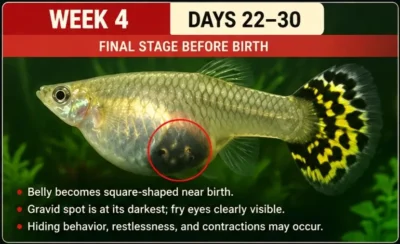
Final Stage Before Birth:
The final week is when the most dramatic physical changes occur. Instead of remaining evenly rounded, the female’s abdomen often develops a distinct square or box-like appearance as the fry move into their final birth position.
The gravid spot reaches its darkest coloration, and many females become more secluded, rest more often, or temporarily lose interest in food. Gentle contractions, shivering, rapid breathing, and hiding behavior usually indicate that labor is approaching.
Most healthy females give birth sometime during this period, although slight variations are completely normal.
Week-by-Week Pregnancy Summary
➜ Week 1: Fertilization occurs and embryo development begins.
➜ Week 2: Belly enlarges and the gravid spot darkens.
➜ Week 3: Fry become fully recognizable and continue growing rapidly.
➜ Week 4: Belly becomes square-shaped, labor signs appear, and birth usually occurs.
Why Does the Guppy Gestation Period Vary?
Although most guppies remain pregnant for approximately 21 to 30 days, there is no exact day when every female gives birth. Several biological and environmental factors influence how quickly the embryos develop, which is why one guppy may give birth after 22 days while another carries her fry for nearly a month.
Understanding these factors helps hobbyists avoid unnecessary worry when a healthy female appears to be carrying her fry for slightly longer than expected.
1. Water Temperature
Water temperature is one of the biggest factors affecting the guppy gestation period. Warmer water increases the embryos’ metabolic rate, allowing them to develop faster, while cooler water slows development.
Healthy guppies generally reproduce best between 76 and 78°F (24–26°C) — see our temperature for guppies guide for the full range. Temperatures significantly below this range often lengthen pregnancy, whereas excessively warm water may shorten gestation but can also place additional stress on both the mother and the developing fry.
2. Genetics
Not every guppy develops at exactly the same rate. Genetics influence embryo growth, brood size, and even the mother’s reproductive cycle. Some bloodlines consistently produce fry a few days earlier than others despite being kept under identical aquarium conditions.
3. First-Time Mothers
Young females experiencing their first pregnancy often carry their fry slightly longer than mature adults. Their reproductive system is still developing, and first broods are usually smaller than those produced later in life.
As females mature, pregnancy length generally becomes more predictable.
4. Nutrition
Developing embryos require protein, healthy fats, vitamins, and minerals to grow properly. Females receiving a varied, high-quality diet throughout pregnancy generally produce healthier fry and experience fewer reproductive problems — see our best guppy food guide for what to feed her.
A poor diet does not simply affect the mother — it can also slow embryo development and contribute to smaller or weaker fry.
5. Stress
Stress can delay labor even after the embryos have finished developing. Common stressors include aggressive tank mates, poor water quality, frequent handling, sudden temperature changes, overcrowding, or moving the female into a breeding box too early.
Providing a quiet, stable aquarium with excellent water quality helps the pregnancy progress normally and reduces the likelihood of delayed birth.
6. Fancy Guppy Gestation Period
The fancy guppy gestation period is essentially the same as that of wild-type and standard guppies, averaging around 21 to 30 days. Popular fancy strains such as Moscow, Dragon, Cobra, Tuxedo, Dumbo Ear, Albino, Platinum, and Grass Guppies all follow the same basic reproductive cycle.
Differences in pregnancy length are usually caused by water temperature, genetics, nutrition, and stress rather than the guppy’s color or fin variety. Regardless of the strain, females show the same general signs that labor is approaching, including a square-shaped belly, a dark gravid spot, and hiding behavior.
What Affects the Guppy Gestation Period?
➜ Water temperature
➜ Genetics and bloodline
➜ First pregnancy vs. experienced females
➜ Nutrition and feeding quality
➜ Stress levels
The Science Behind the Guppy Gestation Period
The guppy gestation period is often described as lasting 21 to 30 days, but this isn’t an arbitrary number. It reflects the time needed for the embryos to develop from a single fertilized egg into fully formed, free-swimming fry capable of surviving on their own immediately after birth.
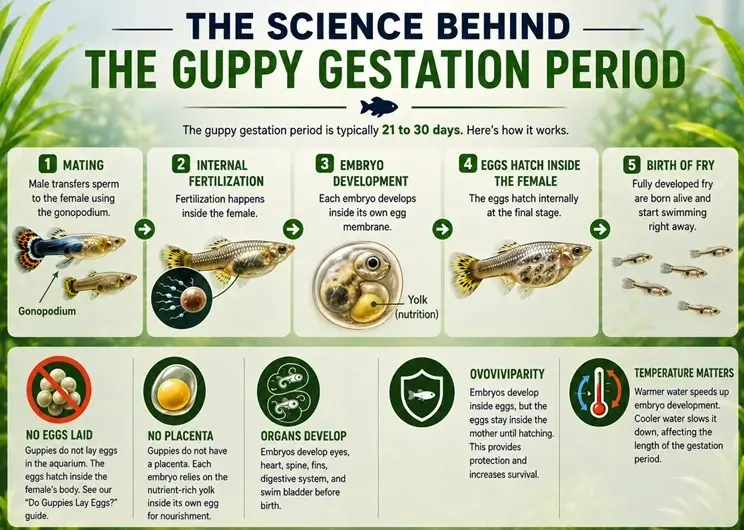
After mating, the male transfers sperm to the female using a specialized fin called the gonopodium. Fertilization takes place inside the female, where each embryo begins developing within its own tiny egg membrane. Unlike mammals, guppies do not have a placenta. Instead, every embryo relies mainly on the nutrient-rich yolk contained inside its own egg for nourishment throughout development.
As the embryos grow, they gradually form their eyes, heart, spine, fins, digestive system, and swim bladder. During the final stage of pregnancy, the eggs hatch inside the female’s body. This is why healthy guppies never release eggs into the aquarium — see our do guppies lay eggs guide for the full explanation. Instead, fully developed fry are born alive and begin swimming almost immediately.
This unique reproductive strategy is called ovoviviparity. The embryos develop inside eggs, but those eggs remain inside the mother until hatching occurs. This gives the developing fry greater protection from predators and environmental changes than they would receive if the eggs were laid openly in the aquarium.
Water temperature plays an important role throughout gestation because embryo development depends on metabolism. Warmer water speeds up development, while cooler water slows it down. This explains why some healthy guppies give birth after around 21 days whereas others naturally remain pregnant for closer to 30 days.
Did You Know? Many hobbyists believe guppies carry live babies throughout pregnancy. In reality, each baby begins life inside its own tiny egg. The difference is that the eggs hatch inside the mother, so the fry are already fully formed by the time they are born.
Signs the Gestation Period Is Ending
As the pregnancy draws to a close, several noticeable changes occur that indicate labor is approaching. These signs usually appear during the final one to three days of gestation, although the exact timing varies between individual females.
➜ Square-shaped abdomen. This teh first reliable sign. Just before 2 to 3 days the evenly rounded, the belly develops into a flat, box-like appearance as the fry move into their final birth position.
➜ A much darker gravid spot. In lighter-colored strains, the tiny eyes of the fry may even become visible through the skin just 2 to 3 days before delivery.
➜ Quieter, more withdrawn behavior. Spending more time hiding among plants than usual.
➜ Faster breathing.
➜ Reduced appetite.
➜ Gentle contractions. Once these begin, labor is usually not far away, and the first fry may arrive within a few hours.
See our guppy giving birth guide for what happens next.
Frequently Asked Questions
How Long Is Guppy Gestation Period?
The average guppy gestation period lasts between 21 and 30 days. However, slight variations are perfectly normal. Water temperature, genetics, nutrition, stress, and the female’s age can all influence exactly when labor begins.
Is the Guppy Gestation Period Always 21–30 Days?
No. While most pregnancies fall within the 21 to 30-day range, some healthy females may give birth slightly earlier or later. A pregnancy lasting a few extra days is not usually a cause for concern if the female remains active and healthy.
Can a Guppy Give Birth After Only 20 Days?
Yes, although it is less common. In warmer water and under ideal conditions, some guppies may complete pregnancy in around 20 to 21 days. However, most pregnancies last closer to three to four weeks.
Can a Guppy Stay Pregnant for More Than 30 Days?
Yes. Some females remain pregnant for slightly longer than 30 days, particularly during their first pregnancy or when water temperatures are lower. Stress and genetics can also delay labor without indicating a serious problem.
Does Water Temperature Affect the Gestation Period?
Absolutely. Warmer water speeds up embryo development, while cooler water slows it down. Maintaining a stable temperature of around 76–78°F (24–26°C) helps support healthy pregnancy and normal embryo development.
Do Fancy Guppies Have a Different Gestation Period?
No. Fancy guppy varieties such as Moscow, Dragon, Cobra, Tuxedo, Dumbo Ear, Grass, Albino, and Platinum Guppies all have a similar gestation period of approximately 21 to 30 days. Differences are caused more by environmental conditions and genetics than by the variety itself.
Can Stress Delay a Guppy’s Pregnancy?
Yes. Poor water quality, overcrowding, aggressive tank mates, frequent handling, or moving the female into a breeding box too early can all increase stress and occasionally delay labor.
How Many Fry Are Born After One Gestation Period?
Most healthy female guppies produce between 20 and 50 fry per pregnancy. Young females usually have smaller broods, while large, mature females may occasionally give birth to more than 80 fry.
Final Thoughts
The guppy gestation period is remarkably short, usually lasting between 21 and 30 days, yet an incredible amount of development takes place during that time. From fertilization to the birth of fully formed fry, the entire reproductive process is carefully adapted to protect the developing embryos and maximize their chances of survival.
Understanding the week-by-week pregnancy timeline, the factors that influence gestation, and the signs that labor is approaching allows aquarists to care for pregnant females with confidence. With stable water conditions, proper nutrition, and minimal stress, most guppies complete pregnancy naturally and give birth without any assistance. For the full picture beyond gestation, see our pregnant guppy guide.
