
Telling male vs female goldfish apart is easier once they mature, especially during breeding season. Look for a combination of breeding tubercles, vent shape, body shape, and spawning behavior rather than relying on one feature alone.
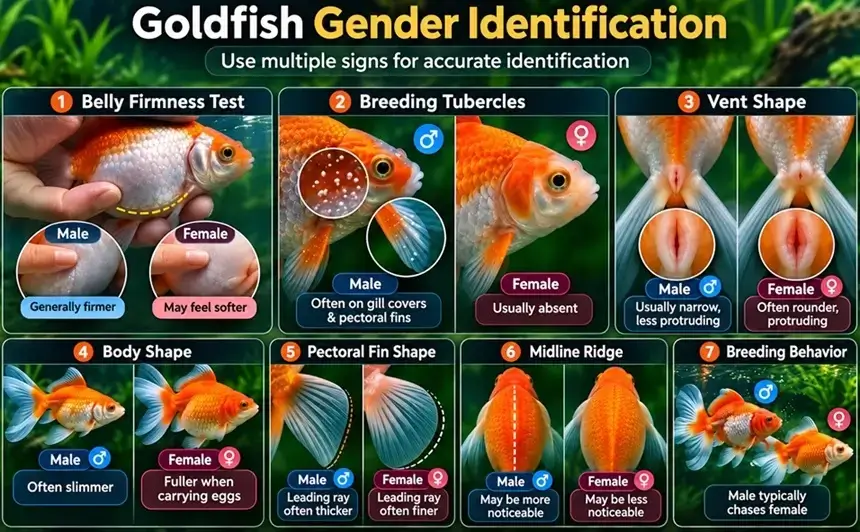
Knowing these differences helps with breeding plans and prevents confusion between normal breeding tubercles—the small white bumps often seen on males—and signs of disease.
Quick Navigation
2) How to Tell a Male Goldfish from a Female
Breeding Tubercles
Vent Shape
Belly Firmness
Body Shape and Size
Pectoral Fin Shape
Midline Ridge
Chasing Behavior During Breeding Season
3) Why Sexing Fancy Goldfish Is Harder
4) Frequently Asked Questions
5) Final Thoughts
Male vs Female Goldfish: Quick Comparison Table
Compare these signs in a mature goldfish, preferably during breeding season when the differences are easier to identify. Use several clues together rather than relying on one alone.
| Feature | Male | Female |
|---|---|---|
| Belly firmness | The lower abdomen generally feels firmer | The lower abdomen may feel softer and more pliable, especially when ready to spawn |
| Vent shape | Usually smaller and less protruding | Often rounder and more protruding, especially during breeding season |
| Breeding tubercles | May develop on the gill covers and the leading edges of the pectoral fins | Usually absent |
| Body shape | Often slimmer than a female of the same age and variety | Often fuller around the abdomen, especially when carrying eggs |
| Pectoral fins | Leading ray may be thicker and more robust | Leading ray may be finer; differences can be subtle |
| Breeding behavior | Typically chases and nudges during courtship | Typically pursued by males during courtship |
Note: Body shape is less useful in rounded fancy varieties, and chasing alone does not confirm sex. Belly firmness is a supporting clue. Squeezing or pressing firmly can injure the fish.
How to Tell a Male Goldfish from a Female
Check a combination of physical and behavioral signs, especially when the fish are mature and in breeding condition. Body shape alone can be misleading in rounded fancy varieties such as Orandas, Ranchus, and Ryukins.
Breeding Tubercles
Breeding tubercles, also called breeding stars, are small, raised white bumps that develop on male goldfish, especially when they are ready to spawn. Look for them on the gill covers and along the leading edge of the pectoral fins—the paired fins just behind the gills.
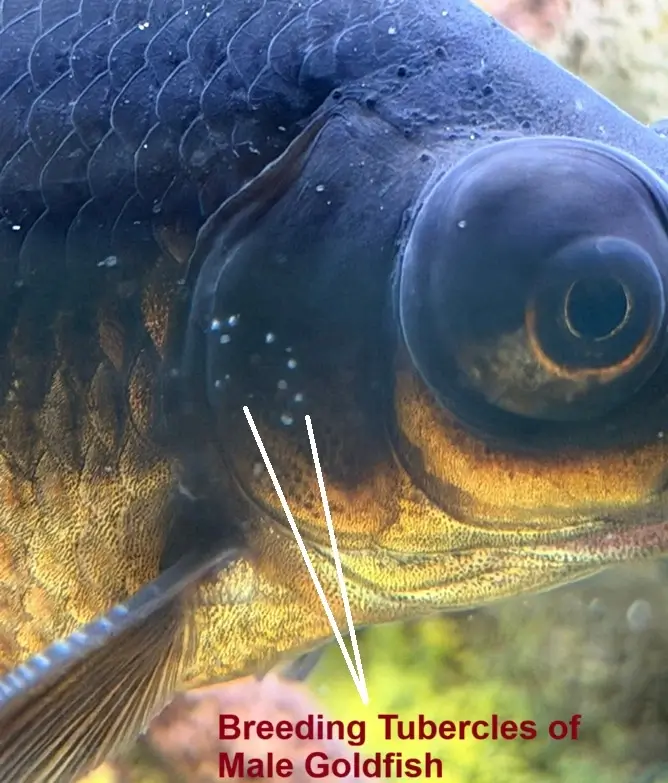
These bumps are a useful clue when identifying mature males. They also help during spawning, when the male nudges the female with his head and fins.
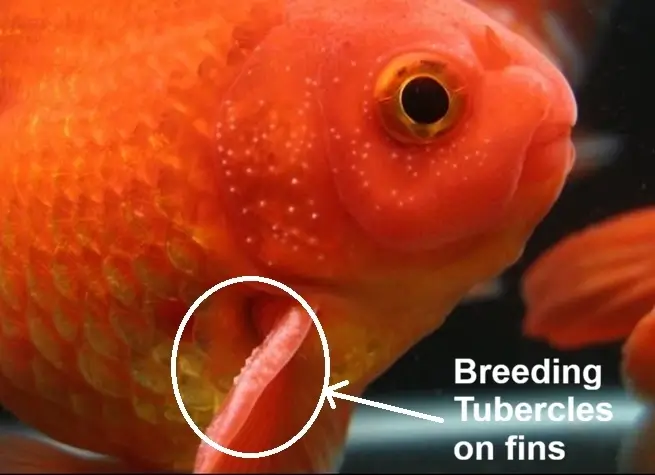
Look closely in a fish with heavy head growth — if the wen makes the gill covers difficult to inspect, check the pectoral fins.
Absence does not confirm a female — a young male or one outside breeding condition may have no obvious tubercles.
Use tubercles alongside vent shape and spawning behavior rather than deciding from one feature alone.
Breeding Tubercles or Ich?
Breeding tubercles usually appear on the gill covers and along the leading rays of the pectoral fins, often in an orderly pattern.
Ich can produce scattered, salt-like spots across the body and fins, although infections concentrated in the gills may cause breathing problems without obvious spots on the body.
White spots accompanied by scratching, rapid breathing, or clamped fins may indicate Ich.
Do not wait for spots to spread if your fish is showing signs of distress. For a closer comparison, see our goldfish breeding tubercles guide.
Vent Shape
The vent is a small opening on the underside of a goldfish, just in front of the anal fin. Its shape can help distinguish mature males from females, especially during breeding season when the difference is often more noticeable.
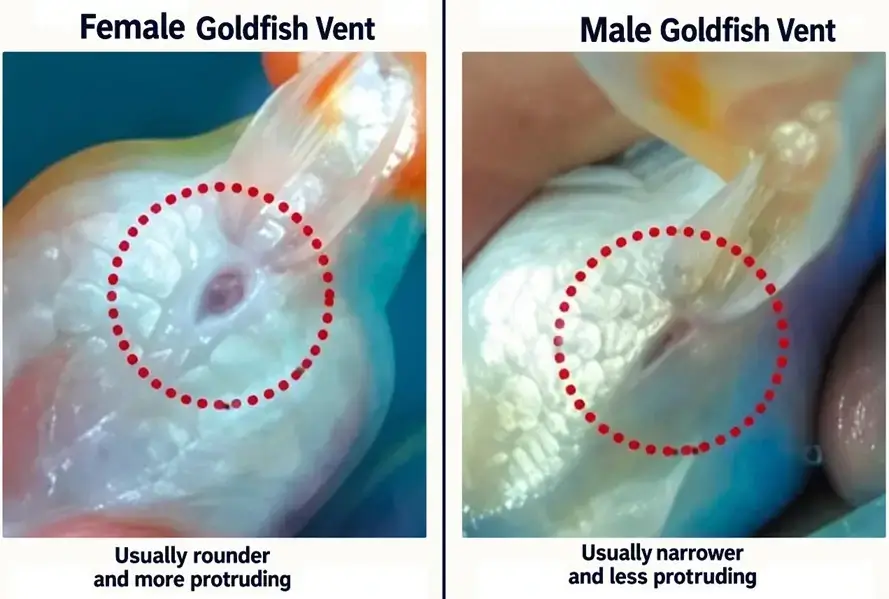
Male vent — usually narrower and less protruding, sometimes appearing slightly recessed.
Female vent — usually rounder and more protruding, particularly when the fish is ready to spawn.
Viewing angle matters — look from below or slightly to the side. A side view can make a protruding vent easier to see.
The difference is not obvious in every fish, so compare vent shape with breeding tubercles and other signs before deciding.
Belly Firmness
Belly firmness can help distinguish mature male and female goldfish, especially during breeding season. A female ready to spawn often has a softer, more pliable abdomen, while a male’s generally feels firmer. The difference may be less obvious outside breeding condition.
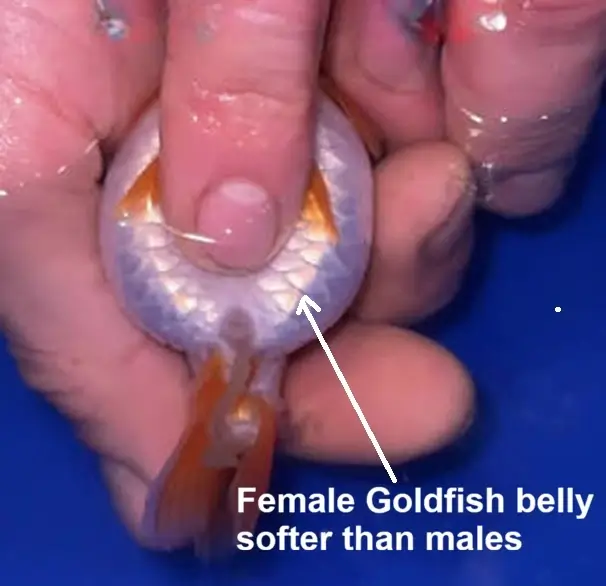
I have found belly firmness more useful than body shape alone in fancy goldfish. Some of my round-bodied fish looked female but turned out to be male, with noticeably firmer bellies. It is a useful additional clue when their body shape makes identification difficult.
Where to check: the lower abdomen just in front of the vent. Use only a light touch; do not press on the opening itself.
Female: The lower abdomen may feel softer and slightly yielding, particularly when ready to spawn.
Male: The same area generally feels firmer by comparison.
This check requires careful handling. If you are inexperienced, use visible signs first or ask an experienced breeder to demonstrate. Keep your hands wet and the fish supported in water. Never squeeze, massage the abdomen, or try to express eggs or milt.
If firmness and appearance disagree, check vent shape and breeding tubercles rather than treating firmness as the deciding test.
Body Shape and Size
Female goldfish often have a fuller, rounder abdomen than males of the same age and variety, especially when carrying eggs. Males tend to look slimmer and more streamlined. These differences are often easier to compare from above.
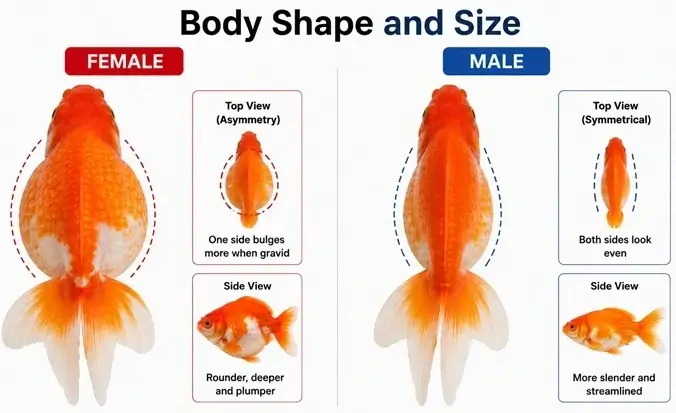
Compare similar fish — differences in age, variety, feeding, and growth can affect size and shape.
Look from above — a female carrying eggs may appear wider through the abdomen, sometimes slightly uneven on either side. Asymmetry alone does not confirm eggs.
Use caution with fancy varieties — Ranchus, Ryukins, and other rounded varieties can be deep-bodied regardless of sex, making shape less reliable.
A slim fish is not automatically male, and a large, round fish is not automatically female. Compare body shape with vent shape and breeding tubercles.
Pectoral Fin Shape
Male goldfish often have a thicker leading ray, the firm front edge of each pectoral fin. Their fins may also look more pointed, while females may have finer, rounder fins. These differences are subtle and vary between fish.
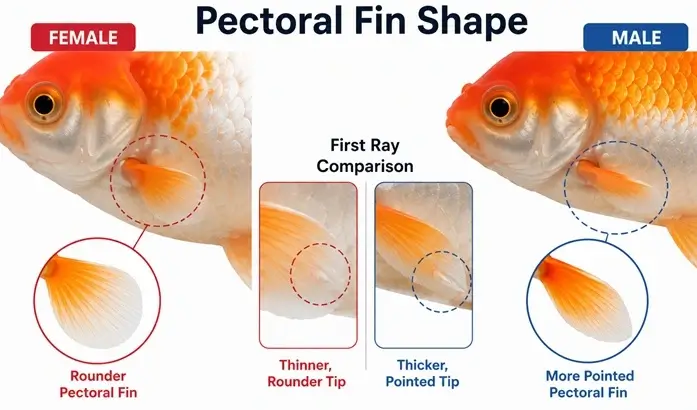
Compare similar fish — look at fish of the same variety and similar maturity, with their fins naturally spread.
Check for breeding tubercles — small white bumps along the leading fin rays provide another clue.
Fin shape works best as a supporting sign alongside tubercles and vent shape.
Midline Ridge
The midline ridge is a raised, seam-like line along the underside of a goldfish, running from behind the pelvic fins toward the vent. It is often more noticeable in males, while females may have a smoother, rounder underside with a faint or less visible ridge.
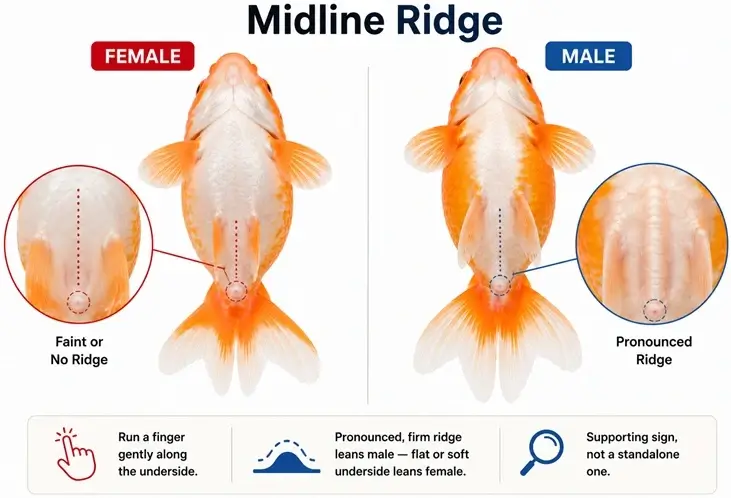
Male: A more pronounced ridge along the lower belly can support identification.
Female: The ridge may be less noticeable or difficult to distinguish.
I check for the ridge by gently running a wet fingertip along the underside without pressing, or by looking closely under good lighting.
Use the ridge alongside other signs rather than treating its presence or absence as conclusive.
Chasing Behavior During Breeding Season
During courtship, male goldfish repeatedly follow females and nudge their abdomen or vent area. This behavior provides another identification clue, especially when the chasing fish also has breeding tubercles.
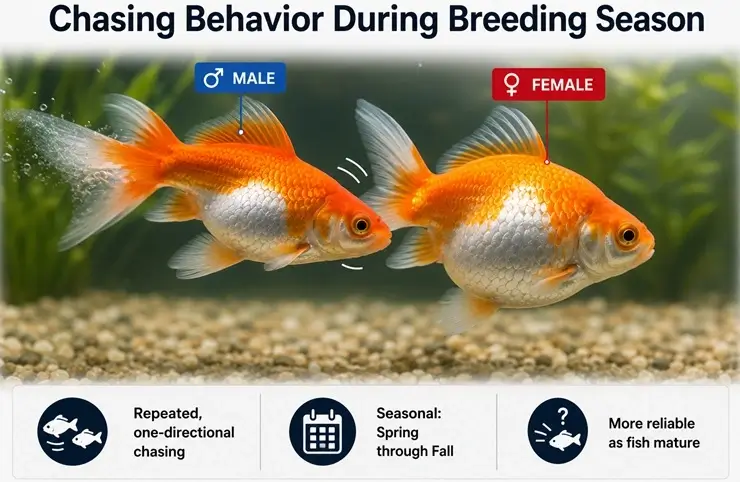
Watch for persistent following and nudging — one or more males may repeatedly pursue the same female.
Breeding conditions matter — spawning activity depends on temperature and lighting, so indoor goldfish may not follow a fixed seasonal calendar.
Chasing alone does not confirm sex — competition and aggression can also cause chasing. Compare the behavior with physical signs.
If the pursued fish becomes exhausted or injured, separate the fish to prevent further harm.
Why Sexing Fancy Goldfish Is Harder
Fancy goldfish can be harder to sex because their body and fin shapes make some differences less obvious. Ranchus and Ryukins are naturally rounded in both sexes, while the flowing fins of varieties such as Veiltails can make fin-shape comparisons difficult.
Give more weight to breeding tubercles, vent shape, and spawning behavior than to body shape alone.
Belly firmness can provide another clue, as described above, but it should be considered alongside the visible signs rather than used as a deciding test.
Frequently Asked Questions
At what age can you tell whether a goldfish is male or female?
Sex differences usually become easier to identify as goldfish mature, often around one year old, although some develop earlier or later. Breeding tubercles, vent shape, and spawning behavior are generally the clearest when mature fish are in breeding condition. If a young fish’s signs are unclear, wait and reassess as it grows.
How can I confirm whether my goldfish is male or female?
Directly observing a fish release eggs confirms it is female; observing it release milt—the sperm-containing fluid—confirms it is male. Identify which fish released it rather than relying on eggs or cloudy water appearing in a shared tank. Do not squeeze a fish to make it release eggs or milt.
Can you tell a goldfish’s sex outside breeding season?
Sometimes, particularly in mature fish. Vent shape, body shape, and other physical differences may still provide clues, but they can be less obvious outside breeding condition. If the signs disagree, leave the identification uncertain and reassess later. Indoor goldfish do not necessarily follow a fixed spring-to-fall breeding calendar.
How do I know if my goldfish is carrying eggs?
Goldfish lay eggs rather than becoming pregnant. A mature female carrying eggs may develop a fuller abdomen and a more prominent vent, and males may begin pursuing her. These signs suggest breeding condition, but a swollen belly alone does not confirm eggs.
Are male or female goldfish more colorful?
Color is not a dependable way to tell them apart. Both sexes can have equally bright colors and similar patterns, so use physical features and spawning behavior instead.
Final Thoughts
To tell male and female goldfish apart, compare several signs: breeding tubercles, vent shape, belly firmness, and spawning behavior. Body and fin shape can help, but they are less useful in some fancy varieties.
If the signs are unclear, give the fish time to mature or enter breeding condition. There is no need to force a conclusion—or repeatedly handle the fish—to identify its sex.