
There are hundreds of named fancy guppy strains, but only a handful earn the label rare fancy guppies at any given moment, and that word “moment” matters more than most articles admit.
Guppies breed fast. A single female can produce 10 to 100 fry every 21 to 30 days, and she can keep producing fry for months off stored sperm without a male anywhere nearby. That means whatever a breeder manages to perfect this season can be everywhere within a year or two. Rarity in fancy guppies isn’t usually about a fish being genetically scarce, it’s about how hard a specific combination of color and pattern is to line-breed true, and how recently someone managed to nail it. The breeder who produces the most striking version of a strain is “rare” for that season, until supply catches up or someone else matches the look.
With that in mind, here are 11 fancy guppy strains that currently sit toward the rare end of the hobby, based on breeding difficulty, documented history, or how recently the specific color-and-trait combination was stabilized.
Quick Navigation
➜ Moscow Blue Guppy
➜ Dragon Guppy
➜ Albino Red Guppy
➜ 24k Gold Dragon Guppy
➜ Rose Tail Guppy
➜ White Tiger Guppy
➜ Pink Fire Guppy
➜ Metal Sky Blue Guppy
➜ Golden Lace Guppy
➜ Phoenix Guppy
➜ Banana Guppy
➜ Frequently Asked Questions
Rare Fancy Guppies
1) Moscow Blue Guppy
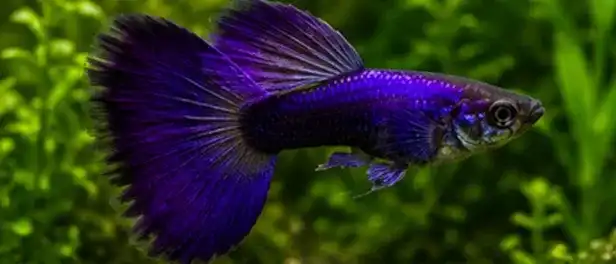
The Moscow Blue Guppy is one of the oldest, truly rare strains still active in the hobby, developed in Russia in the 1960s and not widely available in the West until it was brought over decades later. It carries a solid, deep, velvety blue color running from nose to tail, the most prized shade within the broader Moscow line, and it’s known for breeding relatively true compared to other fancy lines, though body size tends to shrink over successive inbred generations if a breeder isn’t careful. Because the strain has such a long, documented history, a well-kept, correctly colored Moscow Blue line still commands real respect and real prices among breeders.
2) Dragon Guppy
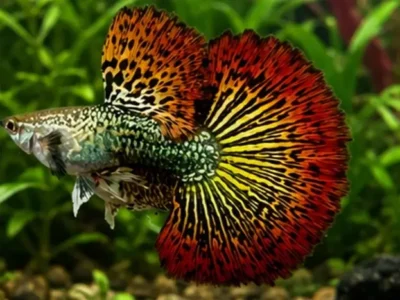
The Dragon Guppy isn’t a single trait, it’s a designer combination strain that stacks Tuxedo, Moscow, and Snakeskin genetics together, sometimes with Dumbo Ear fins layered in as well. It’s mainly developed by breeders in Thailand, Malaysia, and Indonesia, and the heavy, armor-like metallic scaling that gives it the “dragon” name takes several generations of careful selection to stabilize. Because it depends on stacking multiple traits correctly at once, a clean Dragon Guppy line is noticeably harder to maintain than a single-trait strain like Red or Blue.
3) Albino Red Guppy

The Albino Red Guppy, sometimes sold as Albino Full Red, pairs a solid, vivid red body with the albino trait, producing red or pink eyes instead of black. Albino lines in general need more stable water conditions than average guppies and tend to have shorter lifespans, which is part of why they’re often kept as dedicated single-strain show fish rather than casual community tank fish. A clean, fully solid Albino Red, without patchy color or weak finnage, is harder to hold onto across generations than most solid-color strains.
4) 24k Gold Dragon Guppy
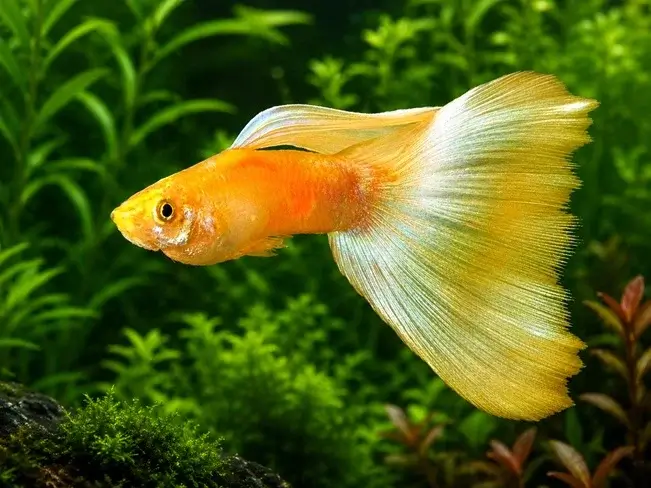
The 24k Gold Dragon Guppy is the gold-colored expression of the Dragon combination strain, carrying the same layered Tuxedo, Moscow, and Snakeskin genetics but selected for a bright, warm gold sheen instead of the more common blue or green Dragon variants. Because it depends on the same multi-trait stacking as any Dragon line, plus a specific gold color outcome that isn’t guaranteed even from Dragon-to-Dragon pairings, it’s one of the harder color results to reliably reproduce in this family of strains.
5) Rose Tail Guppy
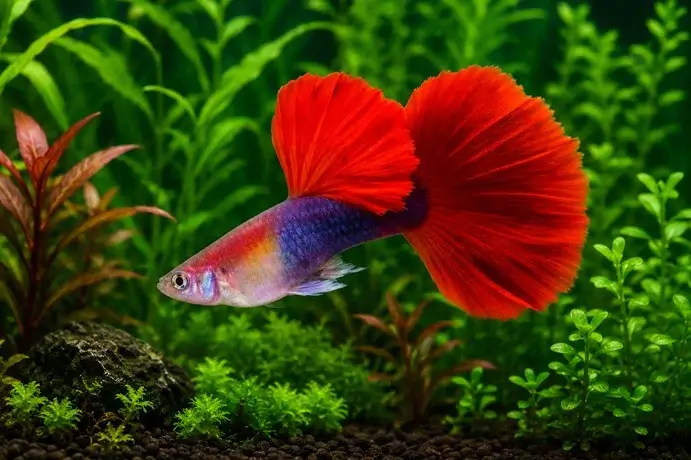
The Rose Tail Guppy is a strain most commonly sourced from Thailand breeding lines, then bred down over further generations once it reaches other countries to adapt it to local water conditions. The name refers to the soft, rose-toned coloring across the tail, distinct from a plain Red like a rose. Because most stock traces back to a small number of import lines, quality Rose Tail guppies can be harder to source locally than more established strains like Delta or Cobra.
6) White Tiger Guppy
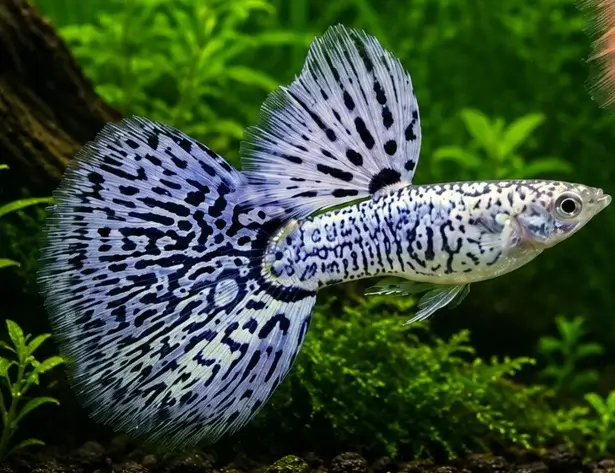
The White Tiger Guppy combines a white or snakeskin base with bold, tiger-like striping across the body and fins, sometimes bred with an added metallic sheen for extra contrast. It’s consistently offered across multiple independent breeders rather than being a single seller’s invention, which suggests it’s a real, established combination rather than a one-off marketing name. Getting clean, well-defined striping against a bright white base is the harder part of maintaining this line.
7) Pink Fire Guppy
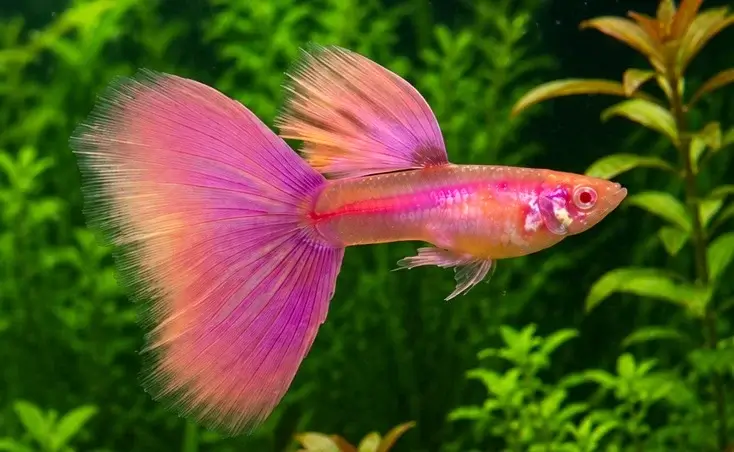
The Pink Fire Guppy pairs an intense, fiery pink color trait with a lighter, pink-shifted base tone, rather than existing as a fully separate, independently documented strain. It’s a good example of how most “named” rare guppies in the hobby work, breeders take two already-established traits, in this case a fire-pink color trait and a pink shading trait, and combine them into a fish striking enough to earn its own sale name for a season.
8) Metal Sky Blue Guppy
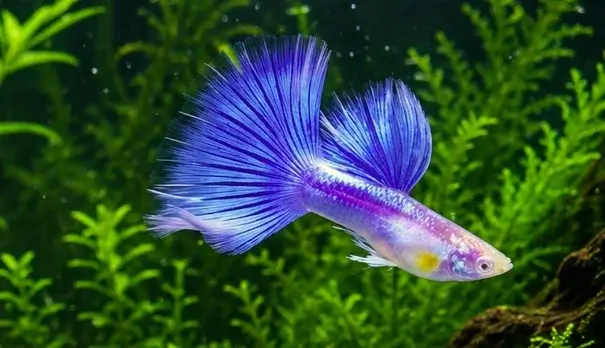
The Metal Sky Blue Guppy combines the Metal trait, a strong metallic sheen from a high concentration of iridophores, with a bright, pale sky-blue base color rather than the deeper navy tones seen in standard Blue Guppies. Both the Metal trait and the Sky Blue shade are individually well established, and it’s the specific pairing, plus how reflective and even the metallic sheen turns out, that decides whether a given fish is worth calling rare.
9) Golden Lace Guppy
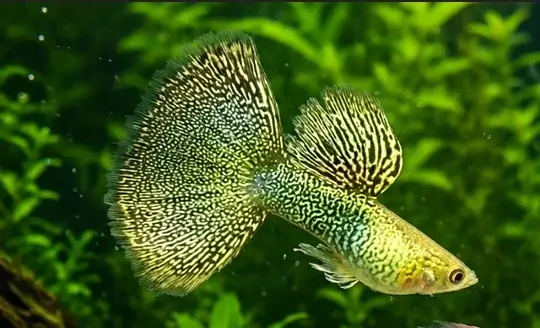
The Golden Lace Guppy combines a warm golden body color with the fine, web-like Lace pattern, the same delicate pattern family as Cobra and Snakeskin but typically finer in detail. Neither the Golden color nor the Lace pattern is new on its own, what makes a specific Golden Lace line rare is how clean and consistent the fine webbing shows up against a true golden, rather than yellow or bronze, base.
10) Phoenix Guppy
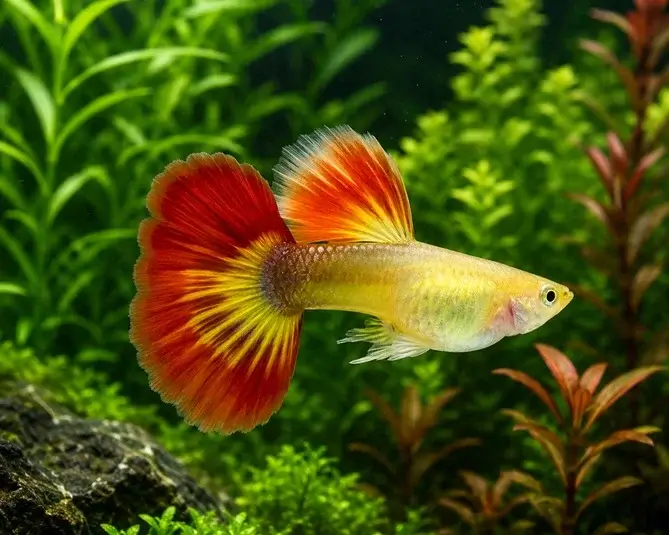
The Phoenix Guppy carries a golden body with a reddish-yellow tail pattern, named for its resemblance to the mythical bird. It’s often sold combined with other fire-toned red or orange strains under names like “Fire Phoenix Guppy,” a good example of how quickly named strains merge and re-merge in the trade as breeders chase whatever combination is catching attention that season. A true Phoenix Guppy needs a clean gold-to-red gradient across the tail to stand apart from a simple Gold or Red Guppy.
11) Banana Guppy
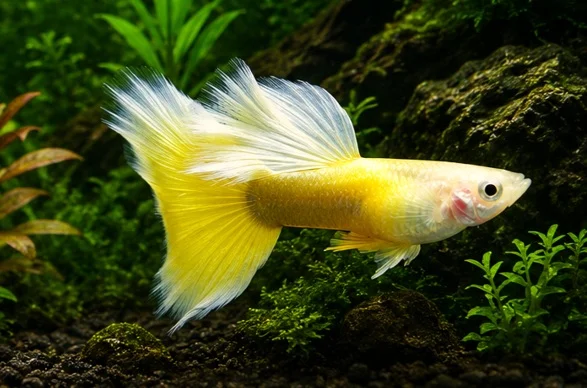
The Banana Guppy carries a bright yellow or golden body with darker markings running through it, a color pattern named for how closely it resembles the peel and flesh of a banana. It’s closely related to the Banana Tuxedo Guppy, sometimes used interchangeably with it, and covered in more depth on our full Tuxedo Guppy guide. Getting an even, glowing yellow across the body without the color fading toward white or bronze is the harder part of holding a clean Banana line together.
Where to Find Rare Fancy Guppies
If you’re searching for rare fancy guppies for sale, it helps to know we don’t sell fish directly, this is a general pointer toward where the hobby actually sources these strains, not a storefront. Most of the genuine innovation in rare strains like Dragon, Moscow Blue, and Golden Lace still comes out of dedicated breeder communities in Thailand, Malaysia, and Indonesia, and Facebook groups run by those breeders are often where a new combination shows up first, well before it reaches Western retailers. In the US, online guppy-specific marketplaces and forums are the more reliable route than general pet stores, since specialty sellers are more likely to actually maintain a clean, correctly named line rather than a mixed-tank “mutt.” eBay listings exist too, though quality varies more there since anyone can list a fish under an eye-catching name, so checking a seller’s feedback history and asking for a clear photo of the actual fish, not a stock image, matters more than on a dedicated breeder platform. Wherever a rare strain comes from, treat it like any new fish, our guppy care guide covers the 2 to 4 week quarantine period worth running before adding anything new to an established tank.
Frequently Asked Questions
What actually makes a fancy guppy rare?
Mostly how hard the specific color-and-pattern combination is to line-breed true, and how recently a breeder managed to stabilize it, not genetic scarcity in the way a rare dog breed might be scarce. Because guppies breed so fast, today’s rare strain can be widely available within a year or two once other breeders match the look.
Why do rare guppies lose their rarity so quickly?
A single female guppy can produce 10 to 100 fry every 21 to 30 days, and can keep producing fry for months from stored sperm alone. Once a breeder successfully stabilizes a striking combination, that supply can multiply fast, which is why “rare” in this hobby is closer to a seasonal label than a permanent one.
Are Dragon and 24k Gold Dragon guppies the same strain?
They’re closely related. Dragon Guppy is the broader combination strain, stacking Tuxedo, Moscow, and Snakeskin genetics, and 24k Gold Dragon is a specific gold-colored outcome within that same Dragon lineage rather than an unrelated strain.
Is Banana Guppy the same as Banana Tuxedo Guppy?
They’re closely related, and the names are sometimes used interchangeably. Both describe a yellow or golden body with darker markings, though Banana Tuxedo specifically pairs that coloring with the classic dark rear-half Tuxedo pattern, while a plain Banana Guppy doesn’t require the Tuxedo split to qualify.
Are compound-named guppies like Golden Lace or Metal Sky Blue less legitimate than strains like Moscow?
Not really, they’re just named differently. Moscow has a specific, documented breeding history behind its name, while names like Golden Lace or Metal Sky Blue describe a combination of two already-established traits, color and pattern. Both routes produce rare, hard-to-reproduce fish, the naming convention is just describing the fish differently.
Final Thoughts
Rarity in fancy guppies is less about a fixed list of untouchable strains and more about timing, which breeder currently has the cleanest version of a demanding color-and-pattern combination. Moscow and Dragon carry the longest, most documented histories on this list, while strains like Golden Lace or Pink Fire show how quickly new combinations earn a name once someone gets the pairing right. For the full picture of how these named strains fit into the broader hobby, see our types of fancy guppies guide and our fancy guppy guide.