
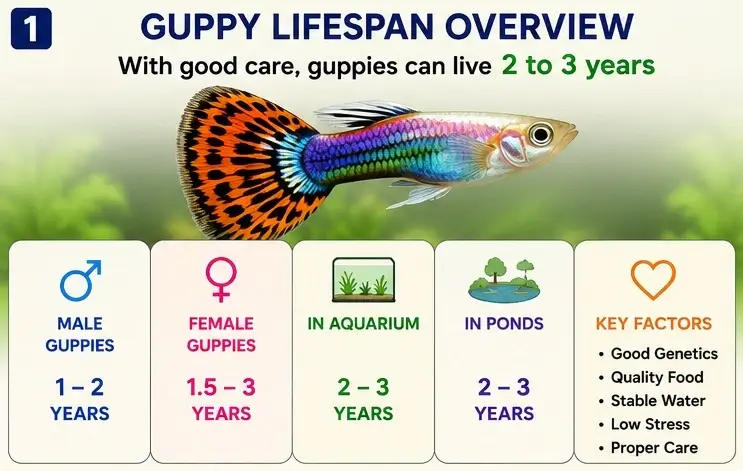
The average Guppy lifespan is around 2 to 3 years. With good care and a healthy environment, they can live up to 3 years. Female guppies generally live around 1.5–3 years, while male guppies typically live around 1–2 years. Proper nutrition, and appropriate water parameters are key factors in ensuring a longer lifespan of guppies. Ultimately, providing a stress-free, well-maintained aquarium environment and a healthy diet is crucial in extending the life of your guppies.
In this article, you will learn:
➜ Male vs female guppy lifespan
➜ Guppy lifespan in bowls
➜ Guppy lifespan in ponds
➜ How to improve guppy lifespan
➜ Signs Your Guppy Is Getting Old
➜ Frequently asked questions
A significant determinant of a guppy’s lifespan is its genetics. You don’t have the control over genetics of a guppy. Most of the time, guppies with weak genetics will pass away before they reach 4 months of adulthood.
Though guppies breed in huge quantities around 20 to 30 percent of guppy fries pass away due to genetic makeup, poor water condition, or other disease-related issues. Guppies that are raised in ponds seem to have a higher survival rate than the ones that are brought up in aquarium tanks. The reason is that ponds are natural and large and there is plenty of algae in ponds that produces oxygen which takes care of the overall health of guppies.
Male vs Female Guppy Lifespan
Female guppies generally live around 1.5–3 years, while male guppies typically live around 1–2 years. Females are usually hardier and often outlive males, although frequent pregnancies may reduce their lifespan.
Male guppies constantly:
➜ chase females
➜ compete with other males
➜ display colors and fins
➜ expend more energy breeding
This continuous activity may increase stress and shorten their lifespan slightly.
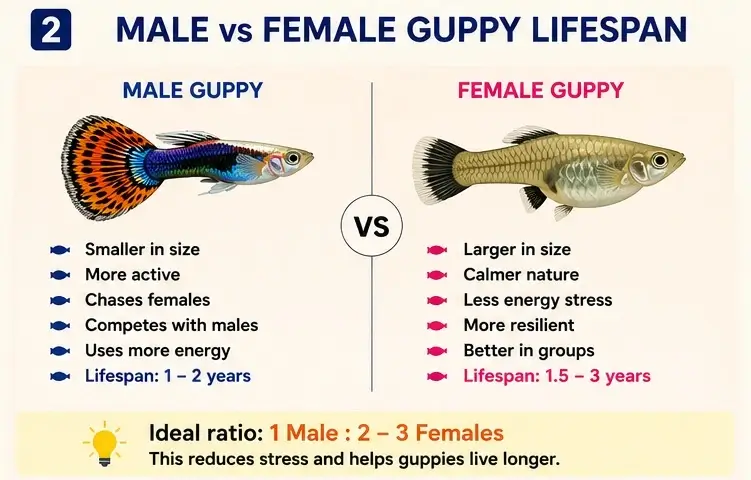
Female guppies are usually calmer and more resilient, especially when kept in proper male-to-female ratios.
A good ratio is:
1 male : 2–3 females
This helps reduce stress and aggression inside the aquarium.
Guppy Lifespan in Bowls
Although guppies may survive in bowls temporarily, bowls are generally not ideal for maximizing guppy lifespan. At the most you can have 1 or 2 guppies in a bowl with live plants and an air stone. Small bowls become unstable quickly and may experience sudden ammonia spikes, oxygen depletion, and temperature fluctuations.
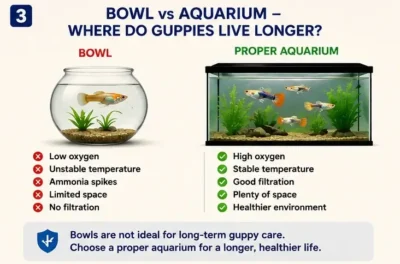
Bowls also lack swimming space and stable filtration compared to proper aquariums. Larger aquariums with proper filtration are always healthier and safer for long-term guppy care.
For complete aquarium setup information, read our guppy tank setup guide.
Guppy Lifespan in Ponds
Guppies raised in outdoor ponds often develop stronger immune systems and better survival rates because ponds provide natural algae growth, larger water volume, and more stable ecosystems.
Outdoor ponds also allow guppies to swim more naturally and receive natural sunlight, which may improve their overall health and coloration.
However, ponds may also expose guppies to predators, parasites, and sudden weather changes depending on the environment.
Natural ponds usually contain algae and microorganisms that guppies graze on throughout the day, helping support their digestive health and overall activity levels.
If you want to create a natural environment indoors, read our guppy tank setup guide and guppy water parameters guide.
How to Improve Guppy Lifespan?
In the following, I would like to give you some useful tips that I have been practicing for a very long time, on how to improve the lifespan of guppy.
1) Buy a healthy and quality Guppy
Since genetics play a big role in the lifespan of a guppy, I would advise you to buy a healthy guppy at the time of purchase. Subsequently, the fries of the guppy will also have a good life span.
2) Feed your Guppy with Quality Food.
Besides good genetics, guppies require quality Guppy food for a healthy and longer lifespan.
Guppy fish would eat almost anything you throw at them when they are hungry. You can feed them with commercial as well as homemade food. But I would always prefer commercial guppy food as I don’t want to take chances with my guppy and I don’t want to spend or waste too much time on food.
The guppy food you choose should be granular in nature or worm-like in shape so that your guppy food can go inside your guppy’s mouth. A quality guppy feed should ideally contain animal matter as well as some plant matter in it.
For feeding advice and food recommendations, read our best guppy food guide.
3) Deworm your guppy once a month
Deworming here simply means that you don’t feed anything for the whole day once in 30 days. This applies not only to guppies but to all fishes. Once you don’t feed them anything for a day, guppies excrete everything including worms. It improves the digestive system of guppies too.
Make sure that you don’t prolong the fasting or deworming process as guppies will end up eating their excreta if they stay hungry for too long. This might give rise to additional problems.
4) Maintain the Right Tank Conditions
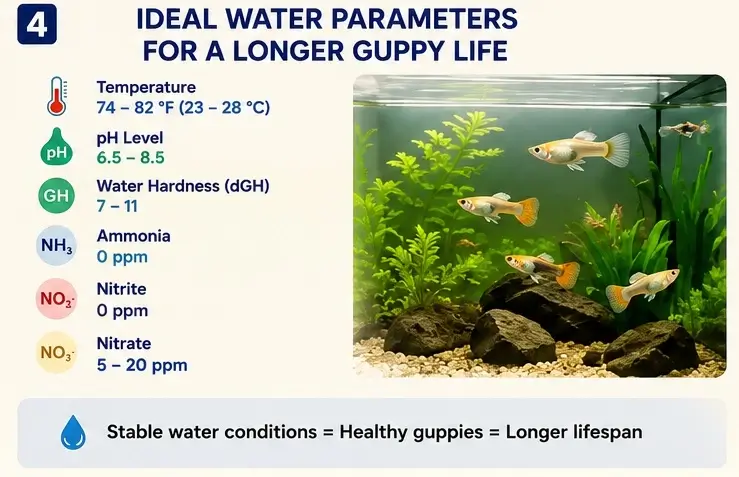
Water parameters are the most important factor for keeping not only guppies but all fish for that matter. Guppy fish are moderately hardy and can thrive in a wide range of water parameters. Here are the ideal water conditions for guppy fish:
Water temperature: 74-82 °F
Water pH: 7.0-8.0
Water hardness (dGH): 7-11
In most cases, regular tap water is great for keeping your guppies well. Make sure that your water does not contain too much chlorine. Chlorine sucks up oxygen in water and increases the acidity of water. You may add some rock salt to neutralize the water if there is too much chlorine.
Stable water conditions are one of the biggest factors affecting guppy lifespan.
Ammonia and nitrite spikes may quickly stress guppies and damage their gills and internal organs.
Bad water conditions may also cause:
➜ lethargy
➜ clamped fins
➜ gasping at the surface
➜ shimmying
➜ disease outbreaks
For ideal parameters, read our guppy water parameters guide.
Make sure 30 % water changes are made as per the size of your aquarium. If you have a filter you would not need frequent water changes. Once in a while, you may need to do a complete water change no matter what sort of filter you have.
Have a few natural things like stones, pebbles, driftwood, and a few plants if you can. All these things add up to creating a natural environment for your fish. Pebbles and driftwood catch algae which is good for your fish. Guppies eat algae too.
5) How Temperature Affects Guppy Lifespan
Water temperature does more than just keep guppies comfortable — it directly controls how fast they age. This is one of the most overlooked lifespan factors in guppy keeping.
Warmer water speeds up a guppy’s metabolism. At 80°F–82°F guppies are more active, breed more frequently, and grow faster — but they also burn through their energy reserves faster and tend to live shorter lives. If you are actively breeding and want faster fry development, warmer water works well for that purpose.
Cooler water at 72°F–74°F slows the metabolism down. Guppies are less frantically active, breed less frequently, and age more slowly. If your goal is maximum lifespan rather than maximum breeding output, keeping the tank at the cooler end of the safe range is one of the simplest things you can do.
The sweet spot for most hobbyists who want healthy, active guppies with a reasonable lifespan is 74°F–78°F — warm enough for good immune function and natural behavior, cool enough not to accelerate aging unnecessarily.
What matters most is stability. A tank that holds steady at 75°F every day produces healthier, longer-lived guppies than one swinging between 72°F and 82°F because of room temperature changes overnight. Temperature swings suppress the immune system and open the door to disease even when the average temperature looks fine.
6) Aeration and Lighting
Guppies require some aeration compared to other fishes like goldfish where they require a lot of aeration. Keep the air flow rate moderate if you maintain an aeration pump in your tank. If the airflow rate is high the water tends to be flowing and this causes swimming problems for your guppies.
All fishes including guppies love stable water. So keep your water stable as much as you can.
Guppies require some lighting during the day and darkness during the night. Guppies do sleep at night. They tend to remain static when the lights are off. So make sure you don’t have the light ON throughout the day.
7) Reduce Stress
Below are the most common stress factors for guppies.
➜ Poor water conditions
➜ Bad tank mates
➜ Overcrowded fish tank
➜ Lack of hiding space
➜ Lack of natural things in your aquarium
➜ Too much lighting throughout the day
➜ Inadequate male-to-female ratio
➜ Constant flowing water due to high aeration from air pumps
If you keep your guppies in a community tank make sure that you don’t keep them with aggressive fishes like barbs, because they will harm or end up eating your guppy fish.
Guppies feel safe when they have hiding spaces. They do not hide though. However, it is a good idea to give them some sort of hiding space just for them to rest if they feel sick. Female guppies can be very stressed by male guppies chasing them continuously and they need rest. They will hide between objects or other aquarium decorations.
An overcrowded tank can also be a huge stress factor not only for guppies but for all fish. So make sure that you don’t overcrowd your tank.
If your guppies are hiding often, read our guppy hiding guide.
Signs Your Guppy Is Getting Old
Guppies age gradually and the signs appear slowly over weeks rather than overnight. Knowing what to look for helps you adjust care for older fish and recognize when a guppy is approaching the end of its natural lifespan rather than suffering from illness.
Common signs of an aging guppy:
Faded coloring — one of the earliest signs. A male that was once vivid and bright gradually loses some of his color intensity. This is different from stress-related color loss which tends to happen quickly. Age-related fading happens slowly over months.
Reduced activity — older guppies spend more time resting near plants or at the bottom. They are less interested in chasing other fish or competing for food at feeding time.
Slower swimming — the energetic darting behavior of young guppies gives way to slower, more deliberate movement. Older fish may struggle slightly to maintain position against even gentle filter flow.
Reduced appetite — older guppies often eat less than they used to. They may come to the surface at feeding time but take less food or lose interest more quickly.
Fin deterioration — the fins of older guppies may begin to look slightly ragged or less full even without any infection present. This is normal wear over time and different from fin rot which progresses rapidly and has clearly infected edges.
Curved spine — some older guppies develop a slight spinal curve as they age, particularly males. A mild curve in an otherwise healthy, active fish is often simply age rather than disease.
If your guppy shows these signs alongside normal eating and swimming behavior, it is most likely aging naturally. If the same signs appear alongside clamped fins, rapid breathing, or loss of appetite in a young fish, investigate water quality and disease first.
Frequently Asked Questions
How long do guppies live in captivity?
Most guppies live around 2–3 years in captivity when kept in stable aquariums with proper care.
How long do guppies live in tanks?
Guppies usually live between 2 and 3 years in properly maintained aquariums with stable water conditions and good nutrition.
Can guppies live in bowls?
Guppies may survive temporarily in bowls, but bowls are usually not recommended for long-term care because they often lack stable filtration, oxygenation, and water quality.
How long do male guppies live?
Male guppies typically live around 1–2 years. Their active breeding behavior, competition with other males, and faster metabolism may contribute to a slightly shorter lifespan.
How long do female guppies live?
Female guppies generally live around 1.5–3 years and often outlive male guppies. However, repeated pregnancies and breeding stress may shorten their lifespan.
What is the lifespan of fancy guppies?
Fancy guppies usually live around 2–3 years in healthy aquariums. However, heavily inbred fancy guppy strains may sometimes have shorter lifespans due to weaker genetics.
How long do Endler guppies live?
Endler guppies typically live around 2–3 years under good aquarium conditions. Healthy diets, stable water quality, and low stress help maximize their lifespan.
Can guppies live for 5 years?
Most guppies live around 2–3 years. Although uncommon, a few guppies may live beyond 3 years with excellent care, stable water conditions, and strong genetics. However, reaching 5 years is considered rare.
Do female guppies live longer than males?
Yes. Female guppies usually live slightly longer than males because male guppies constantly chase females, compete with other males, and expend more energy breeding.
Does stress shorten guppy lifespan?
Yes. Long-term stress weakens the immune system of guppies and increases the risk of disease, poor growth, and early death.
Can water quality affect guppy lifespan?
Poor water quality is one of the biggest reasons guppies die early. Ammonia spikes, unstable temperatures, and poor filtration may significantly shorten guppy lifespan.
Do guppies live longer in ponds or tanks?
Guppies raised in outdoor ponds often develop stronger immune systems due to natural algae growth and larger water volume. However, properly maintained aquariums are usually safer from predators and weather fluctuations.
What temperature helps guppies live longer?
Guppies generally do well between 74–82 °F. Stable temperatures are more important than constantly changing water conditions.
Can overfeeding reduce guppy lifespan?
Yes. Overfeeding may pollute the aquarium and increase ammonia levels, which can stress guppies and shorten their lifespan over time.
Do guppies need filtration to live longer?
Yes. Proper filtration helps maintain stable water quality and reduces harmful toxins that may stress guppies.
Do fancy guppies have shorter lifespans?
Some heavily inbred fancy guppy strains may have weaker genetics and shorter lifespans compared to stronger wild-type guppies.
Can guppies live without an air pump?
Guppies may survive without an air pump in planted aquariums with good surface movement, but proper oxygenation always helps improve fish health and stability.
How can I tell if my guppy is aging?
Older guppies may become less active, lose coloration slightly, develop slower movement, and show reduced appetite compared to younger fish.
Can guppies die from stress?
Yes. Long-term stress caused by poor water quality, bullying, overcrowding, or sudden parameter changes may weaken the immune system of guppies and shorten their lifespan.
Can guppies live without a filter?
Guppies may survive temporarily without a filter in heavily planted aquariums, but long-term filtration helps maintain stable water quality and healthier fish.
Can guppies survive without an air pump?
Yes. Guppies can survive without an air pump if the tank has enough surface movement, healthy plants, and is not overcrowded. However, proper oxygenation always improves fish health.
Can guppies survive 2 days without food?
Healthy adult guppies can usually survive 2–3 days without food. In mature aquariums, they may graze on algae and microorganisms naturally present in the tank.
Can baby guppies survive without food for 2 days?
Baby guppies (fry) should not go without food for long periods because they grow rapidly and need frequent feeding. Fry usually require small meals multiple times per day.
Can guppies live alone?
Guppies are social fish and generally do better in groups. Keeping a single guppy alone for long periods may cause stress and reduced activity.
Can male guppies live without females?
Yes. Male guppies can live without females and many hobbyists keep all-male guppy tanks successfully to avoid overbreeding.
Why do guppies die suddenly?
Sudden guppy deaths are commonly caused by ammonia spikes, poor water quality, sudden temperature changes, disease outbreaks, or stress from overcrowding.
What kills guppies the fastest?
Poor water quality is one of the biggest causes of sudden guppy deaths. Ammonia and nitrite spikes can quickly damage the gills and internal organs of fish.
Do guppies live longer in bigger tanks?
Yes. Larger aquariums are generally more stable and experience fewer sudden water quality fluctuations, which helps guppies live longer and healthier lives.
Can overcrowding reduce guppy lifespan?
Yes. Overcrowded tanks may increase stress, aggression, disease spread, and poor water quality, all of which can shorten guppy lifespan.
Can guppies survive in tap water?
Guppies can live in conditioned tap water if chlorine and harmful chemicals are removed using a proper water conditioner before adding the water to the tank.
How often should I change guppy tank water?
Most guppy tanks benefit from weekly water changes of around 20–30% to maintain stable water quality and reduce harmful waste buildup.
Can guppies live in cold water?
Guppies may survive temporarily in cooler water, but long-term exposure to low temperatures may weaken immunity and shorten lifespan.
Conclusion
Hope my article helps in your journey toward expanding the life span of your guppies. Having all said and done experience in fish keeping matters to an extent in keeping your fish alive.
