Understanding goldfish fry growth stages helps you know what the normal growth timeline is. With goldfish producing a large batch of fry, it’s important to know the growth stages and timeline. Fry grow fast at first, then slow down. This article explains the typical size milestones at each stage, along with what actually speeds growth up or holds it back.
Quick Navigation
1) Goldfish Fry Growth Chart
2) Goldfish Fry Growth Timeline: Week by Week
3) What Actually Controls Growth Rate
4) Do Goldfish Only Grow to the Size of Their Tank?
5) Frequently Asked Questions
Goldfish Fry Growth Chart
These are approximate growth ranges under good conditions, not fixed milestones. Individual fry can grow at different rates depending on their variety, genetics, food, water quality, temperature, and stocking density.
| Age | Approx. Length | Development |
|---|---|---|
| Hatching | About 4–5 mm (0.16–0.2 in) | The fry still has most of its yolk sac and remains largely translucent. The fry eyes are the ones that could be seen in the form of black dots. |
| Days 3–7 | About 5 mm (0.2 in) | The yolk sac is being absorbed and the fry becomes increasingly active. The body begins to take a fish shape while most of the color remains translucent. |
| Week 2 | About 7 mm (0.28 in) | The body begins to thicken as the fry develops beyond the yolk-sac stage. The developing head, fins and mouth become more defined. Dark juvenile pigmentation remains dominant. |
| Week 3 | About 11 mm (0.43 in) | The body continues gaining thickness and becoming less transparent. The fins become increasingly distinct, while pigmentation becomes stronger and the fry still generally appears dark rather than gold. |
| Week 4 | About 13–14 mm (0.5–0.55 in) | The body is noticeably thicker and more developed, with the fin structure becoming clearer. Transparency continues to decrease as muscle, internal organs, and pigmentation develop. Adult gold coloration is usually not yet present. |
| Week 5 | About 16 mm (0.63 in) | The fry has a more developed juvenile body, with the major fins established and scales becoming visible. Pigmentation continues to develop, and the fry generally remains dark or bronze at this stage depending on genetics. |
| Week 6 | About 19 mm (0.75 in) | The fish is now clearly entering the juvenile stage, with a thicker body and more developed fins. Pigmentation stays dark at this stage, with no real color shift happening yet. |
| Week 7 | About 22 mm (0.87 in) | The juvenile body continues to gain length and mass, while the fins become increasingly mature. Most fry remain dark, although differences in pigmentation between individuals become easier to see. |
| Week 8 | About 25 mm (1 in) | The fry has reached roughly 1 inch in length and has a clearly juvenile body shape. The fins and body are well developed, and pigmentation is becoming more established. Some fry may begin their transition toward adult coloration. |
| 2 months | About 1–2 in | Growth continues rapidly, although size can vary considerably between fry. The body becomes more robust and juvenile features become clearer. Color changes may also begin becoming more noticeable, depending on genetics. |
| 1 year | 4–6 in (common/comet) 2–4 in (fancy) | The fish has developed a much more mature body and fin structure. Common and comet goldfish varieties generally become larger than fancy varieties during the first year, while coloration may continue developing beyond this point in some fish. |
For what to feed at each of these stages, see our guide on what goldfish fry eat.
Goldfish Fry Growth Timeline
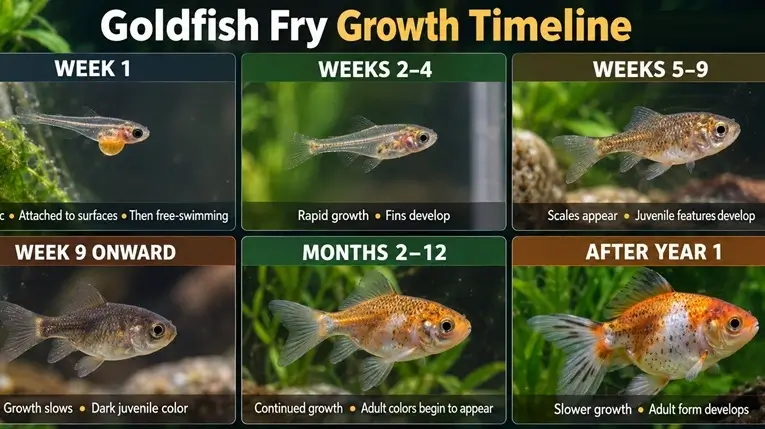
Week 1:
Fry hatch and stay attached to plants or the tank surface for the first few days, living off their yolk sac before becoming free-swimming
Weeks 2-4:
This is the fastest growth phase. Fin development happens fast, caudal fins are usually well-defined by day 14, with the dorsal and remaining fins filling in over the following two weeks.
Weeks 5-9:
Growth continues but at a steadier pace. By day 35 or so, fry typically have all their fins and visible scales, and this is usually when the first fry start to darken and their eyes begin to protrude slightly, which are early signs taht they are becoming juveniles rather than remaining a fry.
Week 9 onward:
Growth slows compared to the first two months. Most of the fry have become darkened in grey or brown by this point, and could be commonly referred to as juveniles from here on.
This stretch also roughly overlaps with when color starts to shift, see our guide on when goldfish fry get their color for the full timeline.
Months 2-12 (Juvenile Stage):
This is when goldfish continue to grow noticeably. Common and comet goldfish usually grow longer and larger than fancy goldfish during this period. Fancy varieties have a more rounded body and generally grow more slowly.
This is also when many fry start changing from their early black or grey color to gold, orange, white, or other adult colors. However, growth and color change do not always happen at the same speed. A fry can grow quickly without developing its adult color quickly.
After Year 1
Growth continues for several more years but slows to roughly an inch a year. Most fish have their final gold, orange, or white color by now, though some stay dark for life.
What Actually Controls Growth Rate
Genetics and variety:
Common and comet goldfish are genetically built to grow larger and faster than fancy varieties like orandas or ryukins do.
Water volume and tank size:
More space supports faster and healthier growth.
Water quality:
Frequent water changes remove waste and growth-inhibiting compounds that build up in crowded or infrequently changed water.
Temperature:
Fry generally grow fastest around 75°F (24°C) as their metabolism speeds up.
Diet:
A protein-rich diet supports faster, healthier growth than a low-protein one.
Do Goldfish Only Grow to the Size of Their Tank?
This myth exists because it looks true in practice. A goldfish kept in a small tank really does often stay small, while one moved to a bigger tank or pond really does grow larger. But the tank itself isn’t setting a hard limit. The tank’s water is and genetics also comes in.
In a small volume of infrequently changed water, waste builds up fast, and that alone is enough to slow growth. Some researchers also think that fish release hormones that signal other fish nearby to slow their own growth, though this specific idea is disputed, other scientists argue it’s really just the stress of crowding and poor water quality shutting down normal growth hormone, not a special “growth-blocking” chemical. Either way, move that same fish to more water with regular water changes, and growth picks back up.
The practical takeaway is the same regardless of which explanation is right: more space and cleaner water support healthier growth. But it’s worth knowing the tank isn’t physically capping the fish’s size, since stunted growth from this cause often comes with other health problems rather than a fish that is simply small and otherwise fine.
Frequently Asked Questions
Why did my goldfish fry suddenly stop growing?
A sudden slowdown can be caused by overcrowding, insufficient food, poor water quality, illness, or other environmental conditions. Growth also naturally becomes slower as fry move beyond their fastest early growth period.
Do all fry from the same spawning grow at the same rate?
No. Fry from the same spawning can grow at different rates. Differences in ablity to compete for food, and individual growth characteristic attained from the egg quality to hatching can cause some fry to become noticeably larger than others.
How fast do goldfish fry grow?
Goldfish fry can grow rapidly during their first several weeks, but the rate is not constant. Growth is generally fastest during the early stages and gradually slows as the fry become juveniles. Food availability, stocking density, water conditions, temperature, and individual differences all affect the rate.
Does temperature affect goldfish fry growth?
Yes. Temperature affects goldfish development and growth. Moderate warm conditions can increase metabolism compared to colder water thus enhancing the growth. That said you should stick to the optimal temperature for fry growth. Warmer water doesnot mean faster growth.
Do fancy goldfish fry grow more slowly than common goldfish?
Growth patterns differ between goldfish varieties. Deep-bodied fancy varieties begin developing their characteristic body shape during the juvenile period, while slim-bodied varieties such as comets continue putting more growth into length. The swimming speed also seems to be higher in comet and common goldfish varieties which means better metabolism and more hunger for food which can have an impact on growth rate.