
The scientific name for these is nuptial tubercles, but most fish keepers just call them goldfish breeding tubercles, or goldfish breeding stars. Either way, if you have spotted small white bumps on your male goldfish, which are hard, pearly, and a bit like tiny grains of salt on the pectoral fins or gill covers, you’re probably not looking at a disease. You’re looking at a male coming into breeding condition.
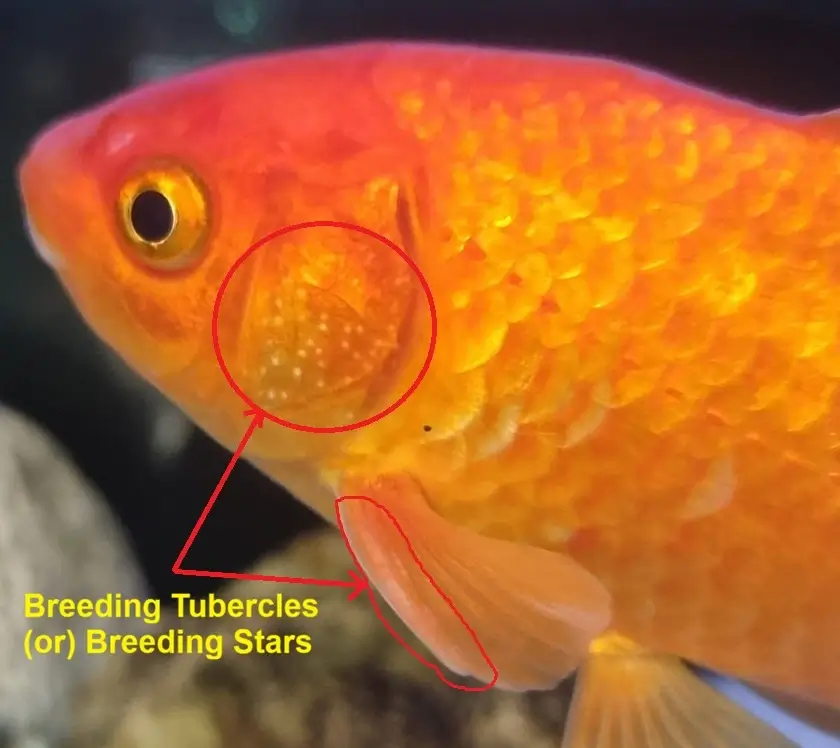
Goldfish breeding stars are driven by a spike in testosterone as spawning season approaches, triggered by warming water and longer days. Most commonly they show up on the pectoral fins and gill covers first, but they can spread further too, around the eyes, across the head, along the pelvic fins, and occasionally in neat little rows across the body itself, following the pattern of the scales.
Quick Navigation:
➜ What Are Goldfish Breeding Tubercles (Breeding Stars)?
➜ Male Goldfish Breeding Tubercles: Close-Up
➜ Goldfish Breeding Stars on the Gill Covers
➜ Goldfish Breeding Stars on the Pectoral Fins
➜ Do All Male Goldfish Develop Breeding Stars?
➜ Are Goldfish Breeding Stars a Sign of Spawning?
➜ Goldfish Breeding Stars or Ich?
➜ FAQ
Goldfish Breeding Tubercles (Breeding Stars): Close-Up
Up close, tubercles look like small, firm, evenly rounded bumps, more like tiny pimples or raised dots than anything flat or fuzzy. They’re usually uniform in size across an individual fish, and they sit slightly raised above the surrounding skin or scale surface rather than lying flat against it.
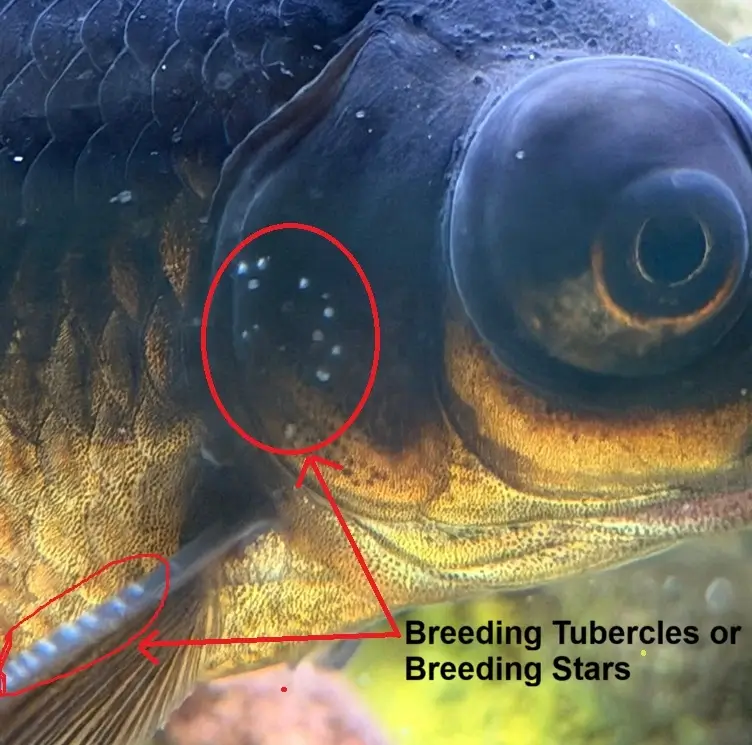
How prominent they become varies quite a bit between individual goldfish. Some males develop a dense and obvious cluster that’s hard to miss even from a distance; others show just a light scattering that takes a close look to notice at all.
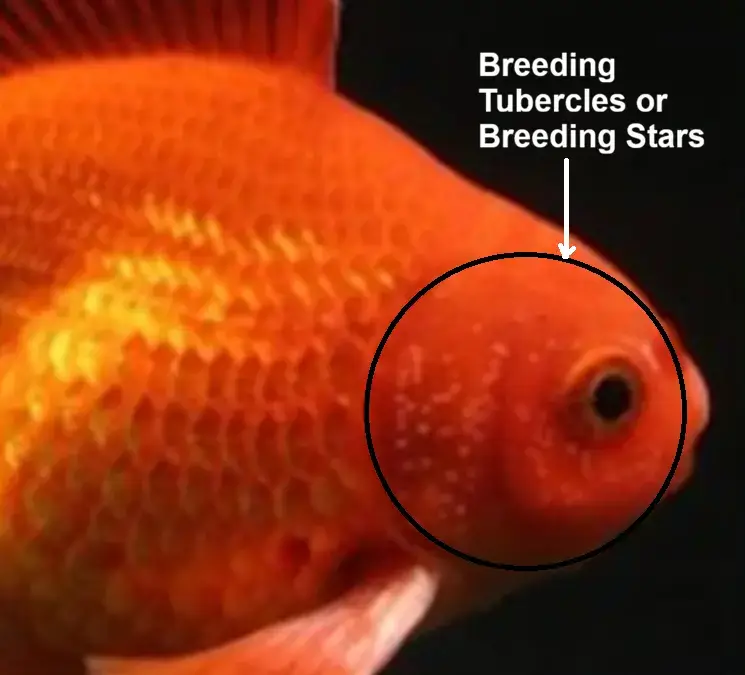
Goldfish Breeding Stars on the Gill Covers
The gill covers, the hard plates protecting the gills on either side of the head, are the single most common place to find breeding tubercles, and usually the first place they show up as a male starts coming into condition.
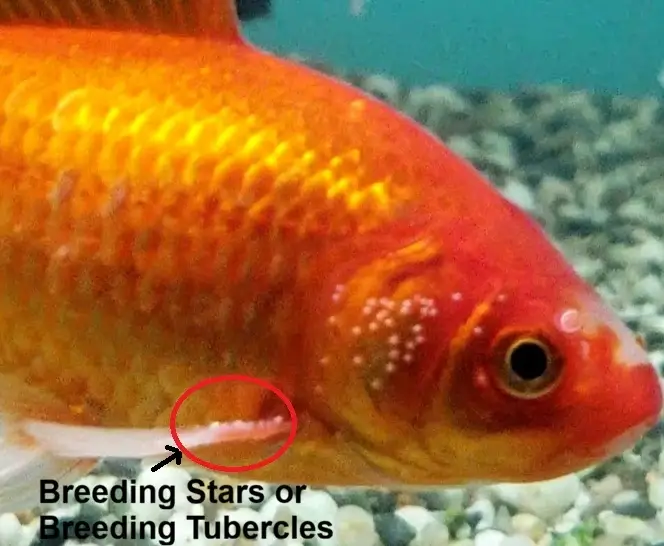
Goldfish Breeding Stars on the Pectoral Fins
The other common spot where it is found is along the leading rays of the pectoral fins, the pair of fins just behind the gills that the fish uses for steering. The tubercles here tend to run in a line following the firmest ray of the fin, rather than scattering randomly across the fin surface.
Do All Male Goldfish Develop Breeding Stars?
No, not every male gets them, and even males that do won’t necessarily show them every year.
• Not guaranteed: some healthy, mature males never develop visible tubercles at all, or they may show them in one breeding season and not the next.
• Their absence doesn’t mean the fish isn’t male. Since not all males develop them, a lack of visible tubercles is not a reliable way to conclude a fish is female.
• They are usually seasonal, meaning they are triggered by rising water temperature and longer daylight in spring, and typically fades again once the breeding season ends. Older males who have been through several breeding seasons sometimes keep them year-round instead.
• Females can develop them too, on rare occasions, though it’s uncommon and tubercles remain a male-dominant trait overall.
• Visibility also depends on the fish itself. They can be genuinely hard to spot on white-colored, bubble eye goldfish or heavily finned varieties, where the bumps can blend into the surrounding pattern of fins.
Because tubercles alone are not a guaranteed sexing method, it’s worth combining this with other signs, body shape, vent shape, or actual chasing behavior during breeding season. You can read more in our Goldfish male vs female guide to know more.
Are Goldfish Breeding Stars a Sign of Spawning?
Tubercles are a strong sign a male is entering breeding condition, but they are only one piece of the picture, not a guarantee that spawning is about to happen. But they are the best reliable signs alongside the actual behavior that signals spawning. Watch for persistent chasing and nudging of a female for confirmation on spawning. You can know more in our article on Goldfish Eggs, Spawning, Fertilization, Hatching & Care.
Goldfish Breeding Stars or Ich?
This is one of the most common points of confusion, since both conditions show up as small white spots on a goldfish. Telling them apart matters, because one needs no treatment at all and the other needs prompt medication.
Breeding Stars
• Raised, relatively uniform bumps
• Concentrated specifically on the gill covers and pectoral fins
• Found mainly on males in breeding condition
• The fish behaves completely normally otherwise, still active and eating
Ich
• Multiple tiny white spots resembling salt grains
• Can appear anywhere across the body, fins, and gills, not confined to one or two areas
• Affects males and females equally
• Comes with other signs of illness, scratching against decorations, clamped fins, lethargy, or loss of appetite
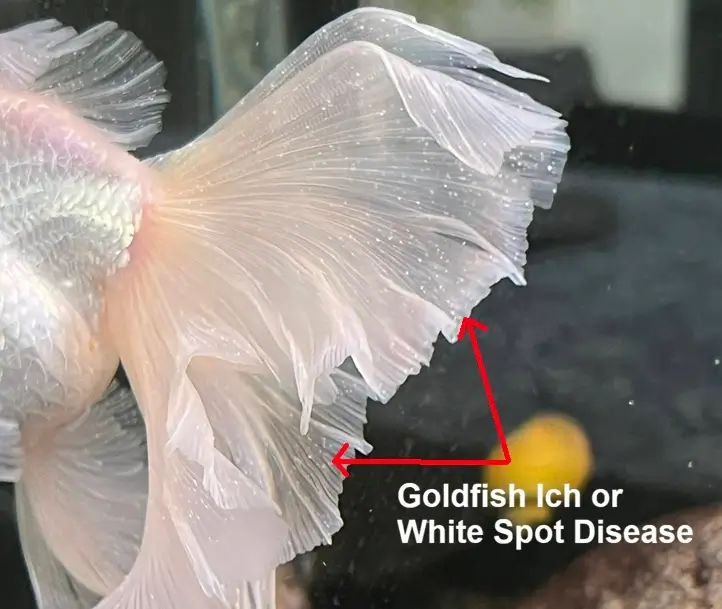
If the spots are limited to the gill covers and pectoral fins on a male, and the fish is otherwise acting completely normal, breeding tubercles are far more likely. If spots are scattered more broadly and the fish seems off in other ways too, treat it as Ich until you’ve confirmed otherwise. Read our full guide Goldfish Ich (White Spot Disease) to know more.
FAQ
Do female goldfish get breeding tubercles?
Rarely, and not to the same degree as males. Tubercles are primarily a male characteristic, tied to the physical demands of chasing and spawning, so a female showing prominent tubercles would be unusual.
How long do breeding tubercles last?
They typically fade once breeding season passes and the male’s hormone levels settle them down, though the exact timing varies between individuals.
Can breeding tubercles hurt the female during spawning?
They are not sharp or damaging under normal circumstances. They are designed to provide grip, not to injure. Some scale disturbance from the physical contact of chasing and nudging is normal during spawning.
Are breeding tubercles the same as Ich in early stages?
No. Early Ich still appears as scattered white spots that spread across the body and fins over time, while tubercles stay confined to the gill covers and pectoral fins and don’t spread or increase in number the way an active parasitic infection would.
Final Thoughts
Breeding tubercles look alarming the first time you notice them, but they’re a completely normal, harmless sign that a male goldfish is healthy and coming into breeding condition. The key distinguishing details, location on the gill covers and pectoral fins, a raised uniform texture, and a fish that’s otherwise behaving completely normally, are usually enough to tell them apart from something that actually needs treatment. For more on what happens once a male is in this condition, see our guides on goldfish eggs and spawning and goldfish Ich.