
So do goldfish fry need a filter? Yes, but not the same kind you would use on an adult goldfish tank — a gentle sponge filter is the safe choice. Goldfish produce a large amount of waste for their size, and without something breaking down that waste, ammonia builds up fast in a small fry tank. The complication with most standard filters is that their intake can pull fry in, which is exactly what a sponge filter avoids.
Quick Navigation
1) Why a Sponge Filter, Not a Standard One
2) The First Few Days: Filter Needed or Not?
3) How to Introduce a Filter Safely in a Goldfish Fry Tank
4) Frequently Asked Questions
Why a Sponge Filter, Not a Standard One
Hang-on-back and canister filters are built for adult fish and pull water in with enough force to injure or kill something as small as a goldfish fry. A sponge filter solves this by using gentle air-driven flow instead of a powerful intake, which means:
• The sponge surface prevents fry from being sucked inside
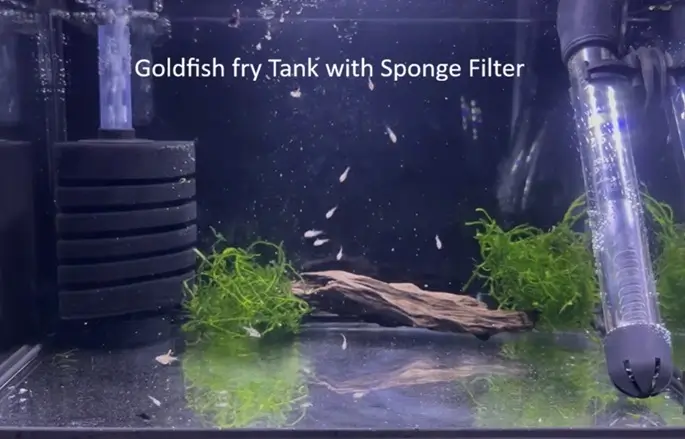
• It provides a large surface area for beneficial bacteria, giving solid biological filtration
• It is inexpensive and simple to run off a basic air pump and an airstone
• Gentle water movement suits baby goldfish, which are not strong swimmers yet
The trade-off is that sponge filters remove very little solid waste mechanically, so they work best for small baby goldfish with regular water changes.
The First Few Days: Filter Needed or Not?
• For the first couple of days after hatching, before fry start eating anything, there’s very little waste in the tank, so some breeders skip a filter and just do manual water changes instead
• During this first week, the water current needs to stay very stable, since the fry are still fragile and just coming out of their shell
• Once fry become free-swimming and feeding begins, waste builds up much faster, and that’s the more practical point to introduce a sponge filter
• Keeping up with manual water changes alone gets harder from here, and frequent changes also carry a risk of water shock to the fry
How to Introduce a Filter Safely in a Goldfish Fry Tank.
Don’t drop a brand-new sponge filter straight into a fry tank. An uncycled filter has no bacteria to break down waste yet, which means it won’t actually protect fry from an ammonia spike when they need it most. Instead:
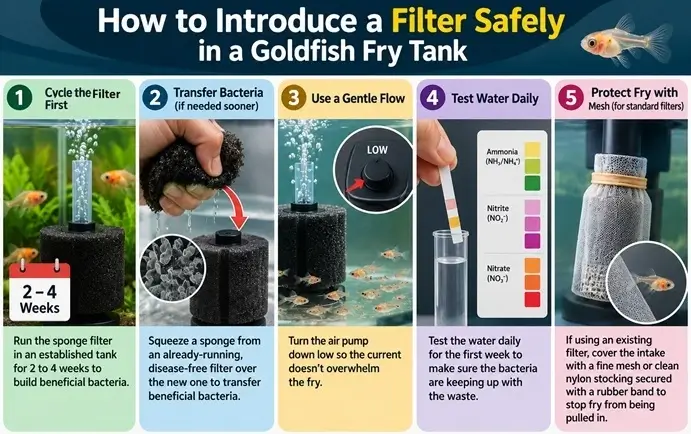
• Running a sponge filter in an already-established tank for 2 to 4 weeks first would be better. It lets to pick up bacteria before it ever touches the fry tank
• If you don’t have that much time to spare, squeeze the sponge from an already-running filter directly over the new one. This transfers some of the bacteria living on the old sponge onto the new one, giving it a head start. Please ensure the old sponge has come froma disease free tank.
• When the filter first goes into the fry tank, turn the air pump down low so the current doesn’t overwhelm fry that aren’t strong swimmers yet
• Test the water daily for the first week to make sure the bacteria colony is actually keeping up with the waste fry produce as feeding ramps up
If you would rather use an existing standard filter than set up a dedicated sponge filter, covering the intake with a fine mesh or a clean nylon stocking secured with a rubber band achieves a similar effect, stopping fry from being pulled in.
Frequently Asked Questions
Will a sponge filter alone keep a fry tank clean?
Not entirely on its own. It handles biological filtration well but removes little solid waste, so regular partial water changes are still necessary alongside it, especially in the first month when feeding is frequent.
Can I use an air stone instead of a filter for fry?
An air stone adds oxygen and water movement but doesn’t provide the bacterial filtration a sponge filter does. It can help in the very first days before a filter goes in, but it isn’t a substitute for one once fry are established and feeding regularly.
How do I clean a sponge filter without killing the bacteria?
Rinse it gently in old tank water, never tap water or soap, since chlorine kills the bacteria colony living on it. Squeeze it lightly to remove debris rather than wringing it out hard, and do this roughly every 2 to 4 weeks, not more often than needed.
When can fry move to a tank with a standard filter?
Once fry are large and strong enough that a standard filter’s intake can no longer pull them in, which is a matter of size rather than a fixed age. Until then, covering the intake with mesh (as covered above) is the safer route if you need to use a standard filter early.
Is one sponge filter enough for a large batch of fry?
It depends on tank size and how many fry you’re raising. A single sponge filter works fine for a small to moderate batch in an appropriately sized tank, but a very large batch or a bigger tank may need a second sponge filter, or a larger one, to keep up with the waste being produced.